

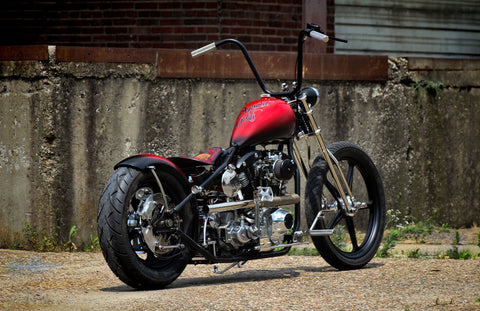
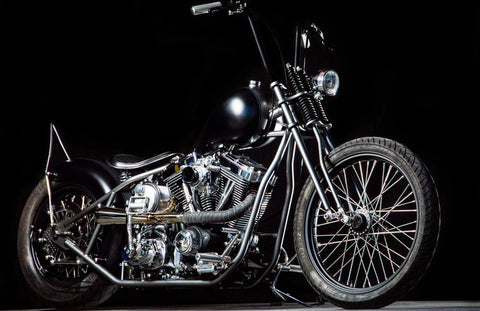
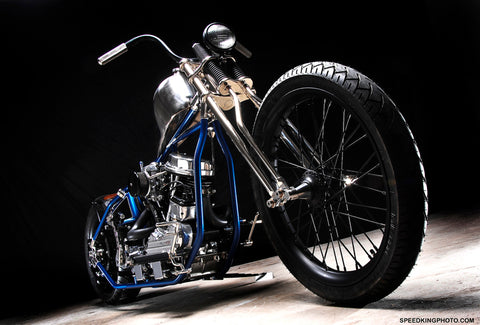
The first thing you notice about Wasted and Wounded is what is missing. The Panhead looks like it is hanging in the air. There is almost no frame around it, just thin titanium tubes that look too light to hold an engine, a springer out front, and a skinny 21-inch wheel. Then you read the spec sheet and find out the whole frame weighs 21 pounds.
That bike is the easiest way into Faith Forgotten Choppers, a small Louisville-area shop that has spent more time teaching other people how to build than bragging about its own work. Here is what the shop is, the build that put it on the map, the parts it makes, and what a home builder can take from how it works.
Who Is Behind Faith Forgotten Choppers
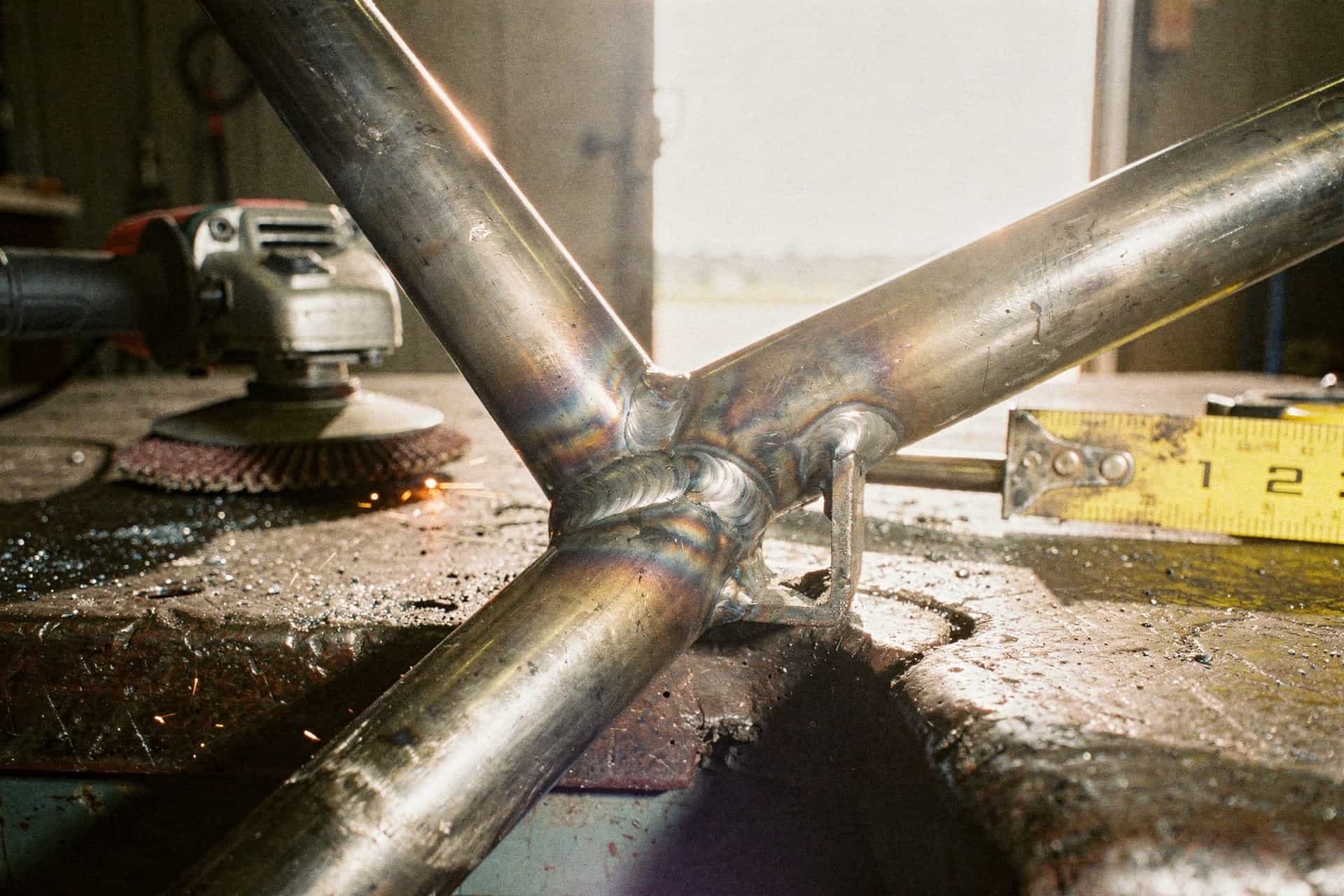
Faith Forgotten Choppers was established in 2009 by Will Ramsey, according to his Cycle Source builder profile. The profile says Ramsey “immersed himself in the scientific studies of Welding, Metallurgy and the history of Industrial Design.” That background shows up in every piece the shop turns out. These are not bolt-together customs. They are frames, forks, tanks and bars made from raw stock by someone who knows why a weld cracks.
Ramsey is also a magazine guy. A Cycle Source interview introduces him as the magazine’s tech editor, based in Louisville, Kentucky, and describes the shop as one that “builds bikes, makes parts.” The same piece sums up the approach in three words: ride-able show bikes. Not trailer queens. Not beaters. Bikes that can win a trophy and then get ridden home.
The Philosophy: Function First, Precedent Never
Plenty of shops say form follows function. Faith Forgotten goes one step further. In the builder profile, Ramsey puts it like this: “Form follows function, but more importantly, we denounce the concept of form following precedent.”
In plain garage terms, that means you do not build a chopper a certain way just because choppers have always been built that way. Every part has to earn its place. If a bracket can be lighter, it gets lighter. If a frame tube does not need to be there, it goes.
The profile also says builders should let the past influence their work but “never dictate it.” That line explains why the shop’s bikes look old school at first glance but use modern metals and precise fab work up close. The profile describes the look as vintage style choppers mixed with modern components, with polished metal set against satin colors.
Then there is the materials claim. The profile states: “Using 100% American materials, and labor, Faith Forgotten Choppers’ products will outlast the road.” Treat that as the shop’s own promise about the parts it makes. A complete bike still carries an engine, wheels, brakes and electrics from other makers, so if American content matters to you, ask about each part when you order.
Wasted and Wounded: The Titanium Panhead
If Faith Forgotten has a signature bike, this is it. Cycle Source ran it as a feature in December 2016, and Barnett’s Magazine covered it in detail. Here is the build, part by part.
| Part | What went on the bike |
|---|---|
| Engine | 1960 Harley-Davidson Panhead, rebuilt to 80 cubic inches by Jess Cleary at K&S Customz in Louisville |
| Engine internals | S&S pistons and heads, Andrews B grind cam |
| Carb and intake | S&S Super E carb, Joker Machine air cleaner |
| Exhaust | Custom 2-into-1 |
| Frame | Titanium wishbone, 35 degrees of rake, no stretch, 21 pounds |
| Front end | Titanium version of the shop’s narrow tapered-leg springer |
| Wheels | 21-inch front, 18-inch rear, Invader wheels |
| Brakes | Dual Wilwood calipers on a Speedking USA bracket |
| Transmission | 1960 Harley four-speed with a kicker |
| Primary | Slim open belt drive from Tech Cycle |
| Paint | Scott Takes, Underground Art Studios, Cedar Rapids, Iowa |
| Seat | Leather with Tom Waits lyrics worked into it |
Why the Titanium Frame Matters
A typical steel chopper frame weighs a lot more than 21 pounds. Titanium is strong for its weight, but it is hard to work. It has to be welded in a clean, shielded environment, because hot titanium picks up oxygen and gets brittle. That is exactly the kind of problem a builder who studied metallurgy wants to solve. It is also why you do not see many titanium frames at local bike nights.
The geometry is worth a look too. Thirty-five degrees of rake with no stretch is restrained for a chopper. The bike gets the long, thin look from the 21-inch front wheel, the springer and the open frame, not from a mile of fork. That keeps it ridable, which fits the ride-able show bike idea.
Why the Springer Matters
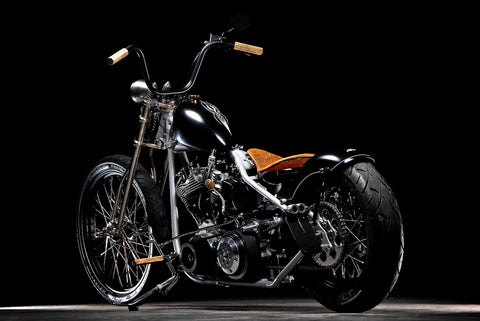
The narrow tapered-leg springer is the part other builders know the shop for. Barnett’s reports that Cycle Source named it the best custom product of 2015. On Wasted and Wounded, Ramsey remade it in titanium to match the frame. A narrow springer keeps the front of the bike slim, which is a big deal on a chopper where the front end is the first thing anyone sees.
We have ridden a few springer bikes over the years. The honest take: a good springer feels tight and precise, and a worn or badly set up one feels like a shopping cart. Which brings us to the shop’s other big contribution.
The Shop That Teaches: Faith Forgotten in Cycle Source
Most custom shops guard their methods. Faith Forgotten has published them. The Cycle Source Faith Forgotten archive lists how-to pieces from 2016 to 2020, most of them bylined by Ramsey and one by shop hand Corey Barnum. Read in order, they are a free course in chopper fab.
- Trimming the Fat: Chopping a Custom Tank (March 2016). Cutting down and reshaping a tank.
- Hand Fabbed Tank (April 2016). Making a fuel tank from flat stock.
- Installing an S&S Hydraulic Valve Train Conversion Kit (December 2016). Converting an old valve train to hydraulic lifters.
- Installing Speed Dealer Customs Lowering Kit (February 2017). A bolt-on suspension job.
- Adjusting the Valve Train on a 1913 Perry Mack (September 2017). Billy Lane shows how to set the exposed valve train on the board track racer he built around the century-old engine.
- Rock Out of the Rockers (June 2020). Shimming the shop’s own springer so the rockers do not knock.
- Developing a Designer’s Eye: Fabricating a Stainless Steel Sissy Bar (July 2020).
- Leaks Suck: Fixing a Leaky Shift Shaft Seal (September 2020), by Corey Barnum.
- The Purge: Shielding a Stainless Steel Exhaust Weld (October 2020). Back-purging so the inside of a stainless weld does not turn to sugar.
There is also a drum brake how-to from the October-November 2020 issue with photos from the shop.
Look at that list and you can see the pattern. Tanks, sissy bars, springers, exhaust welds. These are the exact jobs that separate a real custom from a bolt-on kit. If you are working through our custom bobber build guide, the tank and sissy bar pieces are the ones to read first.
What Faith Forgotten Builds Teach a Home Builder
You probably do not have a titanium welding setup in the garage. We do not either. But the ideas carry over to any build.
Start with what the bike does. Before you pick a tank or a seat, decide how far you will ride it, whether anyone rides with you, and what roads it will see. Every later choice gets easier.
Question every part. Walk around your project with a marker and tag every bracket, tab and cover. For each one, ask if it holds something up, keeps you legal, or keeps you safe. If it does none of those, it is a candidate to go.
Spend on the front end. Wasted and Wounded is built around its springer. On any chopper or bobber, the front end sets how the bike steers and stops. Cheap bars and a tired fork will ruin a nice frame.
Learn one fab skill at a time. Tank work, then a sissy bar, then exhaust. The Cycle Source list above is a good order. Nobody starts with a titanium frame.
Build it to ride. A show bike you are scared to ride is a sculpture. Ramsey’s ride-able show bike idea is the right target for most of us.
Chopper, Not Bobber, and Why That Matters
Faith Forgotten builds choppers. Long front wheels, springers, open frames. That is a different animal from the stripped, short-fendered bikes most of our readers build. If you are still sorting out where the line sits, our bobber vs chopper breakdown covers it.
The skills overlap, though. The same tank chop and the same stainless sissy bar work on a bobber. Plenty of riders start with a bobber, catch the fab bug, and end up building a chopper a few years later. That is how shops like this one keep getting new customers.
If you want to see how other builders handled the same questions, the Exile Cycles builds show a very different take on the modern custom, and our Detroit Choppers builds piece covers another small-shop story. For the bigger picture of the scene these shops came out of, start with our motorcycle culture guide.

Working With a Small Chopper Shop
Faith Forgotten lets riders put their own ideas into the design, down to the frame. If you go that route with any small fab shop, a few things save everyone grief.
- Bring a clear use case. Solo or two-up, city or highway, short hops or long days.
- Bring the engine story. Year, displacement, who rebuilt it and when. Wasted and Wounded started with a 1960 Panhead that another shop rebuilt. Shops like to know what they are building around.
- Agree on the finish early. Polished, satin, paint or raw. It changes prep work and price.
- Ask what is made in house. Frames, springers, tanks and bars from this kind of shop are the point. Wheels, brakes and electrics usually come from outside.
- Plan for time. One-off fab work does not run on a production schedule.
Before you ride out to any shop, check its current channels for hours and who is running the place, because small shops change hands and addresses more often than big ones.
And if you are wrenching on your own chopper while you wait, our Kentucky collection is made for riders from the same part of the map as this shop.
Sources
- Will Ramsey of Faith Forgotten Choppers - Cycle Source builder profile. 2009 founding, Ramsey’s welding and metallurgy background, the form-follows-function and materials quotes.
- Interview with Will Ramsey of Faith Forgotten Choppers - Cycle Source. Louisville base, tech editor role, ride-able show bikes.
- Faith Forgotten Choppers Wasted and Wounded Panhead - Barnett’s Magazine. Full build spec: engine, titanium frame weight and geometry, springer award, wheels, brakes, transmission, paint.
- Faith Forgotten archive - Cycle Source. Dates and bylines of the shop’s how-to articles and the December 2016 Wasted and Wounded feature.
- Drum brake how-to with Faith Forgotten Choppers - Cycle Source. Shop tech article from the October-November 2020 issue.