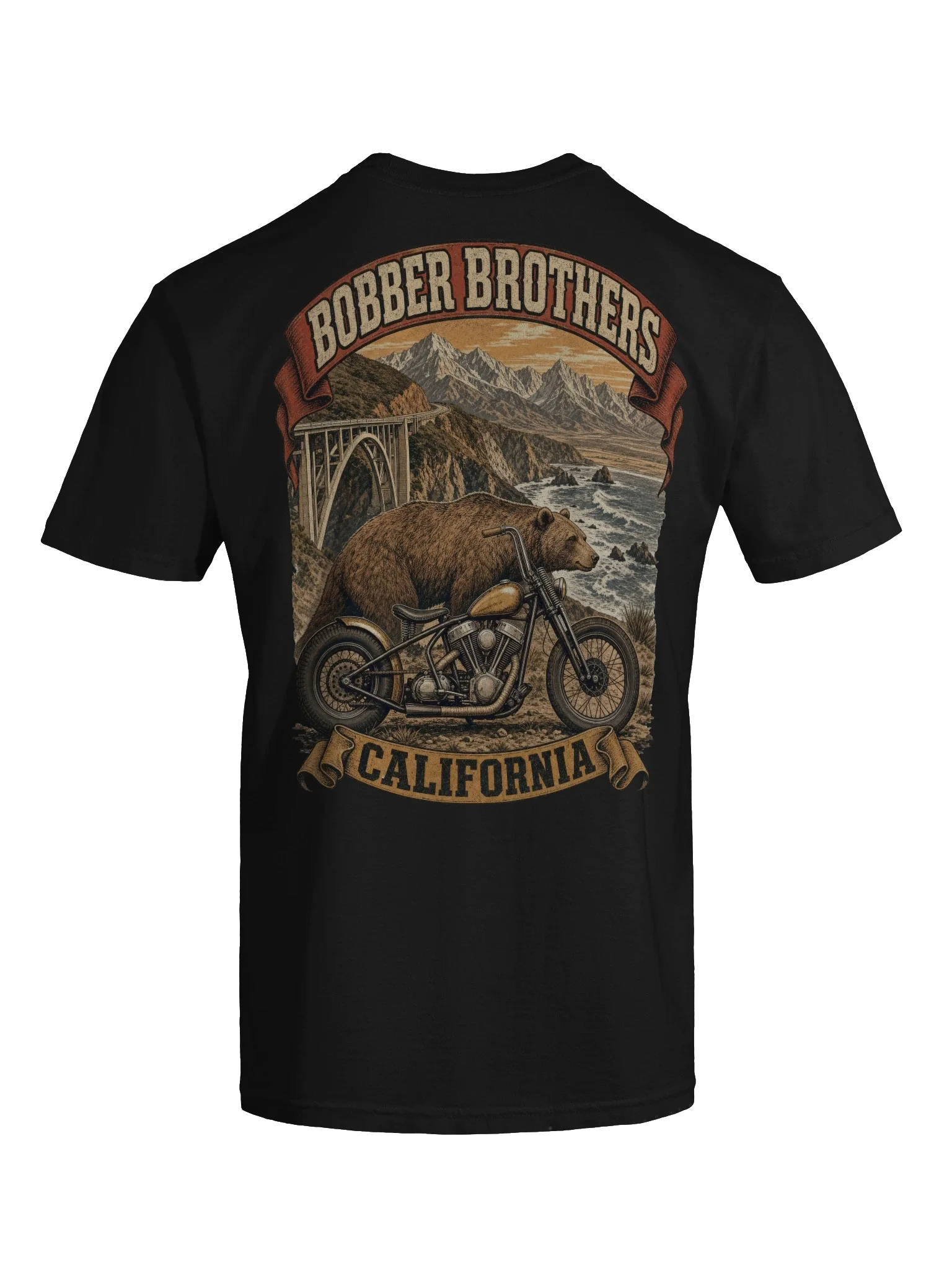
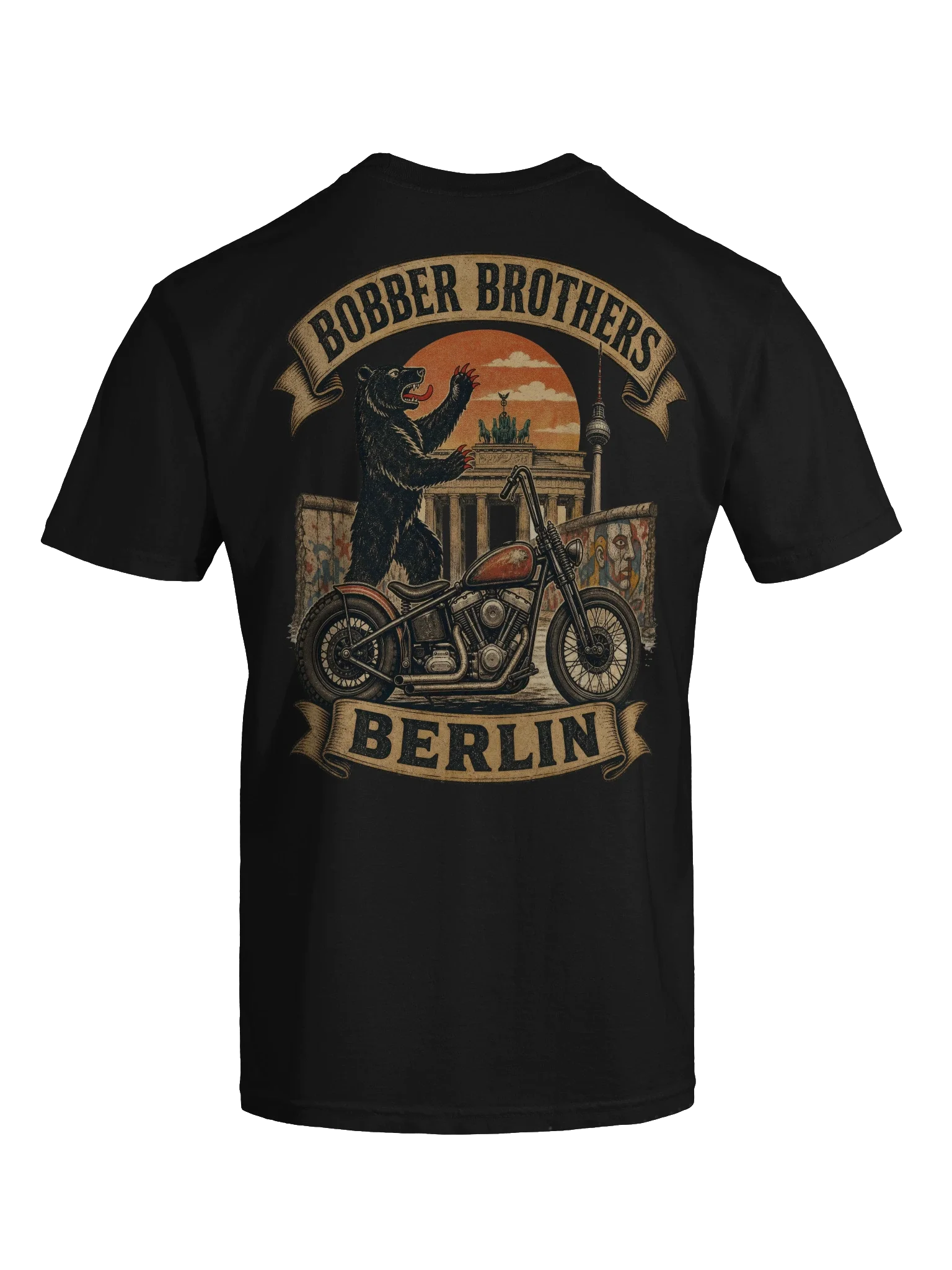
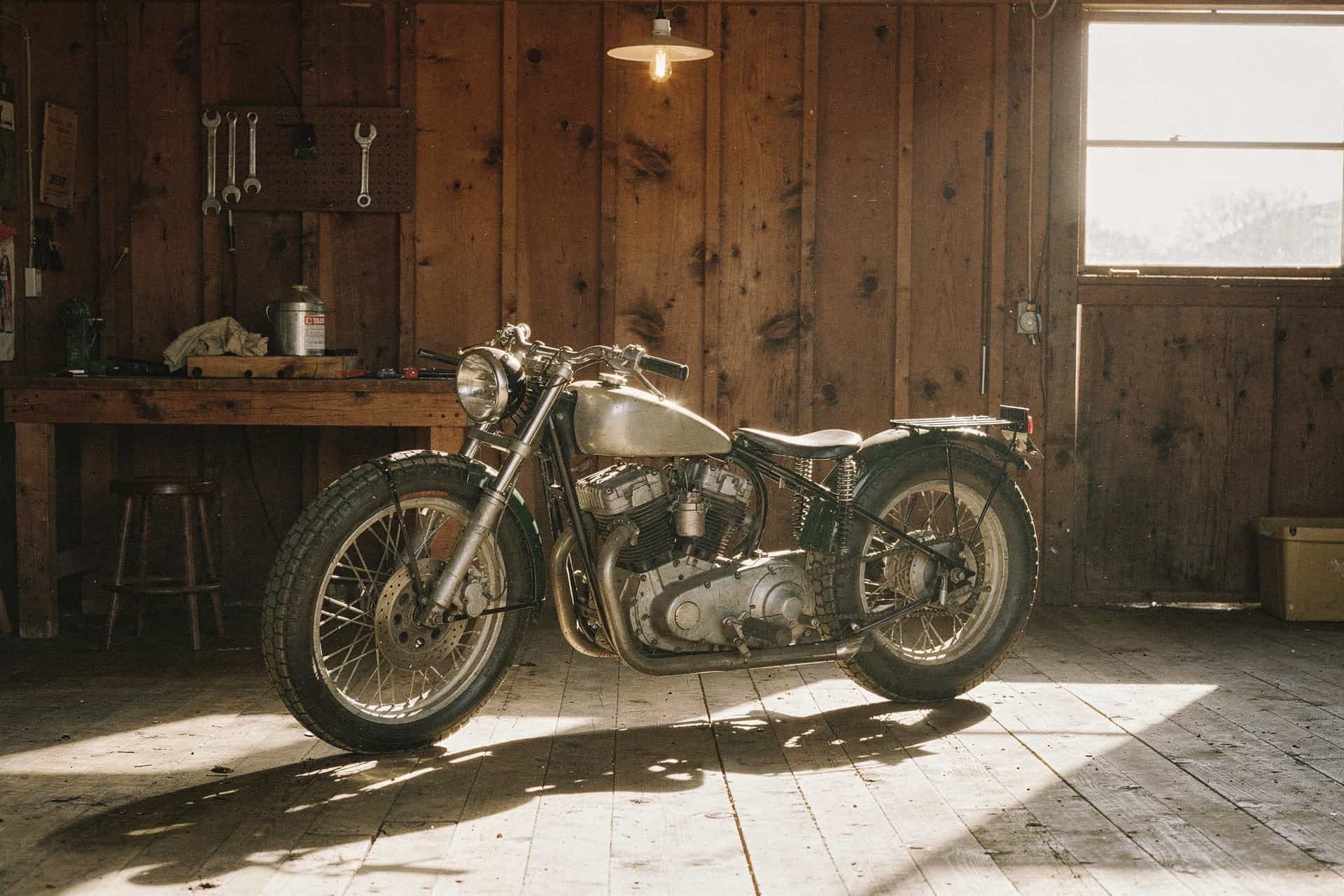
Every bobber question at a bike night ends up in the same place. Someone points at a bike with a cut-down rear fender and asks whether it counts. Half the table says yes because the fender is short. The other half says no because the forks are stretched and that makes it a chopper.
Both halves are arguing about the wrong part. A bobber is not defined by any single component. It is defined by a rule about what you are allowed to touch.
The Short Answer
A bobber is a motorcycle stripped of the parts that do not contribute to riding it. Most use stock or near-stock steering geometry, but that is a strong convention rather than a border nobody crosses.
The rake, the trail and the wheelbase stay close to what the factory built. The rear fender gets cut short or replaced with a small one. The passenger seat goes, replaced by a solo saddle. Bodywork, crash bars, saddlebags, windshields, chrome covers and oversize lighting come off and stay off.
The emphasis is what separates a bobber from other custom styles. Add rake, fork length or frame stretch until proportions become the point and the build reads as a chopper. Add clip-ons, rearsets and a seat cowl chasing lap times and it reads as a cafe racer. Keep the proportions compact and take visual weight off the motorcycle and it reads as a bobber. A rigid rear conversion can belong to either camp, depending on what else changed.
The name is literal. In the 1940s the job was called a “bob job” because you bobbed the rear fender. Everything else in the style grew out of that one cut.
The Five Elements That Define a Bobber
1. A Bobbed Rear Fender
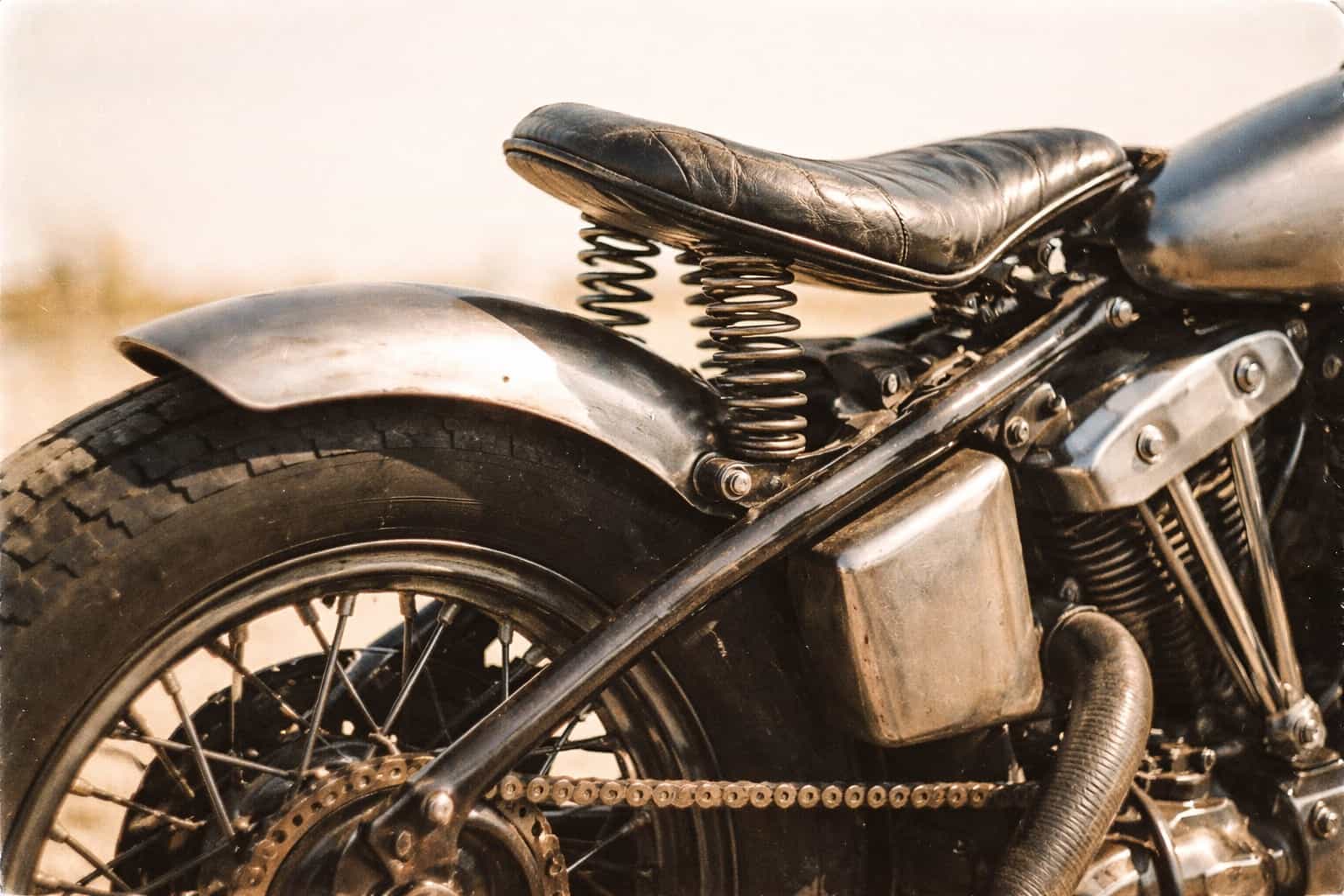
The signature is a shortened rear fender. The stock part gets cut down or replaced with a smaller steel fender that follows the tire radius. Some builders run no rear fender at all, which sacrifices spray and debris coverage and may fail local equipment rules.
2. A Solo Seat
One seat, usually a sprung saddle bolted to the frame rails on a conversion bracket. Passenger pegs and the passenger seat come off with it. This does more to change the silhouette than any other single part, because removing the passenger section drops the visual mass out of the middle of the bike and lets the rear frame rails show.
3. Stock or Near-Stock Frame Geometry
This is the usual bobber starting point. Rake, trail and wheelbase stay close to factory. A raked neck, long fork tubes or a stretched backbone pushes the build toward chopper proportions. A weld-in rigid rear section is the disputed case: it changes the frame and ride quality without necessarily changing steering geometry. Our hardtail versus softail comparison covers that trade. Style labels do not make a frame modification safe, so use a qualified fabricator and check local inspection rules before cutting.
4. Minimal, Not Absent
Bobbers strip out excess. They do not strip out safe function. Keep both braking systems working and retain the lighting, mirrors, signals, plate position and other equipment required where the bike is registered. The legal list varies by jurisdiction, so the test is not whether a part can physically be removed.
5. A Low, Horizontal Profile
Bars usually sit low or mid-height: drag bars, tracker bars, Z-bars or mild risers. Higher bars create overlap with chopper styling rather than invalidating the whole bike. Exhausts often sit close to the frame. The result reads as a compact horizontal line from the front axle to the rear.
What Actually Changes, Part by Part
Definitions are easier to argue about than parts are. Here is the same style described as a work order, ranked by how much each change alters the finished bike.
| Part | What changes | Why it matters | Difficulty |
|---|---|---|---|
| Rear fender | Cut down or replaced with a short fender | The single biggest visual change and the origin of the name | Low to moderate |
| Seat | Solo saddle on a conversion bracket, passenger hardware removed | Reshapes the whole middle of the bike | Low |
| Handlebars | Low-rise bars, often shorter cables and lines | Changes both look and riding position | Low to moderate |
| Exhaust | Shortened, tucked, or a 2-into-1 | Changes sound and the lower silhouette; may require fuelling work | Moderate |
| Lighting and plate | Smaller headlight, LED tail, relocated plate and signals | Where most builds get stuck, and the part inspectors care about | Moderate |
| Wheels and tires | Re-lace, resize or leave alone | The most expensive decision available | High |
| Frame | Usually left alone; sometimes converted to a rigid rear | A hardtail creates overlap with chopper construction | One-way |
Two things fall out of that table for anyone planning a first build.
The changes with the biggest effect are the cheapest and the easiest. Fender, seat and bars carry most of the transformation, and none of them need a welder.
The changes that eat time are the ones nobody photographs. Making the tail light, plate mount and signals work cleanly after the fender is gone is the stage where most half-finished bobbers stall. Budget for brackets, wire and patience, not just for parts.
Check the Final Drive Before You Buy Anything
The most expensive mistake in bobber building has nothing to do with style. It is buying a donor whose rear end will not accept the parts the build needs.
Chain final drive usually gives the most freedom: sprocket changes, axle-position changes and a wide choice of rear wheels. Belt drive is quiet and clean but offers fewer simple gearing options. A shaft ties the swingarm, driveshaft length and rear hub to the final-drive assembly, which rules out a simple bolt-in rigid section and makes major wheel or axle-position changes a fabrication problem.
Model names hide this constantly. The Honda Shadow badge covers both chain and shaft bikes in the same displacement class, which is why our Honda Shadow bobber donor guide sorts the whole family by final drive before it talks about anything else.
Bobber vs Chopper vs Cafe Racer
These three get mixed up constantly, usually by people describing someone else’s bike.
| Feature | Bobber | Chopper | Cafe Racer |
|---|---|---|---|
| Frame | Usually stock steering geometry; rigid rear possible | Often raked or stretched; rigid rear common | Stock, often de-tabbed |
| Front end | Stock or slightly shorter forks | Extended forks, often springer | Stock forks, clip-on bars |
| Rear fender | Bobbed | Minimal or none | Stock or seat cowl |
| Riding position | Upright, neutral | Feet forward, laid back | Forward lean |
| Handlebars | Drag, tracker, Z-bars | Ape hangers or high-rise | Clip-ons or clubmans |
| Era of origin | Late 1920s to 1940s (US) | 1960s (US) | 1950s to 1960s (UK) |
| Governing idea | Remove what is not needed | Rebuild the machine as a statement | Make it faster and sharper |
The shorthand: bobbers are reductive, choppers are transformative, cafe racers are performance-driven. Our bobber versus chopper breakdown and bobber versus cafe racer comparison go deeper on each pairing, and the motorcycle types overview places all of them in the wider category map.
In practice the lines blur. Plenty of finished bikes are half bobber and half tracker, or a bobber with chopper bars. The categories are useful shorthand for deciding what parts to buy, not rules anyone has to obey.
Where the Style Came From
The Documented Postwar Bob Job
The safest historical starting point is the late 1940s. Harley-Davidson’s own retrospective material describes stripped postwar bobbers built by returning American service members, and its custom-history archive places the style’s defining period in the late 1940s and early 1950s. Builders shortened fenders, removed trim and kept the heavy American twins available to them.
That record supports a narrower claim than many online timelines make. Earlier racers and cut-down road bikes helped establish the logic of removing weight, but the sources listed here do not establish a single late-1920s birth date or one J-series motorcycle as the first bobber. The recognizable postwar style is the part we can document. Our Harley-Davidson history guide traces the engine families available around it.
Hollister, 1947, and What Is Actually Documented
The 1947 rally at Hollister, California, is the event usually credited with putting stripped-down bikes into the American imagination. Newspapers reported a rowdy weekend, and a widely reproduced Life magazine photograph of a rider surrounded by beer bottles did the rest.
Be careful with the details, because most of what gets repeated about Hollister is folklore rather than record. RevZilla’s review of the contemporary reporting describes a disorderly weekend rather than the takeover the legend describes, and the famous claim that the American Motorcyclist Association said 99 percent of riders were law-abiding has never been tied to a documented AMA statement. The AMA’s own organizational history does not contain it. We unpack that whole chain in our 1 percenter explainer.
What is safe to say: the coverage of Hollister, and the 1953 film it inspired, fixed the image of the stripped, fenderless motorcycle in public memory. The style was already a decade old. The press gave it a face.
The Factory Bobber Era
For most of its life the bobber was a garage product, but factory versions arrived well before the 2010s. Harley sold the Street Bob for the 2006 model year, then described the 2008 Cross Bones as an authentic factory custom bobber with postwar cues. Triumph, Indian and others later made the category a permanent showroom segment.
Three things drove it. Custom builds became visible to millions of people through social platforms and build channels. A large group of riders wanted the aesthetic without owning a welder. And heritage styling was selling at a moment when the industry needed something to sell.
The result is a market split rather than a winner. Factory bobbers deliver the look with a warranty. Custom bobbers deliver a bike nobody else has. Neither is more legitimate than the other.
A caution about factory bobbers specifically: lineups move fast, and a model that anchored the segment three years ago may not be on the floor now. Check the current model year before you plan a build around a new bike.
Brand by Brand: Which Platforms Get Bobbed
Harley-Davidson
The spiritual home, for the availability reason described above. Harley’s current Street Bob is the most direct factory nod to the tradition: mini apes, bobbed rear fender and blacked-out finishes. For 2026 Harley offers a lower-priced solo trim in Dark Billiard Gray, while other configurations are not all solo-seat bikes. Harley lists the model with the Milwaukee-Eight 117, 98 horsepower at 4,600 rpm, 120 lb-ft at 2,500 rpm and a 646 pound running-order weight. That is worth reading carefully, because earlier Street Bobs used the Milwaukee-Eight 107 and 114, and Harley consolidated the Softail range onto the 117 for 2025.
The Softail Standard, for years the cheapest blank canvas in the Softail range, was dropped after the 2024 model year. It remains an excellent used donor and a poor showroom recommendation.
The air-cooled Sportster remains a common Harley bobber platform, and it ended production in 2022. Our Sportster bobber build guide covers donor years in detail, the Iron 883 specification breakdown has the numbers, and the best Harley bobber builds roundup compares platforms against each other.
The Revolution Max bikes are a different proposition. Harley’s Sportster S makes 121 horsepower at 7,500 rpm from the liquid-cooled Revolution Max 1250T. It is stripped and aggressive, but the radiator, electronics packaging and frame design do not lend themselves to a traditional bob job.
Indian
Indian was there for the original bob jobs, and the modern Scout Bobber is one of the strongest factory entries in the segment. Note the engine change: Scout Bobbers up to 2024 used the 1,133cc Scout V-twin, while the 2025 redesign moved the range to the SpeedPlus 1250, a 1,250cc liquid-cooled 60-degree V-twin rated at 105 horsepower and 82 lb-ft in Bobber trim. Older spec sheets quoting 100 horsepower are describing the previous engine, not the current bike.
For the heritage behind the name, our greatest Indian Scouts roundup covers the line back to the 1920s board-track era the Bobber Twenty trim borrows from.
Triumph
British twins were a large part of the California custom scene in the 1950s and 1960s, and they got bobbed alongside American bikes. Triumph’s Bonneville Bobber is the modern factory version: a 1200cc parallel twin rated at 76 horsepower and 78 lb-ft, with a hardtail-look rear end hiding a monoshock under the seat pan and a cage-mounted saddle that slides fore and aft.
It has the shortest wheelbase of the current Street Bob, Scout Bobber and Bonneville Bobber group, but it is not the lightest. Triumph lists 553 pounds wet, while Indian lists the 2026 Scout Bobber at 542 pounds running order. Those dimensions help explain how different the bikes feel, but they do not prove a universal handling winner. Our roundup of Bonneville Bobber customs shows how far builders push it, and the first-generation Bobber breakdown covers the 2017 launch bike.
Honda
Honda now markets the Shadow Phantom with bobber styling and calls it a factory-built bobber. The wider Shadow line remains a common custom donor because of long production runs, liquid-cooled V-twins and a deep used supply. The catch is the drivetrain split described above, which our Shadow donor guide and VLX build notes both cover.
Beyond the Shadow, the Magna VF750C offers a chain-drive V4 route, and the CB650 and Nighthawk are the inline-four outliers that some builders pick specifically because nobody else has one.
Yamaha
The V-Star line has been a bobber staple for two decades, and the air-cooled V-Star 1100 is the usual pick. Its shaft final drive is the same constraint that shows up on the bigger Hondas, so plan the rear end before buying. The Road Star is the larger-displacement version of the same idea, and the XS400 is a small, cheap platform for a first attempt.
Kawasaki and Suzuki
The underdog platforms, chosen by builders who do not want the same bike as everyone at the meet. Kawasaki’s Vulcan bobber series and the KZ750 both have followings, and on the Suzuki side the Intruder, the Intruder 1400 and the single-cylinder S40 all turn up as donors. Expect fewer model-specific bolt-on parts and more fabrication on all of them.
Moto Guzzi
The transverse V-twin gives a Moto Guzzi bobber a profile nothing else has, and the V9 Bobber is the factory example worth knowing. Shaft drive again, so the same rear-end rules apply.
Building One: How to Scope It Honestly
Pick the Donor for the Build, Not the Badge
Work backwards from the finished bike. If the plan includes a rigid rear section, repeated gearing changes or a substantially different rear wheel, a chain-drive donor usually offers the easiest path. If the plan is a clean bolt-on build with a short fender, solo seat, better bars and tidier lighting, almost any cruiser platform can work and a low-maintenance final drive stops being a problem.
Then check parts depth. A platform with a catalog of model-specific bolt-on fenders, seat brackets, exhausts and lighting mounts turns a first build into an assembly job. A platform without one turns the same build into a fabrication course.
The Order of Operations That Saves Money
- Buy the bike running and sort the mechanical basics first. Brakes, tires, fluids, charging system.
- Mock up before you cut. Clamp the fender, the seat and the plate mount in place and sit on the bike. Frame cuts and fender cuts are one-way.
- Do fender, seat and bars together, because they only look right as a set.
- Check the instructions for the exact intake or exhaust parts before changing fuelling. Some high-flow combinations require jets or calibration; some muffler-only systems do not. Verify mixture and running condition instead of applying one rule to every bike.
- Finish the lighting and plate mount properly before paint. This is the stage that decides whether the bike is legal and whether it looks finished.
- Paint last, when nothing else needs to come apart.
What Builders Underestimate
Three consequences are easy to underestimate. Wiring and bracket work remains after the fender cut. Lighting, plate and inspection parts vary by jurisdiction and belong in the budget before cutting. A short fender also provides less spray control in wet conditions, so choose its coverage for the riding you actually do.
If you want to see the range of what people finish, our bobber build gallery and the blue-collar builds roundup are both worth an hour. For starting from a frame and wheels instead of a complete bike, the rolling chassis guide covers that path.
New to riding as well as to building? Start with our motorcycle beginners guide before the first bolt comes out, and the motorcycle culture guide for the wider world the style sits inside.
The Culture Around the Machine
Bobber culture stays alive through shows, garages and the people who keep old machines running. Custom shows like Born Free, The One Moto Show and Mama Tried put bobbers in front of riders every year alongside every other style, and the online build community has made the knowledge easier to reach than it has ever been.
Bobber Brothers started in 2014 when five friends with bobber motorcycles designed custom shirts for themselves. A 50-unit minimum order turned the garage project into the company. Our full collection and tees are made for wrenching and for wearing off the bike. They are not protective riding gear, so ride in real gear. If you want the look sorted before the bike is, our bobber style clothing guide covers it.
Start With the Fender
The style has lasted for generations because the idea underneath it is simple. Start with a plan: check the service manual, local equipment rules and part fitment, then mock up the seat and fender with the motorcycle secured and the tire clear through its full suspension travel. You do not need to cut the frame to test the silhouette.
If the bike looks better without the parts you just removed, you have your answer, and everything after that is a question of how far you want to take it.
Sources
- Harley-Davidson - Street Bob - the manufacturer’s current Street Bob specification, including the Milwaukee-Eight 117, 98 horsepower at 4,600 rpm, 120 lb-ft at 2,500 rpm and 646 pound running-order weight cited above
- Harley-Davidson - Sportster S - the Revolution Max 1250T output figure of 121 horsepower at 7,500 rpm
- Harley-Davidson - Sportster history - the manufacturer’s own timeline for the 1957 XL, the 1986 Evolution engine and the Dark Custom models
- Triumph Motorcycles - Bonneville Bobber - Triumph’s published 1200cc capacity, 76 horsepower and 78 lb-ft figures for the current Bobber
- Indian Motorcycle - SpeedPlus engine - the 2025 Scout platform change to the 1,250cc SpeedPlus V-twin and the 105 horsepower and 82 lb-ft Bobber rating
- RevZilla - 75 years after Hollister - review of the contemporary Hollister reporting used for the qualified account above
- American Motorcyclist Association - history of the AMA - the organization’s official history, which does not contain the widely quoted 99 percent statement
- Harley-Davidson - Sportster (Wikipedia) - cross-check for Sportster model production years, the 2004 rubber-mount change and the end of Evolution Sportster production in 2022
- Harley-Davidson HOG magazine - postwar Cross Bones inspiration - Harley-Davidson’s account of returning service members building stripped postwar bobbers
- Harley-Davidson HOG magazine - history of factory custom motorcycles - places the recognizable bobber period in the late 1940s and early 1950s and documents factory customs before the 2010s
- Harley-Davidson - 2006 Dyna owner’s manual - official model-year record for the 2006 Street Bob
- Harley-Davidson - 2009 Cross Bones listing - factory description of the Cross Bones as an authentic custom bobber with postwar cues
- Indian Motorcycle - 2026 Scout Bobber specifications - 542 pound running-order weight and 61.5 inch wheelbase
- Triumph Motorcycles - Bonneville Bobber specifications - 553 pound wet weight and 59.1 inch wheelbase
- Honda - Shadow Phantom - Honda’s current factory-built-bobber and bobber-styling descriptions