

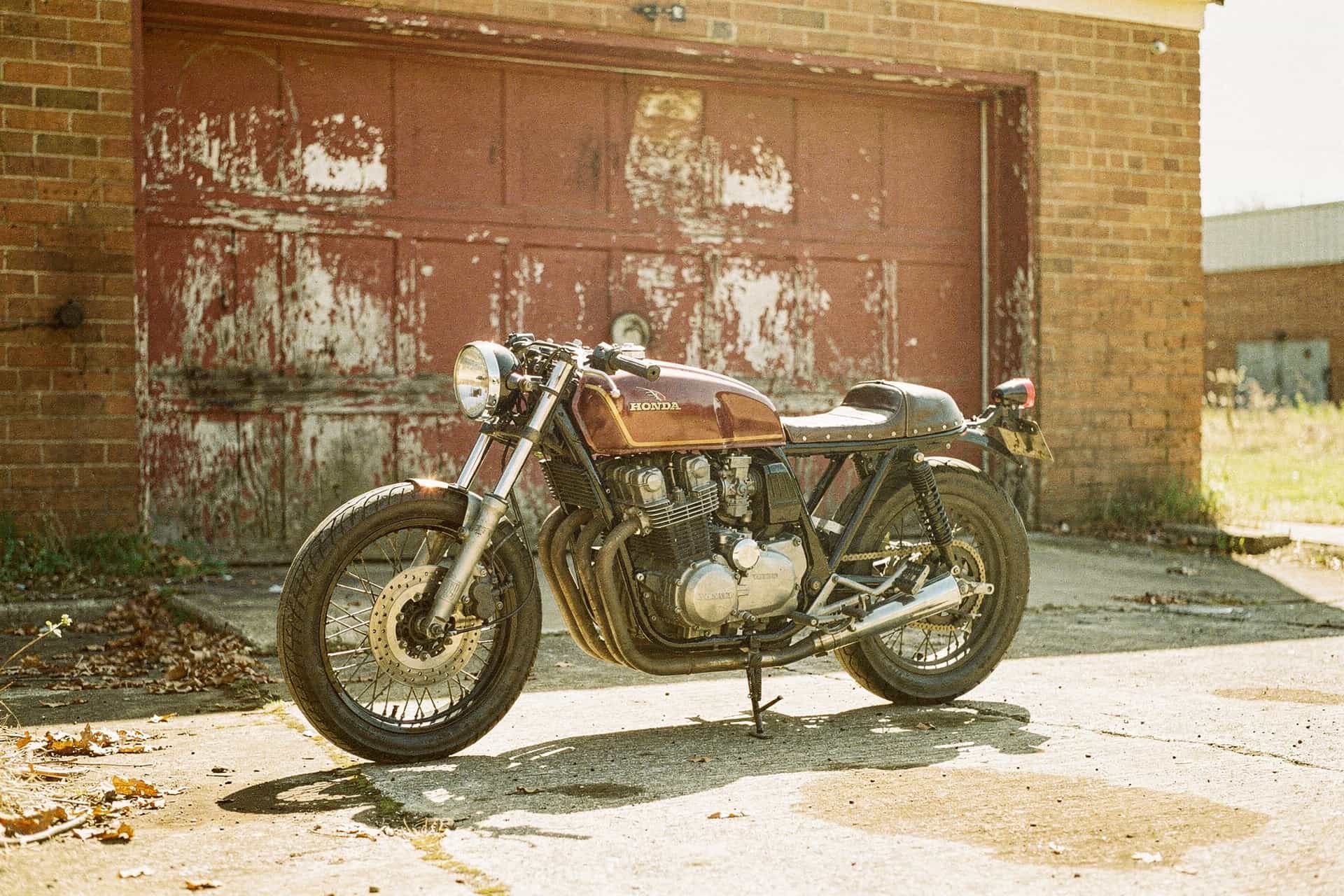
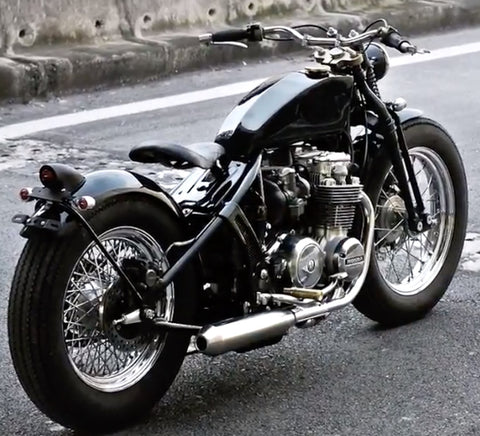
The CB650 you find on a used listing almost always looks the same. Faded tank, cracked two-up seat, a set of four pipes or a 4-into-2 that has seen some rust, and a seller who says it ran when parked. It is also one of the cheapest four-cylinder bikes you can still buy that is easy to turn into a bobber.
Here is which CB650 to buy, what the numbers mean for a build, how to handle the frame, seat, carbs and wiring, and two documented builds that show how far you can take it.
Which CB650 to Buy
Honda sold the CB650 from 1979 to 1985, according to Wikipedia’s CB650 entry. Under that one name there are really three bikes, and only two of them are the classic donor.
| Model | Years | Engine | Final drive | Build notes |
|---|---|---|---|---|
| CB650 Standard | 1979-1982 | 627cc SOHC air-cooled four | Chain | 4-into-2 exhaust, wire-spoke wheels, black headlight nacelle |
| CB650 Custom | 1980-1981 | 627cc SOHC air-cooled four | Chain | 4-into-4 exhaust, Comstar wheels, chrome nacelle, teardrop tank. 1981 adds dual front discs and air-assisted forks |
| CB650SC Nighthawk | 1982 | 627cc SOHC | Chain | Replaced the Custom with a new tank and side covers |
| CB650SC Nighthawk | 1983-1985 | 656cc DOHC, hydraulic valve adjusters | Shaft | A different engine and chassis. See the CB650SC entry |
For a classic bobber, we would buy a 1979-1982 SOHC bike. Chain drive keeps rear-end changes simple, the engine is the one every CB650 parts seller knows, and the frame is close kin to the CB550’s.
The later Nighthawks are good bikes, but shaft drive changes the build. If you already own one, our Honda Nighthawk bobber guide covers that platform.
Standard or Custom? The Standard has wire wheels, which most bobber builders want anyway. The Custom has Comstar wheels and a four-pipe exhaust, and the 1981 Custom brings dual front discs and air forks. If you plan to keep the stock wheels, the Standard’s spokes save you a swap. If you want better front brakes out of the box, look for a 1981 Custom.
The Numbers That Matter
Here is what Wikipedia lists for the CB650 engine and chassis.
| Spec | CB650 |
|---|---|
| Engine | 627cc air-cooled SOHC transverse four, 8 valves |
| Bore x stroke | 59.8 x 55.8 mm |
| Compression | 9.0:1 |
| Power | 63 hp at 9,000 rpm |
| Transmission | 5-speed, chain final drive |
| Weight | 467 lb wet |
| Brakes | Single disc front, drum rear (dual front discs on the 1981 Custom) |
| Frame | Almost identical to the CB550 |
A few of those lines drive the whole build.
Why 627cc. The block was new but kept the CB550’s stud holes, which Wikipedia says may explain why it never reached a full 650. It also tells you the CB650 is the last of the line that started with the 1969 CB750 Four and ran through the CB500 and CB550. Much of the know-how from those bikes carries over.
63 hp at 9,000 rpm. This is a four that wants revs. It will not pull like a V-twin off idle. Build it light and lean, gear it sensibly, and it is a fun, quick bike. Build it heavy with a fat tire and it will feel soft.
467 pounds wet. Not light, but lighter than most V-twin cruiser donors. Pull the stock seat, rear fender, grab rail and turn signals and you shed real weight.
Drum rear, single disc front on most bikes. Brakes are the weak spot on an old Honda. Fresh fluid, new lines and good pads come before paint.
Build Plan: Turning a CB650 Into a Bobber
The Rear End: Hoop, Not Hardtail, for Most Builds
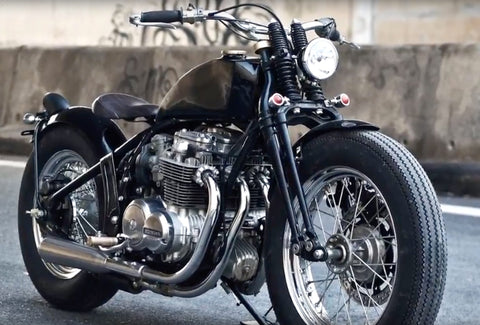
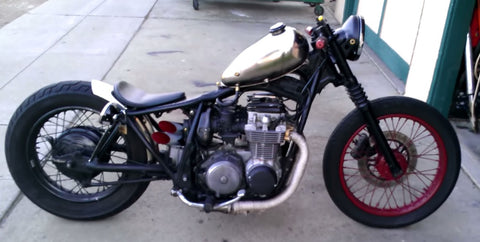
The simplest real bobber move on a CB650 is to cut the rear frame loop behind the shocks and weld in a new hoop. You keep the shocks and swingarm, and the frame ends in a clean line with the new fender. That is exactly what the $1,250 build below did.
A full rigid rear end is possible because the bike is chain drive, but there is no big-name bolt-on CB650 hardtail the way there is for the CB750. Most builders who go rigid have a fabricator make the rear section. Before you decide, read our hardtail vs softail breakdown. On an old Honda with old tires and no rear suspension, you feel every seam in the road.
If you are not comfortable welding structure, pay someone who is. A cracked weld on a frame hoop is not a small problem.
Seat and Fender
A solo seat on a spring or a flat brat-style pad is the classic choice. Keep the rear fender tight to the tire and short. Leave enough clearance for the shocks to compress fully, and check it with the shocks off before you weld any tabs.
Where the battery goes is the first question you will hit once the seat and side covers come off. Many builders move it to a small box under the seat. Keep the regulator and rectifier where they get some airflow, and use proper connectors, not twisted wire.
Tank and Bars
The stock tank shapes vary by model. The Custom’s teardrop tank already looks right on a bobber. Some builders swap in a CB750 tank, which is what the budget build below did. Whatever you pick, check the mounts and the petcock position before you buy.
Low drag bars or a small rise bar suit the CB650’s frame. Tall apes rarely look right on a small four. Any bar swap means checking cable and brake line length at full lock.
Carbs, Pods and Exhaust
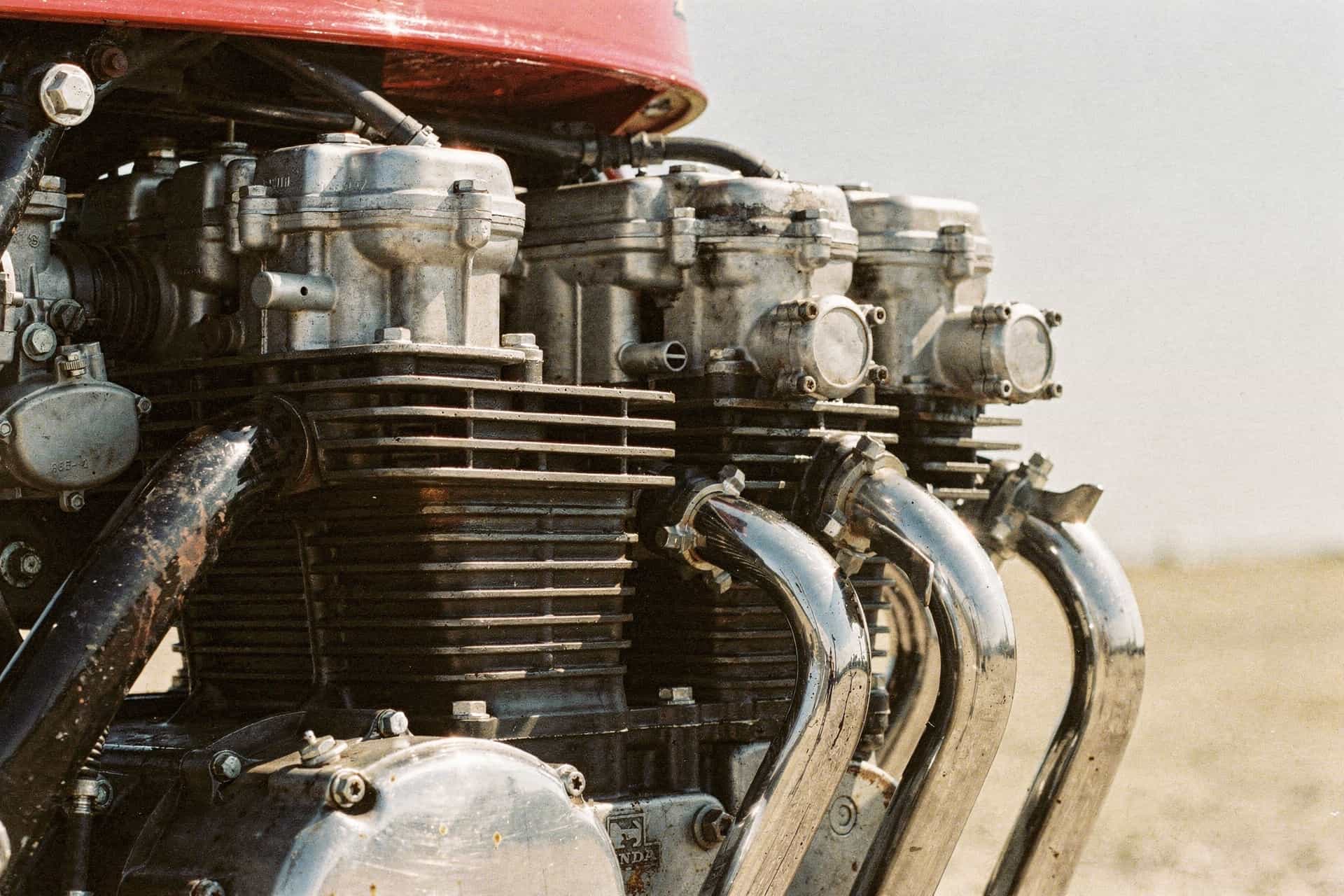
This is where most CB650 bobbers go wrong. Honda switched to CV vacuum carbs and a modified head after 1981, so check which carbs your bike has before you buy parts.
Pod filters and an open exhaust both change how the engine breathes. On a four with four small carbs, that means jetting and a careful carb sync. Skip it and you get flat spots, backfires and a bike that will not idle. If you want a bike that just runs, keeping the stock airbox and exhaust is a legitimate choice. The budget build below kept the stock carbs and exhaust and still looks like a proper bobber.
For the bigger carb picture, our fuel injection vs carburetor guide explains why old carbureted bikes need more fiddling after intake changes.
Charging and Wiring
A 40-year-old Honda charging system needs checking before you trust it. Test the battery voltage with the engine running at a fast idle and again at higher rpm. Look at the regulator and rectifier connectors for heat damage. If you are relocating the battery, rebuild the main grounds while you are in there.
Cut the harness only after you have a wiring diagram and know what each circuit does. We have seen more old Hondas stranded by a tidy-looking hack job than by any engine problem.
Two Real CB650 Builds
The $1,250 Bobber: Redeemed Cycles
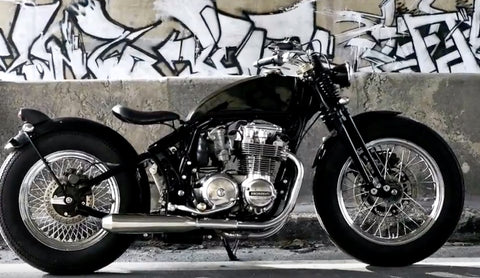
Bob Ranew of Redeemed Cycles in Garner, North Carolina built a 1982 CB650 to prove a point. In his words, “I built a bike just to show folks anyone can do it and you don’t have to have deep pockets.”
- Donor: $300.
- Tank: A CB750 tank off eBay for $80, stripped and clear powder coated for $150.
- Forks: 1981 CB750 forks off Craigslist for $10, rebuilt and lowered an inch.
- Rear: Taller rear shocks from a past build.
- Frame: Front fender chopped, rear frame cut and a hoop welded in, with an LED light strip.
- Seat: Distressed leather from eBay for $18.
- Bits: Renthal bars, 2.5 inch mini gauges, Shinko 705 tires, rattle-can paint.
- Engine: Stock exhaust and stock Keihin carbs.
- Total: About $1,250.
That is the whole lesson of the CB650 in one bike. Keep the engine stock, spend where you see it, and do the cutting yourself.
The Long Game: Trillion Industries
At the other end, Derek Pauletto of Trillion Industries started on a 1979 CB650 in 2004 because, as he put it, nobody wanted a “crappy old nothing bike.” It ended up closer to a cafe-bobber hybrid than a pure bobber, but the work shows how far the platform goes.
- Stock wheels widened from 1.85 to 3.5 inches front and 2.5 to 8.5 inches rear.
- A custom swingarm 2.75 inches longer, still using the stock chain adjusters.
- A Kawasaki ZX front end on custom triple clamps.
- A full engine rebuild with new valves and bearings, and the head shaved 0.015 inch for compression.
- Mikuni flatslide-style carbs.
- An Airtech CR750 replica tank and tail, a V-Rod headlight and a Buell front fender.
Nobody needs to go that far. It is a good reminder that a cheap donor can take as much skill as you want to throw at it. If that build speaks to you more than the budget one, our bobber vs cafe racer guide will help you pick a lane, and our cafe racer motorcycle history covers the other style.
Buying a CB650 Donor: Our Checklist
- Title in the seller’s name. Old bikes with lost titles are a headache in most states.
- Model year and version. SOHC or DOHC, chain or shaft. Look at the engine and the rear wheel before you look at the price.
- Compression and a cold start. Ask the seller not to warm it up before you arrive.
- Carbs. Fuel leaks, varnish, missing parts. Old carbs that have sat usually need a full clean.
- Charging. Check voltage at the battery with the engine running.
- Brakes. Seized calipers and stuck drums are common on bikes that sat.
- Frame. Look for bends, cracks and old welds, especially around the rear loop you plan to cut.
- Tires. Check the date code. Old rubber is not safe no matter how much tread it has.
What About the CB650R Bobber?
People search for a “CB650R bobber,” but that is a different motorcycle. The CB650R is Honda’s modern Neo Sports Cafe naked bike, launched for 2019 with a 649cc liquid-cooled DOHC inline-four. It is a sporty naked bike with a radiator, modern electronics and a shape built around the tank and headlight. You can bolt a solo seat and a short fender on one, but the classic bobber recipe is a better fit for the old air-cooled CB650. If you want a new-bike bobber, look at the factory bobbers instead.
How the CB650 Compares
If you are weighing the CB650 against other old metric donors, the KZ750 bobber is the closest rival, and our bobber rolling chassis guide explains when it makes more sense to start with a new frame and drop an engine in.
The CB650 wins on price, parts supply and simplicity. It loses on low-end grunt and brakes. For a first four-cylinder bobber, that is a trade most builders are happy to make.
When it is running and the new seat is broken in, our bobber clothing line is made for the rider who did the work.
Sources
- Honda CB650 - Wikipedia. Production years, engine layout, bore and stroke, compression, power, wet weight, gearbox and chain drive, the 627cc stud-hole explanation, CB550 frame, post-1981 CV carbs, Standard and Custom differences, 1981 Custom brakes and forks, brakes.
- Honda CB650SC - Wikipedia. 1982 SOHC Nighthawk and the 1983-1985 656cc DOHC, shaft-drive Nighthawk 650.
- Budget-built 1982 Honda CB650 by Redeemed Cycles - BikeBound. Donor price, parts and costs, total build cost, builder quote.
- Trillion Industries 1979 Honda CB650 - Pipeburn. Wheel widths, swingarm, front end, engine work, carbs, bodywork, builder quote.
- Honda CB650R Completes the Neo Sports Cafe Lineup for 2019 - Asphalt & Rubber. The modern CB650R’s 2019 launch, 649cc liquid-cooled DOHC four and Neo Sports Cafe styling.
- Honda CB750 Four heritage - Honda Global. Background on the 1969 CB750 Four that started the SOHC four line.