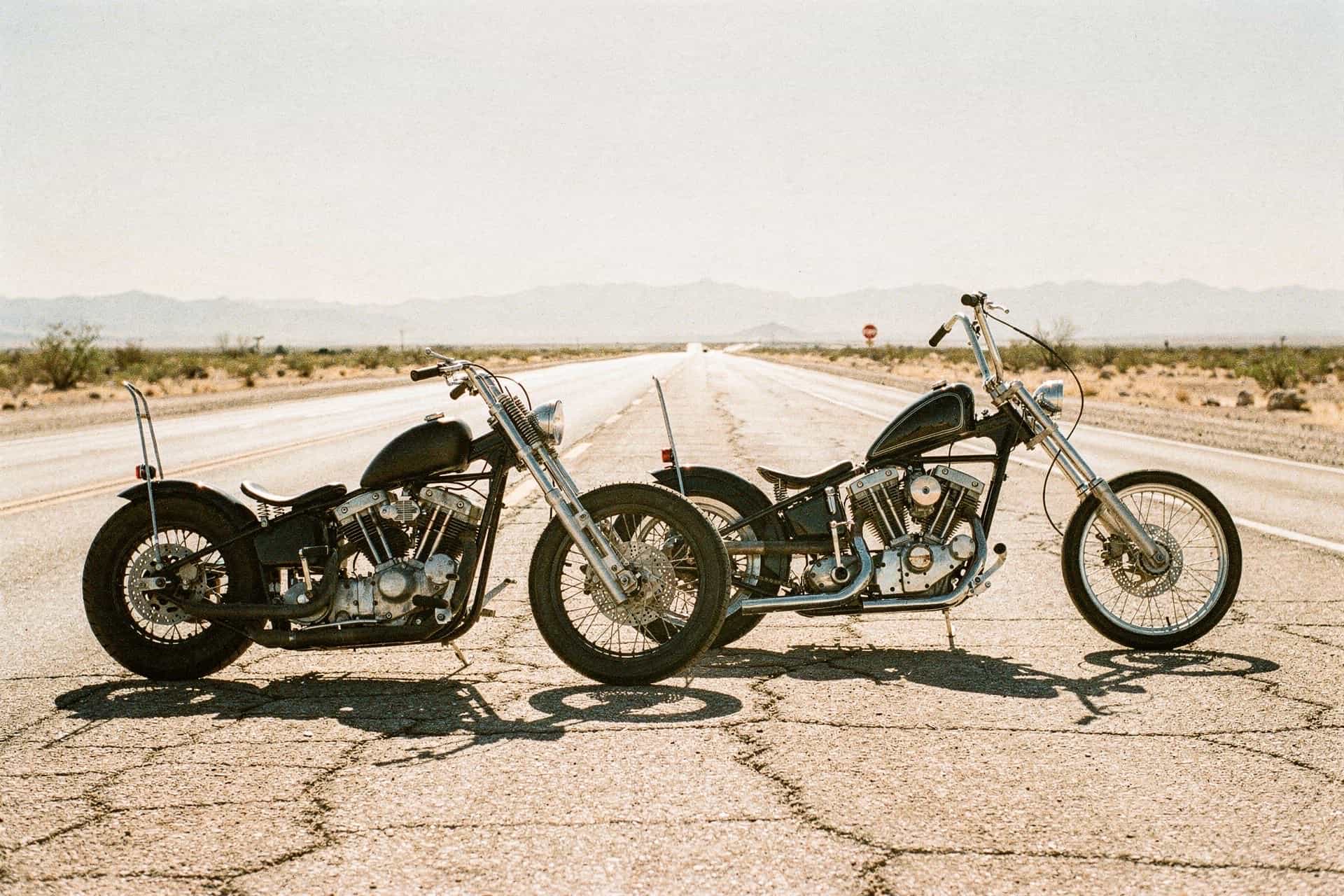
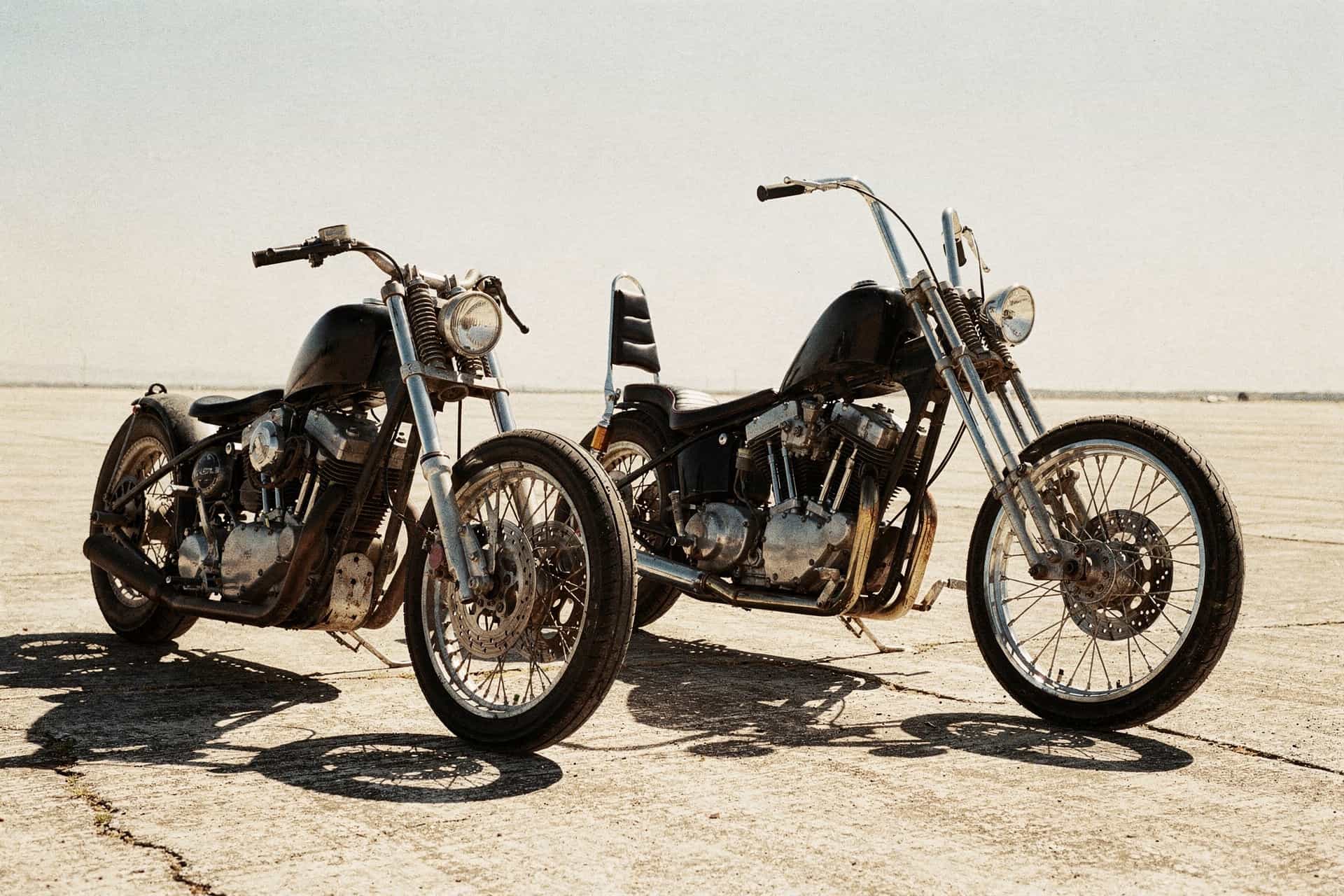
Two bikes roll into the same bike night. One sits low and tight - bobbed fender, drag bars, stock-length forks, the whole machine pulled in close like a fist. The other stretches out a long chrome springer fork, a raked-out hardtail frame, ape hangers pointed at the sky, and a sissy bar tall enough to hang a flag from. Everybody at the table knows one is a bobber and the other is a chopper. Ask them to explain why, and you’ll get ten different answers.
The short version: a bobber keeps the frame the factory built and removes parts. A chopper cuts the frame apart and rebuilds the geometry. A cruiser is the stock machine both of them usually started as. That one distinction - does the frame change or not - decides how the bike steers, what it costs to build, and how much fabrication skill it demands.
Bobber vs Chopper vs Cruiser at a Glance
| Feature | Bobber | Chopper | Stock cruiser |
|---|---|---|---|
| Frame geometry | Stock rake and trail | Neck raked out, often past 38 degrees | Factory spec, unchanged |
| Fork length | Stock, or stock-length springer | Extended, commonly 4 to 16 inches over | Stock |
| Rear fender | Bobbed short | Minimal or none | Full coverage |
| Front fender | Usually removed | Almost always removed | Fitted |
| Handlebars | Low: drag, tracker, Z-bars | Tall: ape hangers | Mid-rise pullbacks |
| Seat | Sprung solo saddle | Solo or king-and-queen | Two-up with pillion |
| Sissy bar | Rare | Common, sometimes very tall | Optional accessory |
| Rear suspension | Stock or hardtail conversion | Usually rigid | Twin shocks or monoshock |
| Steering feel | Close to stock | Slow, wide turning circle | Factory-engineered |
| Build skill needed | Mostly bolt-on plus light fab | Frame welding and alignment | None |
| Origin era | 1930s-1940s | Late 1950s-1960s | Factory production |
| Core idea | Take away | Rebuild | Buy and ride |
If you only remember one line from that table, make it the frame row. Everything else follows from whether the steering neck got cut.
Same Starting Point, Different Directions
Both bobbers and choppers started with the same act: taking a stock motorcycle and cutting parts off it. That’s where the similarity ends.
The bobber motorcycle came first. After World War II, returning GIs took their heavy Harley-Davidson WLAs and Indian 741s and started stripping them - fenders bobbed short, windshields tossed, saddlebags ditched, anything unnecessary removed to drop weight and go faster. They called this a “bob job.” The practice actually goes back further, to the 1930s when riders were doing “cut-downs” on Harley J-series V-twins for informal racing. But the post-war era is when it became a movement.
The chopper evolved from the bobber in the late 1950s and early 1960s, primarily in Southern California. Builders who’d been bobbing bikes started going further - not just removing parts, but fundamentally altering the motorcycle’s frame and geometry. They weren’t stripping bikes down anymore. They were rebuilding them into something the factory never intended. The word “chopper” comes from this act of chopping the frame’s steering neck to increase the rake angle, then welding in extended fork tubes to compensate.
The bobber is subtraction. The chopper is transformation.
Frame Geometry: The Core Difference
This is where the technical split happens, and everything else follows from it.
Bobber Frames
A bobber keeps the stock frame geometry or stays very close to it. The neck angle (rake) stays at the factory specification - typically 28 to 32 degrees on most American V-twins. The wheelbase stays stock. No stretching, no raking, no sectioning. The frame might get de-tabbed (unnecessary mounting brackets ground off), and on hardtail conversions the rear suspension gets eliminated, but the fundamental steering geometry stays the same.
Keeping the factory rake and trail usually preserves more of the donor bike’s steering character than a heavily raked conversion. That does not guarantee good handling or braking: tire choice, suspension, frame work, weight distribution, and brake condition still decide how a finished bobber behaves.
Chopper Frames
A chopper radically alters the frame geometry. The steering neck may be raked well beyond the donor bike’s stock angle. Builders often pair that change with longer fork tubes, described in the aftermarket as a number of inches “over” stock. The exact geometry must be measured as a system because rake, trail, fork length, wheel size, and frame stretch interact.
This geometry change creates the chopper’s long, stretched silhouette. It comes at a cost. Increasing rake and fork length can widen the turning circle and slow steering response, but the final trail figure depends on the whole front-end design. RevZilla’s terminology guide describes the general straight-line bias of longer, more raked configurations, while a bobber that retains sound factory geometry stays closer to the donor bike’s response.
Many choppers also stretch the frame’s backbone or downtube to push the front wheel further forward, lengthening the overall wheelbase. Rigid frames (no rear suspension) are common on both bobbers and choppers, but on a chopper the rigid rear end combined with the extended front end creates a distinctive riding posture that’s entirely its own.
Forks and Front End
The front end is the most visible difference between the two styles.
Bobber front ends are stock or close to it. Some builders swap to springer forks for a vintage look, but the length stays at stock specification. Others keep the modern telescopic forks that came on the donor bike. The point is that the front wheel sits where the factory put it, relative to the steering neck.
Chopper front ends define the style. Extended springer forks were the original chopper look in the 1960s - a set of chrome springer legs stretched well past stock length, often with no front fender. By the 1970s, extended telescopic (conventional) forks became more common, and builders like Arlen Ness and Denver Mullins pushed fork lengths to extremes. The long fork look became so iconic that it’s basically shorthand for “chopper” in popular culture.
Wide glide front ends - where the fork legs are spaced further apart than stock, originally borrowed from Harley’s FLH big-twin - became another chopper signature. A wide glide with a 21-inch spoked front wheel and no fender is about as chopper as it gets.
Fender Treatment
Both styles strip fenders, but in different ways.
A bobber’s defining feature is the bobbed rear fender - cut short so it barely extends past the rear axle, or replaced with a small, flat fender that hugs the top of the tire. The front fender is usually removed entirely. The result is a clean profile that shows off the wheel and tire. “Bobbing” the fender is literally where the bobber gets its name.
A chopper often runs no fenders at all - front or rear. When a rear fender is present, it tends to be a narrow, flat piece mounted tight to the tire, or a custom-fabricated piece that follows the line of the hardtail frame. The front fender is almost always gone. On some choppers, the lack of fender coverage is extreme enough that riding in rain means a rooster tail of water straight into your face. That’s the trade-off, and chopper riders accept it as part of the deal.
Handlebars and Riding Position
The bars and riding position tell you what kind of ride the builder intended.
Bobber handlebars sit low - drag bars, tracker bars, buckhorn bars, or Z-bars that keep your hands at or below shoulder height. The riding position is upright or slightly forward, with feet on mid-controls or forward controls depending on the build. The whole posture is compact and planted. You sit in a bobber, not on it.
Chopper handlebars go high. Ape hangers - tall handlebars that put your hands at or above shoulder height - are the classic chopper choice. The name comes from the posture: arms up, elbows out, looking like an ape hanging from a branch. Heights of 12, 16, even 20 inches above the risers are common. Combined with forward controls on a stretched frame, the riding position is a full-body recline - feet forward, arms up, spine tilted back against a sissy bar. It looks like you’re riding a La-Z-Boy down the highway, and honestly, on a straight road, it’s more comfortable than it looks.
The catch is that ape hangers and forward controls on a raked-out frame make aggressive riding nearly impossible. Choppers are built for cruising, not carving. A bobber gives you more control in traffic, tighter spaces, and twisty roads. A chopper owns the highway.
There is a legal wrinkle here that catches a lot of first-time chopper builders. Handlebar height is regulated state by state, and the rules are not consistent. A Connecticut General Assembly research report surveying the statutes found states using three different tests: a fixed measurement above the seat, a limit tied to the rider’s shoulder height, and no limit at all. Some states in that survey capped grips at 15 inches above the seat while others allowed 30. Check your own state’s vehicle code before you buy 16-inch apes, because a bar that is legal two states over can be a fix-it ticket at home.
If you’re drawn to either style, we’ve got gear that fits the build-it-yourself attitude - no matter which direction your project takes.
Seats, Sissy Bars, and the Rear End
Bobbers almost universally run a solo seat - usually a sprung saddle mounted directly to the frame. No passenger seat, no backrest, no sissy bar. The rear profile is minimal: bobbed fender, solo seat, maybe a small tail light tucked under the fender. Clean, tight, done.
Choppers also run solo seats, but the rear end is a different story. The sissy bar - a tall metal hoop or bar extending up from the rear axle area - is a chopper signature. Originally a practical addition (it kept the rider from sliding off the back under hard acceleration and gave passengers something to lean against), the sissy bar evolved into a style statement. Some stand two or three feet tall. King-and-queen seats - a stepped two-up seat with a raised passenger section - are another classic chopper detail.
The Build Philosophy
This is where the difference between a bobber and a chopper stops being about parts and becomes about intent.
The bobber philosophy is reductive. Start with a complete motorcycle. Take away everything that doesn’t serve the act of riding. The goal is simplicity - mechanical honesty, a machine stripped to its essence. There’s a direct line from the post-war bob job to modern bobber builds. The tools and techniques have improved, but the idea hasn’t changed in 80 years.
The chopper philosophy is expressive. Start with a motorcycle (or just an engine and a pile of parts) and build something that reflects you - your taste, your skills, your willingness to sacrifice practicality for vision. Choppers are rolling art. The best ones are genuine expressions of the builder’s personality, and no two are alike. The worst ones are dangerous, poorly welded deathtraps. The gap between those two outcomes is skill, knowledge, and the willingness to do things right.
The risk sits in different places for each style. A bobber conversion on a stock frame works inside engineering the factory already validated, so most of the job is bolt-on parts, a shortened fender, and a seat mount. A chopper frame is a structural project. Rake angle, neck gusseting, weld quality, and axle alignment all have to be right, because a frame that flexes under braking or tracks crooked is a safety problem you cannot ride around. Swap-meet frames with unknown welds are the classic trap. If you cannot inspect and verify the welds yourself, have someone who can look before that frame carries an engine.
Where the Cruiser Fits
Plenty of riders arrive at this comparison from a third direction: they own a stock cruiser and want to know which style it belongs to. It usually belongs to neither. A cruiser is a factory-built category - low seat, relaxed rake, full fenders, passenger accommodation, working suspension at both ends - and it is the raw material for most bobber and chopper projects rather than a style in its own right. Our breakdown of every motorcycle category lays out where cruisers sit next to standards, sport bikes, and touring machines.
Three practical differences separate a stock cruiser from either custom style:
- Fenders and lighting stay legal and complete. Bobbers and choppers both start by removing coverage, which changes what happens in rain and what your local inspection expects.
- Two-up capability. A cruiser is built to carry a passenger. A bobber almost never is. A chopper might, on a king-and-queen seat.
- Suspension travel. Cruisers keep it. Hardtail bobbers and rigid choppers delete the rear travel entirely, which is a comfort and a chassis decision, not just a look. Our hardtail vs softail comparison covers what that costs you over a long day.
Some factory bikes blur the line on purpose. Harley’s Softail lineup hides the rear shocks to imitate a rigid frame, and several manufacturers sell models with “bobber” in the name that are really cruisers with a short fender and a solo seat. They are a fine place to start. They are not the same thing as a bike somebody built.
Cultural Histories That Shaped Each Style
The bobber and the chopper aren’t just different mechanically - they came out of different cultural moments.
The Bobber: Post-War Speed and Rebellion
Bobbers were born in the late 1940s among veterans who wanted cheap speed. The 1947 Hollister rally and the media frenzy that followed - Life magazine, Harper’s, and eventually the 1953 film The Wild One with Marlon Brando - fixed the bobber rider’s image in American culture as a leather-jacketed rebel. The reality was more mundane: most bob jobs were done by guys who wanted to race on weekends and couldn’t afford a purpose-built racing bike.
Bob jobs were a major strand of American custom motorcycle culture from the late 1940s through the early 1960s. Period photographs also show other race, touring, and custom configurations, so not every modified motorcycle from that era fits the bobber label.
The Chopper: California Counterculture
The chopper emerged in the early-to-mid 1960s, primarily in California. Builders in the Los Angeles area - guys like Ed “Big Daddy” Roth, Von Dutch (Kenny Howard), and later Denver Mullins and Arlen Ness - started pushing bike modifications past the bobber’s subtraction-only approach. They chopped frames, raked necks, extended forks, and created machines that were as much sculpture as transportation.
The 1969 film Easy Rider turned the chopper into a national symbol. The “Captain America” bike - a raked, extended Harley-Davidson panhead with stars-and-stripes paint - became one of the most recognizable motorcycles in history. Peter Fonda later credited Cliff Vaughs and Ben Hardy with building the bikes from former police Harleys. Published accounts differ on some construction details, so exact rake, fork-length, purchase-price, and sketch chronology claims should be treated cautiously unless tied to build records.
Through the 1970s, the chopper scene exploded. Magazines like Easyriders (first issue June 1971), Street Chopper, and Iron Horse fueled the movement with build features and centerfolds. The style reached its most extreme forms during this decade - forks stretching to absurd lengths, frames raked past any reasonable angle, form completely overwhelming function.
The chopper revival of the early 2000s split into two camps. The TV side - American Chopper, Biker Build-Off, Jesse James’s Monster Garage - turned choppers into spectator entertainment and brought a new generation into the motorcycle culture that choppers helped create. But the other camp stayed in the garage. Indian Larry (Larry DeSmedt) out of Brooklyn built raked choppers meant to be ridden hard through city traffic, not displayed at shows. His builds - the “Grease Monkey,” the “Chain of Mystery” - were aggressive, quick-handling machines built entirely by hand with no computer drawings. Indian Larry represented what the chopper was supposed to be before the TV era turned it into a showroom piece. He died in 2004 performing a stunt at Sturgis, and his “Twisted Downtube” frame design remains one of the most sought-after pieces in custom building.
Which One Should You Build?
This comes down to what you want out of a motorcycle.
Build a bobber if:
- You want a bike you can actually ride daily
- You value handling and braking alongside looks
- Your garage skills are intermediate (bolt-on and basic fabrication)
- You want to start with a stock frame and keep things manageable
- You’re working with a tighter budget
Build a chopper if:
- The bike is primarily a statement piece and weekend cruiser
- You have (or are willing to learn) serious welding and fabrication skills
- You’re willing to sacrifice handling for visual impact
- You want a bike that’s unlike anything else on the road
- You have a bigger budget for custom frame work and extended front ends
For Harley bobber builds, the Softail platform is the most common starting point - deep aftermarket, strong frame, and a look that’s already halfway to a bobber out of the crate. For Sportster-based builds, the older Evolution-powered models (1986-2003) offer cheap donors and endless mod potential.
Chopper builds typically start with Harley big-twin engines - Shovelheads, Evolutions, and Twin Cams - dropped into aftermarket rigid frames from companies like Paughco, Kraft Tech, or Rolling Thunder. The frame is the chopper. Everything else hangs off it.
The Lines Keep Blurring
Modern custom builds do not always fit neatly into one box. Some builders use “chobber” for bikes with slightly raked frames and mid-length forks that split the difference. Bobbers can wear ape hangers, and choppers can use conservative rake angles. The categories are useful vocabulary, not rigid law.
That same choice shows up when a rider is torn between a stripped cruiser and a standard-based build. Our bobber vs cafe racer breakdown compares the donor bikes, riding positions, and cornering priorities before you buy parts.
What hasn’t changed is the underlying split in philosophy. Bobbers are about taking away. Choppers are about building up. One starts with a motorcycle and asks “what can I remove?” The other starts with a vision and asks “what do I need to create this?”
Both are legitimate expressions of what it means to build a custom bike. Both carry decades of history and culture behind them. And both start the same way - a rider in a garage, looking at a stock motorcycle, and deciding it needs to be something else. If you’re leaning toward the bobber side and want a hands-on roadmap, our custom bobber build guide walks through the entire process from donor bike selection to first ride.
That’s the whole point. The bike you build is yours. Nobody else’s. If you’re in this world - bobber, chopper, or somewhere in between - you’re part of a brotherhood that goes back generations.
Now go build something.
Sources
- National Motorcycle Museum - Easy Rider, Captain America Bike - Museum background on the Captain America motorcycle and its place in custom-bike history.
- The Vintagent - Peter Fonda: Cliff Built Captain America - Peter Fonda’s own account of the design process and Cliff Vaughs’ role in building the most famous chopper in history.
- RevZilla - Moto-linguistics: How to Speak Chopper Proper - Technical definitions of bobber, chopper, and “short chop” styles with precise distinctions in frame geometry and fork length.
- Cycle World - Art of the Chopper: Indian Larry - Profile of Indian Larry’s build philosophy, his Brooklyn workshop, and the Grease Monkey and Chain of Mystery builds.
- Chopper (motorcycle) - Wikipedia - Overview of chopper history from the 1960s California scene through the TV-era revival, including Arlen Ness and the cultural impact of Easy Rider.