

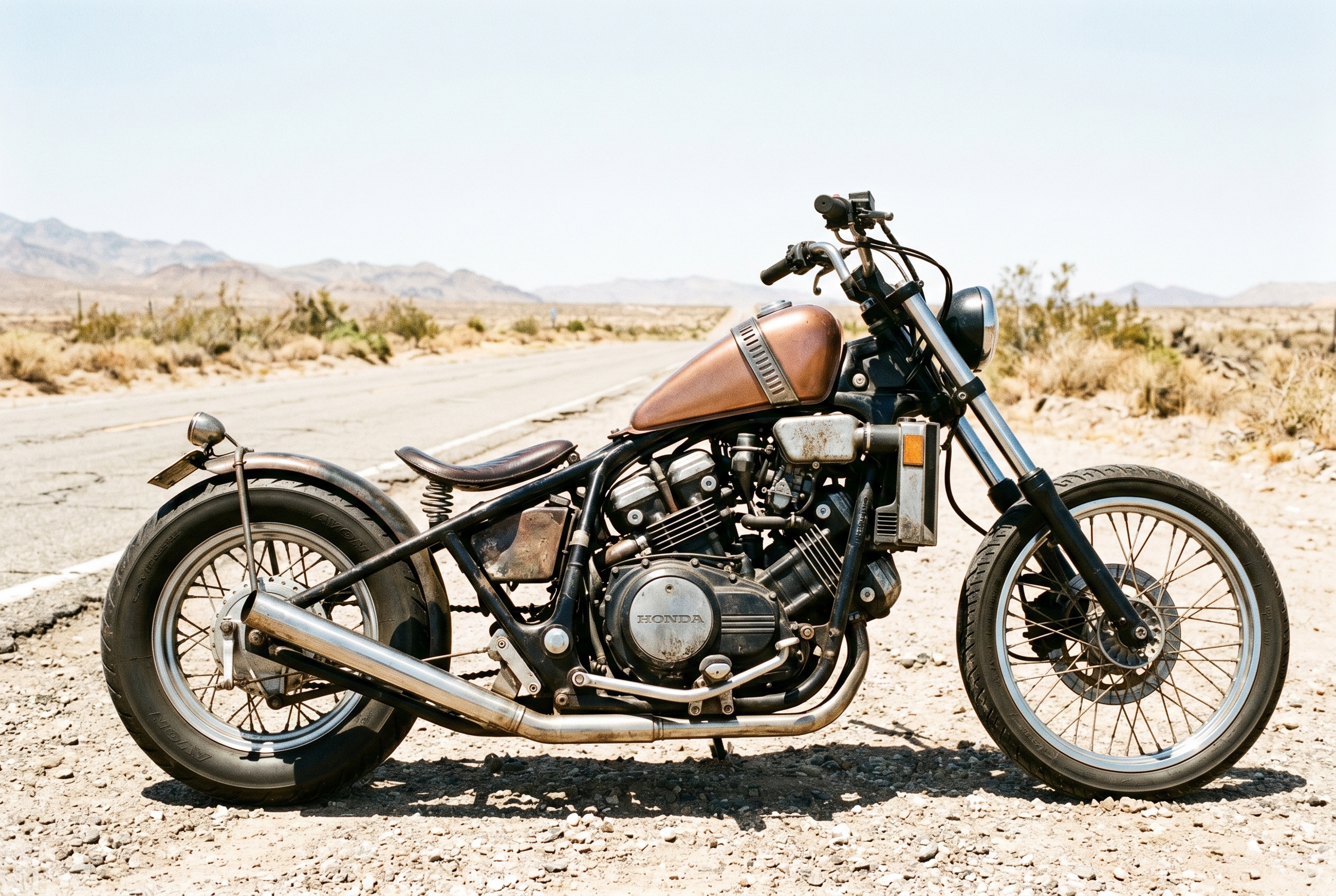
Most bobber builds start with a V-twin. The handful that do not usually start with an inline four. The Honda V65 Magna is the rare donor that is neither, and that is exactly what makes it interesting. A 1,098cc 90-degree V-4 wrapped in a cruiser frame, with shaft drive, six gears, and the Guinness Book of World Records calling it the fastest production motorcycle on earth from 1986 to 1989. Strip it down right and you end up with a bobber nobody else has.
This is the build guide for the V65 specifically. If you are looking at the broader Magna lineup, including the smaller V45 and the second-generation chain-drive Magna, our Honda Magna bobber kit article covers the full family.
What the V65 Actually Is
Honda built the VF1100C V65 Magna from 1983 through 1986. The engine is a 90-degree V-4, double overhead cam, liquid cooled, 1,098cc, with a bore and stroke of 79.5mm by 55.3mm. That is dramatically oversquare, which is why the redline sits at 10,000 rpm and peak power lives at 9,500. Honda claimed 116 brake horsepower at the crank. Period dyno tests typically pulled around 105 at the rear wheel.
Other essentials, from the Wikipedia spec sheet cross-checked against Rider Magazine’s retrospective:
- Six-speed transmission with overdrive sixth
- Shaft final drive
- Wet weight 590 pounds (270 kg)
- Claimed torque 70 lb-ft at 7,500 rpm
- Quarter-mile 11.29 seconds at 119.2 mph in period testing
For context, a stock 1983 Harley-Davidson FXR Super Glide of the same year made roughly 65 horsepower from its 1,340cc Shovelhead. The V65 Magna made nearly twice the power from a smaller engine and weighed about the same. This is what cruisers were not supposed to be in 1983, and Honda built it anyway.
Why It Works as a Bobber Donor
We have worked on a couple of V65 builds in the shop, and the case for stripping one down comes down to four things:
- Engine character nobody else has. A V4 cruiser is a unicorn. Strip the bodywork off a V65 and the engine becomes the visual centerpiece. The four exhaust headers fan out from the V in a way that looks like nothing on a Harley, a Sportster, or any inline four.
- Shaft drive is clean. No chain, no sprocket, no slap. The bobber aesthetic loves a clean rear end, and the V65’s shaft drive delivers that without any extra fabrication. You can run a fender or no fender and the rear wheel area still looks finished.
- Power that does not need fixing. Most older bobber donors get strapped with a builder upgrading carbs, cams, and exhaust to chase 70 horsepower. The V65 delivers 100 plus horsepower at the rear wheel from the factory. Leave the engine alone and use the build budget on chassis and cosmetics.
- Donors are cheap because nobody wants them. Budget-strapped builders default to air-cooled CB inline fours. The V65 sits in a graveyard of underappreciated 80s machines. That is the bobber builder’s advantage.
The honest take: the V65 is not a beginner project. The engine is a Honda, which means it is reliable, but everything around it is complicated. Carb work alone will scare off anyone expecting a CB350 experience.
Donor Bike Scorecard
| Category | Score | Notes |
|---|---|---|
| Engine character | 9/10 | V4 sound, no other cruiser like it |
| Reliability if maintained | 7/10 | Solid Honda bottom end, watch the cams |
| Parts availability | 5/10 | Mechanical OEM is OK, aftermarket sparse |
| Frame friendliness | 6/10 | Hard tail conversion needs care, geometry is forward |
| Brakes (stock) | 3/10 | Anti-dive system, weak twin discs, plan to upgrade |
| Carb access | 2/10 | Notoriously difficult, full tank-and-airbox removal |
| Donor price | 8/10 | $2,500 to $3,500 running |
| Aftermarket support | 4/10 | Limited compared to Sportster or CB |
Net read: a V65 is a great bobber donor for a builder who has done a couple of full builds before. First-time builders are better served by a Sportster or a Honda Shadow. Our Honda Shadow bobber article covers that platform.
Known Weak Points to Address Before You Cut
Anybody buying a V65 for a build project should plan to address these on day one. Forum reports across V4MuscleBike, Honda Shadow Forums, and the Vmax forum all converge on the same list:
Cams. Honda recalled cams on many V4 engines from this era because they pit and wear out. If the donor has not had cams inspected or replaced, plan to do that during the build. Reground cams are available from specialist suppliers. A worn cam destroys the engine character that drew you to the bike in the first place, so this is not optional.
Upper-end oiling. Early production years had inadequate upper-end oiling. The 1985 and 1986 V65s improved on this, but any V65 benefits from a Dave Dodge style oil kit if you can find one. Check for any history of cam-bearing failure before buying.
Second gear. Hard use can blow second. A donor that has been raced or wheelied hard is a risk. Listen for gear noise on a test ride and check for a clean shift into second.
Carbs. The carbs are bank-of-four under the tank with the airbox sitting on top of the engine. Removal requires pulling the tank, the airbox, and a lot of patience. Buy a donor with carbs in known good condition, or budget two days for a clean and rebuild before you start anything else.
Brakes. The factory front brakes are widely criticized. Combined with the anti-dive system that complicates aftermarket caliper mounting, the brakes are the weakest part of the bike. Plan a master cylinder upgrade and braided lines at minimum. A full caliper swap is more involved on a V65 than on most donors.
Build Direction: Strip, Not Reframe
The V65 has a long, low cruiser frame that is already reasonably bobber-friendly. We suggest a strip-and-style approach rather than a hard tail conversion. The reasons:
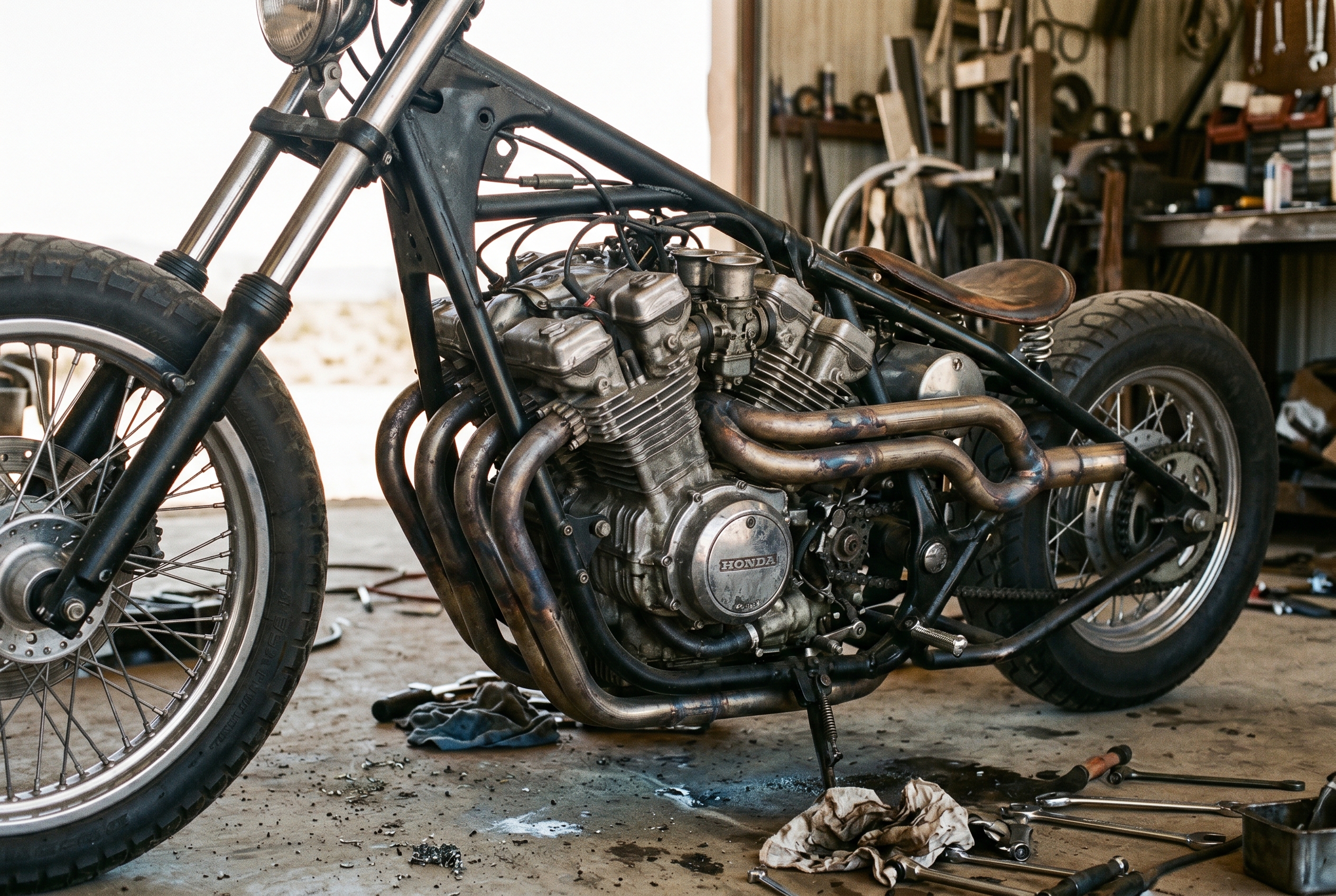
- The shaft drive is integrated into the swing arm. Hard-tailing the rear means rebuilding the entire shaft drive system, which is a job for a fabricator who has done it before.
- The factory rake and trail land close to bobber proportions already. You do not need to chop the neck.
- Removing the bodywork, side panels, fender, and turn signals already gets you 70% of the bobber look without any frame mods.
What to remove first:
- Seat (replace with a solo sprung saddle)
- Rear fender (or trim down to a bobbed shorty)
- Side covers
- Turn signal stalks (use micro turn signals or bar-end signals)
- Rear cowl and grab bar
- Stock exhaust (this is where the build cost lives, see below)
What to add or change:
- Drag bars or a low set of mini apes
- Solo seat with springs
- Bobbed front fender or no front fender
- Smaller, cleaner gauges (the stock cluster is bulky)
- Dished tank or a peanut-style tank if you can fit one over the V (this requires fab work)
For comparison with another Honda V-twin bobber platform, our Honda Shadow bobber and Honda CB650 bobber articles walk through similar strip-and-style builds.
Exhaust: The Hardest Part
The V65’s biggest aesthetic challenge is also its biggest mechanical character: four exhaust headers from a V4. Most cruisers have two pipes from a V-twin, simple and clean. The V65 has four. Aftermarket exhaust options for the V65 are limited because the bike’s aftermarket support is thin to begin with.
The two realistic paths are:
- Find period or vintage Vance and Hines or Kerker headers. Both made systems for the V65 in the late 1980s and early 1990s. Used examples surface on V4MuscleBike forum classifieds and on eBay periodically. Expect $400 to $900 for a complete usable system.
- Build a custom four-into-two or four-into-one. A fab shop with experience building custom headers can do this, but it is not cheap. Plan for $1,200 to $2,500 in fabrication labor depending on the local rate.
Whatever you choose, the V4 sound is what makes a V65 bobber stand out at a bike night. Cheap baffles or a poorly designed system will throttle the engine character that justified the build.
Cost of a Realistic V65 Bobber Build
| Line item | Low | High |
|---|---|---|
| Donor bike (running) | $2,500 | $3,500 |
| Cam inspection or replacement | $400 | $1,200 |
| Carb rebuild | $250 | $600 |
| Brake upgrade (front master, lines, calipers if doing them) | $300 | $1,200 |
| Solo seat, springs, mounts | $200 | $500 |
| Bars, controls, mirrors | $150 | $400 |
| Fender mods, paint | $300 | $900 |
| Exhaust | $400 | $2,500 |
| Misc fasteners, electrical, lighting | $200 | $500 |
| Total | $4,700 | $11,300 |
Compare this to a $7,000 to $12,000 budget for a clean Sportster bobber and the V65 starts to look reasonable, especially since you are starting with twice the horsepower. The wide range on the high end is mostly the exhaust line.
What Most Riders Do Not Realize Until They Ride It
The V65 in stock form pulls to 10,000 rpm and feels like a sport bike that someone bolted forward controls onto. Stripped down to bobber spec, with clip-ons or low bars, it transforms into a different animal. It is fast in a way no other cruiser bobber is fast. The first time you twist the throttle past 6,000 rpm on a V65 bobber, the V4 lights up and the front wheel goes light.
This is also why the brakes need attention before the first ride. The factory brakes were inadequate for the stock bike. They are dangerous on a stripped bobber that has lost weight up front and gained nothing in stopping power.
If you are riding a V65 bobber in any kind of weather or traffic, gear up properly. Our Bobber Brothers hoodies and Built Not Bought collection cover the lifestyle side of the build.
Now Go Find One
The V65 Magna is one of the most underappreciated bobber donors in the Honda catalog. Four model years (1983 through 1986), a 1,098cc V4 making over 100 horsepower at the rear wheel, and shaft drive that keeps the rear end clean. The mechanical complications are real but documented, and the parts ecosystem, while thin, is not empty.
The bigger pillar on what defines a bobber is in our what is a bobber motorcycle guide. The motorcycle clubs complete guide covers the broader culture if your bobber build is heading toward a riding club or a brotherhood.
Sources
- Honda Magna - Wikipedia. Verified production years (1983-1986), engine displacement (1,098cc), V-4 configuration, 6-speed shaft drive, 116 bhp claimed, 590 lb wet weight, 11.29 second quarter mile.
- Retrospective: 1983-1986 Honda VF1100C V65 Magna - Rider Magazine, December 25, 2019. Detailed retrospective with period testing data, engine internals (79.5mm bore, 55.3mm stroke, 38-degree included valve angle, 10.5:1 compression).
- History And Mystery Of The Honda V65 Magna - TopSpeed. Coverage of the bike’s reputation, donor pricing context, and the Guinness Book speed record period (1986-1989).
- V4 Muscle Bike forum - 84 Honda magna bobber project. Long-running build thread with documented bobber conversion experience on the V65 platform.
- History of the Honda V65 Magna - Old Bike Barn. Industry retrospective with notes on cam wear, oiling improvements between model years, and brake system criticism.