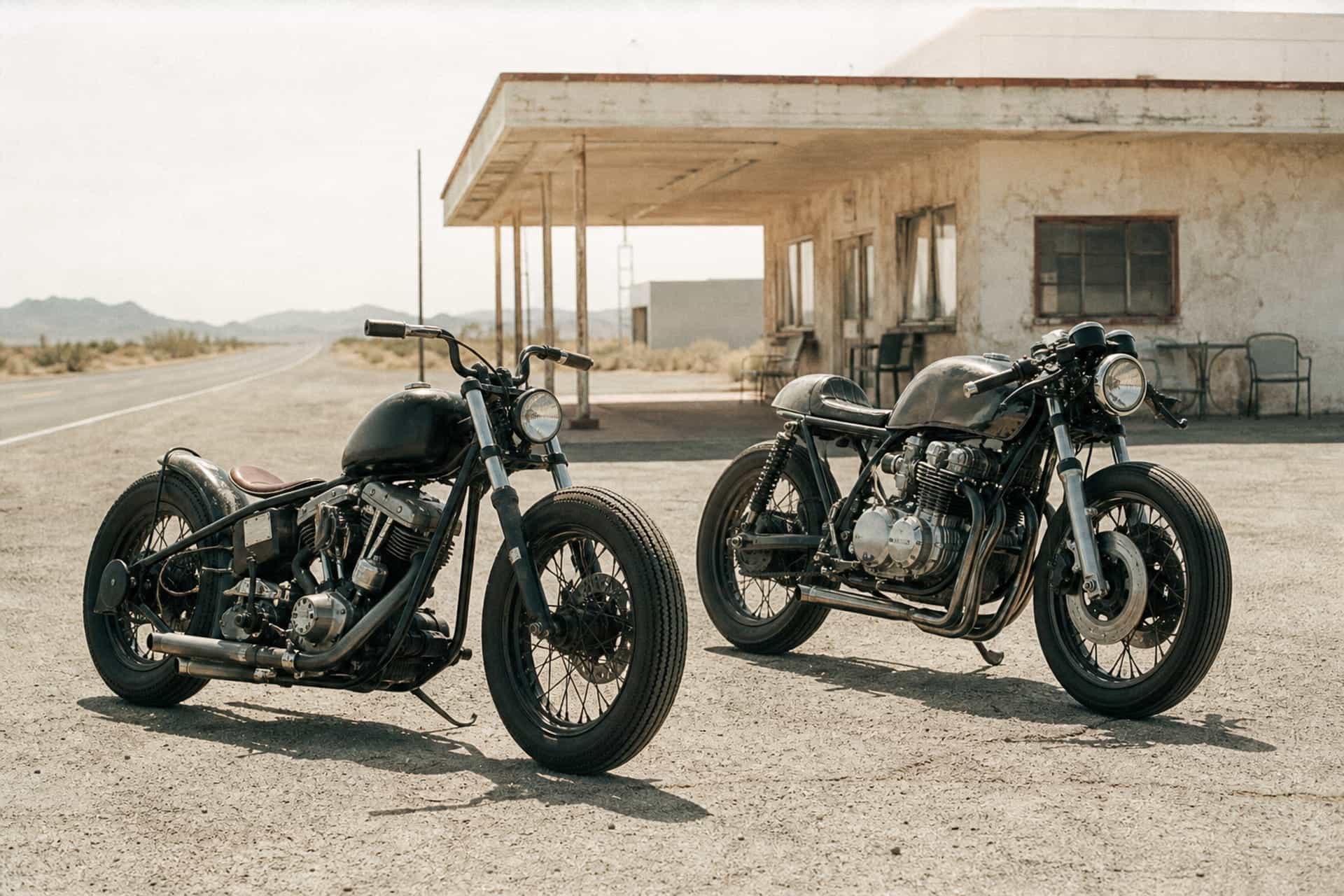
Pull up to any bike night and park a bobber next to a cafe racer, and you are looking at two completely different ideas about what a motorcycle should do. The bobber sits low and wide - bobbed rear fender, fat back tire, pull-back bars, a single sprung seat. The cafe racer crouches forward on clip-on bars, a humped solo seat, and rear-set pegs that fold your body over the tank. Same passion, two different countries, two different answers.
A bobber is a stripped-down American cruiser build chasing raw minimalism. A cafe racer is a British-rooted sport build chasing speed. One subtracts weight for attitude. The other reshapes the whole machine to carve a corner. Here is how they split, where they came from, and how to pick the one that fits how you actually ride.
Two Cultures, Two Countries
These styles were born on different continents, out of different needs, about fifteen years apart.
The bobber came first, in 1930s and 1940s America. Riders stripped their heavy Harleys and Indians down to the bone - fenders bobbed short, front fender tossed, saddlebags and windshields gone - to cut weight and pick up speed. After World War II, returning servicemen brought their mechanical skills home and turned the “bob job” into a movement. The idea was simple: keep the bike on the road at the lowest cost while making it lighter and faster. Everything that did not help you ride got cut off. You can read the full backstory in our guide to what a bobber motorcycle is, but the short version is that the bobber has always been about subtraction.
The cafe racer showed up later, in early 1960s Britain. A generation of young riders called Rockers - also known as the “ton-up boys” - started modifying standard production bikes for short, fast blasts between roadside cafes. The Ace Cafe on London’s North Circular ring road became the legendary gathering spot. The goal was to hit “the ton” - 100 miles per hour - on the run between hangouts. To do that, they stripped the bikes and rebuilt the ergonomics for speed: low bars, tucked-in body, everything aimed at going fast in a straight line and holding a line through a bend. The name itself points at the culture. These were bikes raced from cafe to cafe - timed, as the legend goes, against the length of a jukebox record - built by kids who could not afford a real racer so they made one out of what they had. Whether the record-race story is history or folklore, the culture it describes was real.
So the split is baked in from day one. American builders wanted a lighter cruiser. British builders wanted a homemade race bike. Neither was wrong. They just wanted different things.
The bikes even came out of different economies. In America, surplus military machines and cheap used Harleys and Indians were everywhere after the war, so builders had big, torquey V-twins to work with and plenty of them. In Britain, the standard mid-size twins from Triumph, Norton, and BSA were what a young rider could actually afford, and those bikes were already lighter and revvier. The raw material shaped the result. You strip a heavy American V-twin and you get a lean cruiser. You sharpen a nimble British twin and you get a road racer. The culture followed the metal.
The Base Bike Decides Everything
Before you touch a wrench, the donor bike you pick pushes you toward one style or the other.
A bobber almost always starts life as a cruiser. Harley-Davidson Sportsters, big-twin Softails, Indian Scouts, and Honda Rebels are the classic starting points because the frame geometry, the long low stance, and the big torquey V-twin already sit halfway to a bobber out of the crate. You keep the stock frame, chop the fenders, and clean up everything else. The cruiser DNA - relaxed, low, torque-forward - stays in the bike no matter how much you strip.
A cafe racer starts from a standard or sport bike. The old-school builds came off Nortons, Triumphs, and BSAs. Modern ones lean on Triumph Bonnevilles, Yamaha XS and SR models, Royal Enfields, and older Honda CBs. The reason is geometry. A standard frame already has the flat, horizontal top line and the tighter, shorter wheelbase that a cafe racer needs to flick through corners. You are not fighting the bike’s nature. You are sharpening it.
This is the single biggest fork in the road. If you want the other American custom comparison, our bobber vs chopper breakdown covers how the bobber splits from its more radical cousin. But between a bobber and a cafe racer, the donor bike is the first real decision, and it is hard to undo later. Pick a cruiser and you are building a bobber. Pick a standard and you are building a cafe racer. Trying to force one into the other means fighting the frame the whole way.
If the low American route is calling you, our custom bobber build guide takes that donor choice through the full strip-down, stance, and setup process.
We had a guy roll into the shop last spring dead set on turning his Sportster into a cafe racer. Nice bike, wrong bones. The cruiser rake and long wheelbase meant that even with clip-ons and rear-sets bolted on, it still rode and looked like a bobber wearing a costume. He ended up leaning into the bobber build, and the bike came out honest. Lesson learned the easy way, for once.
The engine character matters as much as the frame. A bobber’s cruiser V-twin makes its power down low, so it pulls hard off the line and loafs along at cruising speed without begging you to shift. A cafe racer’s standard or sport engine wants revs. It comes alive higher in the rev range, which is exactly what you want when you are chasing a corner but is more work in stop-and-go traffic. Neither is better. They just reward different riding. Match the motor to how your right wrist actually behaves.
Riding Position and Ergonomics
This is where the two styles feel the most different from the saddle, and it is the part a lot of new builders underestimate.
On a bobber, you sit upright or slightly laid back. The bars are high or pulled back toward you, the pegs are mid-mount or forward, and the seat sits low - often 26 to 28 inches off the ground. Your spine stays close to vertical, your hands rest easy, and your feet stretch out front. It is a relaxed, planted, in-command posture. You can ride it all day without your wrists and lower back filing a complaint. The low seat and low center of gravity also make it easy to flat-foot at stops, which is a real confidence builder for shorter or newer riders.
On a cafe racer, you fold forward into what riders call the “chin-to-tank” crouch. Clip-on bars mount low, down on the fork tubes. The pegs move rearward - “rear-set” - so your knees tuck up and back. Your weight shifts onto your wrists and shoulders, your chest drops toward the tank, and your whole body becomes part of the bike’s aerodynamics. It is a fast, aggressive, connected feeling. On a twisty back road or a short spirited run, nothing beats it. On a two-hour slab ride, your wrists and neck will let you know they exist.
Honest take: most people who tell us they want a cafe racer have never ridden one for more than twenty minutes. The look is magnetic. The ergonomics are a commitment. Sit on both for a real stretch before you commit your money and your weekends, because the riding position is the thing you actually live with every mile.
If you are living the two-wheeled life either way, our t-shirt collection has the build-it-yourself gear that works in the garage or on the road, no matter which stance you pick.
Styling Cues at a Glance
Here is the fast reference. Print it, screenshot it, settle the argument at the next bike night.
| Feature | Bobber | Cafe Racer |
|---|---|---|
| Origin | 1930s-40s USA | 1960s Britain |
| Base bike | Cruiser (Harley, Indian, Rebel) | Standard/sport (Triumph, Norton, CB) |
| Frame and stance | Stock cruiser geometry, low and long | Standard frame, flat top line, shorter wheelbase |
| Handlebars | High or pull-back drag bars | Low clip-ons |
| Riding position | Upright, laid back | Forward, chin-to-tank crouch |
| Seat | Solo sprung saddle | Cafe hump solo seat |
| Foot controls | Mid or forward pegs | Rear-set pegs |
| Tires | Fat rear, chunky look | Narrower, matched for grip |
| Priority | Style, torque, comfort | Speed, handling, cornering |
| Best use | Relaxed cruising, bike nights | Canyon runs, short fast blasts |
Where the Scrambler Fits
You cannot talk bobbers and cafe racers for long before someone brings up the scrambler, so let us settle it.
A scrambler came out of the same era of stripping bikes down, but it points at a third goal: leaving the pavement. The giveaway is the exhaust. A scrambler runs its pipes mounted high, up and out of the way, so the bike can splash through mud and rough ground without drowning or bending a header. Add knobby-ish tires, taller suspension, and wider bars, and you have a bike built to take the fastest line between two points even if that line runs straight through a field.
Think of it as a triangle. The bobber optimizes for low-slung style and easy cruising. The cafe racer optimizes for speed and cornering on pavement. The scrambler optimizes for going anywhere, paved or not. All three started from the same instinct - take a stock bike and rebuild it for how you actually ride - but each chased a different kind of freedom. The scrambler is its own path, and worth a look if neither the bobber’s cruise nor the cafe racer’s crouch is quite you.
Where it gets fun is the overlap. A brat-style build splits the difference between a bobber and a cafe racer - a flat bench seat, mid bars, a stripped look that leans neither fully laid back nor fully racy. Builders borrow across all these styles constantly, and the labels are more of a shared language than a rulebook. Knowing which cues belong to which style just means you can mix them on purpose instead of by accident.
Which One Should You Build?
Strip away the history and it comes down to how you ride and what your hands and back can live with.
Build a bobber if:
- You want a relaxed, upright ride you can enjoy for hours
- You are starting with a cruiser donor - a Sportster, a Rebel, a Softail
- You like low-end torque and a low, planted stance
- You are newer to wrenching and want to keep the stock frame
- Comfort and a laid-back look matter more than lap times
Build a cafe racer if:
- You crave the forward, aggressive, connected feel of a sport bike
- You have a standard or classic donor - a Bonneville, an XS650, an old CB
- You love carving corners and short, fast runs over long hauls
- You are ready for rear-sets, clip-ons, and a stiffer riding position
- The chin-to-tank silhouette is worth a little wrist ache
There is no wrong answer, only the wrong bike for the way you ride. A cruiser rider chasing comfort and a clean stripped look wants a bobber. A rider who lights up in the twisties and does not mind a sore neck wants a cafe racer. If you are torn, our guides to building a proper cafe racer and the broader motorcycle culture that raised both styles will help you feel out which world is yours.
Budget and skill deserve an honest word too. A bobber build is usually the gentler entry. You keep the stock frame, so most of the work is bolt-on - bars, seat, fenders, a rear tire, some cleanup. A first-timer with basic tools and patience can get a good bobber on the road. A cafe racer often asks for more. Rear-set mounts, a subframe cut to fit the cafe hump, and rewiring are common, and the classic donor bikes - old Hondas, Yamahas, and Triumphs - frequently need carburetor work and electrical sorting before they run clean. None of it is out of reach, but go in with your eyes open. The cheapest cafe racer donor on the listings can cost you a whole winter of fettling to make reliable, while a running cruiser can become a solid bobber over a couple of weekends.
Whichever way you lean, ride examples of both before you buy parts. Sit on a real cafe racer at a shop or a friend’s garage, take a bobber around the block, and pay attention to your wrists, your back, and your grin. The bike that still feels good at the end of a long ride is the one you will actually keep.
Both bikes end up in the same place anyway: a rider in a garage, staring at a stock machine, deciding it needs to become something with their name on it. Pick your donor. Pick your posture. Then go build the thing.
Sources
- Cafe Racer - Wikipedia - Origins of the cafe racer in early 1960s Britain, the Rocker and ton-up boys subculture, the Ace Cafe, clip-ons, rear-set pegs, and the racing seat.
- RevZilla - Moto-linguistics: How to Speak Chopper Proper - Technical definitions of bobber and related custom styles, including the post-WWII stripped-down origins and stock-frame rule.
- Quad Lock - Cafe Racers, Scramblers, Brats: What’s the Difference? - Style taxonomy separating cafe racer, scrambler (high exhaust for off-road), bobber, and brat builds.
- AGVSPORT - Bobber vs Cafe Racer - Side-by-side comparison of bobber and cafe racer origins, base bikes, handlebars, seating, and intended use.