Two Paths Into the Same Garage
Every bobber build starts with a fundamental question: do you buy a complete donor bike and strip it down, or do you start with a bare rolling chassis and build up?
We’ve done it both ways. Starting from a donor teaches you more about motorcycles - you learn what every bracket, wire, and mounting tab does because you’re the one removing them. Starting from a rolling chassis gets you to a running bike faster with fewer surprises. You skip the demolition phase entirely. No cutting off stock fenders. No ripping out factory wiring. No fighting with a tangled mess of brackets that some engineer in Milwaukee designed for a touring bike you’d never ride stock.
Neither path is wrong. But the decision shapes your build in ways that most first-time builders don’t realize until they’re deep into the project. Here’s the full picture - what a rolling chassis actually includes, what it costs, who makes the good ones, and when you should build your own frame instead.
What a Bobber Rolling Chassis Actually Includes
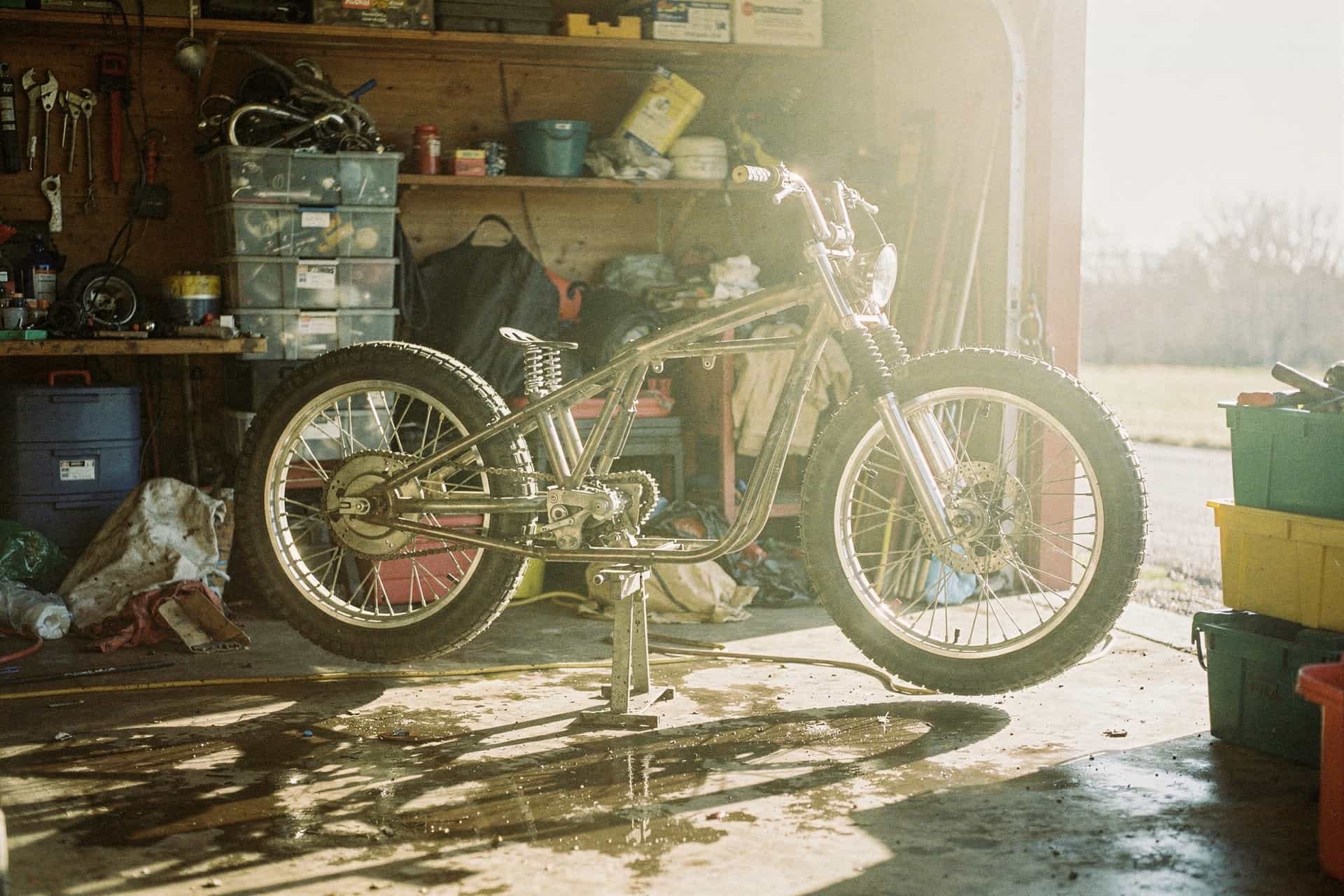
The term “rolling chassis” gets thrown around loosely. Some sellers use it to describe a bare frame with wheels bolted on and nothing else. Others include a complete front end, brakes, wiring provisions, and everything short of an engine. Before you hand over money, know exactly what’s in the crate.
A Proper Rolling Chassis Should Include:
- Frame - typically a hardtail (rigid) design without rear suspension, which is the classic bobber configuration
- Front forks - either springer-style (period correct for old school builds) or conventional hydraulic telescopic
- Triple trees - upper and lower clamps connecting forks to the steering neck
- Wheels - front and rear, laced and trued, with bearings and axles
- Tires - mounted and balanced (not always included on budget kits)
- Brakes - at minimum a front disc or drum assembly; rear brake varies
- Basic hardware - neck bearings, axle nuts, spacers, brake fittings
What a Rolling Chassis Does NOT Include:
- Engine and transmission
- Primary drive (chain, belt, or gear connecting engine to trans)
- Fuel tank
- Seat
- Fenders (some kits include a rear bobber fender, most don’t)
- Wiring harness
- Exhaust
- Foot controls (pegs, shifter, rear brake lever)
Understanding this distinction saves real headaches. A rolling chassis gets you maybe 40% of the way to a running motorcycle. You still need a motor, gas tank, seat, electrical, exhaust, and all the small parts that connect everything. Budget accordingly - the chassis is the foundation, not the house.
Frame Geometry: The Spec That Matters Most
Not all bobber frames are equal, and the geometry differences determine how your finished bike rides, handles, and looks.
Rake and Trail
Rake is the angle of the steering neck measured from vertical. A stock Harley Sportster runs about 30 degrees. A traditional bobber frame typically sits between 30 and 35 degrees. A chopper goes 38 to 45 degrees or more.
Trail is the distance between where the front tire contacts the ground and where the steering axis intersects the ground. Trail creates self-centering - how much the front wheel wants to track straight ahead.
For a bobber (not a chopper), you want 30 to 35 degrees of rake with corresponding trail. Push beyond 35 and the bike starts handling like a chopper - stable at highway speed but slow to turn and heavy in parking lots. Drop below 30 and you get twitchy, nervous handling at speed. The sweet spot for a bike you actually want to ride - not just park at shows - is 32-34 degrees.
Neck Diameter: The Compatibility Trap
This is the spec that trips up first-time builders. The frame’s steering neck must match your triple trees and bearings, which must match your forks.
Harley-Davidson neck - uses Timken-style tapered roller bearings in standard HD dimensions. If you’re dropping in an Evo Sportster or Big Twin engine, you want an HD-spec neck.
Metric/Japanese neck - different bearing dimensions, designed for Honda, Yamaha, Kawasaki, and Suzuki triple trees.
Mixing HD and metric components at the neck is technically possible with adapter bearings, but it’s a headache you don’t need. Buy a chassis that matches the engine and front end family you plan to use. If you’re building around a Harley motor - and our Evo crate motor guide covers sourcing the engine - get an HD-spec frame. If you’re using a Honda CB750 engine, get a metric frame. Don’t mix families unless you enjoy solving problems that don’t need to exist.
Backbone vs. Downtube Frames
Backbone frames (wishbone style) hang the engine below a single large-diameter top tube. This is the classic Harley rigid frame design and the most common style for old school bobber rolling chassis. It puts the engine on display and creates that clean, minimal profile that defines the style.
Downtube frames use a cradle design where tubes wrap around and under the engine. More common on Japanese-style builds and sportier customs.
For a traditional old school bobber, backbone hardtail is the standard. It’s what people picture when they hear “bobber.”
The Rolling Chassis Market: Price Tiers
Rolling chassis pricing spans from under $1,000 to north of $8,000. The range reflects real differences in materials, fabrication quality, and whether you can trust the thing at 70 mph.
Budget Rolling Chassis ($800 - $2,000)
The majority of “bobber rolling chassis” sold on eBay, Amazon, and motorcycle parts websites are manufactured overseas. They arrive in crates, usually disassembled, with quality control that ranges from acceptable to alarming.
What you get:
- Frame, forks, wheels, and basic hardware at a fraction of domestic price
- Usually chrome or raw steel finish
- Instructions that range from adequate to nonexistent
The real risks:
Weld quality varies. We’ve inspected imported frames with excellent welds sitting next to frames with cold welds, porosity, and inconsistent penetration. You cannot evaluate this from a photograph. You need hands and eyes on every structural weld before you ride.
Material grade is often unknown. Reputable domestic builders use known-grade chromoly or mild steel tubing with documented wall thickness. Budget imports may use lower-grade steel with less predictable fatigue characteristics. You won’t know until the frame cracks - or doesn’t.
Dimensional tolerance can be off. We’ve seen imported chassis where engine mounting holes were off by 1/8 inch, requiring drilling and sleeving. Wheel alignment has required re-spacing axles on more than one occasion.
Bearing quality in budget kits is often the first thing experienced builders replace. Neck bearings, wheel bearings, and axle hardware from budget sources are cheap insurance targets - spend $50-$100 replacing them with name-brand components before you ride.
The bottom line: A budget rolling chassis can work as a starting point, but plan to inspect and replace critical components with quality parts. Have the welds inspected by someone who knows what to look for. A frame failure at highway speed can kill you. This is genuinely not the place to save $500.
American-Made Rolling Chassis ($2,500 - $8,000+)
Domestic frame builders charge more because they’re using known materials, controlled processes, and decades of experience building frames that people actually ride at speed.
Paughco has been making custom Harley frames since 1969. They offer over 1,200 frame variations for HD engines. Their rigid frames for Sportster and Big Twin engines are industry standards - weld quality is excellent, fitment is precise, and they stock everything from mild-rake bobber frames to stretched choppers. American-made, with a reputation built over five decades.
TC Bros grew from a two-man shop into one of the most respected names in the DIY bobber world. Their hardtail kits, weld-on frame sections, and complete rolling chassis use quality steel and come with detailed mounting instructions. Strong catalog for both Sportster and Japanese-engine builds.
Lowbrow Customs operates in similar territory to TC Bros, offering complete rolling chassis and individual frame components. Their catalog also covers the small parts - axle kits, brake hardware, bearing sets - that you need to finish a rolling chassis build. They cater to Harley, Triumph, and more, with particular strength in Sportster and Shovelhead applications.
Bitter End Choppers builds hand-made rollers for Harley, Triumph, and Ironhead Sportster engines. Smaller operation, more personal builds, and a reputation for quality among the hardcore custom crowd.
What domestic gets you:
- Known steel grade and tube wall thickness
- Consistent weld quality (often TIG welded by one person)
- Accurate engine mounting holes for the specified engine family
- Customer support and replacement parts
- Often a VIN or MSO (Manufacturer’s Statement of Origin) for titling
- A frame designed by people who ride what they build
Buy vs. Build: Making the Call
Buy a Rolling Chassis If:
- You want to skip frame fabrication and focus on engine, paint, and finishing
- You don’t have welding equipment or access to a frame jig
- You need a VIN or MSO for registration (some states require this for scratch-built bikes)
- You’re on your first bobber build and want known-good geometry
- Timeline matters - a rolling chassis saves weeks or months of fab time
Build Your Own Frame If:
- You have welding skills and a frame jig or can access one
- You want something genuinely one-of-a-kind
- You enjoy fabrication as much as the finished ride
- You have specific geometry that no production frame matches
- Budget is extremely tight and you can source tubing and bending dies
The compromise path: Buy a bare frame and build the rolling chassis yourself. Companies like Paughco and TC Bros sell frames alone - no forks, no wheels, no brakes - for significantly less than a complete chassis. You source front end, wheels, and brakes separately, which gives more control over component quality and lets you spread the cost over time.
Titling and Legal Realities
This catches more first-time builders off guard than any mechanical issue. You can build the most beautiful bobber in your garage, but if you can’t title and register it, you can’t legally ride it on public roads.
Manufacturer’s Statement of Origin
Reputable American frame builders include an MSO with their frames. This document is the birth certificate for the frame - it establishes identity and lets you apply for a VIN and title in your state. Without an MSO, the titling process gets significantly more complicated and sometimes impossible depending on your state.
State Variation
Every US state handles scratch-built motorcycle registration differently. Some states (Montana, Vermont, South Dakota) have relatively simple processes. Others require professional inspections, brake testing, and extensive documentation. Some jurisdictions outside the US - the UK’s MSVA test, for example - have their own requirements for modified and custom-built frames.
Research your state’s requirements before you buy a rolling chassis. The time to discover that your state requires an engineering inspection is before the build starts, not after the bike is painted.
Safety Inspection Requirements
Most states require some form of inspection for scratch-built motorcycles:
- Functional brakes (front and rear)
- Headlight, brake light, turn signals (in states that require them)
- Horn and mirrors
- DOT-compliant tires
- Secure engine and frame mounting
Build to pass inspection from day one. Retrofitting safety equipment onto a finished bike is more work and more expensive than planning for it.
Complete Build Budget From a Rolling Chassis
Starting from a domestic rolling chassis, building around a Harley Evo Sportster engine:
| Component | Budget Range |
|---|---|
| Rolling chassis (domestic) | $2,500 - $5,000 |
| Engine + transmission (used Evo) | $1,500 - $3,500 |
| Primary drive kit | $300 - $800 |
| Fuel tank | $150 - $500 |
| Solo seat + mount | $100 - $300 |
| Exhaust (pipes + muffler) | $200 - $600 |
| Wiring harness + electrical | $150 - $400 |
| Foot controls | $100 - $300 |
| Paint/powder coat | $200 - $1,000 |
| Miscellaneous hardware | $200 - $500 |
| Total | $5,400 - $12,900 |
With a budget import chassis, cut the first line to $800-$2,000 but add $300-$500 for replacement components (bearings, fasteners, brake hardware) and professional weld inspection. The total savings narrows once you account for the parts you’ll replace and the inspection you should pay for.
The Rolling Chassis Isn’t a Cheat Code
A rolling chassis is a shortcut, not a skip button. You still need mechanical skills, a workspace, tools, and patience. The chassis gives you a known-good foundation - proper geometry, aligned wheels, functional brakes - so you can put your time and money into the parts that make the bike yours: the engine, the tank, the paint, the details that make people walk across a parking lot to look at your build.
If you’re planning a build from a rolling chassis and want to see the full process, our custom bobber build guide walks through every step from engine selection to first ride. For platform-specific guidance, we’ve covered the Suzuki Intruder bobber, the Honda Magna bobber, and the best Harley bobber builds. Our remarkable bobber builds roundup covers finished builds across every platform and price range for visual inspiration.
When the build is done and you need something to wear on that maiden ride, the Bobber Brothers collection is waiting.