
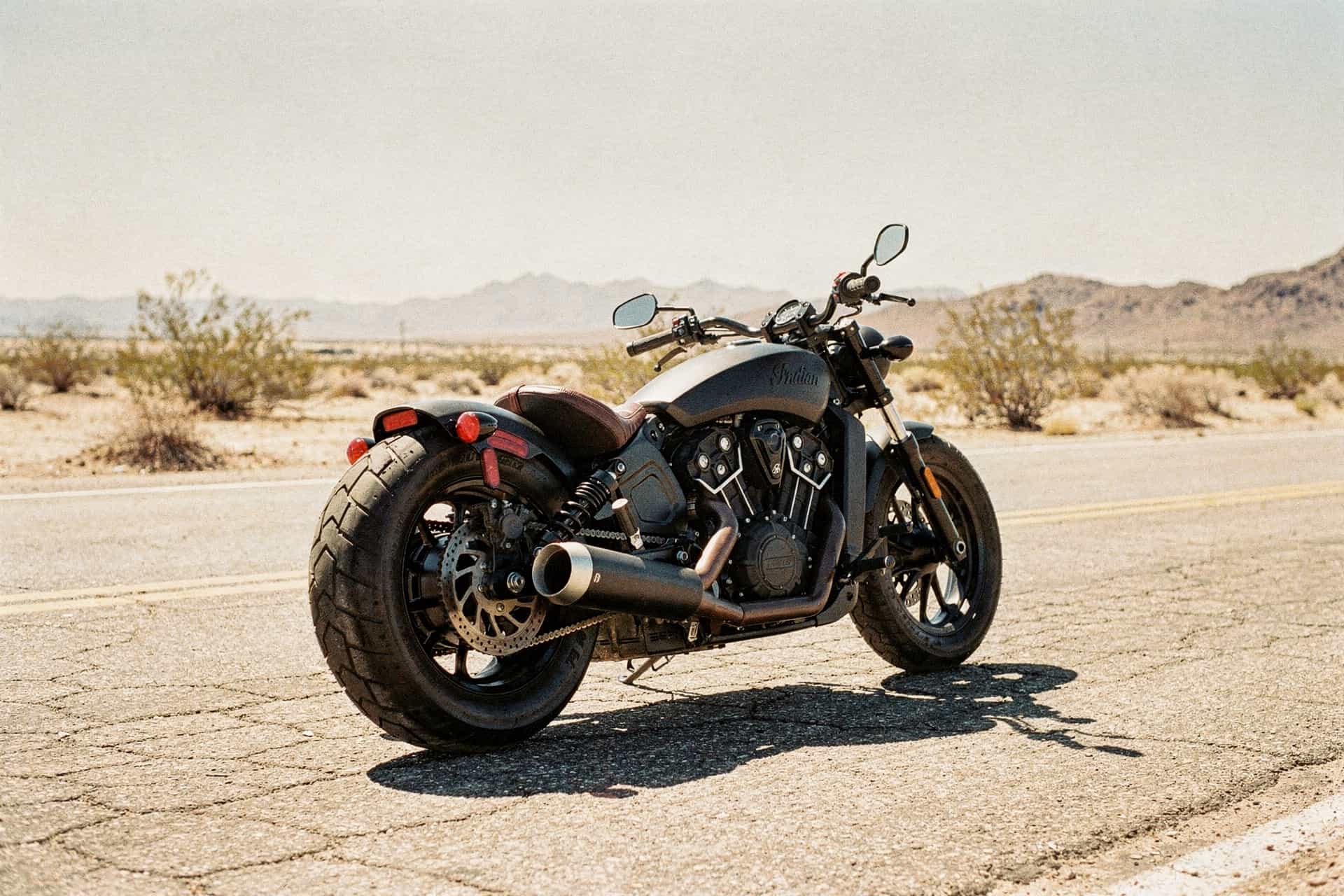
A Hundred Years of Proving Everybody Wrong
In 1920, an engineer named Charles B. Franklin drew up a lightweight V-twin meant to be Indian Motorcycle’s answer to affordable, practical riding. The Scout went on to dominate flat track, serve in a world war, and outsell everything else in Indian’s lineup. Then the company folded. Then it came back. Then the Scout came back with it.
If you are shopping one today, the thing you need to know before anything else is that Indian redesigned the entire Scout family for 2025. A 2024 Scout Bobber and a 2025 Scout Bobber share a name and a silhouette and almost nothing else underneath. Get that wrong and you will overpay for the older bike or undervalue the newer one.
This guide gives you the current factory numbers, the generation split, the trim ladder, and an explicit framework for choosing.
The Comparison Framework
Riders ask “which Scout Bobber” as if it were one decision. It is four, and they are best taken in this order:
- Which engine generation? 1,133cc (2018-2024) or 1,250cc SpeedPlus (2025 and later). This drives price, power, frame, and parts availability.
- Which displacement class? Scout Bobber at 1,250cc or Scout Sixty Bobber at 60 cubic inches. Both current bikes share the redesigned tubular steel chassis, so this is a power, insurance, and budget decision rather than a chassis one.
- Which trim and model year? The 2025 launch offered Standard, Limited, and Limited plus Tech. For 2026, Indian lists Standard and Limited plus Tech, so do not assume the trim ladder stayed fixed.
- Which body style? Bobber, Sport Scout, Scout Classic, Super Scout, or 101 Scout, all sharing the same engine. This is ergonomics and use case.
Work through them in that order and the shortlist collapses fast.
Step 1: The Generation Split (This Is the Big One)
| 2018-2024 Scout Bobber | 2025 and later Scout Bobber | |
|---|---|---|
| Engine | 1,133cc liquid-cooled V-twin | SpeedPlus 1250, 1,250cc liquid-cooled V-twin |
| Rated power | 100 hp | 105 hp |
| Rated torque | 72 ft-lb | 82 ft-lb |
| Valvetrain | SOHC, 4 valves per cylinder | DOHC, 4 valves per cylinder |
| Compression | Lower | 12.5:1 |
| Frame | Cast aluminum | Steel tube |
| Transmission | 6-speed | 6-speed |
| ABS | Optional on some builds | Standard |
| Trims | Single specification | 2025: Standard, Limited, Limited plus Tech; 2026: Standard, Limited plus Tech |
Indian describes the SpeedPlus 1250 as an 11 percent power increase and a 14 percent torque increase over the previous engine, with 105 hp across the Scout Classic, Scout Bobber, Sport Scout, and Super Scout, and 111 hp reserved for the 101 Scout. Press coverage of the launch put the change at roughly 70 percent new parts rather than a simple overbore, with a new cylinder head, bigger valves, new cam profiles, and a lighter crankshaft.
The frame change matters for parts fitment. Indian moved to a tubular steel frame and describes it as ready for customization, but that does not make structural frame welding a casual home job. Use parts listed for the exact generation, and leave structural modification to a qualified fabricator who can check alignment, weld quality, and local approval requirements. The Scout Sixty Bobber also uses the redesigned tubular steel frame.
Step 2: Current Scout Bobber Specs
These are Indian’s figures for the current bike, cross-checked against the launch specifications published by Cycle News.
| Spec | Scout Bobber |
|---|---|
| Engine | SpeedPlus 1250, liquid-cooled 60-degree V-twin, DOHC, 4 valves per cylinder |
| Displacement | 1,250cc (76 cubic inches) |
| Bore and stroke | 104mm x 73.6mm |
| Compression | 12.5:1 |
| Rated output | 105 hp, 82 ft-lb |
| Fueling | EFI, 60mm throttle body |
| Transmission | 6-speed, wet clutch |
| Final drive | Belt |
| Seat height | 25.6 in |
| Wheelbase | 61.5 in |
| Rake and trail | 29 degrees, 4.9 in |
| Front suspension | 41mm telescopic fork, 4.7 in travel |
| Rear suspension | Dual shocks, 2.0 in travel, adjustable preload |
| Ground clearance | 4.3 in |
| Dry weight | 522 lb |
| Weight in running order | 542 lb |
| Fuel capacity | 3.4 gal, 91 octane recommended |
| Front tire | 130/90B16 |
| Rear tire | 150/80B16 |
Two of those numbers are the whole ownership story. Rear travel is 2.0 inches. That is what produces the slammed stance, and it is also why a bad expansion joint arrives through the seat rather than the shock. Fuel capacity is 3.4 gallons. Plan fuel stops accordingly on any ride that leaves town.
The 25.6 inch seat is the lowest in the current Scout lineup, but seat height alone does not determine fit. Indian lists 522 pounds dry and 542 pounds in running order. That weight, seat width, reach to the controls, and rider inseam all matter, so sit on the bike and move it with the engine off before deciding.
Step 3: Trims, and What You Are Actually Paying For
Indian launched the redesigned 2025 Scout Bobber in three trims. The engine did not change between them.
- Standard. ABS, LED lighting, analogue gauge with fuel level and fuel economy readouts, keyed ignition. One color.
- Limited. Adds traction control, cruise control, three ride modes, and a USB charger.
- Limited plus Tech. Adds a 4 inch RIDE COMMAND touchscreen with GPS navigation and keyless ignition.
For the 2026 model year, the 1250 Scout Bobber lineup has two trims: Standard and Limited plus Tech. Indian lists the Standard from $12,999 and the Limited plus Tech at $15,199, both before a $725 destination charge. Pricing moves, so treat those as the published starting points and confirm with a dealer.
The trim decision depends on use. Cruise control and ride modes can matter on highway trips, while the touchscreen adds navigation and keyless operation. Compare those features with the cost of any suspension, seat, or luggage changes you already expect to make.
There is also a Scout Bobber 125th Anniversary Edition for 2026, limited to 450 units with hand-painted anniversary livery. It is not only a paint-and-number collector edition: Indian lists 111 hp, an adaptive LED headlight, three ride modes, cruise control, keyless ignition, a 4 inch RIDE COMMAND display, and machined wheels. Compare that equipment with the two regular trims before deciding what the limited production run is worth to you.
Step 4: Scout Bobber vs Scout Sixty Bobber
Indian sells the Scout Sixty Bobber as a separate model with a 999cc, 60 cubic inch V-twin, listed at 85 hp and 65 ft-lb through a five-speed gearbox, starting at $9,999 before destination for 2026. A Limited trim is listed at $12,199.
It is a real motorcycle rather than a decontented one. The five-speed gearbox is the tell that it is a different powertrain, not a restricted version of the 1250. What it is not is an older bike wearing a lower price: Indian’s spec page lists the same tubular steel frame, the same 25.6 inch seat height, the same 2.0 inches of rear travel, and 16 inch wheels. But the engine, gearbox, weights, overall width, tire specifications, and front-brake rotor description differ from the 1250 Bobber. Compare the exact model-year specification pages rather than treating the Sixty as a displacement-only variant.
Choose the Sixty if: it is your first cruiser, your budget tops out under eleven thousand, or you ride mostly under 60 mph. Choose the 1250 if: you ride two-lane highway regularly, you want the extra 20 hp and 17 ft-lb, or you want the sixth gear for cruising rpm.
Step 5: Bobber vs the Rest of the Scout Family
The 2025 redesign put five body styles on the 1250 engine: Scout Bobber, Sport Scout, Scout Classic, Super Scout, and 101 Scout. Cycle News listed 2025 starting prices at $12,999, $13,499, $13,999, $16,499, and $16,999 respectively. The Scout Sixty family, including the Scout Sixty Bobber, sits below them on the same chassis with the 999cc engine.
Among the 1250 bikes the Bobber is the cheapest and the most stripped. It is also the one with the least rear travel and no passenger provision in stock form. If you carry a passenger, want a windscreen, or plan on 300-mile days, the Bobber is the wrong Scout and one of the other four is right. The Scout Bobber Twenty, a separate model in the previous generation, does not appear in the current lineup.
For riders arriving from Harley bobber builds or a home project, the Bobber’s argument is that it comes out of the crate finished. No seat pan fabrication, no fender chop, no powder-coating bill.
Buying Used: What Actually Matters
Skip the guessing on price bands. Used values move by region and month, and any number printed in an article is stale by the time you read it. Price your target against live sold listings in your market, then use this checklist.
Confirm the engine generation from the VIN and title year, not the seller’s description. A 2024 is a 1,133cc bike. A 2025 is a 1,250cc bike. Sellers conflate these constantly.
Run the VIN through the NHTSA recall lookup. NHTSA lists campaign 19V156000 and campaign 20V454000, both covering certain 2019 Scout, Scout Sixty, and Scout Bobber motorcycles equipped with ABS, where reduced brake performance increases crash risk. Campaign 19E007000 covers an accessory brake lever whose adjustment screw may have been set incorrectly, potentially applying the front brake unintentionally until the wheel locks. Recall work is free at a dealer. Confirm it was done.
Look at what was bolted on and how calibration was verified. Exhaust and intake changes can alter airflow by amounts that depend on the exact parts. Ask for part numbers, installation records, and calibration documentation rather than diagnosing the mixture from sound or temperature alone.
Check the rear shocks. Bottoming can reflect load, preload, spring rate, available travel, or a combination of them. Lost damping more often shows up as repeated bouncing or wallowing after a bump, but no single symptom proves which part has failed. Inspect for leaks and damage, confirm the preload setting and carried load, and test the suspension on ordinary rough pavement at a sensible speed. Have a qualified suspension technician inspect it if the rear end bottoms, bounces, or will not settle predictably.
Ask for service records. Scheduled service on a liquid-cooled, high-compression V-twin is not optional maintenance.
Mods Worth Doing
The aftermarket for the Scout is deep, and Indian says it launched the 2025 bikes with more than 100 accessories across four categories. The order below follows from the bike’s own numbers rather than from any brand recommendation, and every part you buy needs to be confirmed against your exact model year, because the 2025 redesign changed the frame, the shock mounts, and the exhaust.
Suspension first. With 2.0 inches of rear travel, damping and spring rate have little room for error. Choose a shock for rider weight and intended load, and check the maker’s published fitment listing for the exact model year before ordering anything.
Seat second. The stock solo seat is thin by design. Replacement-seat shape and foam density matter as much as thickness, so test fit and confirm that a new seat does not interfere with the tank, wiring, or mounting hardware.
Exhaust and intake, with verified calibration. A slip-on, full system, or high-flow air cleaner can change airflow. Follow the component and calibration supplier’s instructions and verify the result. Vendor dyno figures apply to the tested configuration, not automatically to another bike.
Bars. If the stock bars do not fit you, a bar swap is straightforward mechanically. Budget for extended cables and brake lines on anything meaningfully taller than stock, and confirm clamp diameter and riser fitment against your year rather than a generic cruiser listing.
Before you take it anywhere serious, our biker gear guide covers helmets, gloves, and boots so you are not making rookie gear choices on a bike this capable. If you are building a bobber of your own, Scout-based or otherwise, grab a tee from the shop and wear what you ride.
Living With It: The Honest Trade-offs
Range. The 3.4-gallon tank requires deliberate fuel planning. Real range varies with speed, load, tune, weather, and riding style.
Heat. The liquid-cooled V-twin sits close to the rider’s legs. Check that the cooling system and fan operate correctly, and choose protective gear suited to the weather.
Ground clearance on lowered bikes. Indian lists 4.3 inches of ground clearance stock. Drop the rear with a lowering kit or shorter shocks and the hard parts come down with it. The rear brake pedal sits on the right, so that side deserves the closer look, but the honest answer is to check both sides on a stand at your intended ride height before you find the limit mid-corner.
Solo by design. No passenger seat, no grab rail, no sissy bar in stock trim. That is the point of the model, but it is worth saying out loud before you buy one and then discover it.
How It Stacks Up Against the Competition
Harley-Davidson Softail Standard and Street Bob. Bigger displacement, more low-rpm torque, heavier, more expensive, and an aftermarket nobody else can match. The Scout Bobber makes more peak horsepower and weighs less. If badge matters, buy the Harley. If numbers matter, the Indian wins on paper.
Triumph Bonneville Bobber. The Triumph Bobber is the direct rival and the more refined machine, with a 1,200cc parallel twin and exceptional finish. The Scout Bobber is the rawer, more powerful one.
Honda Rebel 1100. Cheaper, shockingly capable, available with an automatic gearbox, and without the same visual presence or aftermarket depth.
If the factory-versus-built question is where you are stuck, our hardtail versus softail breakdown covers what you actually give up when a bobber’s stance comes from geometry rather than a chopped frame.
The Original Scout, Briefly
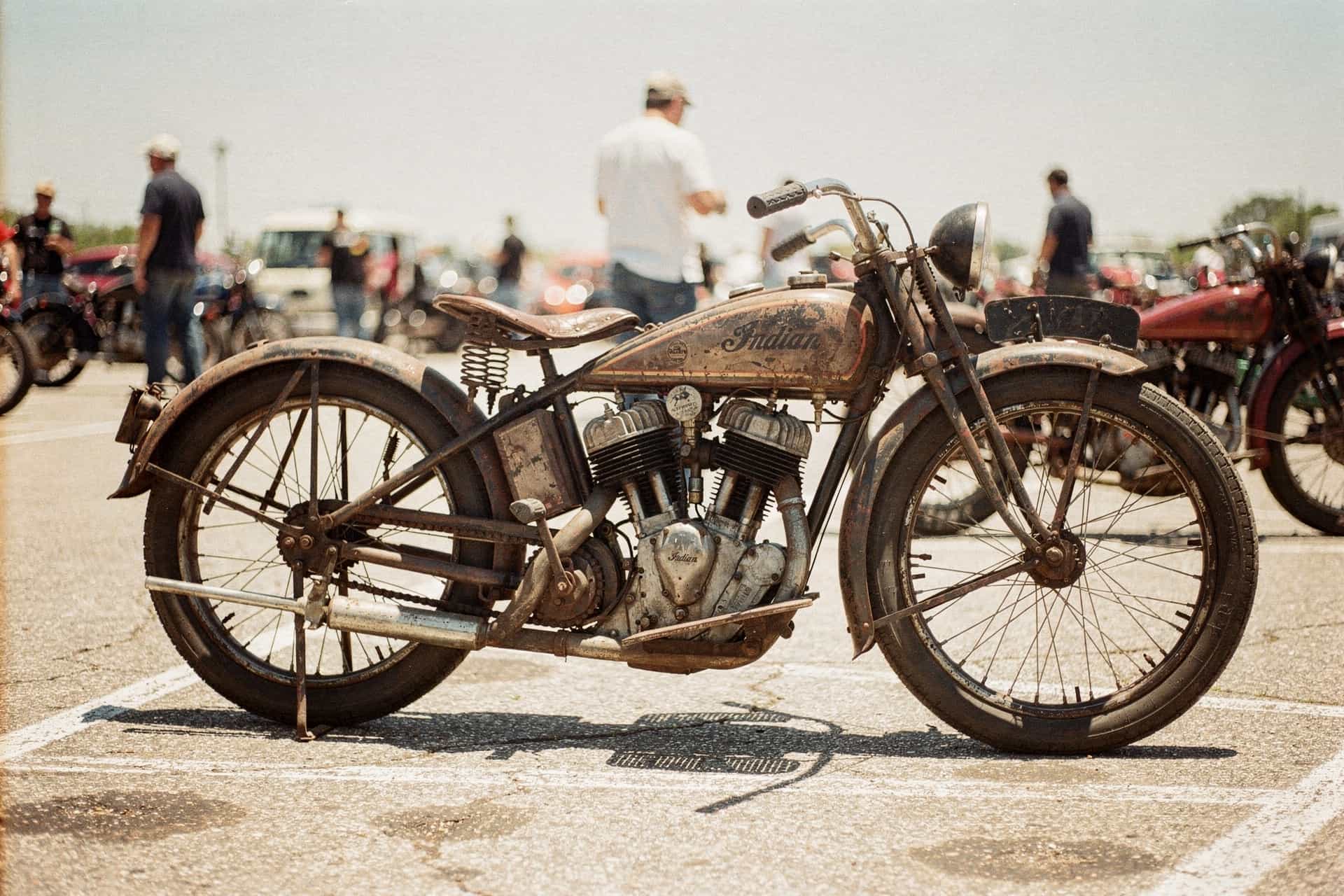
The context is worth having. The 1920 Scout used a 606cc side-valve V-twin with the transmission bolted directly to the engine case, a unit-construction layout that was well ahead of its time. Displacement grew to 745cc by 1927, and the 101 Scout of 1928 added a longer wheelbase and lower seat that made it a favorite of flat trackers and stunt riders. Ed Kretz won the first Daytona 200 on a Sport Scout in 1937. Indian built the 500cc Model 741 Military Scout for Allied forces during the Second World War. Scout production ended in 1949 and the company folded in 1953.
Polaris revived Indian in 2013 and launched the new Scout for the 2015 model year. The nameplate was chosen deliberately, and it earned the reuse.
Why a Factory Bobber Still Counts
The bobber movement started with people cutting parts off post-war bikes, including Indian Scouts. The whole idea was subtraction. A factory-built bobber is, on its face, a contradiction, and plenty of builders will tell you so.
The counterargument is access. Not every rider has a garage, a welder, and 200 hours. The Scout Bobber puts the stance and the riding experience in the hands of people who would never build one from scratch, and more riders on stripped-down bikes is good for the culture, not bad for it. Our bobber motorcycle guide covers the formula and the history behind it, and our motorcycle culture guide puts the whole scene in context.
If you are already in the life, riding anything with a solo seat and a chopped fender, we have gear for that.
Sources
- Indian Motorcycle - SpeedPlus engine. Factory source for the SpeedPlus 1250 output split, 105 hp on the Scout Bobber and 111 hp on the 101 Scout, and the claimed 11 percent power and 14 percent torque increases.
- Indian Motorcycle - Scout Bobber specifications. Factory specification page for the current Scout Bobber.
- Indian Motorcycle - Scout Sixty Bobber. Factory source for the Scout Sixty Bobber’s output, gearbox, and starting price.
- Indian Motorcycle - Scout Sixty Bobber specifications. Factory specification page confirming the 999cc engine, 85 hp and 65 ft-lb, five-speed gearbox, tubular steel frame, 25.6 inch seat height, 2.0 inches of rear travel, and 16 inch wheels shared with the 1250 Bobber.
- Indian Motorcycle - Scout Bobber 125th Anniversary Edition. Factory source for the limited 2026 model’s production count, output, lighting, rider technology, RIDE COMMAND display, and machined wheels.
- New 2025 Indian Scout Lineup Specs and Prices - Cycle News. Launch specifications and model-by-model starting prices for the redesigned Scout family, including the Bobber’s dimensions, suspension travel, weight, tires, and fuel capacity.
- 2025 Indian Scout Review, First Ride - Rider Magazine. Independent riding evaluation of the redesigned platform.
- NHTSA recalls lookup. Primary source for campaigns 19V156000, 20V454000, and 19E007000 affecting certain 2019 Scout, Scout Sixty, and Scout Bobber motorcycles and an accessory brake lever.
- Cycle World - 2018 Indian Scout Bobber First Ride Review. Independent review of the original 1,133cc Scout Bobber, relevant to the used market.
- Silodrome - 5-Minute Histories: The Indian Scout. Original 1920 Scout history, Charles Franklin’s unit-construction design, and the 101 Scout’s racing record.