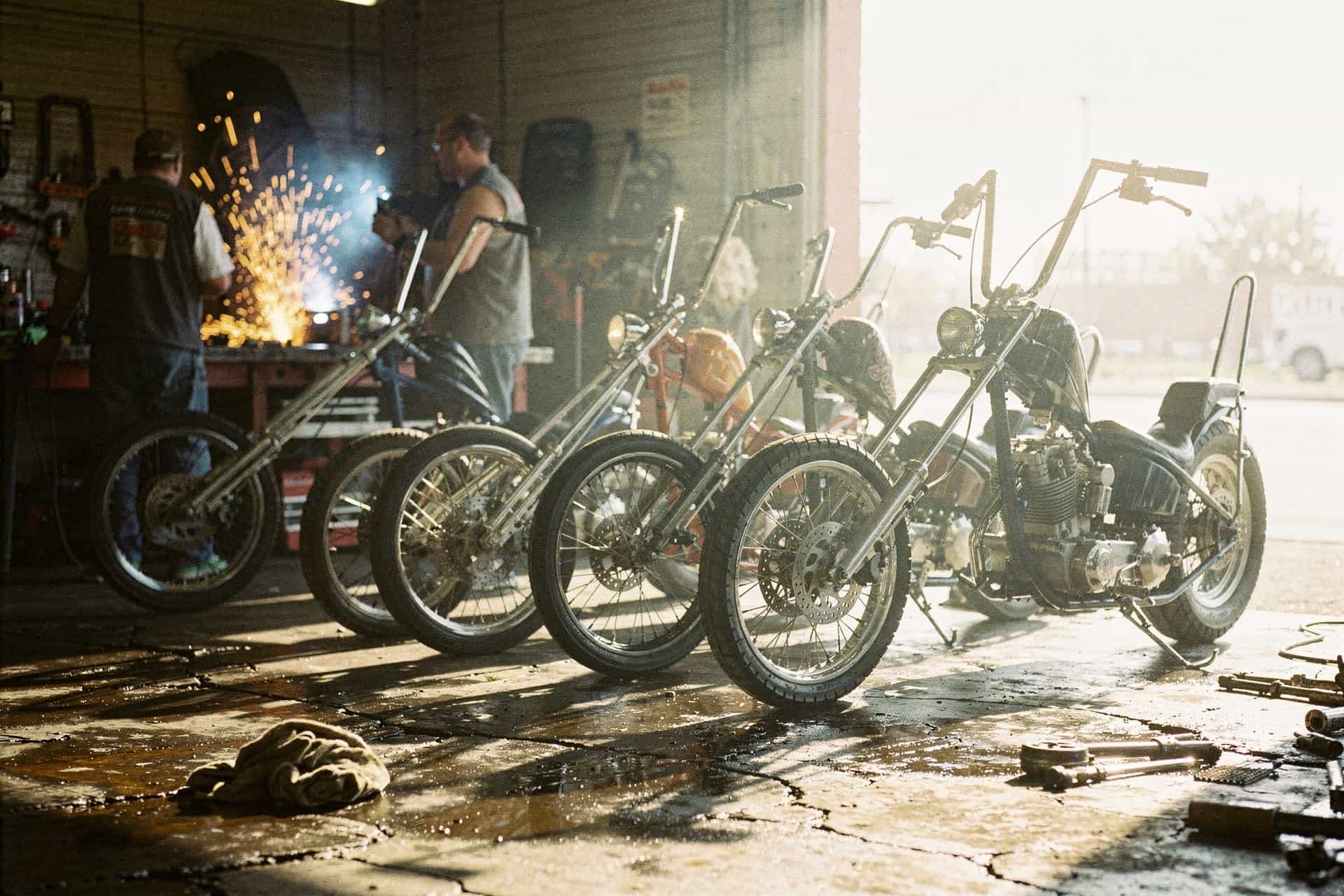
A Panhead rigid sits on a lift in a cinderblock shop on Michigan Avenue, somewhere between Dearborn and the ruins of the old Packard plant. The frame is stretched four inches beyond stock. The tank is hand-formed from 16-gauge steel. Outside, a freight train rattles past on the CSX line, and the builder doesn’t flinch - just keeps grinding weld beads flat with a flap disc, sending orange sparks across a concrete floor stained with decades of motor oil.
This is Detroit chopper building. Not the TV version. Not the magazine-cover showpiece parked under halogen lights at a bike show. The real thing - born out of a city where people have been bending metal and building machines since Henry Ford’s first assembly line, and where the line between “fabricator” and “artist” was never drawn in the first place.
Detroit’s custom motorcycle scene doesn’t get the press that Southern California or the East Coast corridor receives. You won’t find it on reality shows. But the builders who have come out of the Motor City and its surrounding metro - Dearborn, Pontiac, Ferndale, Hamtramck, the Downriver communities - have produced some of the most aggressive, technically sound choppers and bobbers in the country. The reason is simple: Detroit has more skilled metalworkers per square mile than almost any city in America, and that expertise didn’t stay locked inside auto plants.
Automotive Heritage Meets Two Wheels
To understand why Detroit choppers look and ride the way they do, you need to understand what the city actually is. Detroit was not just an auto manufacturing hub. It was the center of an entire industrial ecosystem - tool and die makers, metal stampers, paint specialists, upholstery shops, machine shops, foundries. By the mid-twentieth century, southeastern Michigan had the densest concentration of precision manufacturing talent on the planet.
When the auto industry contracted - first in the 1970s oil crisis, then in waves through the 1980s, the 2008 collapse, and the years of slow bleed in between - that talent didn’t disappear. It scattered. Some went to aerospace. Some opened small fabrication shops. And some turned to motorcycles.
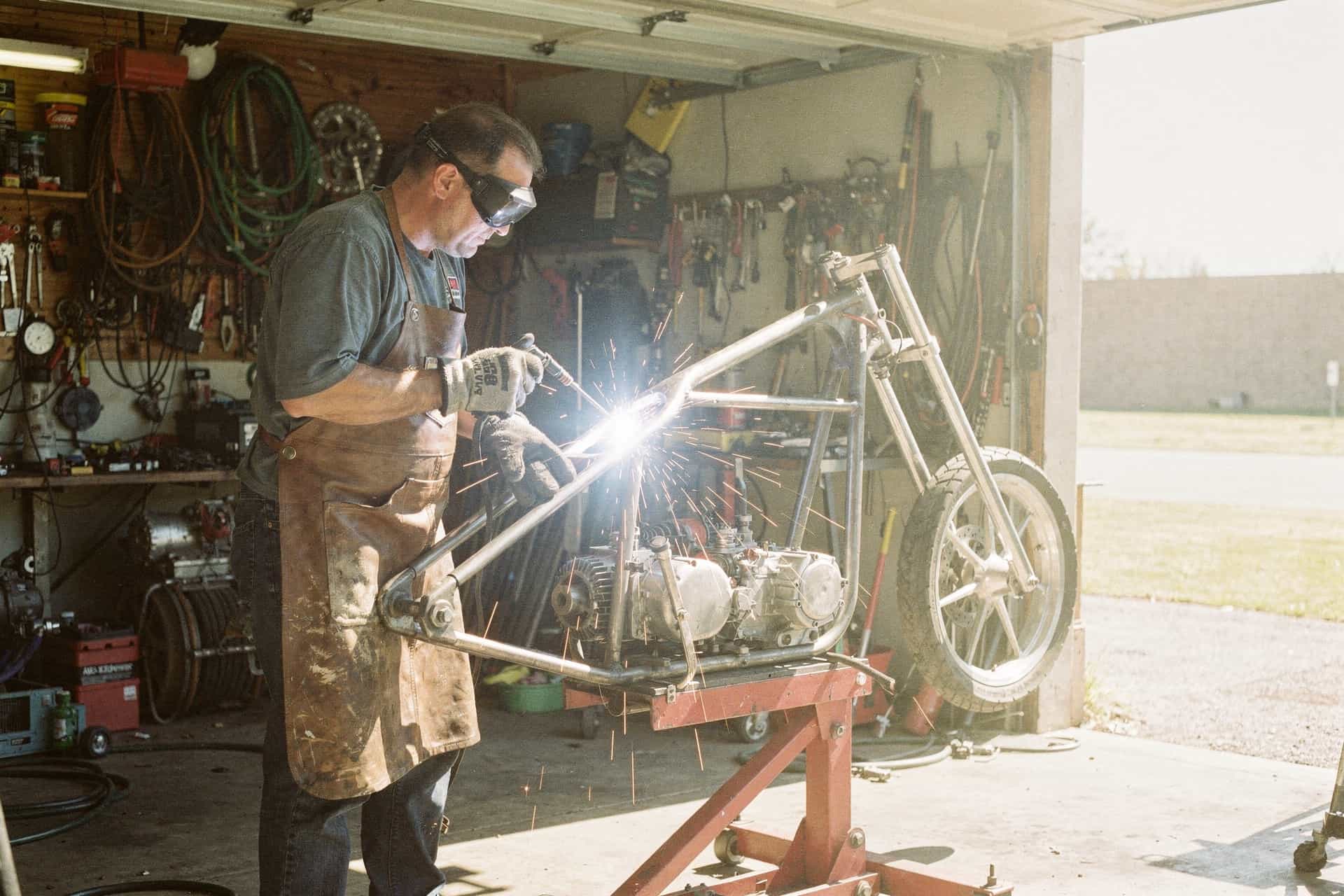
The migration was natural. A guy who spent fifteen years stamping fenders at a Chrysler plant knows how to shape sheet metal. A toolmaker from a GM supplier knows tolerances down to thousandths of an inch. A welder who built truck frames for Ford can TIG a motorcycle frame in his sleep. These skills translated directly, and they brought with them a standard of precision that most custom shops never achieve.
We’ve had guys ship bikes to our shop from the Midwest, and you can always spot a Detroit-area build. The metalwork is clean in a way that comes from industrial training, not YouTube tutorials. Joints are tight. Seams are straight. The builder might not have a social media following, but he’s got thirty years of tool-and-die behind him, and it shows in every bracket and mounting tab on the bike.
Detroit Choppers: The Shop on Michigan Avenue
The name most riders associate with the phrase “Detroit Choppers” belongs to a specific shop - Detroit Choppers, the custom motorcycle operation that built its reputation working on both American and metric bikes out of a facility in the Detroit metro area. What set them apart from the beginning was range. This was never a Harley-only shop.
Detroit Choppers handled Harley-Davidson builds alongside Honda, Yamaha, Kawasaki, and Suzuki customs - a rarity in a world where most chopper shops won’t touch a metric bike. Their willingness to work across platforms reflected the practical, blue-collar ethos of the city itself. In Detroit, you don’t turn down work because the badge on the tank isn’t the right brand. You take the machine apart, figure out what it needs, and build it.
Their service list covered the full spectrum: frame modifications, custom metal fabrication, engine rebuilds, paint and airbrushing, sheet metal shaping, and even insurance claim repairs. According to their shop documentation, they operated as a true one-stop operation - a rider could bring in a stock bike and ride out on something unrecognizable, with every modification done under one roof.
One signature move was their stretched fuel tank work. Rather than bolting on an aftermarket tank from a catalog, Detroit Choppers fabricated custom tanks in-house, shaping steel to fit the specific proportions of each build. They also offered custom fender shaving - stripping fenders down to bare metal, smoothing every surface, and prepping them for chrome or paint. The result was a cleaner line than anything a bolt-on part could achieve.
The Builders You Should Know
Detroit’s chopper scene has never been dominated by a single celebrity builder. Unlike the coasts, where individual names - Billy Lane in Florida, Russell Mitchell’s Exile Cycles in California - became brands unto themselves, the Motor City scene stayed decentralized. Dozens of small shops and garage builders, most operating without websites or Instagram accounts, producing work that rivaled anything coming out of bigger-name operations.
A few names stand out.
Carl Bjork and the Downriver scene. The communities south of Detroit proper - Wyandotte, Southgate, Lincoln Park, Taylor - have a concentration of small custom shops that’s disproportionate to their size. The Downriver area has been a hotbed for rigid-frame choppers since the 1970s, when laid-off auto workers started building bikes in their home garages. The aesthetic down there tends toward old-school: Panheads, Shovelheads, springer front ends, peanut tanks, no electronics beyond a magneto ignition.
Kustom Tech and the fabrication-first approach. Several Detroit-area builders have been closely connected to Kustom Tech, the Italian parts manufacturer known for its hand controls and master cylinders. The relationship makes sense - Kustom Tech’s machined components match the precision-fabrication mindset that Detroit builders grew up with. Builds coming out of this circle tend to be clean, mechanically tight, and low on flash.
The Hamtramck garage builders. Hamtramck, the small city completely surrounded by Detroit, has been a quiet center for custom bike work for decades. The neighborhood’s mix of Polish, Bangladeshi, and Yemeni immigrant communities created a culture where garage fabrication is a way of life - not just for motorcycles, but for everything. Bike builders in Hamtramck work alongside guys who fabricate truck accessories, custom furniture, and architectural metalwork. The cross-pollination of skills is real.
Seven Builds That Define the Detroit Style
What ties these builds together isn’t a single look. It’s an approach - heavy on metalwork, light on catalog parts, and built to be ridden hard on Michigan roads that will shake a poorly built bike apart in a single season.
1. The Shovelhead Hardtail on Gratiot Avenue
A rigid-frame 1978 Shovelhead built in a two-car garage in Eastpointe. The frame was a Paughco hardtail, but the builder - a retired Chrysler stamping plant supervisor - hand-formed every piece of sheet metal on the bike. The oil tank, the fender, the dash panel, the battery box. All shaped on an English wheel he bought at a shop auction when a tool-and-die operation on Eight Mile Road closed. The paint was nothing fancy - single-stage black with a clear coat - but the metalwork underneath was flawless.
2. The Metric Chopper: Honda CB750 Goes Long
Detroit Choppers’ willingness to work on non-Harley platforms produced some genuinely interesting machines. One standout was a Honda CB750 SOHC that received a full chopper treatment - extended forks, a hardtail rear section grafted onto the frame, a narrow custom tank, and a solo seat on a hand-rolled fender. The engine stayed mostly stock, which was the smart call. Honda’s inline-four is reliable in a way that makes it a better daily chopper motor than some riders want to admit.
3. The Ironhead Sportster Drag Build
A 1972 Ironhead Sportster built for straight-line work, coming out of a shop in Ferndale. The motor was punched out, the cams were swapped for Andrews high-lift grinds, and the exhaust was a set of open drag pipes with no baffles. The frame was stock Sportster - no stretch, no rake change - because the builder wanted it to handle, not just look long. He ran it at Milan Dragway, the quarter-mile strip about forty-five minutes south of Detroit, on summer weekends.
4. The Knucklehead Survivor Chop
A 1947 Knucklehead that had been sitting in a barn in rural Macomb County since the early 1980s. The new owner - a Ford Dearborn Truck Plant welder - didn’t restore it. He chopped it. Extended the forks twelve inches, cut the rear fender, threw on a set of drag bars, and laced new stainless spokes into the original hubs. He left the motor alone except for new rings, valves, and a complete top-end rebuild. The patina on the cases told the bike’s history, and he saw no reason to erase it.
5. The Pan-Shovel Frankenstein
Mixing Panhead top ends with a Shovelhead bottom end is a time-honored tradition in chopper building, and Detroit shops have been doing it since the 1970s. One notable example came from a Pontiac-area builder who mated a set of 1963 Panhead heads to a 1972 Shovelhead lower end, dropped the whole assembly into a Santee rigid frame, and built out the rest with hand-fabricated parts. No two components on the bike came from the same decade, but it ran like it was born that way.
If you’re the kind of rider who respects the work that goes into builds like these - the late nights, the skinned knuckles, the obsessive fabrication - you’ll find gear that fits at our shop. We build for the same crowd. Check out the tee collection while you’re at it.
6. The FXR Street Fighter
Detroit’s not all old iron. A builder in the Corktown neighborhood - the revitalized district near Michigan Central Station - turned a 1991 FXR into a street fighter that split the difference between chopper and performance bike. Mid-controls instead of forwards. Clip-on handlebars. An S&S Super E carb feeding a hot-rodded Evo motor. The frame was de-tabbed and smoothed, but not stretched or raked. The result was a bike that could carve corners on Hines Drive along the Rouge River and still look mean parked outside a bar on Michigan Avenue.
7. The Sportster Bobber Built on a Budget
Not every significant build requires a five-figure budget. A machinist from Warren built a 2004 Sportster 883 bobber using mostly hand tools, a small MIG welder, and parts sourced from swap meets at the Gibraltar Trade Center (before it closed). He chopped the rear fender, fabricated a sissy bar from quarter-inch round stock, wrapped the pipes, and bolted on a solo spring seat. Total parts cost was under two thousand dollars. The bike has been his daily rider for over a decade, racking up Michigan miles through winters that would kill a show bike.
Why Motor City Builds Ride Different
Michigan roads are a proving ground that no builder can fake their way through. The freeze-thaw cycle destroys pavement. Potholes on I-94, Gratiot, and Woodward can swallow a front wheel. Road salt eats chrome and bare steel from November through April. A chopper built to survive in Michigan has to be tougher than a bike built for weekend cruises in Southern California.
This reality shapes how Detroit builders approach every decision. Frame gussets get extra material. Wiring gets routed away from salt spray. Fenders - when they exist at all - sit high enough to clear debris. Wheel bearings get sealed, not open-race. The aesthetic might say “don’t care,” but the engineering says “built to last.”
We’ve seen this firsthand - a few Michigan-built bikes have come through our network over the years, and the construction quality on the ones built by trained fabricators is a cut above. The welds look like machine work. The fitment is tight. These builders grew up in a city where sloppy craftsmanship meant a recalled vehicle and a lost job. That discipline carries over.
The Scene Today
Detroit’s custom motorcycle culture is alive, though it looks different than it did twenty years ago. The old industrial spaces that once housed custom shops are being converted to breweries, coworking spaces, and loft apartments as the city rebuilds. But the builders haven’t left. Detroit has always had more in common with the MC world than the coasts give it credit for - the same blue-collar ethos, the same respect for earned skill - and our complete guide to motorcycle clubs covers how that culture and the club scene grew from the same roots. They’ve moved to the outer suburbs - Hazel Park, Madison Heights, Roseville - where shop rent is still affordable and the zoning allows welding at midnight.
The annual Motorcycles on Woodward event, running alongside the famous Woodward Dream Cruise car show every August, draws custom bikes from across the metro. Swap meets still happen in parking lots from Flat Rock to Mount Clemens. And the motorcycle culture that emerged from Detroit’s industrial collapse continues to evolve, feeding on the same combination of skill, stubbornness, and cheap shop space that created it.
Detroit never asked for credit. The city just kept building.
Sources
-
“Detroit: An American Autopsy” by Charlie LeDuff (2013) - background on Detroit’s industrial decline and the skilled trades diaspora that followed factory closures. Penguin Books
-
“The Custom Motorcycles of Dynamic Choppers” - Cycle World feature on Midwest custom builders and the influence of automotive manufacturing skills on motorcycle fabrication. Cycle World
-
“Art of the Chopper” by Tom Zimberoff (2003) - comprehensive survey of American custom chopper builders including Midwest shops, documenting fabrication techniques and regional building styles. Motorbooks International
-
Woodward Dream Cruise official documentation - information on the annual Woodward Avenue automotive and motorcycle events in metropolitan Detroit. Woodward Dream Cruise