Chicago is where one of the oldest organizations later identified with one-percenter culture started, and it is also where a documented 1994 patchover changed the region’s MC history. Both facts are anchored to dated sources. Almost everything else written about Chicago clubs online is harder to verify.
This page sticks to what carries a date: a founding, a patchover, a run of bombings that made the papers, and the federal prosecutions that followed. Where the earlier version of this article stated something we could not source, we have corrected it in the open rather than quietly deleted it.
| Field | Documented detail | Date of record |
|---|---|---|
| Founding of the Outlaws MC | McCook, Illinois, just outside Chicago | 1935 |
| Hell’s Henchmen patchover to the Hells Angels | Completed in late 1994 per secondary accounts | December 1994 |
| Bombings linked to the merger | Chicago and Rockford, reported by the Chicago Tribune | November 1994 |
| Northern District of Illinois racketeering case involving an Outlaws member | Conviction 2010, 60-year sentence 2011, reduced to 30 years 2021 | 2010 to 2021 |
For broader cluster context, our motorcycle clubs complete guide is the reference page.
The Outlaws MC: A McCook Founding
Every conversation about Chicago biker gangs starts with the Outlaws, founded in McCook in 1935. Its origin predates the other major US organizations compared in this cluster. The Hells Angels formed thirteen years later. The Pagans followed in 1959, and the Bandidos in 1966.
The club’s internal chronology after that, the rebranding to the Chicago Outlaws around 1950, the adoption of the skull and crossed pistons emblem members call Charlie in the early 1950s, and the reorganization as the American Outlaws Association in 1965, is consistently reported but comes from club-published history rather than an independent archive. We repeat it here labeled as what it is. The same applies to the frequently cited claim that the Outlaws were the first club east of the Mississippi to be recognized as one-percenters in 1963: it is club chronology, not a record we can verify.
What is independently established is the club’s geographic origin and its longevity, both of which appear in federal charging documents and appellate opinions spanning decades. The neighborhoods most associated with the club’s early Chicago footprint, the working-class areas south and west of downtown, are part of the same story as the stockyards and steel mills that built them.
The 1994 Patchover and the Bombings
The Hell’s Henchmen Motorcycle Club ran chapters in and around Chicago for years as an independent one-percenter club. In late 1994 they patched over to the Hells Angels, and the balance of the Midwest MC world moved.
Here is what is documented, in order. In November 1994, the Chicago Tribune reported bombings in Chicago and Rockford that police linked to a motorcycle gang merger. Secondary accounts give December 5, 1994 as the date the Henchmen were voted in as full-patch Hells Angels, with further bombings and shootings against clubhouses and members’ homes in the Chicago and Rockford area in the weeks that followed. The exact patchover date rests on secondary reporting; the violence around it is in the contemporaneous newspaper record.
That distinction matters, because the more colorful details attached to this story, including specific claims about the size of the explosive charge used on the Grand Avenue clubhouse, come from podcast interviews and enthusiast accounts rather than bomb squad reports or trial exhibits. We are not repeating them.
The Henchmen deserve their own treatment rather than a paragraph here. For the founding, the colors, the chapters, the federal pressure, and the lasting effect on Chicago, see our Hell’s Henchmen MC Chicago article.
Federal Cases: What Chicago Actually Has
Chicago attracts sweeping claims about federal operations, and two of them appeared in the earlier version of this page. Both were wrong, and the corrections are more useful than the originals.
Operation Broken Spoke was not a Chicago investigation. Justice Department material identifies it as one of three named investigations, alongside Operation Detroit Mugger and Operation End Game, behind an August 2007 indictment of sixteen Outlaws members and associates returned by a grand jury in Detroit, covering chapters in Michigan and Indiana. The full account belongs on our Detroit MC history page, and that is where it now lives.
The 2001 racketeering conviction of the Outlaws international president was not a Chicago case either. Harry Bowman ran the club from a Detroit chapter from 1984 to 1999, was arrested in Michigan in 1999, and was tried and convicted in Tampa in April 2001. Chicago’s role in that story is as the club’s founding city, not as the venue.
What Chicago does have is the Cicero pawnshop case. Mark Polchan, described in court and press coverage as a high-ranking Outlaws member, was convicted in 2010 in the Northern District of Illinois in a racketeering prosecution centered on a Cicero pawnshop that a sentencing judge called the epicenter of the enterprise. The charges included racketeering, illegal gambling, and tax offenses, and the heaviest count concerned the 2003 pipe bombing of a video-poker business in Berwyn. He was sentenced in 2011 to 60 years. In October 2021, after he successfully challenged the conviction tied to the bombing on the strength of intervening Supreme Court precedent, the sentence was cut to 30 years.
That is a real, sourced, Illinois federal case involving an Outlaws member. It is also narrower than “the club was prosecuted as a criminal enterprise in Chicago,” which is what a lot of writing about this city implies without support.
The general pattern is national rather than local. Federal prosecutors have used the racketeering statute against members of the major one-percenter clubs in multiple districts, arguing the organizations themselves function as criminal enterprises. The clubs reject that characterization. Our 1 percenter guide covers the difference between an agency classification, a charge, and a conviction, which is the single most useful thing a reader can take away from any of this.
Chicago’s Other Club History
The one-percenter clubs get the coverage. They are not the whole of Chicago’s organized riding history, and in a city this size they are not close to a majority of it.
The Chosen Few MC is the name that comes up first. It is generally described as founded around 1959 and as integrated from early on, and it has a long association with Chicago. We are not going to tell you what it is running this year, how long it has operated without interruption, or which events it holds, because we could not source any of that to a dated record. The club’s own page is where that history belongs.
The Hells Lovers MC also comes up constantly in searches about Chicago clubs. The club is generally described as founded in Chicago in 1967 and as multi-ethnic rather than a Black club specifically, which is how it is often miscategorized. We have not been able to trace the founding to a primary record, and we are noting the gap rather than presenting the common account as verified.
The wider point is that one-percenter clubs are a small slice of organized riding in a city this size. Riding clubs, brand-specific groups, veterans’ organizations, and charity rides all operate here too, and none of that shows up in the federal record because none of it generates cases. The absence of documentation cuts both ways: it is why we cannot give you current numbers for any of those organizations either. The same layered structure shows up in Detroit and New York.
How to Check a Chicago MC Claim
Chicago attracts more unsourced writing than almost any other city in this subject, partly because the founding story is genuinely important and partly because the 1994 bombings make good copy. Four questions filter most of it out.
Does the claim carry a year? A statement about territory, chapters, or leadership without a date is not a claim about any particular time, which makes it unfalsifiable and useless.
Is the venue right? The two most widely repeated Chicago claims, Operation Broken Spoke and the 2001 leadership conviction, both belong to other districts. Checking which court heard a case takes one search and removes a lot of noise.
Is the source describing a charge or a result? Indictments generate headlines and outcomes usually do not. An article that names an operation but never says how it ended is telling you half a story, and the missing half is often an acquittal, a dismissal, or a reduced sentence.
Is the underlying document archived rather than current? Agency threat assessments describe a moment in time. Republished without their original date, they read as a description of today, which is how a fifteen-year-old estimate becomes this year’s chapter count.
Apply those four and most of what is written about Chicago biker gangs collapses into the short, dated list at the top of this page. That list is smaller than the internet’s version, and it is the part that holds.
The Insider Book, and How to Read It
Peter “Big Pete” James served as a regional officer for the Outlaws in the Chicago area. His 2018 book The Last Chicago Boss, written with Kerrie Droban, is the most detailed published account of Chicago Outlaws internal politics that exists.
It is also a memoir by a former member with his own interests, published for a general audience. Read it for texture and for detail that appears nowhere else, and treat specific factual claims in it the way you would treat any single-source firsthand account: as testimony, not as record. The same standard applies to every insider book in this genre, including the ones written by former agents.
The Riding, Which Is Most of Why Anyone Is Here
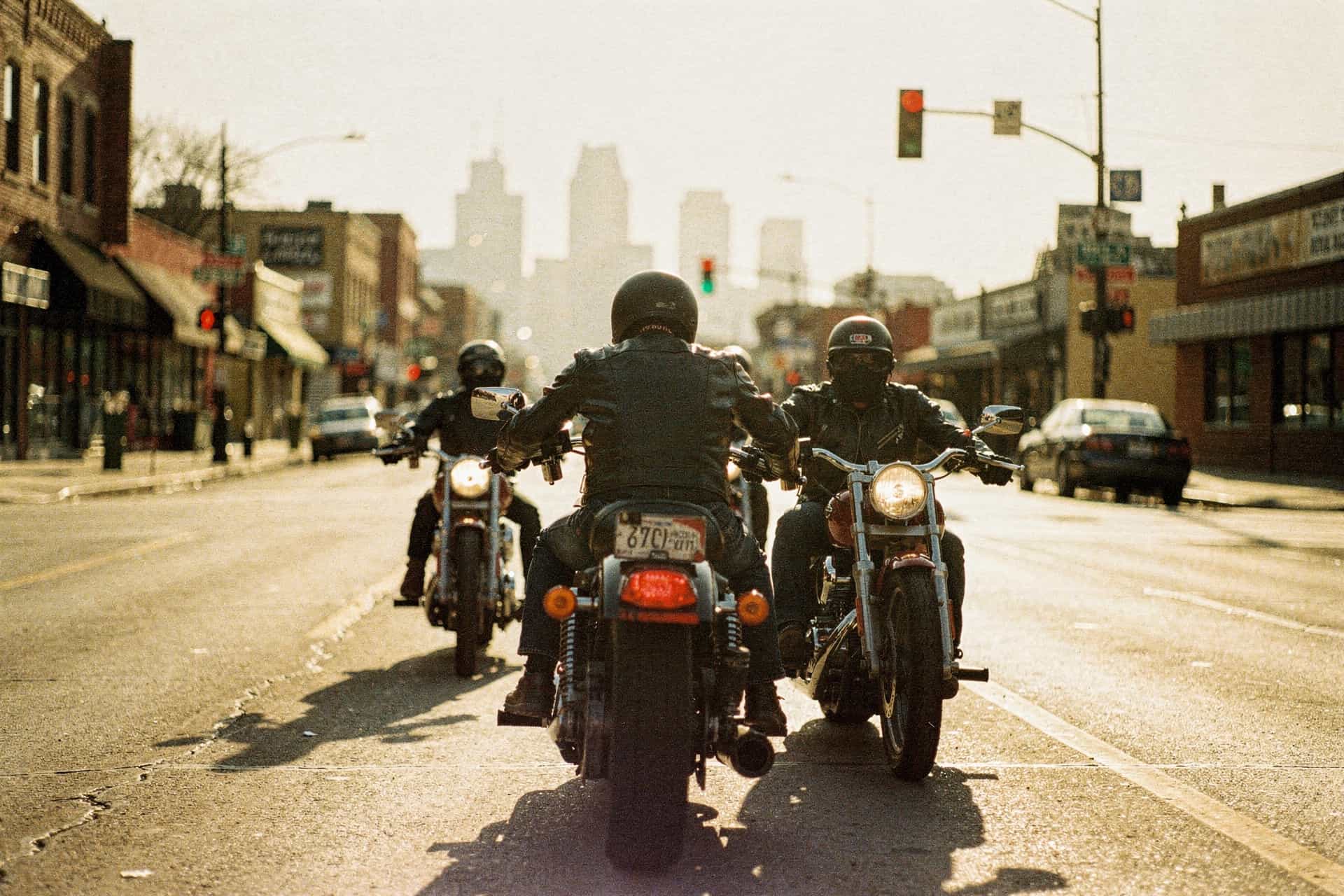
Chicago is hard motorcycle territory. Potholes that swallow a front wheel, traffic that treats a bike as negotiable, and a season squeezed into roughly six months. The riding calendar runs hot from roughly May through October and then stops, which is why anything anyone organizes gets stacked into that window. Riding here is a thing you do against a deadline.
The roads out are the payoff. Northwest puts you into rural Wisconsin inside two hours. South on I-57 opens into prairie. The Indiana Dunes sit an hour east, and Starved Rock is a hundred miles southwest. Riders here do not waste dry pavement, because they have counted the days.
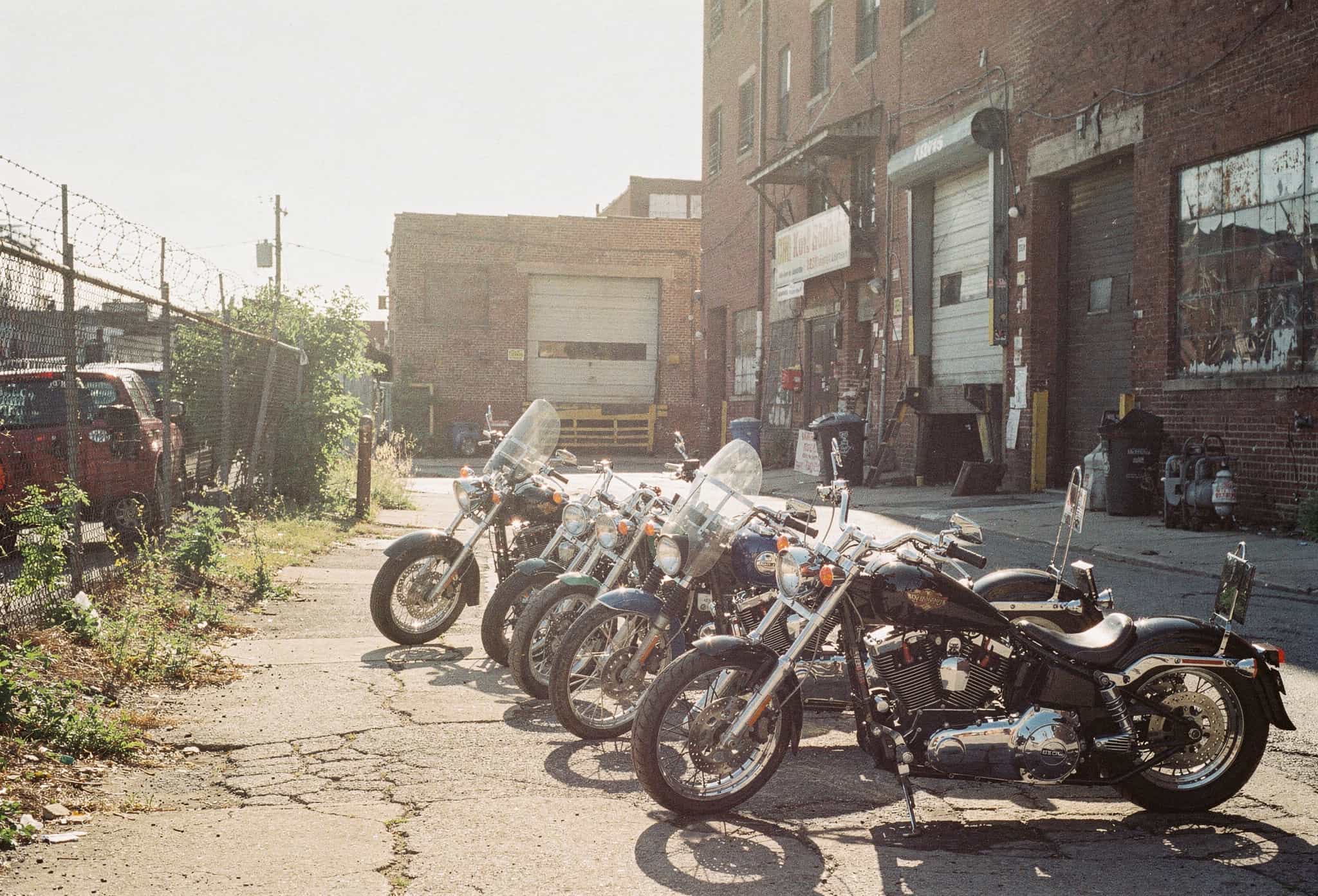
For the machines most of this culture was built on, our Harley-Davidson history guide covers the engine eras behind the bikes filling those parking lots.
We build gear for riders who earn their miles the hard way. Our t-shirts and hoodies are made for people who do not wait for perfect conditions, and our patches and merch carry biker culture themes without imitating any club’s insignia. None of it is protective riding gear and none of it signals affiliation with anything.
Disclaimer
We are not an MC and we do not claim affiliation with one. This article is built from contemporaneous newspaper reporting, Justice Department announcements, federal court records, and published books. It reports documented conduct without endorsing it, and it deliberately omits current chapter, leadership, territory, and location detail.
Sources
- Bombings in Chicago, Rockford Linked to Motorcycle Gang Merger, Chicago Tribune, November 9, 1994. Contemporaneous reporting on the November 1994 bombings and the police link to the Hell’s Henchmen patchover.
- Chicago mob figure gets 60 years in Berwyn store bombing, Chicago Sun-Times, October 30, 2011. Sentencing account in the Northern District of Illinois racketeering case involving a high-ranking Outlaws member.
- Outlaws Motorcycle Club ex-boss Mark Polchan has sentence cut in half, Chicago Sun-Times, October 6, 2021. Resentencing to 30 years after a successful challenge to one count.
- Members of Outlaws Motorcycle Club Indicted in Detroit, US Department of Justice, August 15, 2007. Primary source placing Operation Broken Spoke in Detroit, Fort Wayne, and Indianapolis rather than Chicago.
- United States v. Bowman, 302 F.3d 1228 (11th Cir. 2002). Appellate opinion confirming that the 2001 Outlaws leadership prosecution was tried in Florida.
- The Wolf of Rockford, Gangsters Inc., May 22, 2025. Detailed secondary account of the Outlaws, Henchmen, and Hells Angels conflict, used only for the sequence of events and flagged as secondary.
- James, Peter “Big Pete,” and Kerrie Droban. The Last Chicago Boss. Hachette Books, 2018. Firsthand memoir by a former Chicago-area Outlaws regional officer, cited as testimony rather than record.
- Barker, Thomas. Biker Gangs and Transnational Organized Crime. Routledge, 2nd edition, 2014. Academic survey used for general club-structure observations.