What Does 1 Percenter Mean?
A 1 percenter - often written as 1%er - is a biker who identifies with an outlaw motorcycle club. A diamond-shaped 1% patch is the best-known visual marker. It does not mean that every member has committed a crime.
The name comes from a widely repeated story that 99% of motorcyclists were law-abiding and the remaining 1% were outlaws. The story is linked to the 1947 Hollister rally. Oxford Bibliographies notes that the statement is attributed to the American Motorcyclist Association and that the association has denied making it.
Law enforcement uses “outlaw motorcycle gang” for organizations or chapters it links to criminal activity. Riders and clubs may use “outlaw” or “1%er” as a self-description. Those terms overlap, but they are not proof that every member or chapter is involved in crime.
This guide separates the documented history from the later folklore and explains how to read current claims without treating one club’s customs as universal.
The Origin of the 1 Percenter: Hollister, 1947
The origin story begins with the July 1947 Gypsy Tour rally in Hollister, California. The event drew more riders than the small town expected, and newspapers reported drinking, street riding, and arrests.
The coverage soon became larger than the event. A widely reproduced Life magazine image showed a rider on a motorcycle amid beer bottles. Later reporting has questioned how representative the scene was. RevZilla’s review of contemporary accounts describes a disorderly weekend, but not the lawless takeover later popularized in film and biker folklore.
Later accounts say the AMA answered the bad publicity by claiming 99% of motorcyclists were law-abiding. That attribution is disputed: Oxford Bibliographies records both the attribution and the AMA’s denial. Hollister shaped the public image, while the 1% label developed through the story that followed.
1%er Meaning at a Glance
For readers who landed here looking for the short answer:
- 1%er meaning: a biker who identifies with an outlaw motorcycle club. The “1%” refers to the contested story that 99% of motorcyclists were law-abiding.
- 1 er meaning: same thing. “1er” and “1%er” are both spoken as “one percenter.”
- One percenter biker meaning: a self-selected club identity, not evidence that a person committed a crime.
- The diamond patch: a small diamond-shaped emblem used by clubs and members that claim the 1% identity. Rules for earning and wearing it vary by organization.
- Who qualifies: there is no public governing body that certifies 1% clubs. The label is claimed within club culture and described differently by clubs, researchers, and law enforcement.
The Hollister Effect: How the Media Created a Legend
The 1947 Hollister incident helped create a national mythology around outlaw bikers.
In 1953, the film The Wild One starring Marlon Brando was directly inspired by the Hollister events. When Brando’s character Johnny Strabler is asked “What are you rebelling against?” and answers “Whaddya got?” - that moment defined the outlaw biker image for an entire generation.
The reality at Hollister was far less dramatic than the legend. Local accounts describe the weekend as rowdy but not violent. No one was killed. Property damage was minor. But the media narrative was already written, and it gave outlaw motorcycle culture a permanent place in the American story.
This media-fueled mythology helped define the outlaw biker as a national character. It also makes the history difficult to separate from later books, films, and club storytelling.
Post-War America and the Rise of Outlaw Motorcycle Clubs
To understand the 1%er movement, you have to understand what was happening in America after World War II.
Thousands of service members returned after World War II while military surplus motorcycles and a growing civilian motorcycle market made riding more accessible.
Veterans appear in the founding stories of several postwar clubs, but there was no single cause for outlaw motorcycle culture. Surplus machines, returning service members, working-class social clubs, racing, and the public fascination created by Hollister all played a part. Claims about veterans as a whole craving violence or being unable to adapt to civilian life are not supported by the historical record.
By the 1950s, distinct club histories were developing in several US regions. Their structures and patch customs must be documented organization by organization rather than presented as one national code.
The 1%er Diamond Patch: What It Means
A widely recognized symbol associated with outlaw motorcycle clubs is the diamond-shaped patch embroidered with “1%.” Public images show different placements, so this guide does not assign one wearing rule to every organization.
The 1% diamond is used as an identity symbol by some outlaw motorcycle clubs. Public accounts often describe it as an earned club emblem, but eligibility and wearing rules are organization-specific.
The emblem should not be treated as generic biker decoration. There is no universal rulebook governing every club, but copying a real organization’s name, colors, or insignia can falsely suggest affiliation.
Some organizations use a three-piece design with a top rocker, center emblem, and bottom rocker. Others do not. Our biker patch meanings guide explains common formats while keeping club-specific meanings attributed.
Bobber Brothers does not reproduce club colors or the 1% diamond. For independent garage artwork with no club affiliation, see our rider T-shirts.
Major Clubs in Dated Federal Reporting
“Big Four” is shorthand often applied to the Hells Angels, Bandidos, Outlaws, and Pagans. It is not a live membership table or official global ranking. The FBI’s 2015 National Gang Report discussed those four alongside the Mongols, Vagos, and Sons of Silence. Its descriptions reflect the agency’s 2015 assessment, not current chapter counts, alliances, or territory.
Use the sourced major-clubs hub for dated evidence and links to individual histories. Dedicated pages cover the Outlaws, Pagans, Vagos, Warlocks, and Unknown Bikers MC. A club profile should not be read as a current roster, territory map, or statement of affiliation.
Club Customs Are Organization-Specific
Reliable public bylaws are rare. Memoirs, court records, and reporting sometimes describe prospects, officers, colors, or geographic rockers, but those accounts apply to the organization and period being documented. They do not create one code for every MC, RC, 1% club, or support organization.
The safest factual distinction is limited: MC and RC are self-selected organizational labels, while “outlaw motorcycle gang” is a law enforcement term defined in sources such as the FBI’s 2015 report. Patch format alone does not prove criminal conduct, hierarchy, territory, or affiliation. Our motorcycle clubs guide explains the categories without presenting private customs as universal rules.
What the Label Does Not Establish
The 1% label does not reveal a person’s chapter, office, membership status, criminal record, or beliefs. It also does not establish that two organizations using similar language have the same rules or a relationship with each other. Those are separate claims that require separate evidence.
Three terms are often collapsed into one. “One percenter” is an identity used within parts of club culture. “Outlaw” can be a self-description, a historical label, or part of a law enforcement term. “Outlaw motorcycle gang” is an agency classification tied to that agency’s definition and evidence at a stated date. A source using one term does not automatically establish the others.
Keeping those labels separate prevents a personal identity, an agency assessment, and a criminal case from being presented as if they were the same fact.
Source type matters. A club website is self-description. An intelligence report records an agency assessment on its publication date. An indictment contains allegations, while a guilty plea, verdict, or sentence establishes an outcome for identified defendants and conduct. None of those sources, by itself, supplies a complete current account of a private organization.
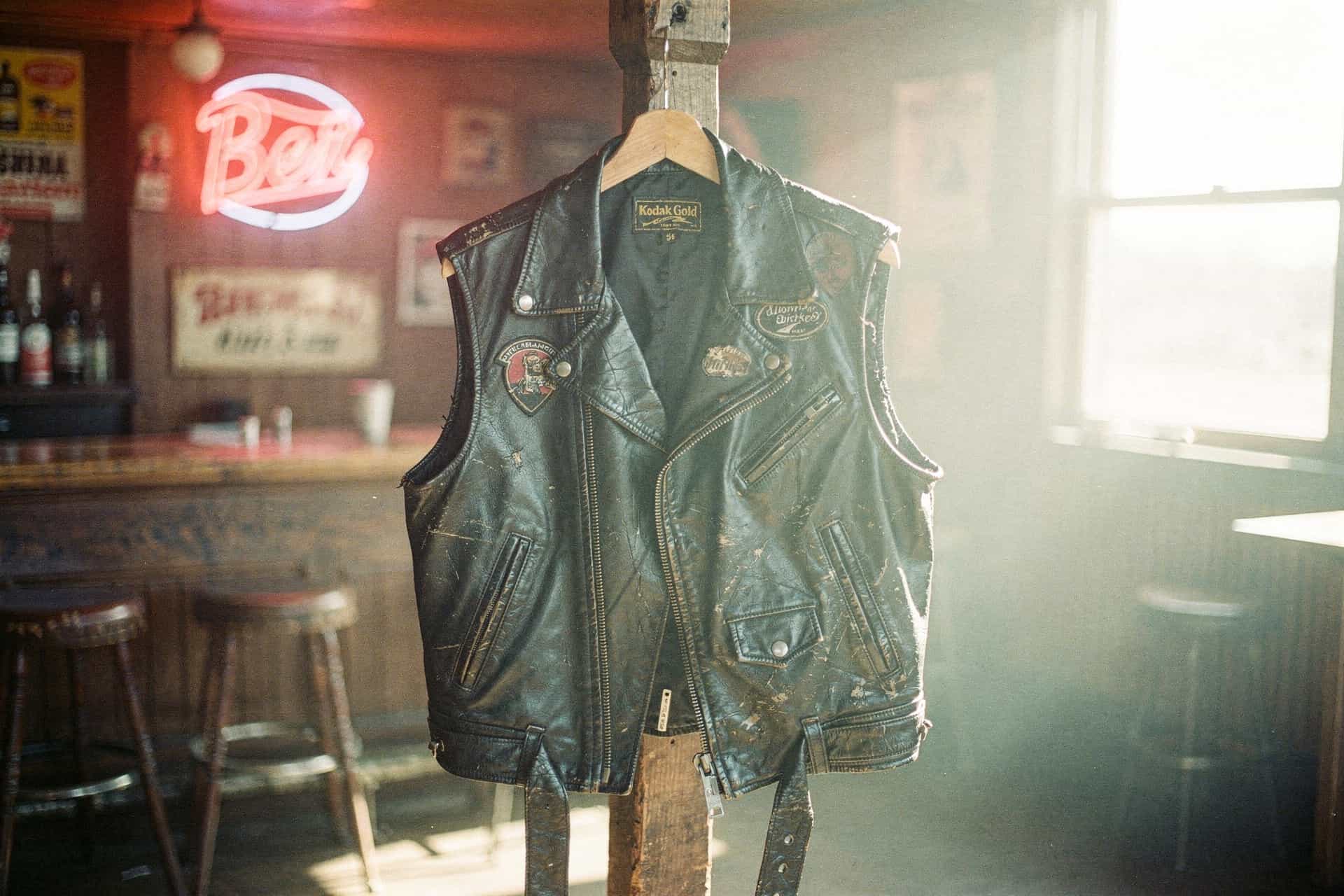
Photographs need the same discipline. A visible diamond can support a description of the garment in that image, but without a reliable caption it cannot establish the wearer’s identity, status, location, chapter, or authority to speak for an organization.
1%er Culture in Media and Film
The outlaw biker has been a fixture in American media since the 1950s, though the line between reality and fiction gets blurred fast.
Key Films
- The Wild One (1953): A fictional biker drama patterned after the Hollister coverage that helped popularize the rebel-biker image.
- Easy Rider (1969): Peter Fonda and Dennis Hopper’s road trip film captured the counterculture era and made the motorcycle a symbol of American freedom.
- Hell’s Angels on Wheels (1967): Jack Nicholson’s early role, filmed with real Hells Angels members as extras.
Television
- Sons of Anarchy (2008-2014): The FX series used fictional club titles, patches, and conflicts. It is entertainment, not evidence of one real organization. Our Sons of Anarchy motorcycles guide covers the bikes used on screen.
Books
- Hell’s Angels by Hunter S. Thompson (1967): A journalistic account based on time spent around the Hells Angels.
- Under and Alone by William Queen (2005): A memoir by an ATF agent who infiltrated the Mongols MC.
- No Angel by Jay Dobyns (2009): Another ATF infiltration memoir, this time inside the Hells Angels.
The Relationship Between 1%er Clubs and Law Enforcement
The FBI’s 2015 National Gang Report used “outlaw motorcycle gang” for motorcycle organizations whose members it assessed as using clubs as conduits for criminal enterprises. That is the agency’s law enforcement definition from a dated report. It is not a finding that every person wearing a club patch committed a crime.
Two cases show why legal labels must be precise. A 2008 DOJ release announced indictments arising from Operation Black Rain against alleged Mongols members. Indictments state allegations, not convictions. The 2015 Twin Peaks confrontation led to 177 arrests, but the Texas Tribune reported in 2019 that the remaining cases would be dismissed.
Membership in a motorcycle club is not by itself proof of a crime. Courts decide charges against identified defendants and entities based on the evidence in each case. A verdict concerning one person, chapter, or organization should not be extended to everyone wearing a similar patch.
International History Is Not a Current Map
The Canadian Encyclopedia documents the 1994-2002 Quebec Biker War involving the Hells Angels and Rock Machine. That historical record shows that the culture spread beyond the United States, but it does not establish where any club operates today. Country lists, chapter totals, bans, and alliances require current jurisdiction-specific sources and are outside this definition guide.
How to Read Current Claims About 1%er Clubs
Claims about current membership, territory, alliances, or hierarchy are hard to verify. Club sites are self-published, while law enforcement reports often describe investigations from years earlier. Treat both as attributed sources, and check the publication date. For the wider history, our motorcycle culture guide traces the arc from postwar garage builders to the global custom scene.
For readers, the useful distinction is between verified event history, allegations in an indictment, facts established by a conviction, and club claims about itself. This guide uses those labels rather than treating biker folklore as settled fact.
Sources
- FBI - 2015 National Gang Report - dated federal definitions and assessments of major outlaw motorcycle groups
- Oxford Bibliographies - Outlaw Motorcycle Clubs - academic overview noting the disputed AMA attribution and the association’s denial
- RevZilla - 75 years after Hollister - review of contemporary Hollister reporting and later mythology
- Quebec Biker War (1994-2002) - The Canadian Encyclopedia - Comprehensive account of the Hells Angels vs. Rock Machine conflict
- Twin Peaks biker shootout results in no convictions - Texas Tribune - Reporting on the collapse of the Waco Twin Peaks prosecutions
- Barker, Thomas. Biker Gangs and Organized Crime. Anderson Publishing, 2007 - Academic reference on outlaw MC structures and the 1%er designation
- Thompson, Hunter S. Hell’s Angels: The Strange and Terrible Saga of the Outlaw Motorcycle Gangs. Random House, 1967 - The seminal journalistic account of outlaw biker culture
- Queen, William. Under and Alone. Random House, 2005 - ATF agent’s memoir of infiltrating the Mongols MC
- Dobyns, Jay. No Angel. Crown, 2009 - ATF agent’s account of infiltrating the Hells Angels
Background reading: our motorcycle clubs complete guide explains MC, RC, and law enforcement terminology without treating private club customs as universal rules.