The Unknown Bikers Motorcycle Club is a Brooklyn club that almost everyone writes about and almost nobody sources. Search the name and you get founding dates, chapter lists, patch symbolism and a rivalry story, all repeated word for word across sites that cite nothing.
There is one real document. In 2008 the club filed a federal trademark application for its patch, and that filing is a public record with dates, a design description and an owner on it. This article is built around what that record and one piece of local reporting actually support, and it is explicit about the rest.
| Field | What the record supports | Source and date |
|---|---|---|
| Claimed first use of patch | June 1, 1974 | Applicant’s own claim, USPTO serial 77527657, filed 2008 |
| Claimed first use in commerce | November 1, 1995 | Same filing |
| Registered owner | Unknown Bikers MC, Inc., Brooklyn, New York | USPTO registration 3880420, registered November 23, 2010 |
| Registration status | Cancelled June 30, 2017 for a missed Section 8 declaration | USPTO status record |
| Patch design | Red banners, red iron cross, white skull in a red helmet, “MC” block, black ground, red/white/black claimed | USPTO mark description |
| Documented location | Williamsburg for roughly 20 years, then Greenpoint from about 2015 | DNAinfo, January 8, 2016 |
| Federal classification | None found; club is not named in the archived DOJ outlaw motorcycle gang profiles | Reviewed 2026-08-08 |
The One Primary Document
On July 21, 2008, an applicant filed to register the mark “UNKNOWN BIKER’S, MC” with the US Patent and Trademark Office. It registered on November 23, 2010 as registration number 3880420, serial number 77527657, owned by Unknown Bikers MC, Inc. of Brooklyn, New York. The goods and services are listed as indicating membership in a motorcycle aficionado organization, specifically a social club.
Two dates on that filing matter. The applicant claimed first use of the mark on June 1, 1974 and first use in commerce on November 1, 1995.
Understand what that is and what it is not. A first-use date on a trademark application is a statement the applicant makes to a federal agency, and false statements in a trademark filing carry consequences. It is a stronger signal than a blog post. It is still the club’s own account of its own history, submitted 34 years after the fact, and the Trademark Office does not investigate whether the date is true. Treat June 1, 1974 as the earliest date the club itself has put on a federal form, which is exactly how this article uses it.
The registration did not survive. On June 30, 2017 it was cancelled because the registrant did not file an acceptable declaration of continued use under Section 8. That is an administrative lapse, not an adverse ruling. It means this registration is not live today.
What the Patch Record Says
The USPTO description of the mark is the most precise public description of these colours that exists, and it is worth quoting the elements: two red banners containing “UNKNOWN BIKER’S” in white above and below; a center design of a red iron cross on a white background with a white skull with black facial features wearing a red helmet in front of it; a red rectangle containing the letters “MC”; all on a black background. Red, white and black are claimed as features of the mark.
Club-reference sites describe that helmet as a three-horned Celtic helmet and attach meanings to each element: the skull as mortality, the helmet as a warrior identity, the iron cross as courage and rebellion. The federal record describes a red helmet and stops there. The horns and the Celtic reading may well be right, but they come from secondary writing, not from the registration.
That gap is typical of this whole subject. Our guide to what biker patches mean walks through how three-piece colours are generally structured, and it makes the same point: symbol meanings vary by club, by region and by decade, and a meaning asserted for one club rarely transfers cleanly to another.
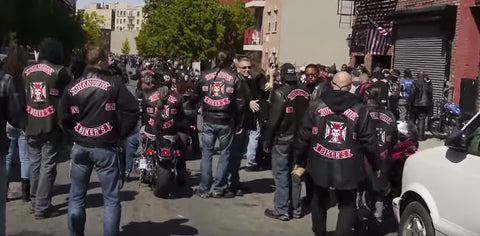
Brooklyn: The Part With a Newsroom Behind It
The only location claim about this club supported by outside reporting is Brooklyn, and the source is a local news story about noise.
On January 8, 2016, DNAinfo New York published a piece by Gwynne Hogan on neighbour complaints in Greenpoint. The reporting established several useful facts. The club had moved to its Greenpoint clubhouse roughly a year earlier, after about 20 years at a Williamsburg location whose lease had expired. Neighbours had filed around 40 complaints to 311 since the previous April about engine noise and late parties, and the NYPD was looking into them. One resident’s line captures the tone: “I get it, it’s a bike clubhouse. But it’s right where I’m trying to sleep.”
Working backwards, roughly 20 years at the Williamsburg address places the club there from about the mid-1990s, which lines up with the November 1995 first-use-in-commerce date on the trademark filing. Two independent records pointing at the same period is meaningful. Neither one establishes 1974.
We are not publishing either address. Both appear in the original reporting if you need them for research, but a decade-old clubhouse address reprinted as current information is the kind of operational detail this site does not carry for any club.
The Community Work Claim, Attributed Properly
Older versions of this page said the Unknown Bikers “positively impacted the region by reducing drug-related issues in the area” and that members “organized block parties, helped keep streets safe, and gave younger riders a path that did not lead to prison.” None of that had a source.
Here is what can actually be said. In that same 2016 DNAinfo story, a club member told the reporter that the club runs toy drives and turkey drives and visits local senior centers, and that the club had historically “chased out all the drug dealers, all the tyrants off the block.” That is a member’s own account of his club, published by a local outlet alongside neighbours complaining about noise from the same clubhouse. It is a real, datable, attributable claim, and it is not the same thing as a documented community record.
The attributed toy-drive claim does not verify other claims about the club or its members. For comparison, our guide to Christian motorcycle clubs covers organisations where charity work is part of the documented mission.
The Polish Connection
The widely repeated account is that until the late 1990s most members were of Spanish or Italian descent, that Polish members began joining in 1999, that a Greenpoint chapter was founded in 2010 under a named leader, and that some members wear a Poland flag patch.
Greenpoint’s Polish community is thoroughly documented and needs no defending. The club-specific claims are not. They trace to enthusiast club-profile sites with no citation, and the founding-leader name is a living private individual who has not been the subject of mainstream press coverage that we could find. We have removed the name. Naming private people on the strength of an uncited fan site is not something this site does.
Greenpoint has a documented Polish community, but neighbourhood demographics do not prove the club-specific dates or membership claims. This page will not turn that context into an unsupported inference.
The International Chapter Claims
Chapter lists for Puerto Rico (San German and Ponce, dated 2003), Poland (dated 2012) and Iceland appear on club-reference sites and self-published pages. We could not match any of them to a court record, a government filing, a foreign police or press report, or a newsroom story.
That is not a claim that the chapters do not exist. It is a statement about evidence. The club’s US trademark registration covered the United States only and lapsed in 2017, so it offers nothing on foreign presence either way.
Compare that to the clubs where international presence really is documented. The Justice Department’s archived outlaw motorcycle gang material and decades of foreign prosecutions establish where the largest organizations operate, which is why our roundup of the most famous motorcycle clubs can put dated figures next to those names. No equivalent record exists for the Unknown Bikers, and a page that pretends otherwise is guessing.
The One-Percenter Question
The three-piece patch layout, the iron cross and the club’s own presentation all sit in the one-percenter visual tradition, and club-reference sites describe the Unknown Bikers as a one-percenter club.
The label itself has a contested origin. The American Motorcyclist Association has said for decades that it never issued the “99 percent of motorcyclists are law-abiding” statement the legend attributes to it after the 1947 Hollister gathering. Our one-percenter explainer covers that dispute in full, because it is the single most repeated piece of unsourced folklore in this entire subject area.
One distinction is worth making plainly. The archived Justice Department profiles of outlaw motorcycle gangs cover a short list of large organizations with membership estimates and chapter counts attached. The Unknown Bikers are not on that list. Absence from a federal profile is not a character reference and it is not evidence of anything about individual members. It does mean the club has not been placed in that federal category in the material we reviewed on August 8, 2026.
The 2016 Long Island Confrontation
Accounts circulating on club-reference sites and in video clips describe a June 2016 confrontation with Hells Angels members in which club vests were taken, followed two days later by a large group of Unknown Bikers assembling outside a Hells Angels clubhouse in Hempstead Village on Long Island until police dispersed everyone.
We could not locate a newsroom report, a police statement, an arrest record or a court filing for either event. Earlier versions of this page treated the confrontation as established and added commentary about what taking a cut means and how much nerve it takes to stand up to a larger club. That was glamorising an incident we cannot even confirm happened, and it is gone.
If the incident occurred as described, Nassau County police records and Long Island newspaper archives would show it. Until someone produces one of those, this belongs in the same bucket as the founding legend: widely repeated, not established.
What We Could Not Verify
Stated plainly, so nobody has to guess what this page is leaving out:
- Founding year, founding members, or the shared founding date with another Brooklyn club
- Any chapter outside Brooklyn, including Puerto Rico, Poland and Iceland
- Current membership numbers, officers, or which clubhouses are in use
- Membership demographics by decade
- The 2016 confrontation with the Hells Angels
- Any specific meaning assigned to the horns, the skull or the iron cross by the club itself
Everything on that list appears elsewhere online stated as fact. None of it survived a source check.
How to Research a Small Club
Three tiers, worth knowing for any club, not just this one.
Government records. Trademark filings, corporate registrations, court dockets and police blotters are searchable, dated and hard to fake. For a club this size, the trademark file is usually the only one that exists.
Local newsrooms. Neighbourhood outlets cover clubhouses because neighbours call them. That coverage is unglamorous and specific, which makes it useful.
Club-reference sites. They carry detail found nowhere else and they almost never cite it. Good for leads. Not proof.
For the wider frame on how clubs are organized, how patches are earned and how outlaw clubs differ from riding clubs, our complete guide to motorcycle clubs is the cluster reference. For the New York picture specifically, our New York biker gangs article covers the city’s better-documented clubs, and our motorcycle culture guide connects all of it to the broader riding world.
Our accessories use Bobber Brothers designs with no club insignia, and nothing we sell is affiliated with, licensed by or connected to any club named on this page.
Sources
- USPTO status record for serial 77527657, “UNKNOWN BIKER’S, MC” - Official federal trademark record: filing date, registration number 3880420, owner, goods and services, claimed first use of June 1, 1974, mark description, and the June 30, 2017 cancellation under Section 8
- Justia Trademarks record for UNKNOWN BIKER’S, MC - Mirrored copy of the same registration record for readers checking the dates and design description
- DNAinfo New York: Biker Club Keeps Us Awake With Roaring Engines and Parties, Neighbors Say, January 8, 2016 - Local reporting establishing roughly 20 years at the Williamsburg location, the move to Greenpoint, the 311 complaint count, and a club member’s account of the club’s charity work
- American Motorcyclist Association: History of the AMA - The organization’s own history, relevant to the disputed origin of the one-percenter label
- U.S. Department of Justice: Outlaw Motorcycle Gangs (archived) - Archived federal profiles of the clubs DOJ classifies as outlaw motorcycle gangs; the Unknown Bikers do not appear in them
- One Percenter Bikers: Unknown Bikers MC - Enthusiast club-profile site and the origin of most founding, chapter and rivalry claims about this club; cited here as the source of those claims, not as verification of them