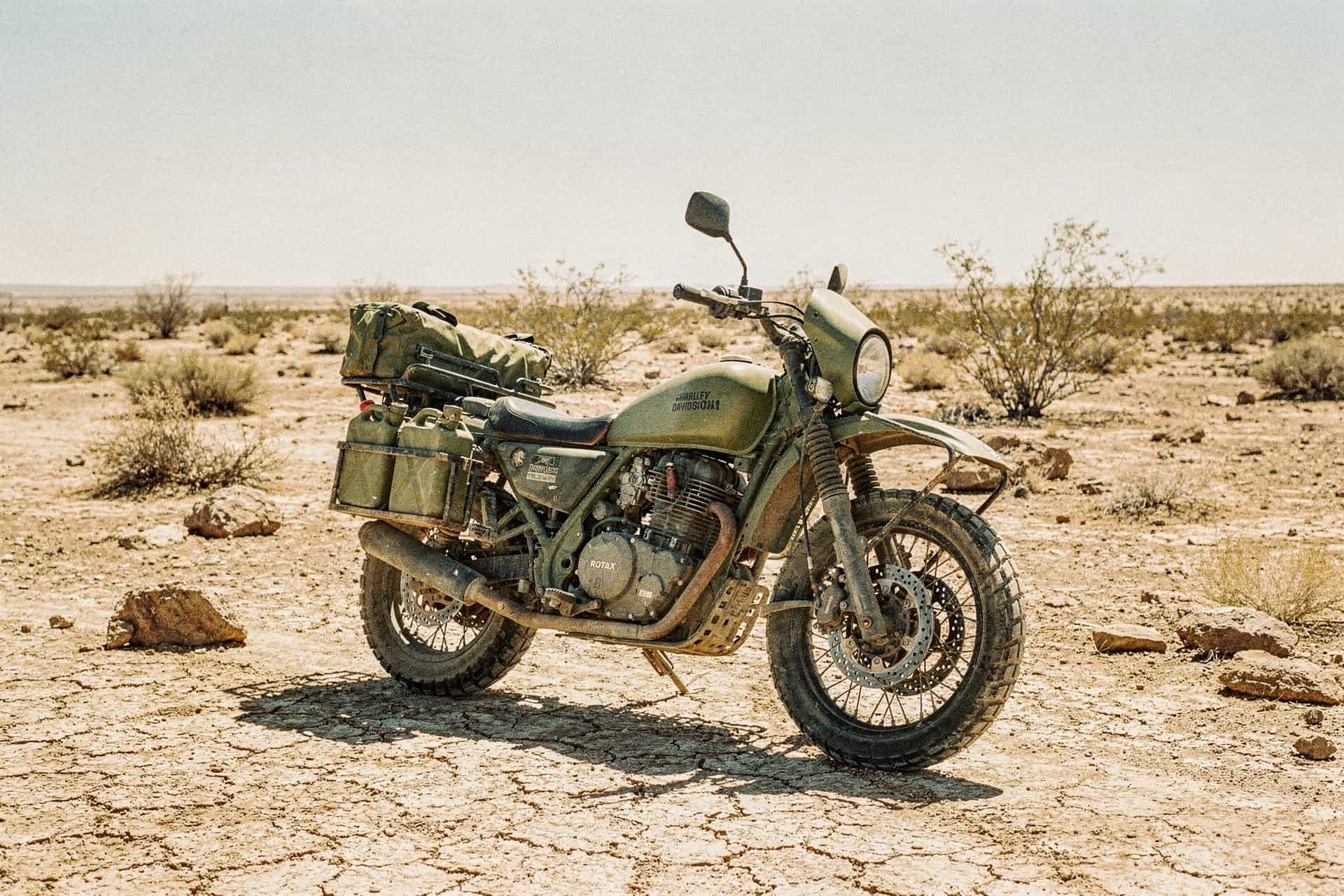
Picture a Harley-Davidson with one cylinder, an Austrian engine, a British frame, Italian roots and a rifle scabbard bolted to the back. Nobody would guess the badge. That bike is the Harley-Davidson MT500, and it is the strangest thing Milwaukee ever sold to an army. It never won the big contract Harley wanted. It still tells you a lot about how the company thought in the late 1980s, when it had just survived near-bankruptcy and was hunting for any steady money it could find.
We love this bike because it breaks every rule people think a Harley has to follow. No V-twin. No chrome. No thunder. Just a tough, light, green single built to be dropped in a ditch and ridden home.
Where the MT500 Came From
The Harley story starts with other people’s work. The design traces back to the Italian SWM XN Tornado, an early-1980s enduro bike. According to Revival Cycles’ history of their 1999 example, the Tornado became the British Armstrong MT500 before Harley ever got involved.
Milweb’s history of the Armstrong MT500 and MT350 says the basic design “passed around SWM & Bombardier” before Armstrong-CCM put it into production. Armstrong-CCM was based in Bolton, Greater Manchester, and the Armstrong MT500 entry on Wikipedia dates its production there to 1983-1987. Armstrong started supplying MT500s to the British Army in 1984.
Then came the twist. Around 1987, Armstrong sold the military motorcycle business to Harley-Davidson, which bought both the design and the production rights. From then on, the bikes wore Harley badges and were built by Harley.
Why Harley Bought a Military Single
This was not Harley’s first time in uniform. The company sent roughly 20,000 machines to the US military in World War I and built about 90,000 WLAs in World War II, as our Harley-Davidson history guide lays out. During that war it even built the shaft-drive Harley-Davidson XA, a BMW-inspired flat twin, for desert work.
By the 1980s the old military connection was gone. Harley wanted it back. Buying a proven design that the British Army already trusted looked like a shortcut. Revival Cycles notes that Harley marketed the MT500 to the US military as a modern answer to the WWII WLA.
It did not work out. TopSpeed’s look at the MT500 puts the main reason simply: diesel was the preferred fuel in military operations. An army that runs its trucks, tanks and generators on diesel does not want a fleet of gasoline bikes that need their own supply chain. That one logistics problem killed the big contract before the riding ever mattered.
MT500 Specs
These figures come from the Armstrong-era specifications and later Harley-badged examples. Where sources disagree, we show the range.
| Spec | Harley-Davidson MT500 |
|---|---|
| Engine | Rotax 504, air-cooled single, four-stroke |
| Displacement | 481.3cc (sold as a “500”) |
| Valves | Four valves, single overhead cam |
| Power | 32 bhp at 6,200 rpm (Rotax figure); TopSpeed lists 28 hp at 6,250 rpm |
| Torque | 28 lb-ft at 5,500 rpm |
| Gearbox | Five-speed |
| Final drive | O-ring chain on hardened steel sprockets |
| Weight | About 355 lb (161 kg); TopSpeed lists 370 lb |
| Fuel capacity | 13 liters (about 3.4 US gallons) |
| Wheelbase | About 57 in (145 cm) |
| Ground clearance | 9.5 in |
| Brakes | 230mm discs with protective covers |
| Top speed | About 75 mph |
| 0-50 mph | 9.3 seconds |
The ground clearance, 230mm discs, 75 mph top speed and 9.3 second 0-50 time are TopSpeed’s figures. That is a slow bike by road standards and a very good one by military standards. It weighs less than half what a modern Harley bagger does. A soldier can pick it up alone, and the long-travel suspension and ground clearance let it cross ground a street bike cannot.
Built for Soldiers, Not Showrooms
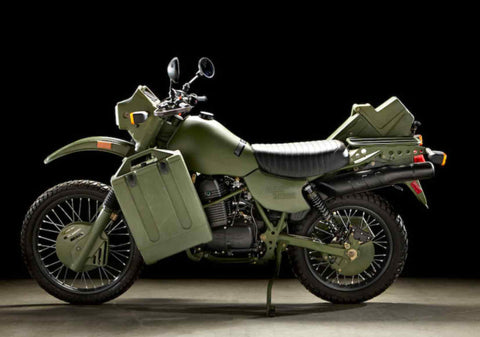
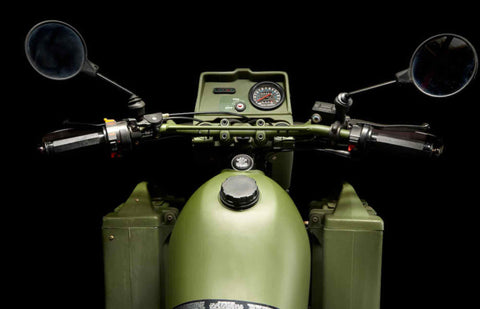
Everything on the MT500 has a job. TopSpeed describes two lockable, waterproof panniers mounted near the tank and a rear case sized for an M16 rifle. The fork is heavy-duty and telescopic, and the rear shocks have adjustable preload so a rider can set the bike up for a full load of kit.
The disc brakes carry covers to keep out mud and rocks. The paint is flat military green. The lighting is simple. Nothing is there for looks.
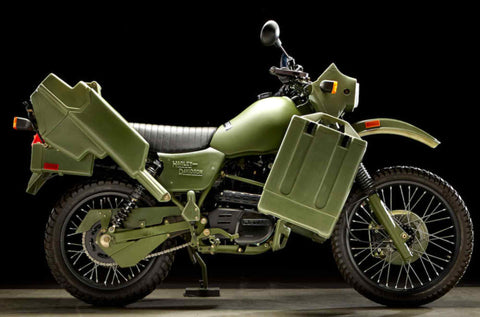
Think of it as a big air-cooled enduro single of its era with army gear bolted on: tall, narrow, at home on dirt, and happiest below its 75 mph top speed. It is a work tool first.
Who Actually Used It
The British Army was the main customer. Milweb and Wikipedia both list Canada and Jordan as smaller users, and both note that electric-start models were built for the Canadian and Jordanian forces. The US military never adopted the bike.
The British connection outlived the MT500. Harley developed a smaller version, the MT350E, released in 1993. The MT350E entry on Wikipedia says it was built in York, Pennsylvania from 1993 to 2000, with a 348cc Rotax single, electric start and disc brakes. The British forces were its main user, again with small numbers going to Canada and Jordan.
By 2000, Milweb says the British Army was moving on to Japanese machines such as the Honda XR250 and Kawasaki KLR. That ended Harley’s military single program.
WLA vs MT500 vs MT350E
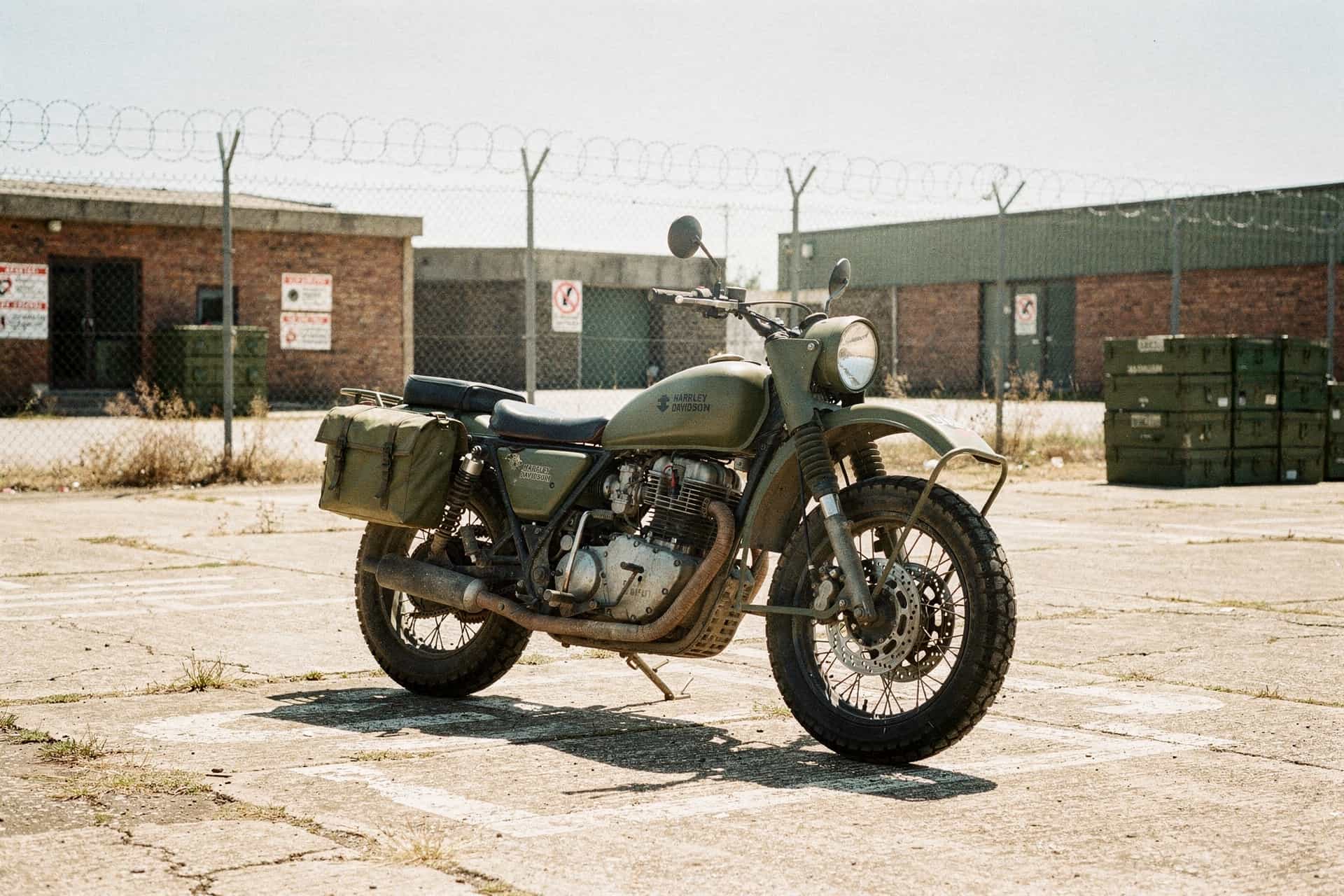
Three military Harleys, three different ideas of what a soldier needs. Laid side by side, the change in thinking is obvious.
| WLA | MT500 | MT350E | |
|---|---|---|---|
| Era | 1940-1945 | Armstrong 1983-1987, Harley from 1987 | 1993-2000 |
| Engine | 45 ci flathead V-twin | 481cc Rotax four-valve single | 348cc Rotax single |
| Start | Kick | Kick (electric on some export bikes) | Electric |
| Built | About 90,000 | A few hundred Harley-badged bikes | British Army main contract |
| Main users | US and Allied forces | UK, Canada, Jordan | UK, Canada, Jordan |
| Job | Dispatch, escort, scouting | Dispatch and recon on and off road | Dispatch and recon on and off road |
The WLA was a road bike that could survive mud. The MT500 was a dirt bike that could survive a war. By the 1980s, armies wanted light machines that one soldier could lift, ride across a field and fix with a small tool kit. A heavy V-twin could not do that job anymore, and Harley knew it. Buying the Armstrong design was the fastest way into that market.
How Many MT500s Were Built?
Here is where you need to be careful with online claims. Some write-ups say “exactly 500 were built.” We could not find a primary source for a round 500.
What the sources do support:
- Harley-built MT500s ran to a few hundred. TopSpeed says fewer than 500 went into production. Revival Cycles says “around 500.”
- Armstrong built MT500s before 1987 for the British Army, so not every MT500 is a Harley.
- The MT350E is a separate model with its own production run, and it is the bike most British Army riders actually remember.
So when a listing says “one of only 500,” read it as “one of a few hundred Harley-badged bikes.” That is rare enough. It does not need rounding up.
What an MT500 Is Worth Now
The MT500 is a collector bike now, and a strange one. It attracts military vehicle collectors, Harley completists and dual-sport riders who want something nobody else at the trailhead has.
TopSpeed puts clean examples at roughly $10,000 to $16,000. Revival Cycles listed a 1999 MT500 with 556 miles at $11,999, and that bike still needed its carburetor cleaned, the chain sorted, a rear tire repaired and the brake fluid flushed. That tells you something: even a low-mile bike has usually been sitting.
Values move on three things: originality, paperwork and whether the military kit is still there. A bike with its panniers, rifle case and correct paint will always beat one that has been turned into a street tracker.
MT500 Buying Checklist
If you find one for sale, go slow. These bikes come out of military surplus, private collections and the occasional barn, and each of those has its own traps.
- Check the paperwork first. Ex-military bikes do not always come with a clean civilian title or registration. Confirm the bike can be legally registered where you live before you talk price.
- Confirm what it actually is. Armstrong MT500, Harley MT500 and Harley MT350E look similar. Check badges, data plates and engine size. A 350 sold as a 500 is a very different bike.
- Plan for storage damage. Low miles usually mean long storage. Expect a gummed carburetor, old tires, dried seals and stale brake fluid, like the Revival bike.
- Look at the kit. Panniers, rifle case, lights and covers are hard to replace. Missing kit lowers the value more than a few thousand miles.
- Listen to the top end. Rotax singles are tough, but a noisy top end or smoke on startup means a rebuild. Budget for it rather than hoping.
- Check the frame and suspension. These bikes were built to be abused. Look for bent brackets, cracked welds and leaking fork seals.
- Find your parts sources before you buy. The MT350 still has a strong spares scene in Britain, and Wikipedia notes its aftermarket support. MT500-specific parts are harder. Know where they will come from.
Where the MT500 Fits in Harley History
It is easy to laugh at a one-cylinder Harley. We would rather respect it. The MT500 came from the same period as the Harley Evo engine and the company’s hard fight back to health. Harley was trying things. Some of them, like the Evo Big Twin, saved the company. Others, like the MT500, just left behind great stories.
It also connects to a line that runs all the way back to the WLA. Harley has always built bikes that soldiers could fix in the field. The WLA did it with a simple flathead. The MT500 did it with a light single. Different tools, same idea. For what the company was building for civilians right after the WLA era, our 1947 Knucklehead breakdown picks up the story.
Stripping bikes down to what matters is also the whole idea behind the bobber. Our guide on what a bobber motorcycle is covers that side of the story. The MT500 got there from the other direction: it never had anything extra to strip.
Harley riders who know the weird corners of the family tree, this one is for you: our biker apparel carries original designs rooted in HD heritage and bobber culture.
Sources
- The Armstrong MT500 & MT350 - Milweb - SWM and Bombardier origins, Armstrong-CCM supply to the British Army from 1984, sale to Harley-Davidson around 1987, users and the move to Honda and Kawasaki by 2000
- Armstrong MT500 - Wikipedia - Bolton production 1983-1987, 1987 rights sale to Harley-Davidson, Rotax 504 engine specifications, users
- Harley-Davidson MT350E - Wikipedia - York, Pennsylvania production 1993-2000, 348cc Rotax engine, users
- Meet The Harley-Davidson MT500 Military Bike - TopSpeed - production estimate, performance figures, military features, diesel logistics, collector values
- 1999 Harley Davidson MT500 - Revival Cycles - SWM XN Tornado lineage, specifications and a dated sale listing of a surviving example