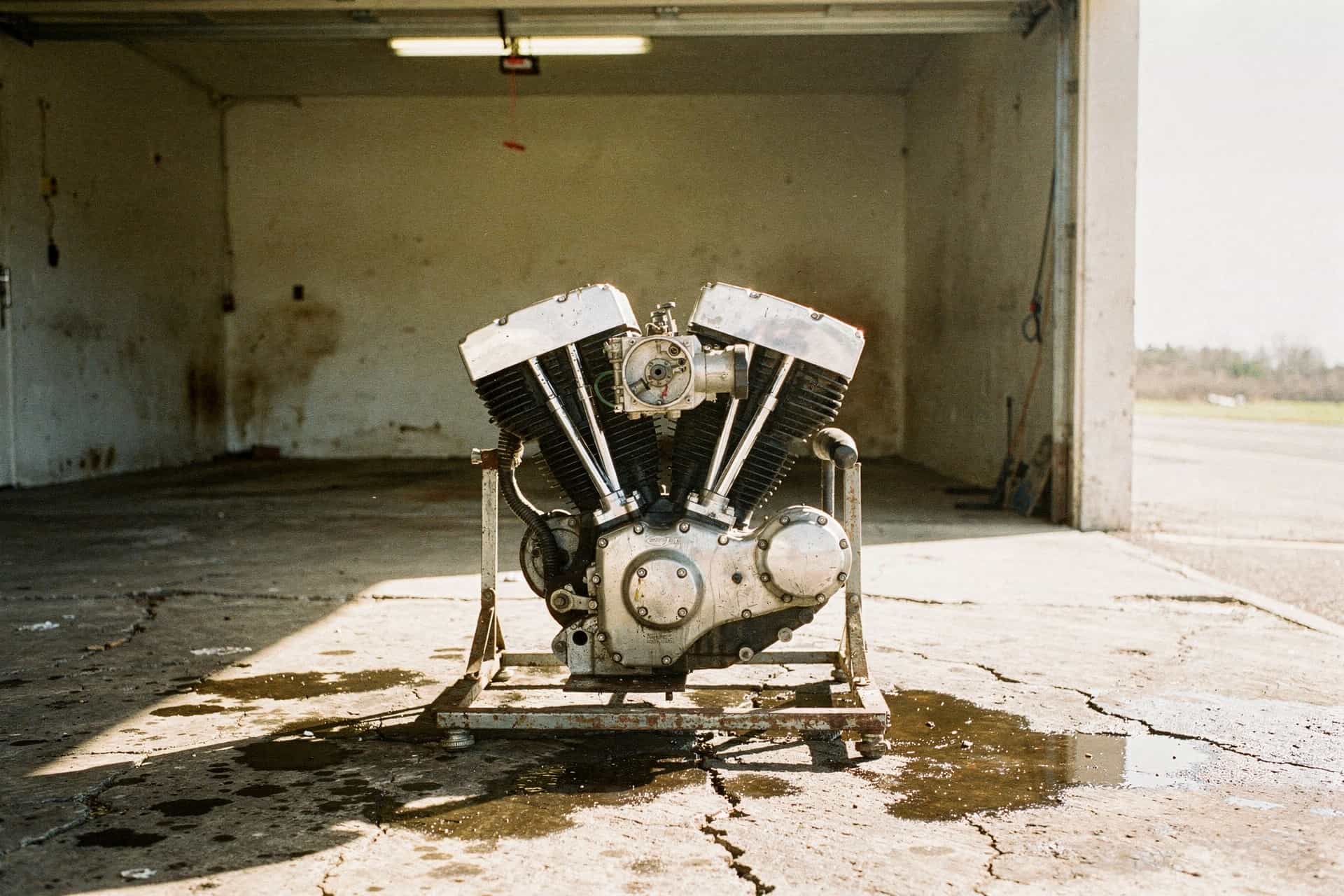
In 1981 Harley-Davidson was a company with one product line, a mountain of buyout debt, and a reputation for leaving oil on the floor. Three years later it shipped the Evolution, the Evo, the Blockhead. Harley describes it as an all-new engine that retained the traditional air-cooled, 45-degree pushrod V-twin layout while changing the design and manufacturing behind it.
Two things confuse riders searching for Evo information. First, there are two entirely different Evolution engines with different valvetrains, and most spec pages blur them together. Second, almost every horsepower number online is unattributed. This guide separates the two engines, gives the numbers that are actually documented, and flags the ones that are not.
The Two Evolution Engines at a Glance
| Big Twin Evolution | Sportster Evolution | |
|---|---|---|
| Model years | 1984-1999 (plus 2000 CVO FXR4) | 1986-2022 |
| Displacements | 1,340cc | 883cc, 1,100cc, 1,200cc |
| Camshafts | One camshaft, four lobes, in the crankcase | Four individual gear-driven camshafts |
| Transmission | Separate unit bolted to the engine | Unit construction, gearbox in the cases |
| Replaced by | Twin Cam 88 / 88B | Revolution Max |
Harley-Davidson’s own engine history page lists the “V2 Evolution” as a 1984-1999 engine and the Sportster Evolution family separately, in “1100cc displacement, later versions … either 883cc or 1200cc engines.” Treat any page that gives one set of Evo specs as covering both engines as unreliable.
Big Twin Evo Specs
| Specification | Detail |
|---|---|
| Configuration | Air-cooled 45-degree V-twin, pushrod OHV, two valves per cylinder |
| Displacement | 1,340cc, marketed as 80 cubic inches |
| Bore x Stroke | 3.498 in x 4.250 in (88.8 mm x 108.0 mm) |
| Compression Ratio | 8.5:1 |
| Valve Train | Single camshaft with four lobes, hydraulic lifters |
| Fuel System | Constant-velocity carburetor; EFI from the 1995 Electra Glide Ultra Classic |
| Oil System | Dry sump with separate oil tank |
| Model years | 1984-1999 |
Two corrections worth making, because they show up constantly in Evo listings.
The 80 cubic inch number is a nominal label. Run the numbers on a 3.498 inch bore and a 4.250 inch stroke across two cylinders and you land near 81.6 cubic inches, or roughly 1,338cc. Harley marketed the displacement as 1,340cc and 80 cubic inches, so arguments over the extra fraction are about rounding rather than a different engine.
Nobody has published a factory horsepower figure. Harley did not put an SAE horsepower rating on Evo Big Twins in its US model materials, and the numbers floating around online reflect that vacuum. Spec databases variously list 58 hp at 5,000 rpm, 64 hp at 5,200 rpm, and around 50 hp at the rear wheel, none of them stating dyno type, correction factor, exhaust, or whether the figure is crank or wheel. The same problem affects the “an Evo weighs 20 pounds less than a Shovelhead” claim: it is repeated everywhere and sourced nowhere.
Measured road-test data is more useful than any of it. Cycle World’s January 1990 test of the new Fat Boy recorded a 14.53 second quarter mile, a 112 mph top speed, and 126 feet to stop from 60 mph, on a bike that weighed 660 pounds on their scales. That is what an Evo Big Twin did in a heavy Softail chassis, measured by a magazine that published its methods.
Why Harley Built It
American Machine and Foundry bought Harley-Davidson in 1969 and expanded output faster than the plants could absorb. Vaughn Beals, who ran the company through the recovery, put it plainly: “Our quality got out of whack in the early ’70s because AMF expanded way too rapidly and couldn’t assimilate the growth.”
The market punished it. Harley’s share of the US super-heavyweight segment fell from roughly 80 percent in 1969 to about 20 percent a decade later while Honda, Kawasaki, Yamaha and Suzuki shipped machines that started every time.
On 16 June 1981, Beals and twelve other executives, Willie G. Davidson among them, took the company private in a leveraged buyout backed by Citicorp. Fortune put the price at $81.5 million; other accounts cite figures just above $75 million, so treat any single number as approximate. Development of the engine that became the Evolution had already been running for years inside the company before the buyout closed.
The design brief was narrow and mechanical: stop the oil leaks, run cooler, hold tolerances, and keep the 45-degree V-twin layout that customers were actually buying. The Shovelhead used aluminum heads on cast-iron cylinders. The Evo went to aluminum for the cylinders as well, with iron liners pressed in, and Harley’s own history page calls it “the first Harley engine created using computer-aided design,” with “aluminum cylinders and heads, a new ignition system,” and describes the result simply as “oil-tight.”
Aluminum barrels shed heat faster than cast iron and expand at a rate closer to the aluminum heads, helping the top end through heat cycles. Harley’s oil-tight result also depended on the wider redesign, gasket sealing, machining, and manufacturing control, not on cylinder material alone.
Which 1984 Models Got the Evo
The Evo did not launch in one bike. Harley fitted it to five 1984 models, including the brand-new FXST Softail, whose hidden-shock chassis came from a concept by outside designer Bill Davis. The FXR chassis had been on sale since the early 1980s with Shovelhead power, and 1984 was the first FXR model year with the Evolution engine, so the frequently repeated claim that “the FXR got the Evo first” is not accurate. They arrived together.
Over the following fifteen years the 1,340cc Evo powered essentially every Big Twin Harley built:
- FXR (1984-1994, plus CVO FXR2/FXR3 in 1999 and FXR4 in 2000). Rubber-mounted engine in a twin-shock steel frame, the stiffest Big Twin chassis Harley built in this period, and our 1982 FXR breakdown covers where it came from.
- Softail (1984-1999). Rigid-mounted engine, hidden rear shocks, hardtail looks. The Heritage, Springer and Fat Boy all sit here.
- Dyna (1991-1999). The cheaper rubber-mounted platform that replaced the FXR.
- Touring (1984-1998). Electra Glide, Tour Glide and Road King. The 1995 Electra Glide Ultra Classic was Harley’s first EFI motorcycle.
The “Blockhead” Nickname
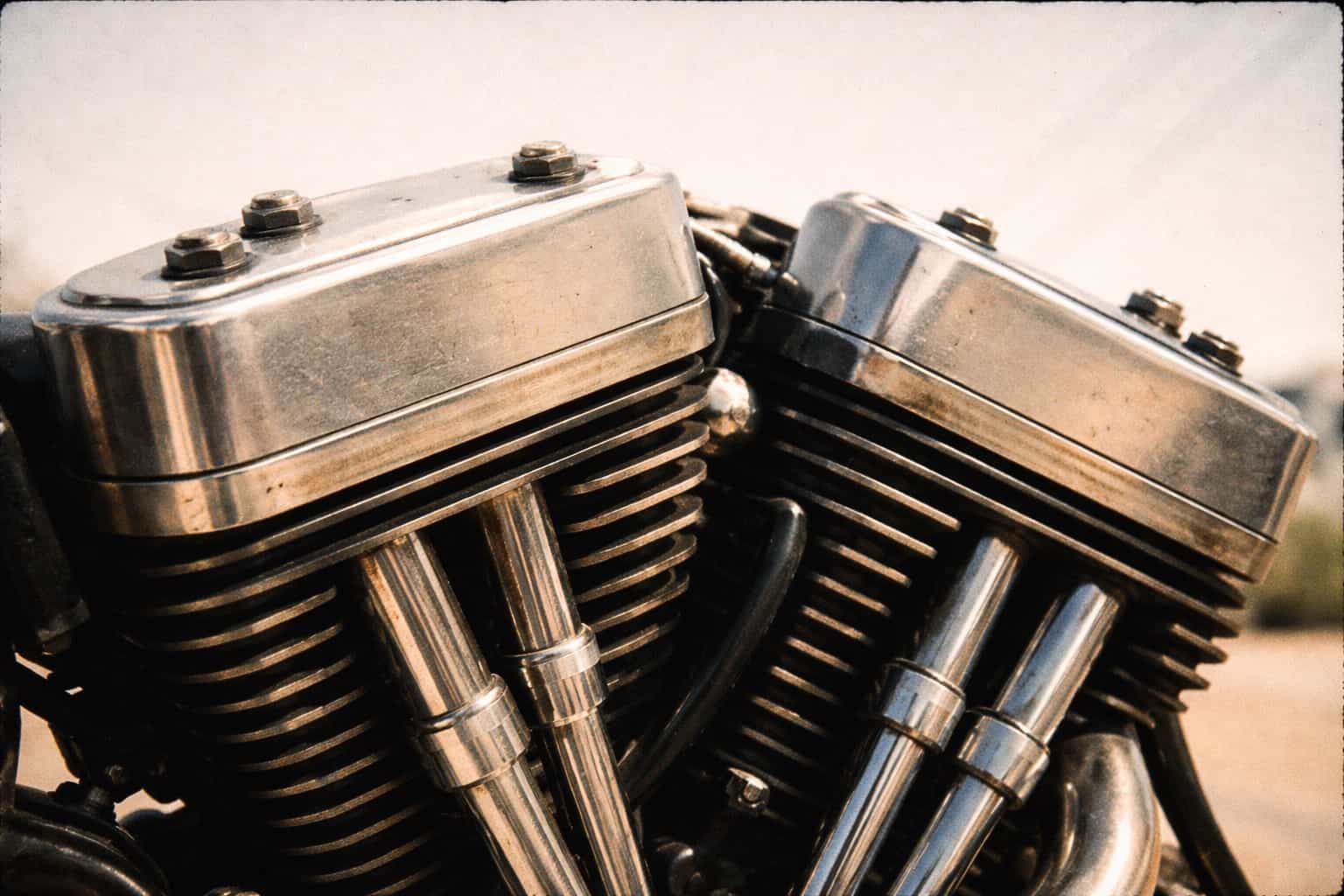
Harley engines get named for their rocker covers. The Knucklehead (1936-1947) had covers shaped like knuckles, the Panhead (1948-1965) like upside-down pans, the Shovelhead (1966-1984) like the back of a coal shovel. The Evo’s flat rectangular covers got it “Blockhead,” a nickname Harley never used in advertising and that plenty of owners still dislike. It stuck anyway.
The Sportster Evolution Is a Different Engine
This is where most Evo pages go wrong. The Sportster Evolution arrived in 1986, two years after the Big Twin, and Harley’s official Sportster timeline describes it as receiving “the Sportster Evolution engine in 883 and 1100cc displacements.”
| Sportster Evo variant | Displacement | Model years |
|---|---|---|
| XLH 1100 | 1,100cc | 1986-1988 |
| 883 (XLH, later XL883 variants) | 883cc | 1986-2022 |
| 1200 (XLH 1200, later XL1200 variants) | 1,200cc | 1988-2022 |
The architecture differs in two ways that matter to anyone building or buying one.
Camshafts. The Big Twin Evo uses a single camshaft with four lobes sitting in the crankcase. The Sportster Evo uses four individual single-lobe camshafts, each driven by its own gear, one per valve, with the lobes stacked front to back. That layout is a direct descendant of Harley’s late-1920s racing engines and it tolerates aggressive cam profiles well.
No cam chain. Because Sportster cams are gear-driven, there is no cam chain and no polymer tensioner shoe in a Sportster Evo. If somebody tells you to inspect the cam chain tensioner on an 883, they are describing a Twin Cam Big Twin problem and applying it to the wrong engine.
The Sportster also uses unit construction, with the gearbox inside the engine cases, a layout carried over from the 1952 K model. The Big Twin keeps engine and transmission as separate assemblies. Nothing meaningful interchanges. Our full Sportster history walks the model line from the 1957 Ironhead forward.
Harley built the last Evolution Sportster, a Gunship Gray 883, on 18 November 2022. That is the 1986 through 2022 model years on one basic engine design.
What the Evo Actually Fixed
Reliability, not performance. A 1984 Honda VF1100 made close to double the power from similar displacement. Harley was not competing on output.
Oil leaks. Matched aluminum expansion rates and flatter factory machining kept gaskets sealed. Harley’s own engine page uses the phrase “oil-tight,” which is a strong claim for a company that had spent a decade being mocked for the opposite.
Heat. Aluminum conducts heat several times faster than cast iron, and the Evo’s revised fin geometry added surface area. An air-cooled V-twin still cooks you at a stoplight in August. It just no longer cooks itself.
Valve adjustment. Hydraulic lifters self-adjust, which removed a recurring service item from the owner’s calendar.
Ignition. The Evo used a new electronic ignition system, but electronic ignition itself was not an Evo first. Harley had already fitted electronic ignition to late Shovelhead models, including the 1978 FLH80.
On longevity, be careful with the numbers you read. Harley has never published a factory or fleet-level mileage-to-overhaul figure for either Evo family, and no independent test house has published one either. That means “an Evo will do 100,000 miles” is an anecdote circulating at scale, not a specification, and there is no source you can check it against. Service history and heat exposure decide the outcome far more than the badge on the cases.
How the Evo Fits Into Harley’s Recovery
The engine gets most of the credit. It deserves a share, not all of it.
Three things happened at once. Beals cut the workforce roughly 40 percent, moved headquarters back to Milwaukee, and imported Japanese manufacturing practice, statistical process control and just-in-time inventory, after touring Honda’s own plant. Second, on 1 April 1983 President Reagan approved Harley’s petition for import relief and imposed a 45 percent tariff on imported motorcycles over 700cc, stepping down to 35, 20, 15 and 10 percent over five years. Third, the Evo gave the company something worth selling into that window.
The recovery is documented year by year. By 1986 Harley held 33.3 percent of the US super-heavyweight market, passing Honda for the first time since 1980, and the company returned to public markets that year. In March 1987 Beals asked the International Trade Commission to end the tariff a year early, telling it the company no longer needed protection; Reagan removed it on 9 October 1987. By 1989 Harley was back near half the heavyweight segment.
That last figure is worth stating carefully, because the “over 50 percent by 1988” version circulates widely and does not match the contemporaneous record. For the broader timeline around these years, our Harley-Davidson history guide puts the engine eras and the business story side by side.
Building With an Evo
Fifteen years of Big Twin production and a Sportster run from 1986 to 2022 left an aftermarket that is still deep. S&S Cycle, Ultima and others sell complete Evo-pattern engines in displacements well beyond stock, and cam, head, ignition and induction parts are available for both families. If you are shopping complete assemblies rather than rebuilding, our Evo crate motor buyer’s guide covers what the current options actually are.
For a bobber build, the Evo earns its reputation on practical grounds rather than nostalgia. It is physically compact, it makes its torque low in the rev range where a stripped-down bike is usable, it needs no dealer-only diagnostic tooling, and used donors are plentiful. Bobber Brothers has built its catalog around that kind of work: our full collection is cut for garage work, not for a showroom floor.
Two cautions for builders. Aftermarket big-bore Evo-pattern engines are not drop-in equivalents to a stock 1,340; case, frame, oiling and charging requirements change with displacement, and the kit maker’s installation instructions, not a forum thread, are the document to follow. And any horsepower claim attached to a built Evo needs the same scrutiny as a stock one: ask which dyno, which correction factor, and crank or wheel.
Evo vs Twin Cam
Touring and Dyna models moved to the Twin Cam 88 for 1999, and Softails to the counterbalanced Twin Cam 88B for 2000. The Twin Cam brought more displacement, two camshafts, and a stiffer case, and it carried a design detail the Evo never had: a chain-driven cam system with spring-loaded polymer tensioner shoes on 1999-2006 engines, replaced by hydraulic tensioners from 2007. That difference is the single biggest reason riders shopping used Big Twins treat the two engines differently, and it is covered in depth in our Twin Cam 96 guide.
The Evo is also the end of a mechanical line. It was the last Harley Big Twin with a single camshaft and the last to share its fundamental bottom-end layout with the Shovelhead. Whether that makes it the last “real” Harley engine is a bar argument. What it makes it, verifiably, is the last one you can work on with the tools and knowledge that carried over from the previous forty years.
Buying an Evo Today
Skip the model-year superstitions. There is no factory-documented problem year for either Evo family, so the useful screening questions are mechanical:
- Which engine is it? A 1,340cc Big Twin and an 883 or 1,200 Sportster are different machines with different parts costs. Confirm from the VIN, not the seller’s description. Our VIN decoding guide covers how to read it.
- What does the paperwork show? Oil change frequency and top-end work matter more than the odometer reading.
- Carburetor or EFI? Big Twin EFI starts with 1995 Touring models; Sportsters went to ESPFI for 2007. Carbureted bikes are simpler; EFI bikes are easier to live with cold.
- Is the top end original? Aftermarket big-bore work is common on Evos and is not a defect, but it changes the maintenance picture and the tune it needs.
- Where is the oil? An Evo that seeps is an Evo with a deferred gasket job, not an Evo behaving as designed.
Harley called the Evolution all-new while keeping the layout riders recognized. It did not win a power war. Its importance was the combination of redesign and tighter manufacturing that addressed heat, sealing, and reliability without abandoning the 45-degree pushrod V-twin.
Sources
- History of Harley-Davidson Engine Types - Harley-Davidson USA - manufacturer’s own dating of the V2 Evolution (1984-1999), the Sportster Evolution displacements, the CAD and aluminum-cylinder claims, the “oil-tight” description, and the 1995 EFI Electra Glide Ultra Classic
- Harley-Davidson Sportster History - Harley-Davidson USA - official Sportster timeline including the 1986 arrival of the Sportster Evolution in 883 and 1100cc
- 1990 Harley-Davidson Fat Boy road test - Cycle World, January 1990 - measured quarter-mile, top speed, braking distance and scale weight for an Evo Big Twin Softail
- Vaughn Beals obituary - The Seattle Times - the 16 June 1981 leveraged buyout by 13 executives, the Fortune figure of $81.5 million, the 40 percent workforce cut, and the Beals quote on AMF-era quality
- 1983 motorcycle tariff - Wikipedia - the 1 April 1983 presidential memorandum, the 45/35/20/15/10 percent schedule, Harley’s 33.3 percent 1986 super-heavyweight share, Beals’ March 1987 request, and the 9 October 1987 removal
- Motorcycle tariffs and Harley-Davidson: Lessons from the last time - RevZilla - context on how much of the turnaround the tariff can actually account for
- Why Harley-Davidson Used Four Camshafts For Pushrod V-Twins - Jalopnik - the Sportster Evolution’s four individual gear-driven camshafts and why the layout exists
- Harley-Davidson Evolution engine - Wikipedia - the 2000 CVO FXR4 as the last Big Twin Evo application and the 80 versus 81.6 cubic inch discrepancy
- Harley-Davidson Sportster - Wikipedia - the 18 November 2022 date for the last Evolution Sportster and the 2007 switch to ESPFI