

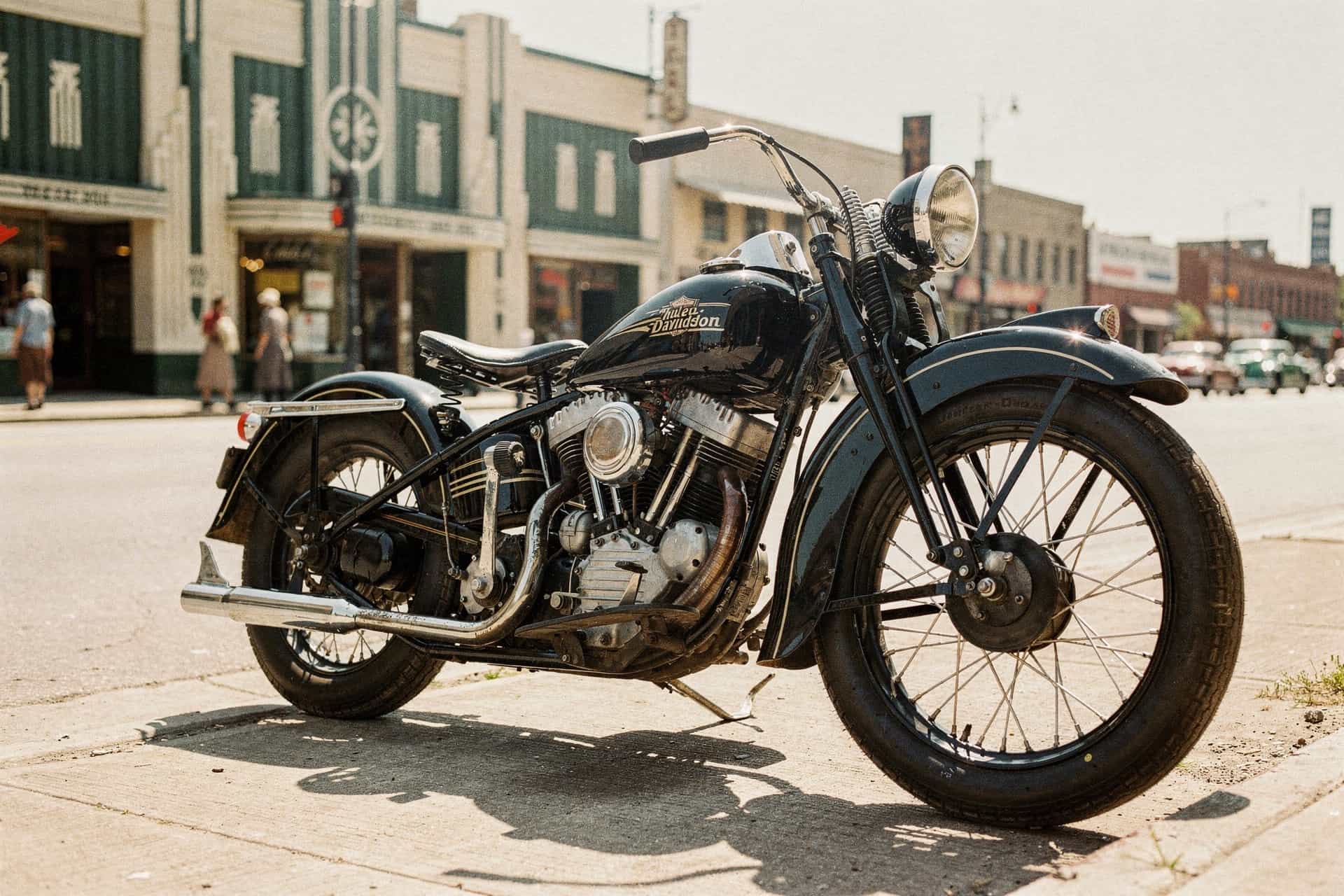
The 1947 Knucklehead in Short
If you are here because you are looking at a 1947 bike, this is the summary before the history.
| Question | Answer for 1947 |
|---|---|
| Is 1947 the last Knucklehead year | Yes. The Panhead replaced it for 1948 |
| Displacements offered | 61 cubic inches, about 989cc, and 74 cubic inches, about 1,208cc |
| Model codes | E and EL for the 61, F and FL for the 74, with S variants geared for sidecar use |
| What changed by 1947 | Eleven years of running changes to oiling, cam profiles and valve train. Final-year bikes are the most sorted of the run |
| Recorded auction range | About $44,000 for a 1947 EL and $192,500 for a 1947 FL, both at Mecum Las Vegas in 2021 |
| Biggest buying risk | Reproduction cases and heads on a bike sold as original. Matching numbers is the value hinge |
Horsepower figures for these engines come from period literature and enthusiast references, not a modern standardized dyno, so treat any single number as approximate. The sections below give the full lineup, the engineering, and what the final year actually changed.
March 1936: A Clenched Fist on the Showroom Floor
Harley-Davidson dealers had been waiting four years. Rumors of a new overhead valve engine had circulated since 1932, when prototypes were spotted at the Milwaukee factory. Indian already had OHV power in its Sport Scout lineup. The British were shipping fast overhead valve singles across the Atlantic. Harley’s flatheads were tough and proven, but they were losing the horsepower race - and everyone in the dealer network knew it.
Then the 61E rolled onto showroom floors for the 1936 model year, and the wait was over.
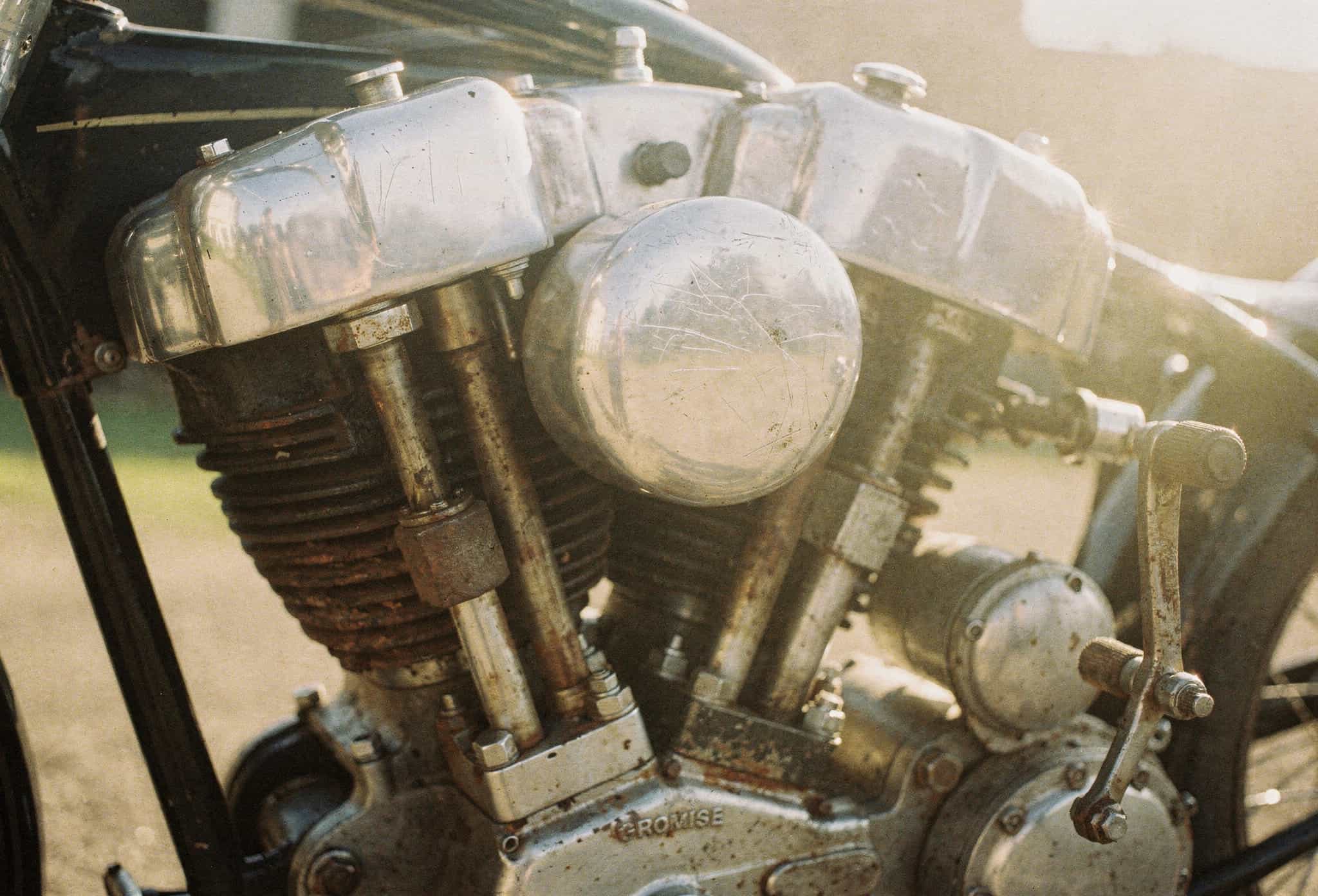
The new engine looked nothing like the flatheads. Two massive rocker covers sat on top of the cylinders, each one bulging with the rounded contours of a clenched human fist. Nobody at Harley-Davidson called it the “Knucklehead” - that nickname came from riders and mechanics who saw those rocker covers and could not un-see the resemblance. The factory designation was the Model 61E (or 61EL for the high-compression Sport Solo version). But “Knucklehead” stuck, and it became one of the most recognized engine names in motorcycle history.
What sat beneath those knuckle-shaped covers was a genuine engineering leap. The Harley Knucklehead was the company’s first overhead valve Big Twin - and the first Harley V-twin with a recirculating oil system. Those two innovations alone put Harley-Davidson back in the performance conversation after years of playing it safe with side-valve designs.
Why the Knucklehead Mattered: Technical Breakthroughs
To understand what the Knucklehead represented, you need to know what came before it.
The Flathead Problem
Harley’s side-valve (flathead) engines positioned both valves beside the cylinder bore rather than above the combustion chamber. This made for a simple, reliable motor - easy to manufacture and easy to service with basic tools. The 45-cubic-inch flathead was a workhorse that would eventually serve in World War II as the WLA military bike.
But flatheads had an inherent breathing limitation. Because the intake charge had to make a sharp turn around the valve and into the combustion chamber, volumetric efficiency dropped off at higher RPMs. You could make a flathead reliable. Making it fast was a different problem.
OHV: Valves Move Upstairs
The Knucklehead solved this by placing the valves directly above the combustion chamber, operated by pushrods and rocker arms. This overhead valve (OHV) layout allowed for hemispherical combustion chambers - a design that improved flame propagation and allowed higher compression ratios without detonation. Air and fuel flowed in a straighter, more efficient path.
The result: more horsepower per cubic inch than anything Harley had built before.
Recirculating Oil System
Pre-Knucklehead Harleys used a total-loss oiling system on some components, where oil was consumed and expelled rather than recycled. The Knucklehead introduced a true dry-sump recirculating system with an external oil tank, oil pump, and return lines. Oil circulated through the engine, was scavenged from the crankcase, cooled in the external tank, and pumped back through.
This was not a Harley invention - the concept existed in automotive and aviation engines - but it was a first for the Harley-Davidson Big Twin platform, and it made extended high-speed riding feasible without cooking the engine.
The system was a major step forward for 1936 and it still had quirks. The check valve in the oil pump could let oil seep past while a bike sat, pooling in the crankcase, the condition riders have called wet sumping for decades. The practical consequence has not changed: if you buy a Knucklehead that has been parked for a long time, drain the crankcase before you kick it over. Otherwise you risk hydraulic lock, or at minimum a smoke show that will alarm everyone in a two-block radius.
The Model Lineup: E, EL, ES, F, and FL
The Knucklehead was produced from 1936 through 1947 across two engine displacements and several model variants. Here is how the lineup broke down.
61-Cubic-Inch Models (989cc) - 1936 to 1947
| Model | Compression Ratio | Horsepower | Configuration |
|---|---|---|---|
| 61E | 6.5:1 | ~37 hp | Standard solo |
| 61EL | 7.0:1 | ~40 hp | Sport Solo (higher compression) |
| 61ES | 6.5:1 | ~37 hp | Sidecar gearing |
The 61EL was the performance model - the one racers and sport riders wanted. Its higher compression ratio squeezed roughly 3 more horsepower from the same displacement, and paired with solo gearing, it was the fastest production Harley-Davidson you could buy in 1936.
Bore and stroke for the 61-inch engine: 3.3125 inches bore x 3.5 inches stroke. The classic undersquare design that favored low-end torque over top-end screaming - a Harley tradition that continues to this day.
74-Cubic-Inch Models (1208cc) - 1941 to 1947
| Model | Compression Ratio | Horsepower | Configuration |
|---|---|---|---|
| 74F | 6.5:1 | ~45 hp | Standard solo |
| 74FL | 7.0:1 | ~48 hp | Sport Solo (higher compression) |
| 74FS | 6.5:1 | ~45 hp | Sidecar gearing |
Harley expanded the Knucklehead to 74 cubic inches for the 1941 model year by increasing the bore to 3.4375 inches and the stroke to 3.96875 inches. The bigger motor added meaningful torque across the rev range and made the FL the preferred platform for police departments and long-distance touring.
The 74FL in particular became the heavyweight champion of American motorcycling - enough power to haul a loaded sidecar or cruise at highway speeds with authority. This engine displacement would remain the core of Harley’s Big Twin lineup for decades, carrying through the Panhead and Shovelhead eras.
For a full picture of how the Knucklehead fits into the larger Harley-Davidson engine timeline - from flatheads through the Milwaukee-Eight - read our complete Harley-Davidson history guide.
Joe Petrali and the Daytona Speed Record
Before the Knucklehead even reached most dealers, a factory rider named Joe Petrali proved what it could do.
On March 13, 1937, at Daytona Beach, Florida, Petrali rode a 61-cubic-inch Knucklehead to a two-way average of 136.183 mph on the hard-packed sand, setting a new motorcycle speed record and beating the mark Indian had held.
The machine matters to the story. This was Harley-Davidson’s first factory-built land speed racer, a 1937 EL fitted with low handlebars, a fairing reshaped from a fuel tank over the front forks, and a tail fin. The fin generated enough vibration during testing that the team removed it before the record attempt. So the engine architecture was the production Knucklehead, but the motorcycle around it was not.
Petrali was already a decorated racer by then, with a national board track championship, five dirt track titles between 1931 and 1936, and eight national hillclimb championships. He was later inducted into the Motorsports Hall of Fame of America in 1992 and the AMA Motorcycle Hall of Fame in 1998.
The record stood for eleven years, until Rollie Free ran 150.313 mph on a Vincent at Bonneville in September 1948. Petrali’s number has never been beaten on sand. Daytona Beach later commemorated the run with a bronze sculpture by Jeff Decker.
The same year, Fred Ham took a 61 OHV around Muroc Dry Lake in California for 24 hours at an average near 76 mph. Between the two runs, Harley had an answer for anyone asking whether the new overhead valve twin would hold together.
The War Years: Production Interrupted
The Knucklehead’s momentum was cut short by World War II. After the attack on Pearl Harbor in December 1941, the War Production Board restricted civilian motorcycle manufacturing. Harley-Davidson shifted nearly all production to military contracts, building approximately 90,000 WLA flathead motorcycles for the Allied forces between 1940 and 1945.
A small number of Knucklehead-powered machines were produced during the war years for essential civilian and military-adjacent use, but volume dropped dramatically. The 74-cubic-inch FL model had barely established itself when wartime restrictions kicked in, meaning the big-bore Knucklehead never got the full peacetime production run it deserved.
If you’re into the Harley heritage and want to wear the history, our full collection has tees and hoodies built for riders who know what these engines mean. And for everyday riding gear, check out our t-shirt lineup - designed in the garage, not a boardroom.
1947: The Final Year
The 1947 model year was the Knucklehead’s last. Harley-Davidson produced both the 61-inch and 74-inch versions, but the factory was already preparing the next evolution - the Panhead, which would debut for 1948 with aluminum heads, hydraulic lifters, and improved oil sealing.
The 1947 Knucklehead received incremental updates from the prewar models - improved internal oiling, refined cam profiles, and detail changes to the valve train - but it was fundamentally the same engine that debuted in 1936. Eleven years of continuous refinement had made it more reliable than the early models, which had earned a deserved reputation for oil leaks, stuck valves, and bottom-end failures when pushed hard.
By 1947, Harley had sorted most of those issues. The final-year Knuckleheads are considered by many collectors and mechanics to be the most refined and reliable of the entire production run - the bugs worked out, the tolerances tightened, the oiling system improved.
The World Around the 1947 Knucklehead
The 1947 model year occupies a unique place in motorcycle history beyond just the engine. That same year:
-
The Hollister rally took place over the Fourth of July weekend, when roughly 4,000 riders descended on the small California town. The event turned rowdy, the media sensationalized it, and the incident eventually inspired the 1953 film The Wild One starring Marlon Brando. The Hollister incident is widely considered the birth of the outlaw biker image in American culture - the Knucklehead era essentially seeded everything that came after; for the full picture of how that culture evolved, our motorcycle culture guide traces the thread from Hollister to the present day.
-
Postwar demand surged. Thousands of veterans returning from World War II wanted motorcycles. Many had ridden military bikes during the war and came home with riding skills and a taste for the freedom that two wheels offered. The surplus of military-trained riders created a massive wave of demand for civilian motorcycles.
-
The custom culture seeds were planted. Returning GIs with mechanical training from military service began stripping down and modifying their bikes - removing fenders, cutting frames, swapping handlebars. This is the generation that created the bobber and chopper movements. The Knucklehead, with its strong aftermarket support even in 1947, was one of the platforms they built on.
Early Reliability Issues and How They Were Solved
The Knucklehead’s reputation today is almost entirely positive - an icon, a collector’s grail, a symbol of everything right about Harley-Davidson engineering. But the early production years were rough.
1936-1937: Growing Pains
The first-year 61E models had significant problems. Oil leaks were widespread - the rocker covers, pushrod tubes, and crankcase joints all seeped. The recirculating oil system was a first for Harley’s Big Twin, and the sealing technology was not always up to the task.
More seriously, some early engines experienced valve train failures under sustained high-RPM riding. The cam lobes wore prematurely, rocker arms cracked, and the valve springs were not always matched to the engine’s operating range. Harley issued running changes throughout the 1936 and 1937 model years to address these problems, making early Knuckleheads something of a moving target for restorers - two “1936” engines can have different internal specifications depending on when they were built.
1938-1940: Refinement
By 1938, most of the critical early-production issues were addressed. Harley improved the cam profiles, upgraded valve spring materials, and revised the oil pump check valve design. The engine became substantially more reliable, and the Knucklehead’s reputation shifted from “promising but troublesome” to “proven performer.”
1941-1947: Maturity
The introduction of the 74-cubic-inch models in 1941 brought further refinements to the entire Knucklehead line. The larger engine required stronger cases and improved oiling, and many of those improvements were applied across both displacement options. The postwar 1946 and 1947 models represent the peak of Knucklehead development - the most reliable, the best-sealed, and the strongest-running versions ever produced.
Riding one is a different experience from any later Big Twin, and that is a design consequence rather than an opinion. The valve train is exposed and mechanically audible in a way the enclosed Panhead top end is not, and the engine is mounted with less isolation than the bikes that followed. Some riders want exactly that. Others find it tiring over distance. If you have never ridden one, expect a machine that asks for your attention continuously.
Knucklehead vs. Panhead: What Changed
The Panhead replaced the Knucklehead for the 1948 model year. Understanding what changed - and what did not - helps explain why both engines have passionate followings.
| Feature | Knucklehead (1936-1947) | Panhead (1948-1965) |
|---|---|---|
| Cylinder heads | Cast iron | Aluminum alloy |
| Valve adjustment | Manual screw adjusters | Hydraulic lifters |
| Rocker covers | Exposed “knuckle” shape | Enclosed “pan” shape |
| Oil sealing | Improved over production run, but persistent leaks | Better (still not perfect) |
| Cooling | Adequate for 61ci, marginal for 74ci | Significantly improved (aluminum conducts heat 3x better than iron) |
| Bottom end | Identical architecture | Same as late Knucklehead |
The Panhead kept the Knucklehead’s bottom end - same crankcase architecture, same transmission bolt-up pattern. The changes were all in the top end: aluminum heads for better cooling, hydraulic lifters to eliminate manual valve adjustment, and pan-shaped covers that enclosed more of the valve train (though they introduced their own oil sealing challenges).
What a 1947 Knucklehead Is Worth Today
The Knucklehead is one of the most valuable production motorcycles in the collector market, and 1947 models - as the final year - command particular attention.
Values depend heavily on condition and originality. The critical factor is matching numbers, meaning the engine cases, frame and transmission carry serial numbers from the same original production unit.
Rather than publish a made-up range, here is what has actually been recorded at auction. These are individual results, not a price guide.
| Bike | Result | Sale |
|---|---|---|
| 1947 Model EL | $44,000 | Mecum Las Vegas, 2021 |
| 1947 Model FL | $192,500 | Mecum Las Vegas, 2021 |
| 1940 Model EL | $220,000 | Mecum Las Vegas, 2020, the Knucklehead auction record at the time |
| 1943 Model E and 1946 Model FL | $220,000 each | Mecum Las Vegas, 2021, matching that record |
| 1936 Model EL | $159,500 and $154,000 | Mecum Las Vegas, 2021, two separate first-year bikes |
| 1944 Model FL | $143,000 | Mecum Las Vegas, 2021 |
Two things stand out in that data. The first is spread: two 1947 bikes at the same auction house differed by roughly $148,000, which tells you that “a 1947 Knucklehead” is not a price point. The second is scarcity at the top. Before the 2020 and 2021 sales, only a handful of Knuckleheads of any year had ever cleared $100,000. Any valuation that treats a six-figure result as the baseline is describing the exception.
The final-year status of 1947 does carry collector interest, but the results above show model, condition and documentation moving the number far more than the year does.
Reproduction parts are widely available for Knuckleheads. That keeps bikes on the road, and it also means a restored example needs scrutiny. A bike with period-correct appearance but reproduction cases and heads is worth a fraction of a genuine matching-numbers machine, and the difference does not show up in photographs.
The Harley-Davidson Fat Boy is a modern descendant that carries some of the same Big Twin DNA - worth reading about if you want to see how the platform evolved across seven decades.
The Knucklehead’s Place in the Big Twin Lineage
The Knucklehead was not just an engine. It was the foundation of a platform architecture that Harley-Davidson would build on for over 80 years.
The OHV Big Twin layout - 45-degree V-twin, pushrod-operated overhead valves, separate transmission, dry-sump oiling - debuted with the 1936 Knucklehead and continued through:
- Panhead (1948-1965): Aluminum heads, hydraulic lifters
- Shovelhead (1966-1984): Restyled heads, alternator conversion
- Evolution (1984-1999): All-aluminum, the engine that saved Harley from bankruptcy
- Twin Cam (1999-2017): Dual camshafts, increased displacement options
- Milwaukee-Eight (2017-present): Four valves per cylinder, dual-cooled options
Every one of those engines traces its DNA back to the architecture decisions made on the Knucklehead. The 45-degree cylinder angle. The separate gearbox. The dry-sump oiling. The pushrod-operated OHV layout. The Knucklehead established the template that Harley-Davidson refined for the next eight-plus decades.
That is why the Harley Knucklehead holds the position it does in motorcycle history. Not because it was perfect - the early models were far from it. But because it was the right engine at the right time, and its basic architecture proved durable enough to evolve through nearly a century of production.
Sources
- City of Daytona Beach - A Record Run, Remembered - the March 13, 1937 record, the 136.183 mph two-way average, and the commemorative sculpture
- Harley-Davidson Insurance - Joe Petrali, A Motorcycle Racing Legend - Petrali’s championship record and career after racing
- Motorsports Hall of Fame of America - Joe Petrali - induction record and racing career summary
- Silodrome - American Legend: A 1937 Harley-Davidson EL Knucklehead - the factory streamliner build, the removed tail fin, and the engine’s development context
- New Atlas - Harley-Davidson Knuckleheads rock the collectible motorcycle auction marketplace - the recorded Mecum results used in the values table, including the $220,000 record and the sub-$100,000 historical baseline
- Classic.com - 1947 Harley-Davidson EL Knucklehead - auction result tracking for the specific model year
- Wilson, Hugo. The Encyclopedia of the Harley-Davidson. Dorling Kindersley, 2001 - model designations, displacement data and compression ratios for the E, EL, F and FL models
- Sucher, Harry V. Harley-Davidson: The Milwaukee Marvel. Haynes Publishing, 2000 - early Knucklehead reliability history and the running changes made across the production run