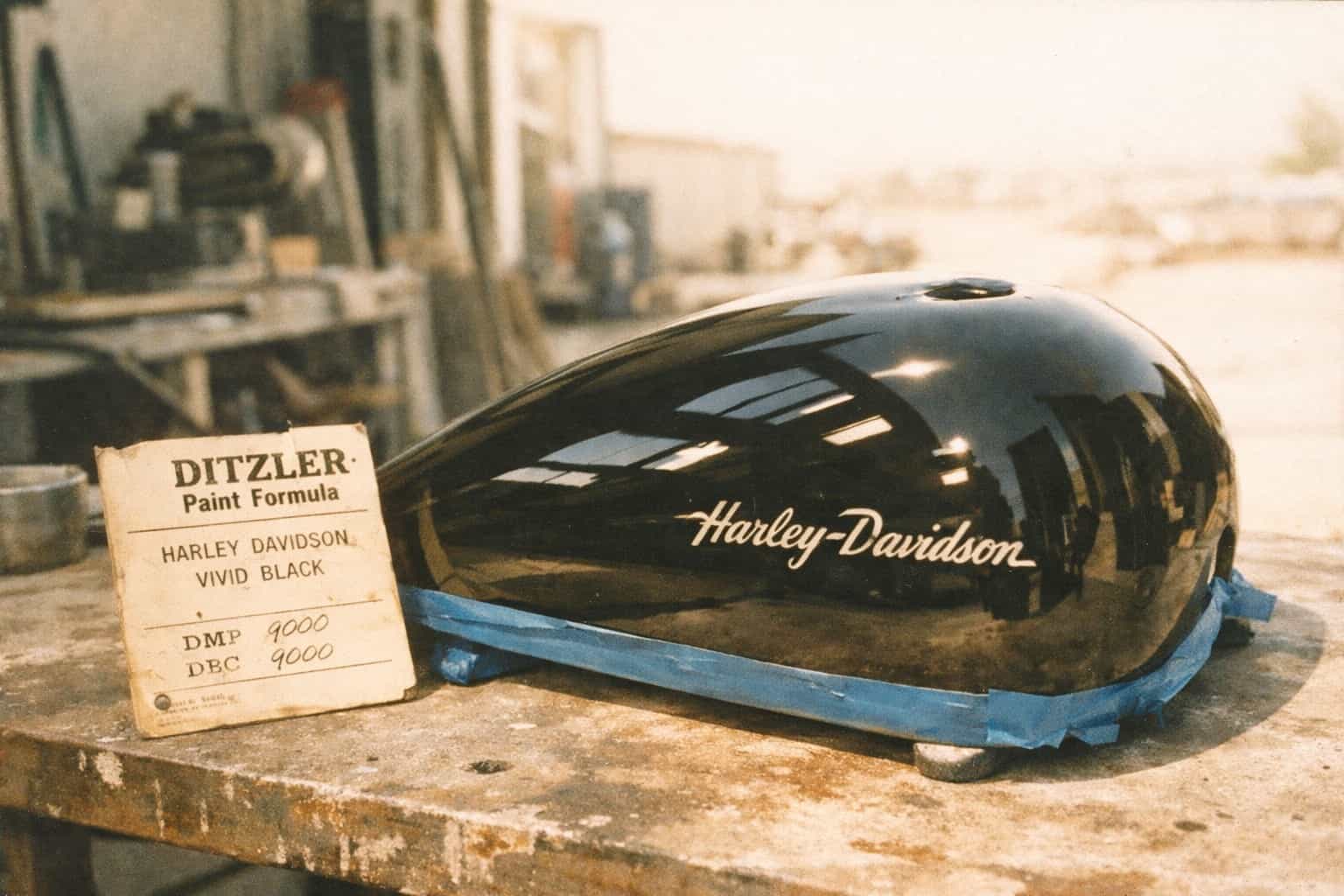
There is no single number that solves every Harley paint repair. A motorcycle can carry a factory color option code, a painted-part suffix, a color name, and a refinish formula from PPG or another supplier. Those identifiers are related, but they are not interchangeable.
That is why two tanks both called Vivid Black can become a bad match in sunlight. Model year, product line, formula variant, aging, substrate, film build, and spray technique all affect the result. The reliable workflow starts with the motorcycle, not a number copied from an unsourced chart.
This guide shows how to identify the factory finish and hand a paint supplier enough information to retrieve the right current PPG formula.
The Three Codes Riders Commonly Mix Up
1. Harley color option code
Harley-Davidson painted-parts catalogs list color option codes alongside models and paint names. The same color name can carry different option codes in different catalogs or applications. For example, factory catalogs list Vivid Black with several codes across years and models.
The option code identifies a factory configuration inside Harley’s parts system. It is not automatically a PPG mix formula.
2. Harley painted-part suffix
Painted tanks and fenders often have a base part number plus a suffix that identifies the finish. The suffix helps a dealer order a finished part. It does not tell a painter how many grams of each toner to mix.
3. PPG refinish formula and variant
PPG formulas belong to a specific refinish system and product line. A distributor or body shop retrieves the formula using the vehicle maker, color identity, product line, market, and available variant information. PPG’s own color material explains that variants and standardized application methods are part of accurate color matching.
A historical Ditzler number can be a search lead, but it is not a complete repair specification. It may not identify the current product line, undercoat, variant, additive, clear, or application process.
Factory Harley Color Examples
The examples below come from Harley-Davidson painted-parts catalogs. They are factory option codes, not PPG formulas. Their purpose is to show why a year and model are required.
| Catalog application | Factory color name | Harley option code | What the example shows |
|---|---|---|---|
| 1999 FLHT | Vivid Black | 024 | A documented late-1990s Touring application |
| 2003 FXD | Vivid Black | 010 | The name remains while the catalog code differs |
| 2013 FXDBP 103 | Vivid Black | 010 | Exact model and engine application are part of the lookup |
| 2013 FXDBP 103 | Black Denim | 016 | Low-gloss black is a separate finish identity |
| 2013 FXDBP 103 | Big Blue Pearl | 512 | Pearl identity is tied to a specific catalog entry |
| 2013 FXDBP 103 | Ember Red Sunglo | 514 | A color name and option code travel together |
| 2014 FLHR | Vivid Black | 024 | Vivid Black does not carry one universal Harley option code |
| 2014 FLHR | Brilliant Silver | 073 | The option belongs to this documented application |
| 2017 XL1200X | Vivid Black | 010 | Sportster application from the 2017 factory catalog |
| 2017 XL1200X | Billet Silver | D31 | Letter-number option codes also appear |
| 2021 FLTRXS | Vivid Black | 010 | Factory code documented for this Touring application |
| 2021 FLTRXS | Midnight Crimson | F20 | Later colors use their own option identities |
These rows do not imply that a code applies to every Harley in the same year. The factory catalogs frequently list different codes, trim treatments, two-tone schemes, and painted-part assemblies within one model family.
PPG Formula Lookup: Turn the Harley Record Into a Mix
PPG says ColorMobile has been replaced by PPG LINQ Color. Its current PaintManager XI software manages color retrieval and mixing. Access and available product lines depend on the shop, distributor, and market. That means a useful lookup has two stages: establish the Harley factory identity first, then retrieve the formula inside the current PPG system that will actually be sprayed.
Use the factory examples above as lookup inputs, not mix codes:
| Motorcycle record | Harley identity to give the PPG operator | PPG result the shop must record |
|---|---|---|
| 1999 FLHT | Harley-Davidson, 1999 FLHT, Vivid Black, option 024 | Product line, formula identifier, variant, ground coat, and clear system |
| 2003 FXD | Harley-Davidson, 2003 FXD, Vivid Black, option 010 | Product line, formula identifier, variant, ground coat, and clear system |
| 2013 FXDBP 103 | Exact color name plus option 010, 016, 512, or 514 | The result for that specific gloss, Denim, pearl, or Sunglo entry |
| 2014 FLHR | Vivid Black 024 or Brilliant Silver 073 | The result attached to the selected 2014 Road King color, not another 2014 model |
| 2017 XL1200X | Vivid Black 010 or Billet Silver D31 | The result for the selected Sportster application and local product line |
| 2021 FLTRXS | Vivid Black 010 or Midnight Crimson F20 | The result for the selected trim and color application |
At the counter or in the shop software, use this order:
- Select Harley-Davidson as the manufacturer and enter the exact model year.
- Search the factory color name, then use the Harley option code and model to reject same-name results from another application.
- Select the PPG product line that the painter is equipped and approved to spray.
- Record the formula identifier and every available variant rather than copying only the first result.
- Print the formula with its ground-coat, additive, clear, and technical-sheet references.
- Spray a test card and keep the approved card with the printout.
A public static article cannot safely reproduce the live toner recipe for every PPG line, region, and formula revision. The supported value here is the cross-reference path and the verified Harley inputs. If a supplier cannot show which PPG system produced the formula, the lookup is incomplete.
Our rule for paint work is simple: no mix gets near the tank until the formula printout and test card agree with the motorcycle in more than one light.
How to Find the Right Harley Paint Identity
Step 1: Establish the exact motorcycle
Record the complete VIN, model, model year, and market. Use the Harley VIN decoder guide if the bike’s identity is uncertain.
The VIN helps select the correct factory literature. It does not directly translate into a PPG formula. A repaint, replacement tank, or market-specific configuration can also break the link between the current panel and the motorcycle’s original build.
Step 2: Find the factory color name
Open the model-year painted-parts catalog in the Harley-Davidson Service Information Portal. Match the model and trim to the listed color name and option code. If the motorcycle is a Custom Vehicle Operations model, limited paint set, anniversary edition, or police model, use its dedicated catalog or parts entry.
Do not choose a color because a marketplace photograph looks close. Screen calibration, lighting, camera processing, and image compression make visual identification unreliable.
Step 3: Check whether the panel is original
Inspect invoices, labels, paint edges, decal placement, and the back of the part. Look for a painted-part number or suffix. A tank can be a genuine Harley part from another model, a service replacement, or a previously stripped and repainted original.
Our Harley tank-emblem guide explains how graphics, mounting points, and part numbers can support the investigation without pretending the emblem proves the year.
Step 4: Give the PPG distributor complete inputs
Provide:
- Manufacturer: Harley-Davidson
- Exact model and model year
- Market, if known
- Factory color name
- Harley option code
- Painted-part suffix, if available
- Finish type, such as gloss, pearl, candy, or Denim
- The PPG product line the painter intends to use
Ask the distributor whether more than one formula variant exists. If the color is absent from the current system, ask what spectrophotometer or custom-match process the shop recommends.
Step 5: Spray a test card
Mixing to a formula is not the end of color matching. Spray a card with the intended ground coat, gun setup, film build, flash times, and clear. Compare it with the clean motorcycle panel in daylight and controlled shop light.
For metallic and pearl finishes, compare face and side angles. PPG’s color science material describes how color travel and flake orientation affect the appearance. A card that matches head-on may shift too dark or too green from the side.
Why the Old 1991-2012 PPG Chart Was Removed
Earlier versions of this page reproduced a large year-by-year table from third-party websites. That created two problems:
- The rows were not tied to PPG formula records or Harley factory catalogs.
- The table implied complete year coverage even though it listed only selected colors.
One cited database is now suspended, and the remaining crossover page does not provide the primary formula record needed to validate every row. Repeating those numbers would create false confidence. The factory-option examples above are narrower because each comes from a Harley catalog, and the article sends the final formula lookup back to PPG’s current system.
This is less convenient than a giant chart. It is also safer than mixing expensive paint from an unsupported number.
Finish Type Changes the Repair
Solid and basecoat colors
A solid-looking color may still be supplied as basecoat and clearcoat in the shop’s chosen system. Use the current technical sheet rather than assuming the historical factory process.
Metallic and pearl
Metallic flake orientation changes with gun distance, pressure, reducer, coat pattern, and flash time. Pearl systems may include a ground coat or mid-coat. Formula identity alone cannot correct poor application.
Candy and multi-stage finishes
Color depth changes with the ground coat and number of translucent coats. A slash between two historical numbers does not prove that those are the only components or provide the application sequence.
Denim and other low-gloss finishes
Do not polish a Denim finish as if it were conventional gloss clear. Gloss level is part of the match. Blending and spot repair can leave a permanent sheen difference, so the repair plan should come from the exact product system.
Two-tone and special paint
Confirm both colors, the dividing graphic or stripe, and the trim package. A two-tone option code can identify the complete scheme rather than one panel color. Custom factory paint may require a dedicated parts catalog or specialist match.
Matching Paint That Has Aged
UV exposure, heat, chemicals, fuel spills, polishing, and prior repairs change the panel. Even a verified factory formula can look different beside paint that has spent twenty years in the sun.
A painter may choose a documented variant, measure the panel, tint the mix, or blend into an adjacent area. Which method is appropriate depends on the finish and repair size. Keep the formula printout, variant, product line, spray-out card, and final mix notes with the motorcycle’s records. That evidence saves the next repair from starting at zero.
Touch-Up, Panel Repair, or Full Repaint
The correct paint identity does not determine the repair size. A tiny chip on a solid color may be suitable for careful touch-up. A damaged metallic area may need blending beyond the visible defect. A candy or low-gloss finish can make a small local repair more visible than a larger controlled refinish.
Ask the painter to explain where the color and clear will end, which adjacent panels will be blended, and how the repaired texture and gloss will match. Fuel-tank work also requires attention to fuel resistance, decal or emblem placement, and safe curing before reassembly.
For a full custom repaint, the original code may matter only as a record of what was removed. Write down the new manufacturer, product line, formula, variant, ground coat, clear, matting additive, and spray-out result. A custom color without a recorded system becomes the next owner’s unsourced mystery.
What the Shop Should Return
Keep a copy of the formula and variant, the mixed quantity, batch information where available, technical sheets, and a labeled test card. Photograph the repaired panel in daylight after assembly. If leftover activated material cannot be stored, ask whether a small amount of unmixed base can be labeled for future reference.
Those records are more useful than writing one number under the seat. They preserve the complete system needed to repeat the finish.
Photograph the Existing Finish Before Work
Take reference photographs in open shade, direct sun, and neutral shop light before sanding. Include the whole motorcycle, each panel, emblem placement, pinstripes, transitions, and close-ups of damage. Place a neutral gray card in several frames if the painter uses photographs during planning.
Phone images cannot provide a mixing formula, but they preserve layout and condition. They also show whether a mismatch existed before the repair. Measure stripe widths and distances from fixed edges instead of relying on perspective-distorted photographs alone.
Questions to Ask Before Buying Paint
- Is this number a Harley option code, painted-part suffix, historical Ditzler reference, or current PPG formula?
- Which PPG product line does the formula use?
- Does the lookup show variants?
- What ground coat, sealer shade, clear, or matting process is required?
- Is the formula available in the market where the repair will happen?
- Has the painter sprayed and compared a test card?
- Is the existing tank confirmed original to the motorcycle?
If the seller cannot answer what kind of code it is, do not treat the number as mix-ready.
Paint as Restoration Evidence
Factory paint can help establish originality, but it should be read with the VIN, parts, fasteners, emblems, and service history. The Harley-Davidson history guide provides the model-era context, while the custom bobber guide covers builds where factory paint is not the goal.
For an original-style repair, document every identifier before stripping the panel. For a custom build, keep the new formula and spray-out card so future touch-ups can be matched without repeating the research.
Whatever the finish, gear up for the ride. We build for people who use their machines. The In Gasoline We Trust tee fits the hours spent getting the tank right.
Sources
- Harley-Davidson - 1999 Painted Parts Catalog - factory 1999 model, color, and option-code entries
- Harley-Davidson - 2003 Painted Parts Catalog - factory 2003 model and Vivid Black option-code entry
- Harley-Davidson - 2013 Painted Parts Catalog - factory model, color, option-code, and painted-part entries used in the example table
- Harley-Davidson - 2014 Painted Parts Catalog - factory 2014 color option examples
- Harley-Davidson - 2017 Painted Parts Catalog - factory 2017 color option examples
- Harley-Davidson - 2021 Painted Parts Catalog - factory 2021 color option examples
- PPG Refinish - PPG LINQ Color - official notice that PPG LINQ Color replaced ColorMobile
- PPG Refinish - PaintManager XI - current PPG color-retrieval and paint-mixing software
- PPG Refinish - Identify Color Formula - current manufacturer procedure for identifying a color formula and checking variants