


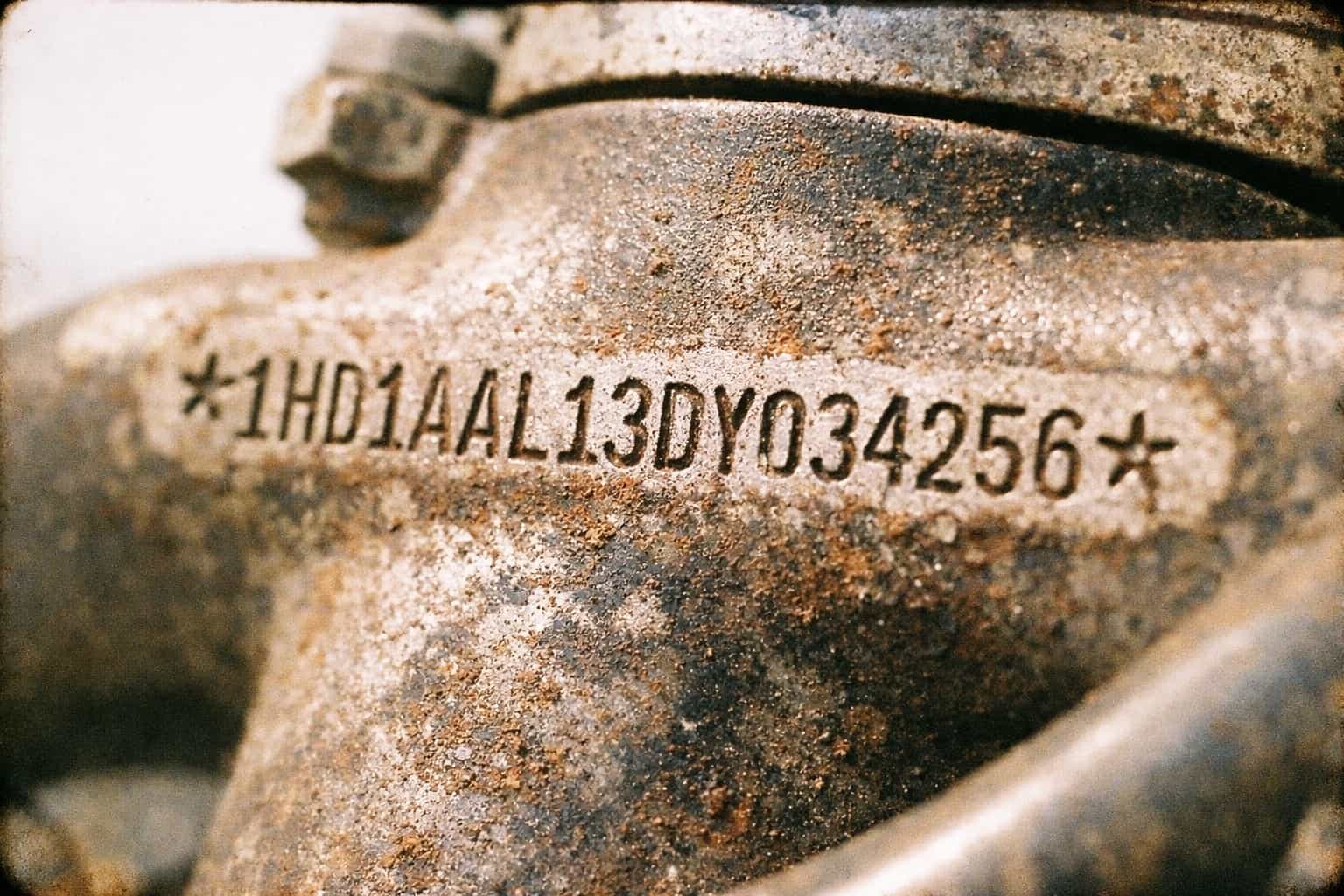
A VIN is the only part of a used Harley that cannot tell you a story. The seller can be wrong about the year, the title can carry a typo copied forward for three owners, and a set of badges can say anything. The number stamped into the frame either checks out or it does not.
Most VIN pages online hand you a chart and let you guess whether it applies. This one is ordered by how much you can trust each step: the free federal tools first, then the math you can do yourself, then the manufacturer code that needs confirming, and finally the pre-1981 formats where no verification method exists at all.
Decode a Harley VIN in Four Steps
Start here. This takes about fifteen minutes and it costs nothing.
1. Read the stamped number off the bike. Start with the owner’s manual for the exact model and year because the location is not universal. On the 2018 Softail pattern used below, the full VIN is stamped on the right side of the frame at the steering head. Pre-1970 machines generally use a number on the left engine case. Photograph the stamp and compare it character by character against the title, including the characters people mistype: 1 against I, 0 against O, 5 against S, 2 against Z.
2. Run it through NHTSA vPIC. The free federal VIN decoder returns what the manufacturer reported to NHTSA for that VIN pattern: make, model, model year, plant, and engine data where the manufacturer supplied it. It covers vehicles from model year 1981 onward. This is a better first move than any enthusiast chart, because the data came from the manufacturer rather than from someone copying a chart.
3. Validate the check digit yourself. Position 9 is a calculated character. If the math does not agree with what is stamped, stop, because everything downstream is unreliable. The worked calculation is below.
4. Run the free safety and history checks. NHTSA’s recall lookup tells you about open recalls on that exact machine. NICB VINCheck reports theft and salvage records contributed by participating insurers. Both are free.
Everything after this point is detail that helps you interpret the results and handle the bikes those tools cannot cover.
Where the Number Is Stamped
2018 Softail example. The full VIN is stamped on the right side of the frame at the steering head. This is the family and year used in the worked example below.
Other 1970 and later models. Consult the exact model-year owner’s manual before choosing a side or frame tube. Harley has used the steering-head area, adjacent frame tubes and separate certification labels differently across families and generations. The stamped VIN, label and title should agree character for character.
Before 1970. The identification number was stamped on the left engine case. There was no separate frame number, so the engine was the vehicle identifier. That is exactly the problem on machines that went through the chopper era, when motors and frames were separated routinely.
Compliance label. Modern bikes also carry a federal certification label, usually on the frame, showing the VIN with the manufacture date. Easier to read, and easier to replace or forge. It is a convenience copy. Verify it against the stamp.
Frame number against engine number. On an unmodified modern Harley the engine carries its own stamped number and it should correspond to the frame VIN. A mismatch usually means a motor swap, which is common and not automatically a problem. It does mean the machine’s history is more complicated than the title suggests, and it means parts ordered by VIN may not match what is actually installed.
The legal VIN claim, stated accurately
Older guides say the steering-head stamp is “always” the legal VIN. That overstates it.
For ordinary US titling of modern motorcycles, the frame VIN is the identifier of record, and that is why the stamp is what you match against the title. Titling rules for pre-1981 machines, rebuilt and assembled vehicles, kit and custom frames, and imported bikes vary by state and by era, and some historic registrations were issued against an engine number. If you are titling a custom build, a barn find, or anything with a story attached, the answer comes from your state DMV, not from a decoder chart.
Validate the Check Digit
Position 9 is defined by the federal standard, which means it can be checked without trusting anyone’s table. Here is the method, worked all the way through.
Step 1: transliterate. Numbers keep their value. Letters convert as follows.
| Letter | Value | Letter | Value | Letter | Value |
|---|---|---|---|---|---|
| A | 1 | J | 1 | S | 2 |
| B | 2 | K | 2 | T | 3 |
| C | 3 | L | 3 | U | 4 |
| D | 4 | M | 4 | V | 5 |
| E | 5 | N | 5 | W | 6 |
| F | 6 | P | 7 | X | 7 |
| G | 7 | R | 9 | Y | 8 |
| H | 8 | Z | 9 |
Step 2: apply the position weights. In order from position 1 to 17: 8, 7, 6, 5, 4, 3, 2, 10, 0, 9, 8, 7, 6, 5, 4, 3, 2. Position 9 carries a weight of zero, which is what lets the check digit be calculated from the other sixteen characters.
Step 3: sum, divide by 11, take the remainder. A remainder of 10 is written as X.
Worked on the synthetic VIN 1HD1YJJ1XJC000001. It uses a valid 2018 Harley descriptor pattern and a made-up sequence for arithmetic. NHTSA vPIC returns error code 0 for this pattern and confirms the check digit is correct.
| Position | Character | Value | Weight | Product |
|---|---|---|---|---|
| 1 | 1 | 1 | 8 | 8 |
| 2 | H | 8 | 7 | 56 |
| 3 | D | 4 | 6 | 24 |
| 4 | 1 | 1 | 5 | 5 |
| 5 | Y | 8 | 4 | 32 |
| 6 | J | 1 | 3 | 3 |
| 7 | J | 1 | 2 | 2 |
| 8 | 1 | 1 | 10 | 10 |
| 9 | X | check digit | 0 | 0 |
| 10 | J | 1 | 9 | 9 |
| 11 | C | 3 | 8 | 24 |
| 12 | 0 | 0 | 7 | 0 |
| 13 | 0 | 0 | 6 | 0 |
| 14 | 0 | 0 | 5 | 0 |
| 15 | 0 | 0 | 4 | 0 |
| 16 | 0 | 0 | 3 | 0 |
| 17 | 1 | 1 | 2 | 2 |
Total: 175. Divide by 11: 15 with a remainder of 10. A remainder of 10 is written X, and position 9 is X, so the check digit passes.
This is worth doing by hand at least once, because it is the only part of a VIN you can verify with no outside source. Charts can be wrong. Arithmetic cannot.
What Each Position Means, and How Much to Trust It
Under the federal standard, some positions are defined by rule and some are left to the manufacturer. That distinction decides how much weight to put on a decode.
Positions 1-3: World Manufacturer Identifier
| WMI | Meaning |
|---|---|
| 1HD | Harley-Davidson, United States |
| 5HD | Harley-Davidson, export or international |
| MEG / other | Later international assignments |
A 1HD machine was built for the US market. A 5HD was not, which can mean different emissions equipment, instruments and lighting, and it can affect parts fitment. WMI assignments are administered under the federal system, so this position is reliable.
Positions 4-8: Harley’s descriptor section
This is where every enthusiast chart lives, and where the caution belongs. Under the federal standard these five characters are the vehicle descriptor section, and their meaning is assigned by the manufacturer. Harley has used them for weight class, model family, engine displacement and introduction period.
The commonly circulated tables assign codes such as CK and BE to specific model families, and letters in position 7 to specific engine displacements. Those tables came from parts and dealer references compiled by third parties, and they are not a published Harley document. They are a good working guide and they are frequently right. They are not evidence.
Treat position 4-8 output the way you would treat a seller’s description: useful, and worth confirming. Confirm it against vPIC, against the title, and against the machine in front of you. If a chart tells you the bike should have one engine and the case says another, believe the bike.
Position 9: check digit
Calculated, verifiable, described above. This is the strongest single character in the number.
Position 10: model year
Defined by the federal standard as a 30-year cycle of letters and numbers. The letters I, O, Q, U and Z are never used because they read too much like numbers.
| Code | Year | Code | Year | Code | Year |
|---|---|---|---|---|---|
| B | 1981 | V | 1997 | A | 2010 |
| C | 1982 | W | 1998 | B | 2011 |
| D | 1983 | X | 1999 | C | 2012 |
| E | 1984 | Y | 2000 | D | 2013 |
| F | 1985 | 1 | 2001 | E | 2014 |
| G | 1986 | 2 | 2002 | F | 2015 |
| H | 1987 | 3 | 2003 | G | 2016 |
| J | 1988 | 4 | 2004 | H | 2017 |
| K | 1989 | 5 | 2005 | J | 2018 |
| L | 1990 | 6 | 2006 | K | 2019 |
| M | 1991 | 7 | 2007 | L | 2020 |
| N | 1992 | 8 | 2008 | M | 2021 |
| P | 1993 | 9 | 2009 | N | 2022 |
| R | 1994 | P | 2023 | ||
| S | 1995 | R | 2024 | ||
| T | 1996 | S | 2025 | ||
| T | 2026 |
The cycle repeats, which is the trap. A B in position 10 is 1981 or 2011, and a G is 1986 or 2016. The rest of the VIN, and common sense about what the machine is, resolves it. This is also the position that catches a seller who has the year wrong, so it is worth reading before anything else.
Position 11: assembly plant
Harley has assembled in York, Pennsylvania; Kansas City, Missouri, until that plant closed; Milwaukee, Wisconsin; Tomahawk, Wisconsin; Manaus, Brazil; and Bawal, India, for specific models and periods. Plant codes are manufacturer-assigned, so confirm the plant through vPIC rather than a chart if it matters to you.
Positions 12-17: production sequence
The sequential build number within that model year. Lower numbers were built earlier in the run. It is the position that makes a VIN unique, and it is what recall and warranty systems key on.
Reading a Complete VIN
Using the same synthetic example, 1HD1YJJ1XJC000001, and keeping the trust levels straight:
| Position | Characters | Reading | How solid |
|---|---|---|---|
| 1-3 | 1HD | Harley-Davidson, US market | Federally administered |
| 4-8 | 1YJJ1 | Manufacturer descriptor | vPIC decodes the pattern as a Street Bob with 1,750 cc displacement |
| 9 | X | Check digit, verified by the calculation above | Verified by math and vPIC |
| 10 | J | 2018 model year in this descriptor context | Federally defined cycle |
| 11 | C | Kansas City, Missouri assembly plant | vPIC result |
| 12-17 | 000001 | Synthetic sequence used for this example | Made up for illustration |
Notice what each layer proves. The check-digit calculation proves internal consistency. vPIC confirms that the descriptor is a valid 2018 Harley pattern and returns Street Bob, 1,750 cc and Kansas City. It does not prove that this made-up production sequence belongs to a real motorcycle, which is why a real purchase still requires the physical stamp, title, recall check and history checks to agree.
Older versions of this guide printed a worked example whose check digit did not survive the calculation, with a model year and engine combination that did not agree with each other. That is exactly the failure this section exists to prevent, and it is why the arithmetic goes in the article rather than a footnote.
Pre-1981 Serial Numbers
Before model year 1981 there was no federal VIN standard for these machines. Harley used several formats, changed them, and stamped them with less consistency than a modern process would allow. There is no check digit, so there is no way to validate a pre-1981 number by math. Verification is physical and archival.
Before 1930. Numbering was not standardized and surviving records are incomplete. Identification runs through the Harley-Davidson archives, the Antique Motorcycle Club of America, or a marque specialist. No chart will do it.
1930 to 1962: year, model code, production number. For example 49 FL 0001 reads as 1949, FL, first unit of that year. Common model codes include E and EL for the 61 cubic inch overhead-valve twin, F and FL for the 74, WL for the 45 cubic inch flathead, G for the Servi-Car, K and KH for the K models, and XL for the Sportster from 1957.
1962 to 1969. Same structure, longer sequence numbers as volume grew, and more suffix letters describing features.
1970 to 1980, the AMF era: model code, production number, year code. For example 2A 10859 H4. The year code used a letter plus digit, H0 through H9 for 1970 to 1979 and J0 for 1980.
| Code | Year | Code | Year |
|---|---|---|---|
| H0 | 1970 | H6 | 1976 |
| H1 | 1971 | H7 | 1977 |
| H2 | 1972 | H8 | 1978 |
| H3 | 1973 | H9 | 1979 |
| H4 | 1974 | J0 | 1980 |
| H5 | 1975 |
Model codes from this era include 1A for FL and FLP 1200, 2A for FLH 1200, 3A for XL and XLH 1000, 4A for XLCH 1000, 2C for FX 1200, 3G for FLH 80, 1H for the FXB Sturgis, and 9G for the FXWG 80.
These era tables are compiled from third-party reference work, including Lowbrow Customs’ decoder chart and Throttle Addiction’s format walkthrough. Use them to form a hypothesis, then confirm it. On any 1970s machine, read the engine number and the frame number, compare both against the title, and expect that a bike from the chopper era may have been assembled from more than one donor.
What a VIN Decode Cannot Tell You
Worth being blunt about the limits, because several are load-bearing when you are handing over money.
- It does not prove what is installed now. A VIN describes what left the factory. Engines, cams, heads and displacement change over a machine’s life.
- vPIC covers 1981 and later. Pre-1981 machines are outside it entirely.
- vPIC returns manufacturer-reported pattern data. Coverage for motorcycles can be thinner than for cars, and a missing field means the manufacturer did not report it, not that the bike lacks the feature.
- NICB VINCheck reports what participating insurers contributed. A clean result is good news, not a guarantee.
- A valid check digit does not prove a clean history. It proves the number is internally consistent. A stolen bike can carry a perfectly valid VIN.
Red Flags on a Used Bike
The stamp does not match the title. Stop until it is explained in writing. A clerical error and a replaced frame look identical from the saddle.
The stamping looks hand-struck. Factory stamps are uniform in depth, spacing and font. Uneven characters, mixed fonts, filed surfaces or fresh paint over the steering head are serious warnings.
The check digit fails. Either the number was transcribed wrong, or it was invented. Neither is something to work around.
The compliance label is missing on a recent bike. Not fatal on older machines, but unusual enough on a modern one to ask about.
The engine number does not correspond to the frame VIN. Ask what was swapped, when, and whether there is paperwork. On a modern bike this changes what parts fit and can change what your state wants to see at registration.
Putting It to Use
Beyond buying, the number earns its keep in a few places.
Parts. Ordering by VIN rather than by model name removes the guesswork on year-split parts and supersessions. If you have a machine with a swapped engine, tell the parts counter both numbers.
Recalls. Run the VIN, not the model, because recalls are issued against production ranges.
Insurance and valuation. Insurers rate the exact model the VIN reports, which is another reason a mismatch between chart and reality matters.
Documenting a build. If you are dropping an Evo crate motor into a frame, keep the receipts showing the engine serial number and photograph the installation. Riders building custom bobbers on modified or aftermarket frames should sort the paperwork before the build, because states vary widely on how they title an assembled motorcycle.
Choosing the right service data. Once the model year and engine family are confirmed, the correct manual, the correct spark plug numbers and the correct diagnostic code list all follow from it. Guessing the year is how riders end up testing the right circuit against the wrong specification.
For the wider context of which engines and models existed when, our Harley-Davidson history guide lays the generations out in order, which is a quick sanity check on any decode that looks odd.
Verify the number, then buy the bike. And if you are shopping for your next one, grab a Bobber Brothers tee for the ride home.
Sources
- NHTSA vPIC VIN decoder - free federal decoder returning manufacturer-reported data for 1981 and later VINs
- NHTSA vPIC result for the synthetic worked example - clean decode confirming the descriptor pattern, model year, assembly plant and check digit used in the arithmetic
- 49 CFR Part 565 - Vehicle Identification Number Requirements - the federal rule defining VIN length, the descriptor and identifier sections, the check digit, the model year cycle and the excluded letters
- NHTSA recall lookup - open safety recall search by VIN
- NICB VINCheck - theft and salvage records contributed by participating insurers
- Harley-Davidson Service Information Portal - model-year owner’s manuals, service manuals and parts catalogs for confirming model and engine identity
- Lowbrow Customs - Harley-Davidson VIN lookup decoder chart - compiled third-party reference for pre-1981 serial formats and AMF-era model codes
- Throttle Addiction - Harley-Davidson VIN decoding explained - compiled third-party walkthrough of Harley serial number formats by era