

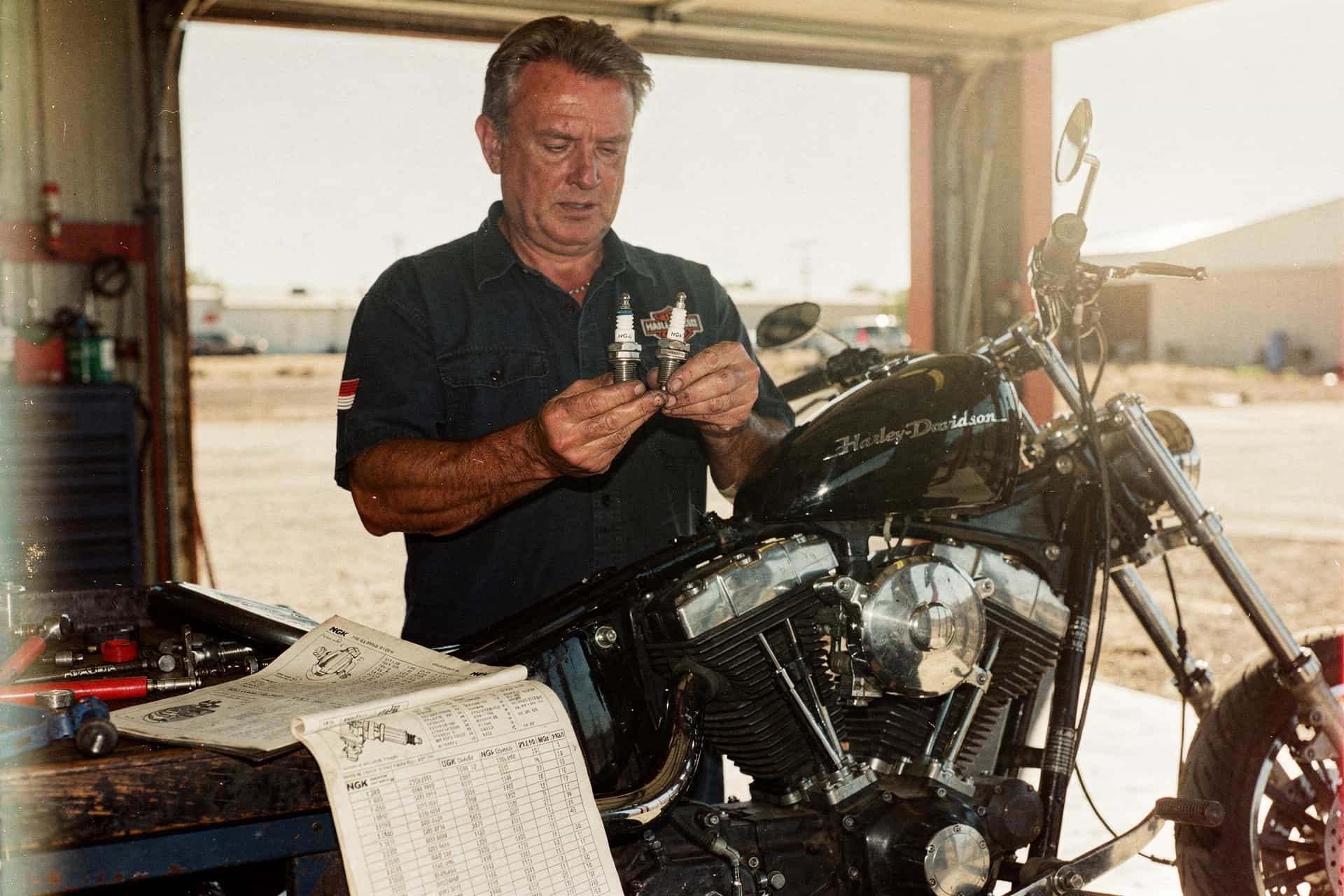
Every Harley spark plug chart online repeats the same handful of tables, and they do not agree with each other. One chart gives a Milwaukee-Eight the same 0.038 inch gap as a Twin Cam. Another lists a Champion number for a Twin Cam that contradicts the number on the next page. A third quietly copies a thread size that does not match the plug it recommends.
That matters because a spark plug is the cheapest part on the bike and one of the easiest to get wrong. Wrong heat range fouls or overheats. Wrong reach either buries the electrode in the head or leaves it hanging in the chamber. And an engine that fires two different plugs runs like it has two different personalities.
This chart is built the other way around. Every number is labeled with where it came from: Harley’s own parts listings and service documentation where that exists, and clearly flagged compiled data where it does not. Use the confirmed numbers directly. Treat the rest as a starting point you check before you buy.
Start Here: Find Your Engine, Then Your Plug
Harley part numbers follow the engine, not the model name. A Road King and a Fat Boy from the same year take the same plug because they share an engine. Find your engine family in the left column and everything else follows.
| Your bike | Engine | Harley plug | Part number | Confirmed by |
|---|---|---|---|---|
| 1999-2017 Dyna, Softail, Touring | Twin Cam 88 / 96 / 103 / 110 | 6R12 | 32362-04A | Harley parts listing |
| 1986-2022 Sportster | Evolution XL 883 / 1200 | 6R12 | 32362-04A | Harley parts listing |
| 2017-present Softail, Touring | Milwaukee-Eight 107 / 114 / 117 | 6R10 | 31600012 | Harley parts listing |
| 2015-2021 Street | XG 500 / 750 Revolution X | 6R10 | 31600012 | Harley parts listing |
| 2002-2017 V-Rod | Revolution VRSC | 10R12A | 32335-04 | Harley service procedure |
| 1984-1999 Big Twin | Evolution 1340 | 5R6A | see note below | Compiled charts and catalogs |
| 1975-1984 Shovelhead | Shovelhead 1200 / 80 | 5R6A / 5RL | see note below | Compiled charts and catalogs |
| 1948-1974 Panhead, early Shovel | Panhead / Shovelhead | 4R / 4R5 | see note below | Compiled charts and catalogs |
| Pre-1986 Ironhead Sportster | Ironhead XL | 4R5 | see note below | Compiled charts and catalogs |
Two things riders miss on that table. The 6R12 spans both the Twin Cam Big Twins and the Evolution Sportster, which is why the same plug shows up on a 2005 Road King and a 2005 Sportster 883. And the Milwaukee-Eight and the Street share a plug even though nothing else about those engines is similar.
How to Verify Any Cross Reference in Three Steps
Do not take a cross reference from any single chart, including this one. The check takes about two minutes.
1. Start from the Harley number, not the brand number. Charts drift over time because people cross a cross reference. The Harley plug code is the anchor. Everything else is derived from it.
2. Confirm fitment on Harley’s own parts listing. Harley publishes fitment text with each original-equipment plug. The 6R12 listing states it fits 1986-2022 Evolution-equipped XL models and 1999-2017 Twin Cam-equipped models. The 6R10 listing states it fits 2015-2021 XG models and 2017-and-later Milwaukee-Eight models, and it gives the plug number as RG6HCC. That is a fitment statement from the manufacturer, not a chart.
3. Cross to the aftermarket brand in that brand’s own catalog. NGK publishes a V-twin application sheet, and Champion and Denso both run searchable application catalogs. Searching the Harley part number in the brand’s catalog beats searching a forum thread.
If a number cannot survive all three steps, it goes in the “verify before you buy” pile below, not in your engine.
Current OEM Fitment and Published Cross References
Harley’s current listings confirm the OEM plug number and fitment in this section. The NGK Iridium rows are direct mappings from NGK’s own V-twin cross-reference sheet. The remaining aftermarket rows are common catalog mappings, not direct Harley equivalences, so confirm them in that manufacturer’s current application catalog before buying.
Twin Cam 88 / 96 / 103 and Evolution Sportster: 6R12
| Brand | Part number |
|---|---|
| Harley-Davidson (standard) | 6R12, part 32362-04A |
| Harley-Davidson Gold | part 32365-04 |
| NGK | DCPR7E - verify in current NGK application catalog |
| NGK Iridium IX | DCPR7EIX - direct NGK mapping from 6R12 |
| Champion | RA8HC - verify in current Champion catalog |
| Denso Iridium | IXU22 - verify in current Denso catalog |
Published gap: 0.038 to 0.043 inch.
Harley’s listing covers 1999-2017 Twin Cam and 1986-2022 Evolution Sportster with the same plug, and the Gold plug carries identical fitment. The displacement steps from 88 to 96 to 103 came from bore and stroke changes, not from a different plug interface, which is why a 2001 Road King and a 2016 Street Bob take the same part.
CVO models with the 110 cubic inch Twin Cam are covered by the same 6R12 listing, but CVO calibration and compression differ enough that the model-year manual is the authority on gap.
Two numbers that used to circulate for this engine have been dropped from this guide. Champion RA6HC appears in some charts alongside RA8HC for the same application, and the two cannot both be right. Bosch and Autolite numbers for Twin Cam applications trace back to chart-copying rather than to a manufacturer catalog. Search the Harley part number in those catalogs directly instead.
Milwaukee-Eight 107 / 114 / 117 and Street XG: 6R10
| Brand | Part number |
|---|---|
| Harley-Davidson | 6R10, part 31600012 |
| Champion | RG6HCC (the number Harley prints on the plug) |
| NGK | CR9EB - verify in current NGK application catalog |
| NGK Iridium IX | CR9EIX - direct NGK mapping from 6R10 / 31600012 |
| Denso | U27ESR-NB - verify in current Denso catalog |
| Denso Iridium | IU27 - verify in current Denso catalog |
Published gap: 0.031 to 0.035 inch.
The Milwaukee-Eight plug is physically a different family from the Twin Cam plug. NGK’s CR series is a 10 mm thread plug; the DCPR series used on the Twin Cam is 12 mm. They do not interchange, and no adapter makes that a good idea.
The detail most charts leave out: Milwaukee-Eight heads are dual-plug. A full plug change is four plugs, not two. Budget accordingly and replace all four together so every chamber sees the same plug.
Harley sells this plug individually, and Harley’s own fitment note spans two unrelated platforms, so confirm against your VIN before ordering rather than assuming Street and Milwaukee-Eight parts are otherwise interchangeable.
V-Rod Revolution: 10R12A
| Brand | Part number |
|---|---|
| Harley-Davidson | 10R12A, part 32335-04 |
| NGK | DCPR8E - verify in current NGK application catalog |
| NGK Iridium IX | DCPR8EIX - NGK maps 10R12, not the later 10R12A suffix |
| Denso Iridium | IXU24 - verify in current Denso catalog |
Published gap: 0.035 inch (0.89 mm).
The Harley service procedure for the Revolution engine tells the technician to check the gap and adjust it to 0.89 mm if necessary, and to confirm the motorcycle has the correct 10R12A plug. That is a rare case where a factory document states both the gap and the part in one place. NGK’s sheet maps the older Harley key 10R12 to DCPR8EIX. It does not print the 10R12A suffix, so confirm V-Rod fitment in NGK’s current application catalog before ordering.
The gap is tighter than the air-cooled engines, and that is the trap. NGK ships DCPR8E plugs at a factory pre-gap that is not the Harley figure, so a rider who drops them in straight from the box is running the wrong gap. Set every plug to 0.035 inch.
The DCPR8E is one heat range colder than the DCPR7E used on the Twin Cam. That is deliberate: the Revolution runs higher compression than the air-cooled twins.
Older Engines: Numbers to Verify Before You Buy
Harley no longer publishes current parts listings for Panhead, Shovelhead, Ironhead or Evolution Big Twin plugs. Every number below comes from compiled cross-reference charts and vintage parts catalogs rather than a live factory listing. They are widely repeated and probably right. They are not confirmed, and this guide is not going to pretend otherwise.
| Engine | Years | Harley plug | NGK | Champion | Gap (see note) |
|---|---|---|---|---|---|
| Panhead and early Shovelhead | 1948-1974 | 4R / 4R5 | B6HS (BR6HS resistor) | RL82YC | 0.025-0.030 inch |
| Late Shovelhead | 1975-1981 | 5R6A | BPR5ES-11 | RN12YC | ignition dependent |
| Late Shovelhead | 1982-1984 | 5RL | BPR5ES-11 | RN13LYC | ignition dependent |
| Evolution Big Twin 1340 | 1984-1999 | 5R6A | BPR5ES-11 | RN12YC | 0.038-0.043 inch |
| Ironhead Sportster | pre-1986 | 4R5 | B6HS | RL82YC | 0.025-0.030 inch |
| XR-1000 | 1983-1985 | 6R7 | B7EB | RN7YC | 0.035-0.040 inch |
Notes that matter more than the table:
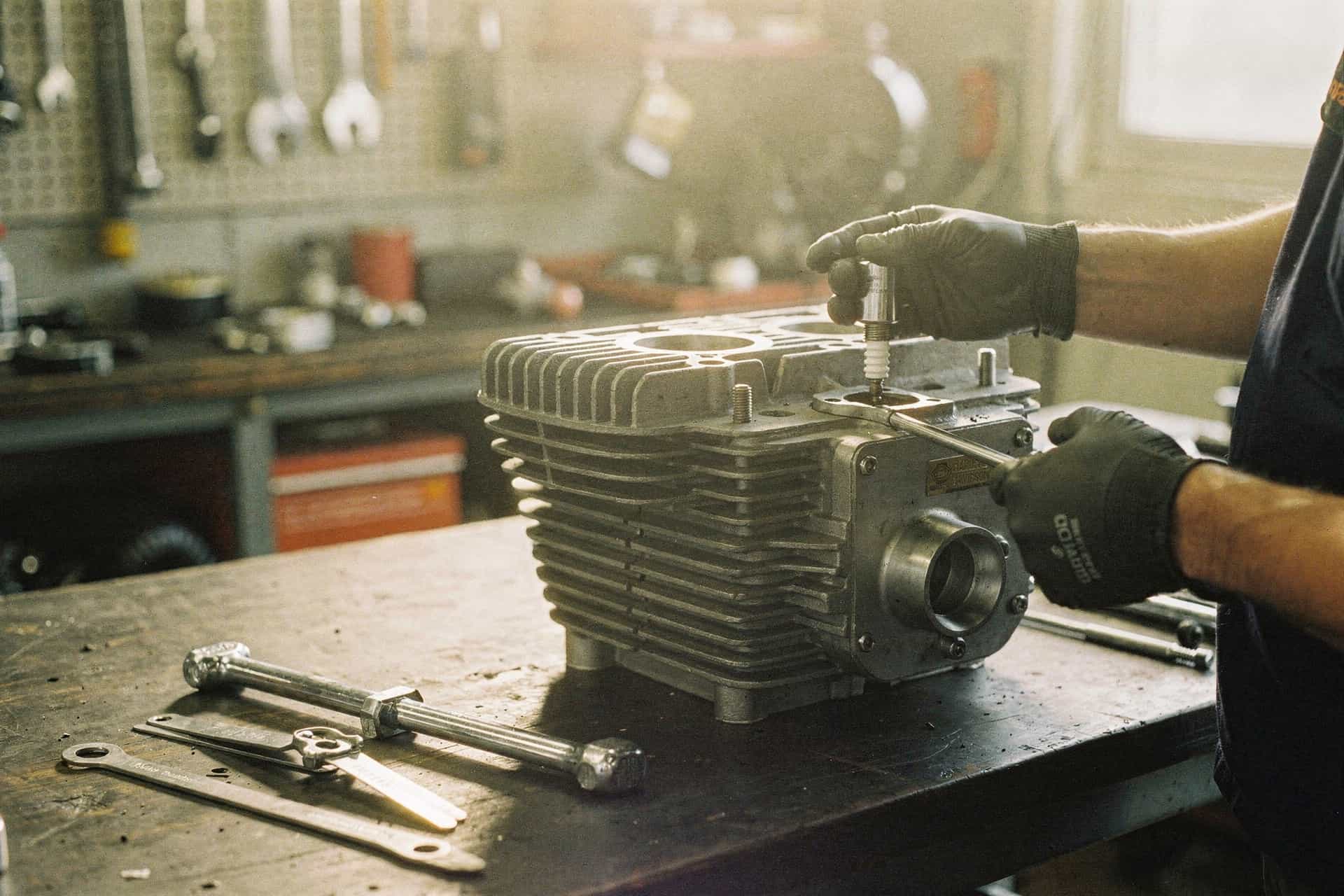
The 5R6A spans two very different engines. Parts catalogs list the 5R6A for Shovelheads from 1975 and Evolution Big Twins from 1984. Same plug, cast iron heads on one, aluminum on the other. That changes the torque figure, not the plug.
These are 14 mm plugs, not the 12 mm plugs used from the Twin Cam onward. Older guides sometimes describe the Panhead plug as a half-inch SAE thread. That does not match NGK B6HS, which is a 14 mm thread with a short half-inch reach. If a plug does not thread in by hand for several turns, stop.
Non-resistor plugs and electronic ignition. The early plugs are non-resistor. If the bike has been converted to a Dyna S, Pertronix or similar, the resistor version (BR6HS in place of B6HS) reduces radio interference. This is a commonly repeated recommendation, not a factory requirement.
Denso, Bosch and Autolite numbers that used to sit in these tables have been removed. They came from chart-copying, and several were internally inconsistent with the NGK number sitting next to them. If you want a Denso or Bosch plug for a vintage engine, search the Harley number in that manufacturer’s catalog.
Gap Specs and Why Sources Disagree
Gap disagreements on Harleys are usually real, not sloppy. Two things drive them.
Ignition system. Points ignition wants a smaller gap because it cannot reliably fire a wide one. Electronic ignition can. That is why Shovelhead gap figures split roughly into a 0.028-0.033 inch points spec and a 0.038-0.043 inch electronic-ignition spec. Neither figure is wrong. They belong to different bikes wearing the same engine name. Find out what ignition your bike actually runs before you set anything.
Manuals are model-year specific. Use the gap in the owner’s or service information for the exact motorcycle and plug. Do not transfer a Milwaukee-Eight figure between years or choose one end of a conflicting online range without checking the current factory procedure.
The rule that survives all of it: gap every new plug, including ones sold as pre-gapped. Use a wire-type gauge rather than a coin gauge, which can bend a ground electrode and wreck a fine-wire iridium tip.
Heat Range: What the Harley Number Tells You
Riders get tribal about brands. Heat range is what actually decides whether the plug works.
Heat range describes how fast the plug moves heat from the electrode tip into the cylinder head. A hotter plug holds heat and stays clean at low load. A colder plug sheds heat and resists pre-ignition under sustained high load. Every engine is designed around a range.
The useful trick with Harley numbers: the leading digit is the heat range, and higher means colder. That is why the sequence 4R, 5R6A, 6R12, 10R12A runs from the hottest vintage plug to the coldest plug Harley fits, which is the V-Rod’s. Once you see that, the cross references stop looking arbitrary.
NGK and Denso count the same direction (higher number is colder), which is why NGK DCPR8E for the V-Rod is colder than DCPR7E for the Twin Cam. Champion counts the other way. That single inconsistency is behind most bad cross references on the internet.
Consider one step colder if you have run high-compression pistons, ported heads, or a longer-duration cam, or if you pull the plugs and find white, blistered insulators.
Consider one step hotter only if the bike lives on short low-speed trips and fouls carbon on an otherwise healthy engine. A hotter plug does not fix a rich condition, it hides it.
On a stock or lightly modified engine, the OEM heat range is right. Do not chase heat range without a plug reading that justifies it.
Reading Your Plugs
Pulling plugs is still the cheapest diagnostic you own, and it tells you things a code reader does not.
Tan or light brown insulator, light grey electrode. Correct mixture and correct heat range. This is the target.
Dry black soot. Rich mixture, weak spark, or a plug that is too cold for how the bike is ridden. Check jetting on carbureted engines, the fuel map on injected ones, plus air filter and ignition.
Wet black oil. Oil reaching the combustion chamber through worn guides, rings, or a leaking intake seal. A different plug does not fix oil consumption.
White or blistered insulator with an eroded electrode. The engine is running hot: lean mixture, over-advanced timing, or too hot a plug. Sustained detonation from this condition damages pistons. Stop riding and diagnose it.
Heavy crusty deposits. Usually fuel additive buildup or bad fuel. On a V-Rod, coolant entering the chamber can look similar, which is worth ruling out on a liquid-cooled engine.
If plugs keep reading wrong after you have fitted the correct part, the plug is a symptom. Something upstream is doing it.
Installation
Install NGK plugs dry. NGK says its plated shells need no anti-seize. Lubricant changes the relationship between wrench torque and clamping load, which can over-tighten the shell and damage the plug or cylinder-head threads. Follow the plug manufacturer’s instruction if you use another brand.
Torque. The correct figure depends on thread diameter, seat type, cylinder-head material, plug design, and whether the threads are dry. Use the value and procedure from the model-year service information and the plug manufacturer rather than a generic chart.
Replace as a set. Two cylinders on a V-twin, four plugs on a Milwaukee-Eight. Mixed-age plugs give you mixed-behavior cylinders.
Intervals. Follow the maintenance schedule in your manual rather than a generic mileage number. Long-life iridium plugs stretch the replacement interval but do not remove the reason to pull and read them.
What This Chart Cannot Tell You
A cross reference identifies a part. It does not diagnose an engine. If plugs foul repeatedly, run the fault down rather than buying a different brand.
Cam timing drift from worn tensioners changes how an engine burns fuel, and our Twin Cam 96 guide covers that failure pattern in detail. A misfire that looks like a plug problem can also come from ignition timing input, which is where the bad crank position sensor guide and the Harley diagnostic code lookup do more for you than any plug chart.
If you are not certain which engine is actually in the frame, especially on a bike that has been apart before, decode the number first. Our Harley VIN decoder guide walks the positions that identify the engine, and the Harley-Davidson history guide puts each engine generation in order so you know what should be there. Riders newer to their own maintenance can start with the motorcycle beginner guide before pulling anything apart.
One legal note worth knowing while you shop: fitting a non-Harley plug does not void your warranty by itself. Under the Magnuson-Moss Warranty Act, a manufacturer generally cannot require branded parts for warranty coverage unless it provides them free. Buy on specification, keep your receipts.
Keep a correct set on the shelf so a plug change is never the reason a ride gets cut short. And if you want to wear the wrench life, our t-shirt collection is built for riders who do their own work, including the Snake and Wrench tee.
Sources
- Harley-Davidson Original Equipment Spark Plug 32362-04A - manufacturer fitment statement for plug 6R12 covering 1986-2022 Evolution XL and 1999-2017 Twin Cam models
- Harley-Davidson Original Equipment Spark Plug 31600012 - manufacturer fitment statement for plug 6R10, including the RG6HCC plug number and 2015-2021 XG plus 2017-later Milwaukee-Eight coverage
- Harley-Davidson Service Information Portal - Revolution spark plug procedure - factory instruction specifying the 10R12A plug and the 0.89 mm (0.035 inch) gap for the V-Rod Revolution engine
- Harley-Davidson Service Information Portal - model-year owner’s manuals, service manuals and parts catalogs, the authority for gap, torque and interval on your exact bike
- NGK Spark Plugs - V-twin application listing - manufacturer application data for NGK V-twin part numbers referenced in the cross-reference tables
- NGK Spark Plugs - Five things you should know about spark plugs - manufacturer guidance to install NGK plugs dry and the torque risks created by anti-seize
- W&W Cycles - Spark Plug 5R6A - parts catalog listing showing 5R6A application across 1975-on Shovelhead and 1984-on Evolution Big Twin
- Federal Trade Commission - A Businessperson’s Guide to Federal Warranty Law - Magnuson-Moss Warranty Act guidance on tie-in sales, branded parts and warranty coverage