A Headlight People Actually Talk About by Name
Most motorcycle parts live anonymous lives. Nobody asks what brand your clutch cable is. Nobody cares who made your turn signals. But the Daymaker is different. Harley-Davidson’s flagship LED headlight became one of the few bolt-on accessories that riders identify by name, argue about by price, and recommend to strangers in parking lots. It changed what night riding feels like on a Harley, and it split the community into two camps: those who pay the Harley premium and those who buy the same light under a different label for less.
We’ve installed both versions in the shop - the Harley-branded Daymaker and the JW Speaker 8700 that it’s actually built from. This guide covers what the Daymaker is, how the two sizes differ, what the Adaptive version adds, how to install it, and whether the price tag makes sense when the aftermarket sells the same technology for less.
What the Daymaker Actually Is
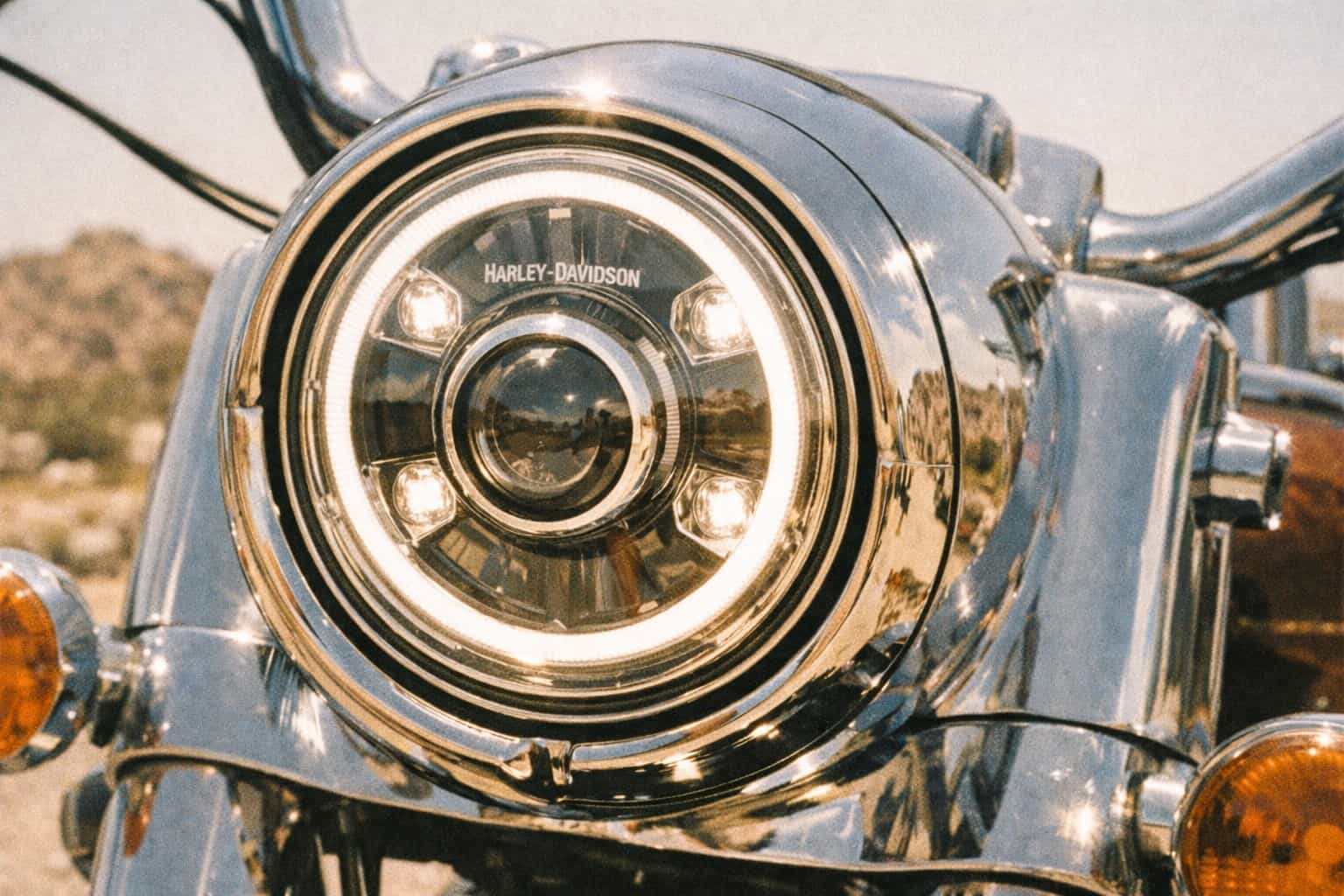
The Daymaker isn’t a bulb swap. It’s a complete sealed headlight assembly: LED array, reflector housing, polycarbonate lens, and integrated aluminum heat sink. You remove the old headlight ring and unit from the bucket, and the Daymaker drops in as a direct replacement. No rewiring on most models. No modifications to the headlight nacelle. Plug-and-play in the most literal sense.
The name “Daymaker” comes from Harley’s marketing pitch: the LED output is close to natural daylight in color temperature, so night riding feels more like day riding. That’s actually not far from the truth. The unit runs at approximately 6,000K to 6,500K color temperature - close to midday sunlight - compared to the warm yellowish 3,200K of a stock halogen. Your eyes process the whiter light differently. Road surfaces, lane markings, and obstacles become easier to identify because the light matches what your brain is calibrated for during daytime.
The open secret of the Daymaker is its manufacturer. The OEM unit is built by JW Speaker, a Wisconsin company whose model 8700 is the actual headlight behind the Harley name. JW Speaker makes some of the best LED lighting products on the market. Harley puts their badge on it and charges accordingly.
Sizing: 7-Inch vs. 5.75-Inch
This is the first question every buyer needs to answer, and getting it wrong means a headlight that physically won’t fit your bucket.
The 7-Inch Daymaker
The full-size unit fits the larger headlight housing used on most Harley touring models and Softails. This is the Daymaker most riders picture when they hear the name.
Fits: Road King, Street Glide, Electra Glide, Heritage Softail, Fat Boy, and other models with 7-inch headlight housings.
The 7-inch unit (Harley P/N 67700430A for the standard LED projector) throws a wide, defined beam. The low beam uses a projector-style LED array with a sharp cutoff line that keeps light below oncoming drivers’ eye line. The high beam opens the full array for maximum distance. Output runs around 1,700 lumens - a dramatic improvement over stock halogen, not a marginal one. Riders who make this switch consistently describe it as transformative for night riding confidence.
The 5.75-Inch Daymaker
The smaller unit (also referenced as 5-3/4 inch) fits the headlight bucket on Sportsters, Dynas, and related models. Some aftermarket 5.75-inch units advertise up to 3,600 lumens on high beam and 1,800 on low beam using CREE LED chips.
Fits: Sportster 883, Sportster 1200, Dyna Street Bob, Dyna Low Rider, Iron 883, Forty-Eight, and other models with 5.75-inch housings.
The beam pattern is slightly more concentrated due to the smaller reflector, but still vastly superior to halogen in both brightness and color temperature. Same LED technology, smaller package.
How to Know Your Size
Measure the inside diameter of your headlight bucket - the housing, not the trim ring. Seven inches or 5.75 inches. If you’re unsure, your model’s service manual or Harley’s fitment guide will tell you. Don’t guess. A 7-inch Daymaker won’t fit a 5.75-inch bucket, and a 5.75-inch unit will rattle around in a 7-inch housing.
Standard vs. Adaptive: The Lean Angle Difference
Standard Daymaker LED
The non-adaptive Daymaker is the core product. Sealed, shock-resistant, vibration-resistant, solid-state LED with a rated lifespan around 30,000 hours. (For comparison, a halogen bulb lasts 500-1,000 hours.) Die-cast aluminum housing with integrated heat sink. DOT approved for on-road use. Power draw is significantly lower than halogen equivalents - LEDs produce more lumens per watt, which matters on custom builds where electrical systems have been simplified.
The color temperature is the spec that changes the riding experience most. At 6,000K, the Daymaker’s output looks and feels like daylight. Stock halogen at 3,200K produces that warm yellow glow that your brain associates with less visibility. The switch isn’t just brighter. It changes how your eyes read the road.
Adaptive Daymaker LED
The Adaptive Daymaker (P/N 67700427A for the 7-inch version) includes everything in the standard unit plus a lean-sensing system that solves a real problem.
Here’s the issue: when you lean a motorcycle into a turn, a conventional headlight points toward the road surface on the inside of the turn - not toward the road ahead where you need to see. The faster and deeper the lean, the worse the dark zone becomes in exactly the direction you’re heading.
The Adaptive Daymaker uses internal accelerometers and gyroscopes to detect lean angle. As the bike leans, additional LED elements within the housing activate progressively, directing light toward the inside of the curve. The cornering lights respond to the actual lean angle in real time and work in both high and low beam modes.
We’ve ridden behind bikes with the Adaptive version on mountain roads, and the difference through switchbacks is noticeable from the outside - you can see the beam sweep toward the turn exit as the rider commits to the lean. From the saddle, riders describe it as illumination that finally follows where you’re looking instead of where the bike is pointed.
The Adaptive Daymaker commands a higher price than the standard, and it’s the one upgrade where the premium arguably justifies itself for riders who regularly ride twisty roads at night.
Installation: Simpler Than You Think
Installing a Daymaker is one of the easiest upgrades you can do on a Harley. Total time for a first-timer is twenty to thirty minutes. Ten if you’ve done it before.
Tools
- Torx bit set (T25 and T27 are typical for headlight trim ring screws)
- Flat-blade screwdriver
- Clean microfiber cloth
The Process
Remove the trim ring. A small screw at the bottom holds it. Remove the screw, rotate the ring slightly, pull it forward.
Remove the retaining ring. Three screws hold the headlight unit in the bucket. Remove them and the retaining ring comes free. Don’t drop the headlight unit - hold it as the ring comes loose.
Disconnect the old headlight. A standard H4 or H13 connector (depending on model year and headlight size) plugs into the back. Unplug it.
Connect the Daymaker. Same connector type. Plug it in. Some models may need an adapter harness, which comes included in the Daymaker kit.
Mount the Daymaker. Place it in the bucket, reinstall the retaining ring and three screws, reattach the trim ring.
Test. Ignition on. Verify low beam, high beam, and - if Adaptive - lean-sensing function.
No special tools. No wiring modifications on most models. This is a genuine bolt-on upgrade, which is the main reason it became so popular. If you can change a lightbulb and operate a Torx driver, you can install a Daymaker.
Watch For These
Older models (pre-2014) may have a different headlight connector. An adapter harness resolves it - usually sold separately if not included.
Anti-flicker modules. Some Harley models with CAN-bus electrical systems cause LED headlights to flicker. An anti-flicker adapter fixes it. Not always needed but worth knowing about before you start.
Aim adjustment. After installation, check your headlight aim. The Daymaker’s sharp beam cutoff makes proper aiming more critical than with halogen - too high and you blind oncoming traffic, too low and you lose distance visibility. Adjusting aim takes five minutes and a flat wall.
The Money Question
Here’s where we stop being diplomatic.
The Harley-branded Daymaker retails in the two-fifty to five-hundred-plus dollar range depending on size and version. The Adaptive version for touring models sits at the top of that range. Meanwhile, JW Speaker sells their own-branded 8700 Evolution 2 - the same light from the same factory - for around $268. Same optics. Same build quality. Different badge.
Beyond JW Speaker, the aftermarket runs deep:
Mid-range options ($80-150) from brands like Truck-Lite and Auxbeam deliver solid LED performance with DOT compliance. Good build quality. Good beam patterns. Not quite JW Speaker’s optical precision, but the gap is smaller than the price difference suggests.
Budget options ($30-60) are a gamble. Some perform adequately. Others have scattered beam patterns that blind oncoming traffic, overheat and dim during extended use, or fail within a year. No meaningful warranty. DOT certification you can’t verify.
What You’re Paying For With the Harley Badge
Guaranteed fitment for your specific bike. Harley’s accessory warranty. JW Speaker build quality. Verified DOT compliance. Zero guesswork.
What the Aftermarket Gives You
The JW Speaker own-brand versions offer identical quality without the Harley markup. That’s the open secret of the Daymaker - you’re paying a premium for the bar-and-shield logo on what’s already a JW Speaker product.
Our Honest Take
If money isn’t the issue and you want zero friction, the official Daymaker is a solid product. It works, it fits, it’s warrantied. But the JW Speaker 8700 under their own brand is the same light for less. If you’re on a budget, spend a hundred to a hundred-fifty on a reputable mid-range LED unit rather than gambling on the cheapest thing available. A bad LED headlight with a scattered beam pattern isn’t just a quality problem. It’s a safety problem. You need a clean cutoff line on the low beam so you’re not blinding oncoming riders and drivers.
Whatever you choose, the upgrade from halogen to LED is one of the highest-impact changes you can make to a Harley. Night riding goes from tense to comfortable. Peripheral visibility improves. Your reaction time to obstacles effectively increases because you see them sooner. That alone justifies the cost at any price point.
Daymaker on Custom Builds
If you’re running a bobber or custom build, three things matter when fitting a Daymaker or JW Speaker LED unit.
Bucket compatibility. The Daymaker is designed for Harley’s stock headlight housings. If your build uses an aftermarket bucket, measure the depth carefully. Most aftermarket 5.75-inch and 7-inch housings will accept a standard unit, but depth varies and a too-shallow bucket will leave the back of the headlight exposed.
Electrical load. LED headlights draw less power than halogen, which is good news for custom builds with simplified wiring. Less load on the charging system means more margin for other accessories - or a smaller battery if you’re chasing a clean, minimal build.
The face. The Daymaker has a distinctive LED array pattern that’s immediately recognizable. Some builders want that look. Others prefer a more traditional lens face and opt for LED units with different aesthetics. Worth seeing the headlight face in person before committing - it’s the most visible part of the front end and it changes the character of the bike.
Halogen vs. LED: What’s Actually Different Under the Lens
If you’ve never swapped from halogen to LED, the difference is worth understanding beyond marketing language.
A halogen headlight works by running current through a tungsten filament inside a gas-filled glass envelope. The filament heats to incandescence. It’s the same basic technology as a household light bulb - simple, proven, and inefficient. Most of the energy goes to heat, not light. A typical halogen motorcycle headlight produces around 700-1,000 lumens on low beam and runs hot enough that you can feel the heat radiating off the lens after ten minutes of riding.
An LED headlight uses semiconductor diodes that convert electricity directly to light with far less waste heat. The Daymaker’s output of approximately 1,700 lumens on low beam comes from a fraction of the power draw, which is why LEDs last 30,000 hours versus halogen’s 500-1,000. The light is also directional by nature - LEDs emit in a specific direction rather than radiating in all directions like a filament - which is why well-designed LED headlights have sharper, more defined beam patterns.
The practical difference on the road: halogen gives you a warm, diffuse pool of yellowish light that fades gradually at the edges. A good LED unit gives you a bright, white, clearly defined beam with a sharp cutoff line. You see further, you see more clearly, and oncoming traffic doesn’t get blinded - assuming the beam pattern is properly engineered. That last part is where cheap LED units fail. A well-designed reflector and lens are what separate a Daymaker from a forty-dollar Amazon special that scatters photons like a flashlight in a fog bank.
For the broader story of how Harley-Davidson developed its engineering approach, read our Harley-Davidson history guide. If you’re deep in the HD engine world, our coverage of the Evolution engine and the Shovelhead are worth your time. The Harley VIN decoder helps confirm your exact model and year for headlight fitment. For riders building or upgrading machines more broadly, our biker gear guide covers the essentials beyond the bike. To understand where bobber builds fit in the custom landscape, read our guide on what a bobber motorcycle is. And if you’re looking to rep the lifestyle, browse our full collection.
Sources
- 7in Daymaker Projector LED Headlamp (P/N 67700430A) - Harley-Davidson USA - official product specifications and fitment guide
- 7in Daymaker Adaptive LED Headlamp (P/N 67700427A) - Harley-Davidson USA - Adaptive version specifications with lean-sensing technology details
- Harley-Davidson LED Headlights Made by JW Speaker - Better Automotive Lighting - manufacturer identification and comparison of OEM vs. JW Speaker-branded units
- J.W. Speaker 8700 Evolution 2 Dual Burn LED Headlight - RevZilla - JW Speaker own-brand specifications and pricing
- LED Headlights - Model 8700 Evo 2 Dual Burn - J.W. Speaker - official manufacturer specifications for the headlight behind the Daymaker
- J.W. Speaker Motorcycle Headlights - J&P Cycles - aftermarket pricing and model comparison for Harley fitment