

Cake Pans on Top of an Aluminum Head
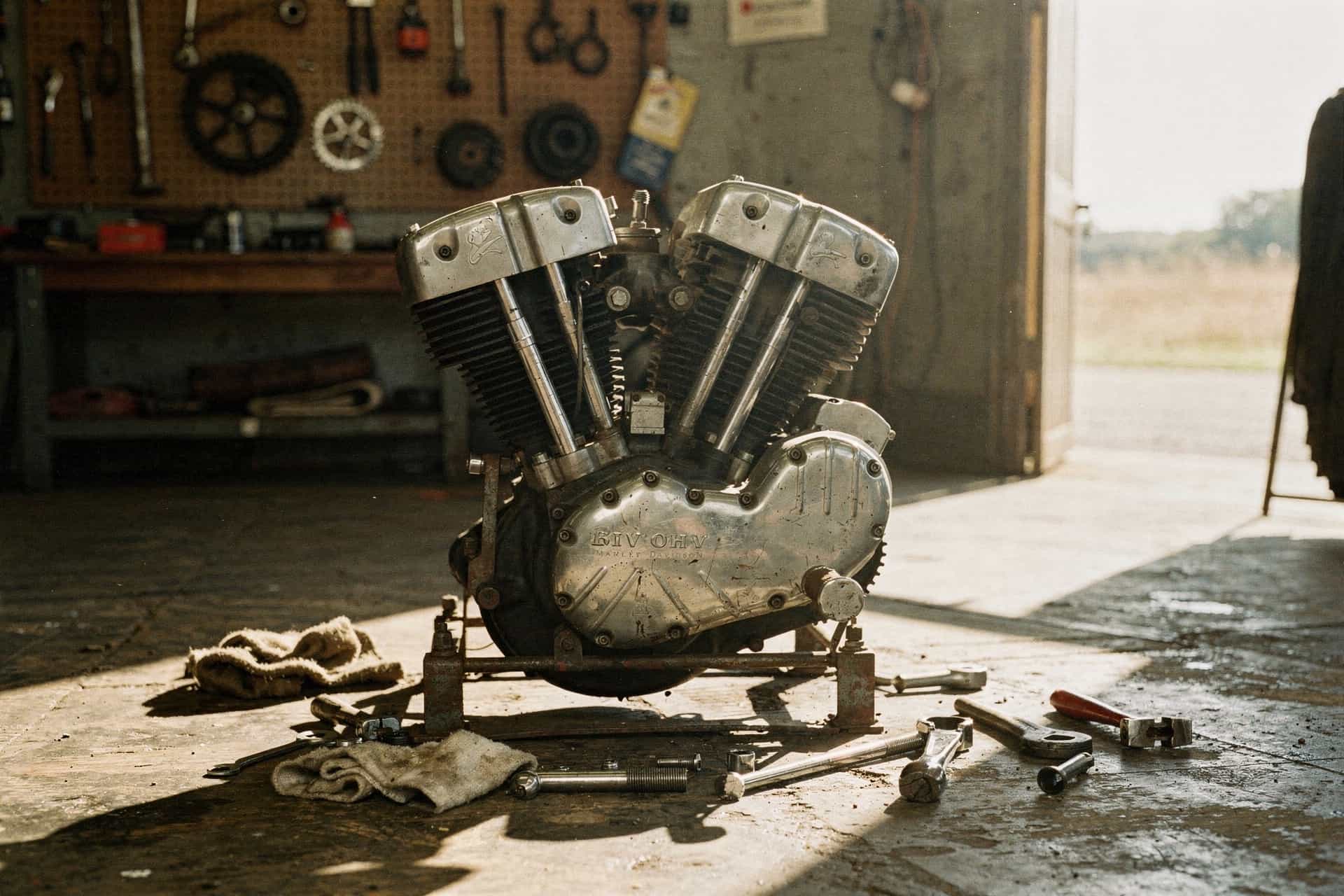
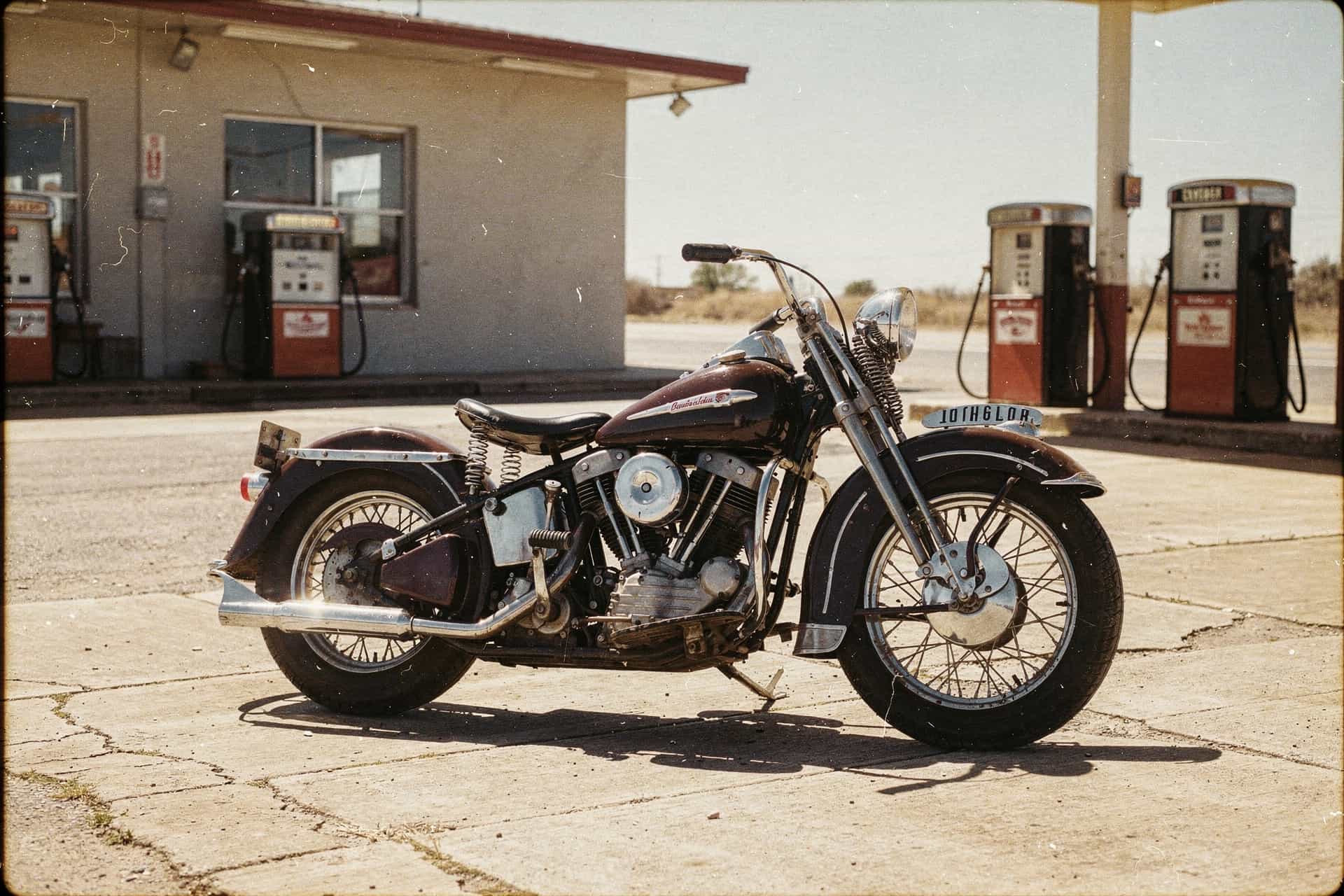
Nobody at the factory named this engine. When the 1948 Big Twin arrived with rounded, stamped-steel rocker covers sitting on new aluminum heads, riders and mechanics decided the covers looked like upside-down cake pans, and the name was stuck before Milwaukee could pick anything better. Harley eventually used it themselves, describing the engine as “Panhead for the new stamped rocker covers that looked to some like cake pans”.
What the name hides is how much actually changed underneath. The Knucklehead had carried Harley’s overhead-valve Big Twin since 1936 and had earned its reputation, but it ran hot in its 74 inch form, leaked, and needed constant valve attention. Harley’s own summary of the Panhead lists the fixes: aluminum cylinder heads, hydraulic valve lifters, improved oiling and crank pin roller bearings, in a package eight pounds lighter than the Knucklehead, with displacement unchanged at 61 and 74 cubic inches.
Eighteen model years later, in 1965, the last Panhead left the line under a brand-new name that is still on Harley’s price list: Electra Glide.
Year-by-Year: What Actually Changed and When
Buying or building a Panhead without knowing these dividing lines is how riders end up with the wrong parts.
| Year | Change |
|---|---|
| 1948 | First Panhead year. Aluminum heads, hydraulic lifters at the top of the pushrods, still on the springer front fork and rigid frame. Late in the year the rocker-shaft welch plugs were replaced with a steel drive plug after the originals worked loose |
| 1949 | Telescopic hydraulic front fork replaces the springer. The model becomes the Hydra-Glide |
| 1952 | Hand clutch with foot shift becomes available alongside the traditional foot clutch and hand shift. Last year for the 61 inch EL |
| 1953 | Hydraulic lifters move from the top of the pushrods into the tappet blocks, fed directly from the oil pump. Adjuster moves to the bottom of the pushrod. Check valve and oil screen added |
| 1955 | FLH high-compression option arrives with a hotter cam. O-ring intake manifold ports replace the Knucklehead-carryover design |
| 1958 | Rear suspension arrives. Swingarm and twin shocks plus a hydraulic rear brake turn the Hydra-Glide into the Duo-Glide |
| 1963-1965 | External oil lines feed the top end, delivering cooler oil to the heads than the internal passages did |
| 1964 | Full-width alloy finned front brake drum |
| 1965 | 12-volt electrics and a push-button electric starter. The Electra Glide name arrives. Final Panhead year |
The 1953 line is the one that matters most in ownership terms, and it is the fact most Panhead articles skip entirely.
The Hydraulic Lifter Story, Told Properly
Harley put hydraulic lifters on a motorcycle for the first time with the Panhead, and the reason was aluminum. Aluminum heads expand more than iron as they heat, which would have meant chasing valve lash constantly with solid lifters. Hydraulic units take the lash out automatically.
The problem was where Harley put them. From 1948 to 1952 the lifter unit was pressed into the top of the pushrod, up at the rocker end. Oil got there the long way: through passages drilled in the cylinders and heads, into the rocker arm holders, and finally into the lifter. That path works when the engine is cold, clean and fresh. It works badly when the oil is hot and thin, when there is dirt in the system, or when the engine has some miles on it. It takes only a few psi to keep a lifter pumped up, and a hot Panhead top end may not have it.
The result was clicking, sticking and collapsing lifters, valves that stopped opening fully, and owners who had been sold a maintenance-free valve train doing more maintenance than before. Enough riders replaced the lifter internals with a ball bearing to convert them back to solid lifters that you still see that fix on period-built bobbers and choppers.
Harley fixed it properly for 1953. The lifter units moved down into the tappet blocks on the right side of the cases, close to the oil pump and fed directly by it. New pushrods put the adjuster at the bottom. A check valve and an oil screen went into the feed to keep debris out. That layout is essentially what Harley still uses.
Two noises get confused constantly, and the difference follows directly from how the system works. Hydraulic units bleed down while a bike sits, so a Panhead that clatters at startup and quiets down once oil pressure reaches the lifters is doing what the design does. A Panhead that keeps clattering warm, or gets noisier as it heats up, is pointing at the failure mode the pre-1953 layout was known for: lifters that will not stay pumped up because the feed is dirty, restricted or short of pressure. Separate those two before anyone starts pulling covers.
Oil Leaks: Where the Reputation Came From
The one-piece stamped rocker covers were a genuine improvement over the Knucklehead’s multiple sealing surfaces. They did not stop the bike leaking.
The covers are stamped steel, and stamped steel warps after enough heat cycles. Once a cover is not flat, no gasket seals it reliably. Oil weeps past the joint, runs down the fins, and ends up on everything below. Harley worked at it across the production run through revised rocker assemblies, better gasket materials and, from 1963, external oil lines that fed cooler oil to the heads instead of routing it through the castings.
Two related details worth knowing if you are pulling one apart:
- Early rocker shafts are hollow and plugged at the ends. The original welch plugs could loosen and fall out, which dumps top-end oil pressure immediately. Harley switched to a steel drive plug late in 1948.
- Felt inside the covers. Early engines used a felt blanket to damp valve noise and catch oil mist. It deteriorates, and pieces of it can find their way somewhere they are not wanted.
Top-end oil seepage is common on Panheads, but it is not inevitable and should not be dismissed without inspection. Confirm the source, check the oil level, and repair leakage that is worsening or reaching the tire, brakes, or exhaust.
Specifications: 61 and 74 Cubic Inches
Harley launched the Panhead in the same two displacements the Knucklehead had used.
61 cubic inch EL (1948-1952)
| Spec | Detail |
|---|---|
| Designation | E / EL |
| Displacement | 60.32 ci (989cc) |
| Bore x stroke | 3-5/16 x 3-1/2 in (84.1 x 88.9 mm) |
| Compression | Approximately 7:1 |
| Period power claim | Around 50 hp |
| Valve train | OHV, hydraulic lifters, four pushrods |
| Carburetor | Linkert M-series by year: M-35 family carried over at launch, M-36 for 1948-1949, M-61 and M-61B for 1950-1952 |
| Ignition | Circuit breaker with battery and coil, 6 volt |
| Lubrication | Dry sump, recirculating |
The 61 was the lighter and livelier of the pair, using the same bore and stroke as the Knucklehead EL it replaced. Harley dropped it after 1952 and consolidated the Big Twin line on the 74.
74 cubic inch FL and FLH (1948-1965)
| Spec | Detail |
|---|---|
| Designation | F / FL / FLH |
| Displacement | 73.66 ci (1,207cc) |
| Bore x stroke | 3-7/16 x 3-31/32 in (87.3 x 100.8 mm) |
| Compression | Approximately 7:1 (FL), approximately 8:1 (FLH from 1955) |
| Period power claims | Around 50-55 hp (FL), around 60 hp (FLH) |
| Valve train | OHV, hydraulic lifters, four pushrods |
| Carburetor | Linkert M-series by year: M-35 family at launch, M-36 for 1948-1949, M-45 and M-45A late 1949 to early 1950, M-74 for 1950-1951, M-74B from 1951 to 1965 |
| Ignition | Circuit breaker with battery and coil, 6 volt to 1964, 12 volt in 1965 |
| Lubrication | Dry sump, recirculating |
The carburetor is not one part across the run. Calling every Panhead carburetor an M-74 is a common shorthand and it is wrong for the first years of both engines. Period Linkert application data lists the M-35 family covering E, EL, F and FL into the first Panhead season, the M-36 for 1948-1949 on both displacements, the M-45 and its M-45A field conversion on the 74 inch F and FL from late 1949 into early 1950, and then the split that most people remember: M-61 and M-61B on the 61 inch E and EL for 1950-1952, M-74 on the 74 inch for 1950-1951 and M-74B on the 74 inch from 1951 through the end in 1965. Check the Linkert application chart against your engine’s parts book before you buy a rebuild kit, because venturi and jet sizes differ across those models.
A necessary caution on the horsepower numbers. These are period claims, and period claims are not modern rear-wheel dyno figures. Different sources attach 50 hp to the 1949 Hydra-Glide at 4,800 rpm, 55 hp to a later FL and 60 hp to the FLH, with a top speed usually given as about 100 mph. The measurement method behind those figures is not documented in a way anyone can reproduce today. Use them to compare Panheads to each other, not to compare a Panhead to anything with a modern number attached to it.
If you want to fly the Milwaukee flag without a restoration budget, our full collection is built for riders who keep old iron running rather than parked.
Three Chassis, Three Different Motorcycles
The engine is only half the story. The Panhead spans the era when Harley turned the Big Twin from a rigid-framed machine into a genuine touring bike.
1948 and the Hydra-Glide, 1949-1957
The 1948 bikes still used the springer front end. For 1949 Harley fitted a telescopic hydraulic fork, which the company’s own Electra Glide history describes as “a revolutionary telescopic hydraulic front fork” replacing the springer, and named the result the Hydra-Glide. Teardrop tanks arrived at the same time.
The back end was still rigid. A sprung saddle over a hardtail frame was the standard of the day, and every rival was doing the same thing. Springer forks remain popular on bobber builds for good reasons, but comfort is not one of them.
Duo-Glide, 1958-1964
For 1958 Harley added a swingarm and twin shocks, plus a hydraulic rear brake. Two ends of suspension, hence Duo-Glide. This is the change that turned the Big Twin from a short-hop machine into something you could ride across a state without regretting it.
Our 1963 Duo-Glide FLH breakdown shows how developed the platform was by then: buddy seat, bags, screen, external top-end oil lines, and a Panhead that had been refined for fifteen years.
Electra Glide, 1965
The last Panhead year was the first Electra Glide year. Harley fitted 12-volt electrics and a push-button starter, and the kick-start became the backup rather than the only option. The extra battery and starter added weight, and fitting an electric leg to an engine that was about to be replaced looks odd on paper. It was not odd to the touring riders who bought them.
That combination is why the 1965 is the Panhead collectors chase hardest: last year of one engine generation, first year of a model name still in production sixty years later.
Buying and Owning One
Panheads are not difficult motorcycles. They are unforgiving of neglect and of optimistic descriptions in listings.
- Establish which side of 1953 the engine is on. Top-of-pushrod lifters or tappet-block lifters changes parts, service procedure and what noises mean. Do not take the seller’s word for the year.
- Do not go looking for a frame number to match. Harley did not stamp frames until 1970. On a Panhead the serial number is hand-stamped on a raised boss on the left crankcase and nowhere else, so a seller offering a “numbers matching” engine-to-frame Panhead is describing something the factory never did. What you check instead is the engine number against the title and registration paperwork, and the serial boss itself for grinding, filing or a restamp.
- Read the belly numbers. Both crankcase halves carry a stamped number on the underside. These are not VINs, but a matching pair tells you the cases were machined together at the factory rather than assembled from two different motors. Photograph them before you commit.
- Date the frame on its features, not on a stamp. Rigid or swingarm, springer or telescopic fork mounts, brake and tank mount details and period-correct hardware are what place a Panhead frame in a year. Documentation carries the rest of the weight: dated invoices, old registrations and restoration records.
- Check oil pressure and top-end feed, not just leaks. A leaky Panhead is normal. A Panhead with no oil reaching the rockers is expensive.
- Look at the valve seat inserts if the top end is off. Aluminum is too soft to seat valves directly, so hardened steel seat rings are pressed in. Decades of heat cycling, and any history of overheating, can loosen or recess them. Replacement is a machine shop job.
- Ask what the electrics are. Six volt through 1964, 12 volt in 1965, and a great many surviving bikes have been converted at some point. Conversions are fine. Undocumented wiring is not.
- Ride it before you decide. Foot clutch and hand shift on the earlier bikes is a genuinely different skill. Some riders love it. Some sell the bike within a year.
- Parts are available but not uniform. The reproduction and specialist supply for Panheads is good. Correct, year-specific original parts for a numbers-matching restoration are a different market at a different price.
What They Are Worth, and How to Find Out
We removed the fixed price table this article used to carry. Those numbers were not tied to dated sold results, and stale price bands do real damage when a rider uses one to argue a deal.
The method that works:
- Price the exact year and model. A 1948 first-year FL, a 1955 FLH and a 1965 Electra Glide are three different markets. First-year and last-year bikes carry premiums.
- Grade the bike honestly first, then look up the number. Hagerty’s valuation tools publish condition-graded values and recorded past sales for specific Harley model years.
- Read dated auction results, not asking prices. Mecum, Bonhams and the major collector sales publish what bikes actually sold for, with lot descriptions covering condition and documentation. A sold result with a date and a condition description beats any range printed in an article.
- Weigh originality heavily. Original paint, original tinwork, documented history and an unaltered engine serial with matching belly numbers move a Panhead far more than mileage does.
- Price chopped bikes separately. A Panhead motor in a custom frame trades in a different market from a restored FL, and can be worth more or considerably less depending on who built it.
The bobber and chopper world has always created its own demand for Panhead engines independent of complete bikes. Those pan-shaped covers over finned aluminum are among the most recognizable shapes in motorcycling, which is exactly why they get pulled out of complete bikes and put into rigid frames. If you want the reasoning behind that whole approach, our guide to what a bobber motorcycle is lays it out.
Where the Panhead Sits in the Lineage
Look at the Harley-Davidson engine story as a chain and the Panhead is the link where the modern Big Twin gets assembled. It took the Knucklehead’s 45-degree OHV architecture and dry-sump oiling, added aluminum heads and hydraulic lifters, and handed all of it to the Shovelhead in 1966. The Shovelhead kept the Panhead-derived generator bottom end for four model years before moving to an alternator lower end for 1970.
Count what arrived during those eighteen years: aluminum heads, hydraulic lifters, telescopic front forks, rear suspension, hydraulic rear brakes, 12-volt electrics, electric start, and the Electra Glide name. No other single Big Twin engine generation carried that many firsts.
If you want to wear that history rather than restore it, our tees are made for riders who know why 1953 matters.
Sources
- History of Harley-Davidson Engine Types - Harley-Davidson USA - manufacturer statement of the Panhead’s aluminum heads, hydraulic lifters, improved oiling, crank pin roller bearings, eight-pound weight saving, 61 and 74 cubic inch displacements, and the origin of the name
- Harley-Davidson Electra Glide History - Harley-Davidson USA - manufacturer account of the FL designation, the 1949 telescopic fork and Hydra Glide name, the 1958 addition of rear suspension, and the 1965 electric starter
- The Harley-Davidson Panhead Engine - JustPanhead - specialist reference for the 1948 top-of-pushrod lifter design and its oiling path, the late-1948 rocker shaft plug change, the 1953 relocation of the lifters into the tappet blocks with check valve and oil screen, and the 1963-1965 external oil lines
- Post-War Legend: 1948-1965 Harley-Davidson Panhead - Old Bike Barn - year-by-year summary used to cross-check the 1949 fork, 1952 foot-shift option, 1953 lifter relocation, 1958 Duo-Glide changes and 1965 electric start
- Retrospective: Harley-Davidson Hydra-Glide 1949-1957 - Rider Magazine - period power claim of around 50 hp at 4,800 rpm, 7:1 compression and roughly 100 mph, plus Brooks Stevens styling
- The History of the Panhead - Cycle World - production overview across the 1948 to 1965 run
- Harley-Davidson Panhead V-Twin Motorcycles: History of the Big Twin - Cycle World - technical evolution of the engine and chassis
- Linkert carburetor fitment information - Crazyhorse - period Linkert M-series application chart used for the M-35, M-36, M-45, M-61 and M-74 year and model ranges on the 61 and 74 inch OHV engines
- Deciphering Harley’s Serial Numbers 1936-1969 - Riding Vintage - source for the pre-1970 practice of stamping the identifying number on the left engine case rather than the frame
- Hagerty valuation tools - condition-graded values and recorded past sales, used for pricing a specific year and model rather than the platform
- Wilson, Hugo. The Ultimate Harley-Davidson. DK Publishing, 2021 - reference for Panhead specifications and production changes
- Rafferty, Tod. The Complete Harley-Davidson: A Model-by-Model History. Motorbooks International, 2004 - reference for valve train and chassis evolution across the Panhead years