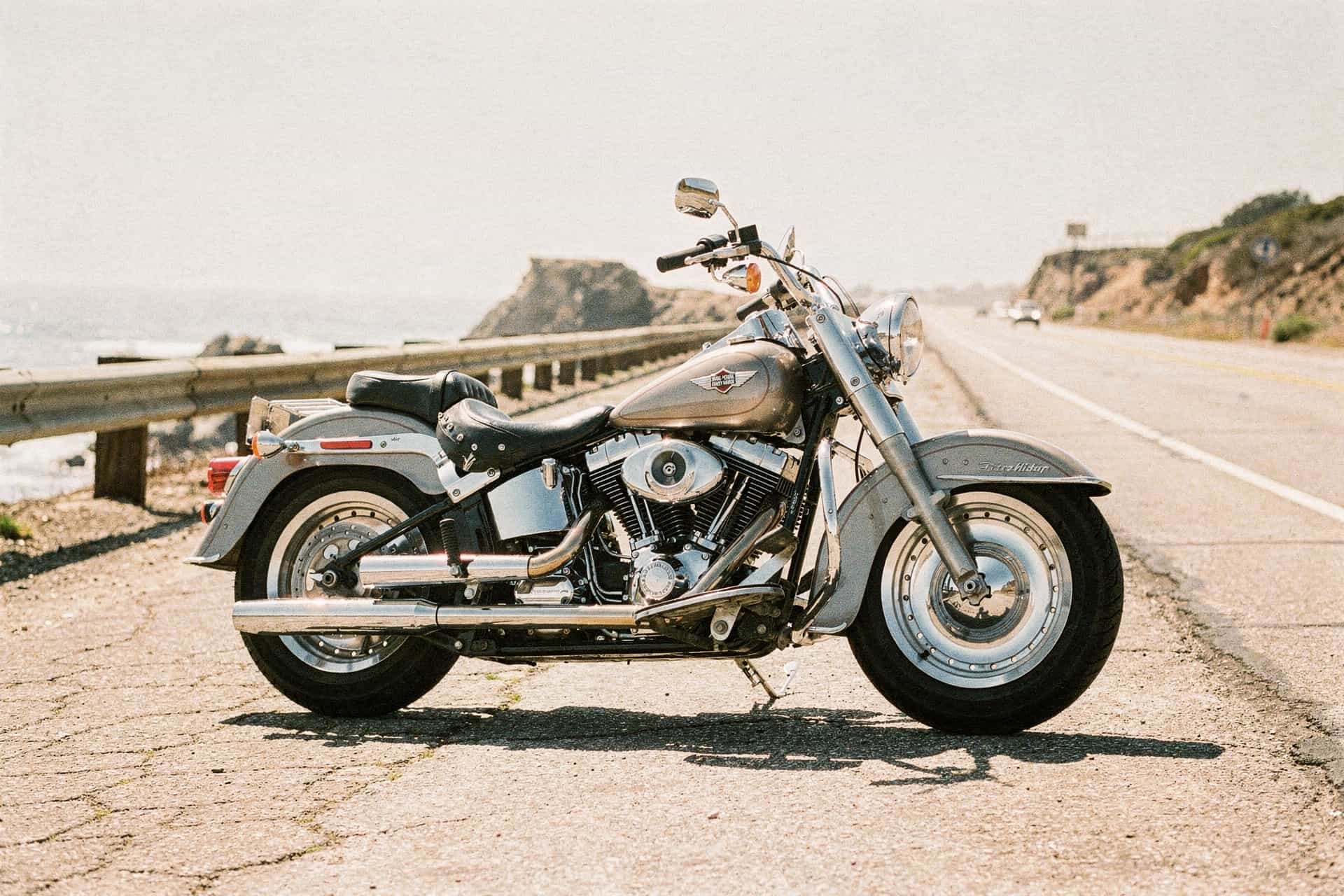
In 1988 Harley-Davidson took a prototype to Daytona Bike Week with no spokes and no laced rims, just two solid aluminum discs. It came back in 1989. For 1990 it went on sale as the FLSTF Fat Boy, and it is still in the catalog for 2026, which no other Softail can claim.
This guide is organized the way the bike actually changed: by generation, with the engine, chassis and model-code changes that define each one, the specifications that are documented rather than repeated, and the wear items and recall campaigns worth knowing about before you buy a used one.
One housekeeping note first, because it affects every search you will run on this bike. Harley-Davidson spells it Fat Boy, two words. Fatboy, one word, is a misspelling that dominates classified listings and forum posts. The parts catalogs, the trademark and the model designations all use two words, and searching the one-word version will bury you in listings written by people who did not check.
Generations at a Glance
| Generation | Model code | Model years | Engine |
|---|---|---|---|
| Evolution | FLSTF | 1990-1999 | 1,340cc Evolution |
| Twin Cam | FLSTF and FLSTFI, plus FLSTFB, FLSTFBS and FLSTFSE | 2000-2017 | Twin Cam 88B, 96B, 103B, plus Screamin’ Eagle 95, 103 and 110B variants |
| Milwaukee-Eight | FLFB and FLFBS | 2018-2024 | Milwaukee-Eight 107 and 114 |
| Milwaukee-Eight | FLFBS | 2025-present | Milwaukee-Eight 117 |
The two Milwaukee-Eight rows are split on engine, not on chassis. The 2018 Softail frame carries through to the current bike; what changed for 2025 is the powertrain. Engine availability inside the 2018-2024 span also varied by market and model year, which the next section covers.
Where the Name Came From
Two explanations circulate, and only one of them has a named source behind it.
The documented one is simple description. The bike is wider than its stablemates when you look at it head on, and Harley named it for that. Harley-Davidson’s vice president of styling, Scott Miller, addressed the question publicly in 2015 and said the name was purely descriptive.
The other explanation, that “Fat Boy” is a portmanteau of the Fat Man and Little Boy atomic bombs, is a false etymology. It gets repeated because the original silver-grey paint and the solid discs invite the comparison, and because it makes a better story. Harley has never supported it and the company’s own styling leadership has explicitly denied it. Treat it as folklore, not history.
The bike was heavy enough to earn the name honestly either way.
Generation 1: FLSTF Evolution, 1990-1999
The first Fat Boy is a Softail chassis with a rigid-mounted 1,340cc Evolution engine and a five-speed gearbox, wearing bodywork nothing else in the lineup had.
Cycle World tested one in January 1990 and published measured numbers rather than factory claims:
| 1990 FLSTF, Cycle World measured | |
|---|---|
| Price | $10,995 |
| Weight | 660 lb |
| Seat height | 26 in |
| Quarter mile | 14.53 sec |
| Top speed | 112 mph |
| Braking, 60-0 mph | 126 ft |
| Carburetor | Keihin 40mm constant velocity |
| Handlebar width | 34 in |
| Front tire | MT90-16 |
That 660-pound figure is worth holding onto. The “710 pounds wet” number that appears all over the internet has no attributed source. The magazine weighed the bike.
What set it apart above the frame:
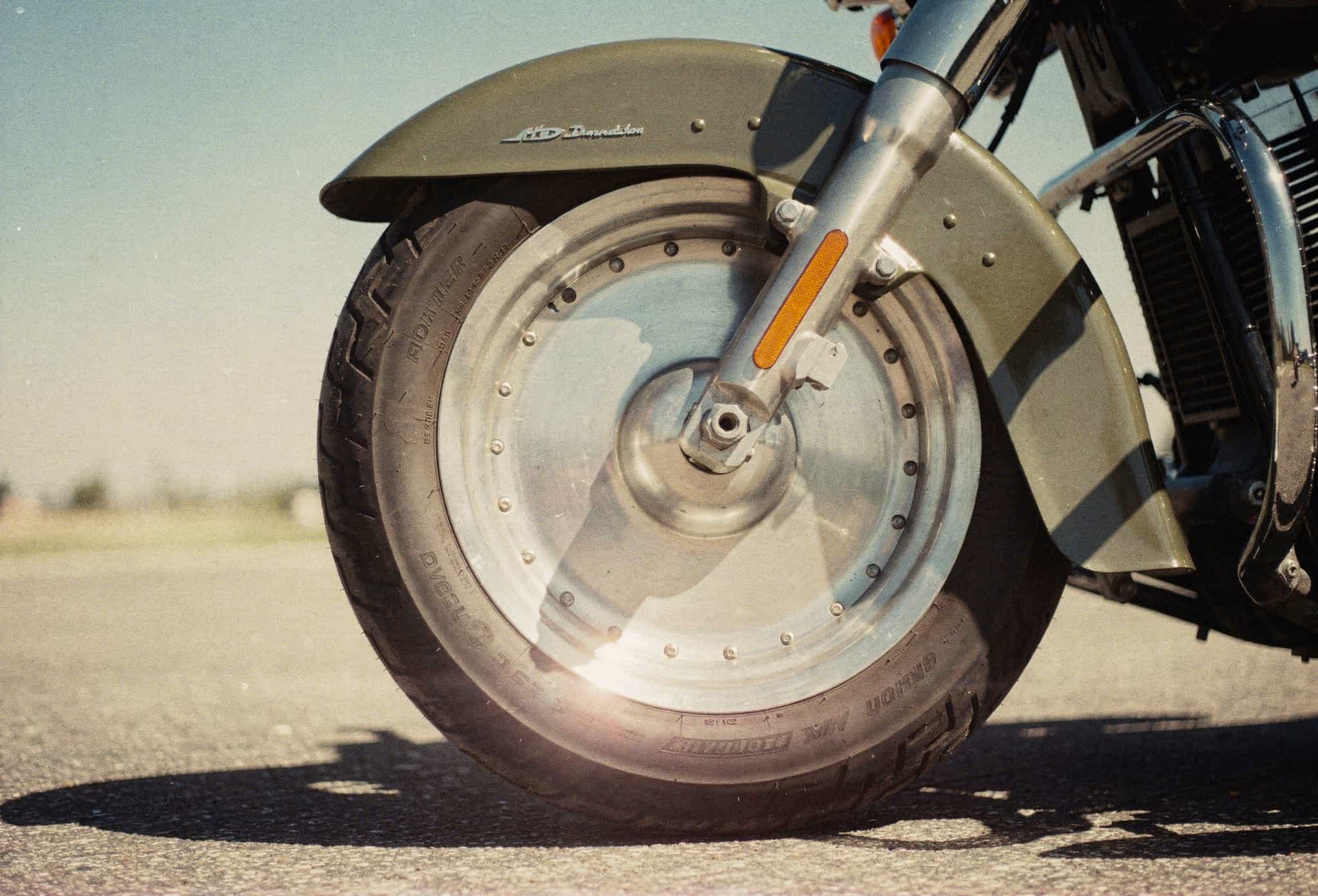
The disc wheels. Solid aluminum, 16 inches at both ends, when everything else rolled on wire spokes or castings. They read as machined hardware rather than motorcycle jewelry, and they eliminated spoke truing as a maintenance item.
Rigid engine mounting. Like every Softail, the Fat Boy bolts its engine solidly to the frame instead of rubber-isolating it the way the FXR and Dyna platforms do. You feel the V-twin through the chassis. That is a defining characteristic of the bike, not a fault.
Shotgun exhaust. Both mufflers on the right side, side by side, giving a note distinct from the staggered pipes on a Heritage.
Monochromatic paint. The launch scheme was a flat grey with almost-fluorescent yellow accents, chosen to make the bike read as raw machinery.
Changes across the decade were incremental: a seamless exhaust for 1994, revised master cylinder and switchgear for 1996. The engine underneath is the same one that pulled the company out of its 1980s crisis, and our Evolution engine guide covers what it actually fixed and which numbers attached to it are documented.
Terminator 2
In 1991 James Cameron put a Fat Boy under Arnold Schwarzenegger in Terminator 2: Judgment Day, and the model stopped being a motorcycle and became a silhouette.
Several bikes were used in filming. One of the machines Schwarzenegger actually rode came out of the production company’s holdings and sold at the Profiles in History “Icons & Legends of Hollywood” auction in June 2018 for $480,000, against a pre-sale estimate of $200,000 to $300,000, with 392 miles showing. Another of the film’s Fat Boys sits in the Harley-Davidson Museum in Milwaukee.
The cultural effect outlasted the film’s box office run by decades, and it is one of the clearest examples of a machine becoming an identity marker; our motorcycle culture guide traces how that process works across the rest of biker culture.
Generation 2: FLSTF Twin Cam, 2000-2017
For 2000 the Fat Boy got the Twin Cam 88B. The B is the important letter: it denotes internal counterbalancers, which the rigid-mounted Softail chassis needed and the rubber-mounted Dyna and Touring bikes did not. The non-counterbalanced Twin Cam 88 had arrived a year earlier on those platforms.
Dated changes across this generation:
- 2000: Twin Cam 88B, 1,450cc, replaces the Evolution.
- 2002: Bullet-style turn signals, factory alarm and immobilizer.
- 2005: two anniversary bikes, not one. The FLSTFI 15th Anniversary Edition left the factory with a 1,550cc, 95 cubic inch Twin Cam 88B carrying a Screamin’ Eagle big-bore kit, alongside chromed disc wheels, a 24K gold-plated tank emblem and Vivid Black or Brilliant Silver paint. Separately, the Fat Boy entered the CVO program for the first time as the FLSTFSE Screamin’ Eagle Fat Boy, on a 1,690cc Screamin’ Eagle Twin Cam 103 stroker.
- 2007: Twin Cam 96B, 1,584cc, plus a six-speed transmission and electronic fuel injection as standard. The carbureted Fat Boy ends here.
- 2010: Fat Boy Lo (FLSTFB) joins the line as a lower, blacked-out variant.
- 2012: Twin Cam 103B, 1,690cc.
- 2016-2017: Fat Boy S (FLSTFBS) with the Screamin’ Eagle Twin Cam 110B, 1,801cc, rated at 108 ft-lb at 4,000 rpm and previously a CVO-only engine.
Two designations to keep straight here. The Fat Boy Lo arrived for 2010, and FLSTFB is a separate model designation rather than a trim package on the standard FLSTF. And the 2005 95 cubic inch anniversary engine was a factory-fitted big bore on the standard 88B bottom end, which is a different thing from the CVO bike’s stroked 103 that year.
For the output side of the Twin Cam story, including why single-source horsepower claims for these engines rarely survive scrutiny, see our guides to the Twin Cam 96 and the Twin Cam 103 dyno numbers.
Generation 3: FLFB and FLFBS, 2018 onward
The 2018 model year replaced the Softail platform outright and absorbed the Dyna line into it. The Fat Boy came out the other side with new model codes and two engine choices, and the codes are where most write-ups on this bike go wrong.
FLFB is the Milwaukee-Eight 107 bike. FLFBS is the Milwaukee-Eight 114. They are not two trim levels of the same engine. Harley quoted 109 lb-ft of torque for the 107 and 119 lb-ft for the 114.
What Harley actually claimed for the chassis, from its own launch material:
- The frame is 65 percent stiffer than the 2017 Softail frame, producing a 34 percent increase in overall chassis stiffness. The frame also uses 50 percent fewer component parts and 22 percent fewer welds.
- The models are up to 35 pounds lighter than their 2017 equivalents. That figure varies by model and is a model-to-model comparison rather than a frame weight, which is the distinction to keep straight when you see it quoted as a curb weight.
- Rear suspension moves to a single under-seat monoshock in place of the twin shocks, with a Showa dual bending valve fork at the front.
- Wheels grow to 18-inch Lakester discs at both ends, wearing a 160mm front and a 240mm rear tire.
Later changes:
- 2020: Harley adds a serialized 30th Anniversary edition as a mid-year model. Engine availability this year is where published accounts disagree, so treat a blanket statement either way with suspicion: Harley’s own US parts catalog indexes the year as Fat Boy 114 FLFBS, while FLFB 107 fitment listings and European price lists for the 2020 Fat Boy also exist. Confirm a specific 2020 bike from its VIN and model code rather than from a lineup summary.
- 2025: the Milwaukee-Eight 117 arrives with reworked rear suspension. The limited Gray Ghost edition of that year ran to 1,990 serialized units at $25,399 and up, quoted at 101 hp and 122 ft-lb.
- 2026: the standard Fat Boy runs the Milwaukee-Eight 117 Custom, quoted at 126 ft-lb at 3,000 rpm, from $22,599, at 694 lb in running order with a 25.9-inch laden seat height and a 5-gallon tank.
Spec Comparison Across the Eras
| Spec | 1990 FLSTF | 2018 FLFBS | 2026 Fat Boy |
|---|---|---|---|
| Engine | Evolution 1,340cc | Milwaukee-Eight 114, 1,868cc | Milwaukee-Eight 117 Custom |
| Torque | Not published by Harley | 119 lb-ft | 126 lb-ft at 3,000 rpm |
| Transmission | 5-speed | 6-speed | 6-speed |
| Wheels | 16 in solid disc, front and rear | 18 in Lakester disc | 18 in Lakester disc |
| Rear suspension | Twin shocks under the frame | Under-seat monoshock | Under-seat monoshock |
| Seat height | 26 in (Cycle World measured) | Redesigned chassis | 25.9 in laden |
| Weight | 660 lb (Cycle World measured) | Up to 35 lb lighter than 2017 | 694 lb in running order |
| Fuel delivery | Keihin 40mm CV carburetor | Electronic fuel injection | Electronic fuel injection |
Two gaps in that table are deliberate. Harley did not publish a torque figure for the Evolution Big Twin in its US model materials, so the cell stays empty rather than carrying an invented number. And Harley described the 2018 weight saving as a model-level figure against the 2017 bike rather than publishing a directly comparable curb weight for every variant, so quoting a single 2018 wet weight against a 1990 measured weight would compare two different things.
Known Issues by Generation
Nothing here is a reason not to buy a Fat Boy. All of it is a reason to know which one you are looking at.
Twin Cam cam chain tensioners, 1999-2006. Engines from this window use spring-loaded cam chain tensioners with polymer shoes that wear against the chain. Harley moved to hydraulic tensioners from 2007. The service manual for the specific model year carries the wear limit and the inspection procedure, and that manual is the document to use rather than a mileage rule of thumb from a forum, because reported wear rates vary widely. If you are shopping a 2000-2006 Fat Boy, budget for an inspection inside the cam chest as part of the purchase, not as a surprise later.
Clutch recall, campaign 0173 / NHTSA 18V734. This 2018 campaign covered roughly 177,000 machines over a hydraulic clutch defect in which the secondary clutch actuator cylinder could leak internally and the master cylinder could lose the ability to disengage the clutch. It included the 2017 Fat Boy S (FLSTFBS) among many other models. Run any candidate bike’s VIN through Harley’s recall lookup and NHTSA’s database before you buy.
Softail rear shock adjuster recalls, 23V591 and 25V375. These campaigns covered a fracturing rear shock preload adjuster on 2018-2024 Softails that could damage the rear tire. The Fat Boy is not on the affected model list, and Harley’s stated reason is that other Softail models use a different style of rear shock adjuster. This is worth knowing precisely because plenty of coverage described it loosely as “the Softail recall,” which reads as though it covered every Softail. It did not.
Heat. Air-cooled V-twins push heat at the rider’s legs in slow traffic, and the Twin Cam Fat Boys have a long-standing reputation for it. The Milwaukee-Eight’s four-valve heads and revised cooling changed the character of that, but no air-cooled 117 cubic inch engine is cool in stop-and-go traffic in July. Plan for it rather than expecting to be surprised by it.
Lean angle and mass. Forward controls and a low chassis mean the Fat Boy grounds hard parts before it runs out of tire. Harley publishes a lean-angle figure for each model year, and that number, not tire grip, is the real limit on this chassis. Read it off the spec sheet for the year you are riding and leave margin against it. Mass is the other half of the same problem: 694 pounds in running order is a lot of motorcycle to hold up at a gas pump on a crowned surface.
Price. The 2026 Fat Boy starts at $22,599 before options, dealer charges or tax. Accessories move that quickly.
Why It Has Lasted
Most motorcycle models get five to ten years before they are discontinued or redesigned into something else. The Fat Boy has been continuously catalogued since 1990.
The silhouette is unmistakable at distance. The disc wheels are its fingerprint. Other manufacturers have tried solid wheels on cruisers. None of them own the look.
It arrives looking modified. Wide bars, heavy proportions, minimal chrome relief. A stock Fat Boy reads as a bike somebody built, which is a rare thing to get right from a factory.
The film never stopped working. Every few years another generation finds Terminator 2 and the association renews itself at no cost to Harley.
Harley has updated it without breaking it. The 2018 redesign changed the frame, the engine, the suspension and the wheel size, and the result still reads as a Fat Boy at a glance. That is harder than it sounds. Compare the fate of the V-Rod, a technically strong motorcycle that never resolved into a recognizable part of the brand’s visual language and was eventually dropped. The broader arc of which Harley platforms survived and which did not runs through our Harley-Davidson history guide.
Bobber Brothers has stocked gear for bobber and Softail riders since 2014, and our full collection is cut for the garage rather than the showroom floor.
Model years 1990 through 2026, three Harley engine families, one set of wheels nobody has successfully copied. Whichever generation you end up on, buy it on condition and service history, verify the model code against the VIN rather than the seller’s description, and check the recall databases before the money moves.
Sources
- 1990 Harley-Davidson Fat Boy road test - Cycle World, January 1990 - measured weight, seat height, quarter-mile and top-speed figures, braking distance, price, carburetor and handlebar width for the first-year FLSTF
- Harley-Davidson Fat Boy - Wikipedia - cited entries for the 1988 and 1989 Daytona prototypes, the Scott Miller statement on the name, the FLFB and FLFBS model codes and torque figures, the 2010 Fat Boy Lo, the 2025 move to the Milwaukee-Eight 117, and the museum bike. Its flat statement that the 2020 Fat Boy came only with the 114 is the claim contradicted by the FLFB 107 listings cited below
- Harley-Davidson Introduces Next Custom Revolution With Eight New Iconic Softail Motorcycles - Harley-Davidson Media - the manufacturer’s own 2018 chassis claims: 65 percent stiffer frame, 34 percent stiffer chassis, up to 35 pounds lighter, monoshock and Showa fork
- 2026 Fat Boy - Harley-Davidson USA - current model engine, torque, MSRP, running-order weight, laden seat height and fuel capacity
- 2025 Fat Boy Gray Ghost - Harley-Davidson USA - the 1,990-unit serialized limited edition, its Milwaukee-Eight 117 output figures and pricing
- Terminator 2 Fat Boy sold at auction for $480,000 - MotorBiscuit - the June 2018 Profiles in History sale, the pre-sale estimate and the bike’s provenance
- 2005 Harley-Davidson Owner’s Manual - Engine specifications - factory specification for the 95 cubic inch engine, including 91.0 lb-ft at 3,500 rpm
- Grey Ghost Registry timeline - the 2005 15th Anniversary Fat Boy’s factory-fitted Screamin’ Eagle big bore taking it to 1,550cc, and its commemorative trim
- HARLEY-DAVIDSON CVO Fat Boy specs - autoevolution - the separate 2005 FLSTFSE Screamin’ Eagle Fat Boy, the model’s first CVO, on the 1,690cc Screamin’ Eagle Twin Cam 103 stroker
- 2016 Harley-Davidson Fat Boy S review - webBikeWorld - the Fat Boy S air-cooled Twin Cam 110B, 1,801cc, 108 ft-lb at 4,000 rpm, and the engine’s prior CVO-only status
- 2020 Softail Fat Boy 114 FLFBS parts - Harley-Davidson USA - Harley’s own US parts catalog index for the 2020 model year
- Harley-Davidson FLFB Fat Boy 107 2020 - Dynojet - a 2020 model-year FLFB 107 fitment listing, which is why a blanket “114 only for 2020” claim does not hold up
- Harley-Davidson Recalls 82,117 Softail Motorcycles - Ultimate Motorcycling - NHTSA campaign 25V375, the affected model list that excludes the Fat Boy, and Harley’s explanation about the different rear shock adjuster
- Motorcycle Safety Recall Information - Harley-Davidson USA - the manufacturer’s VIN recall lookup
- History of Harley-Davidson Engine Types - Harley-Davidson USA - official dating of the Evolution, Twin Cam and Milwaukee-Eight engine families