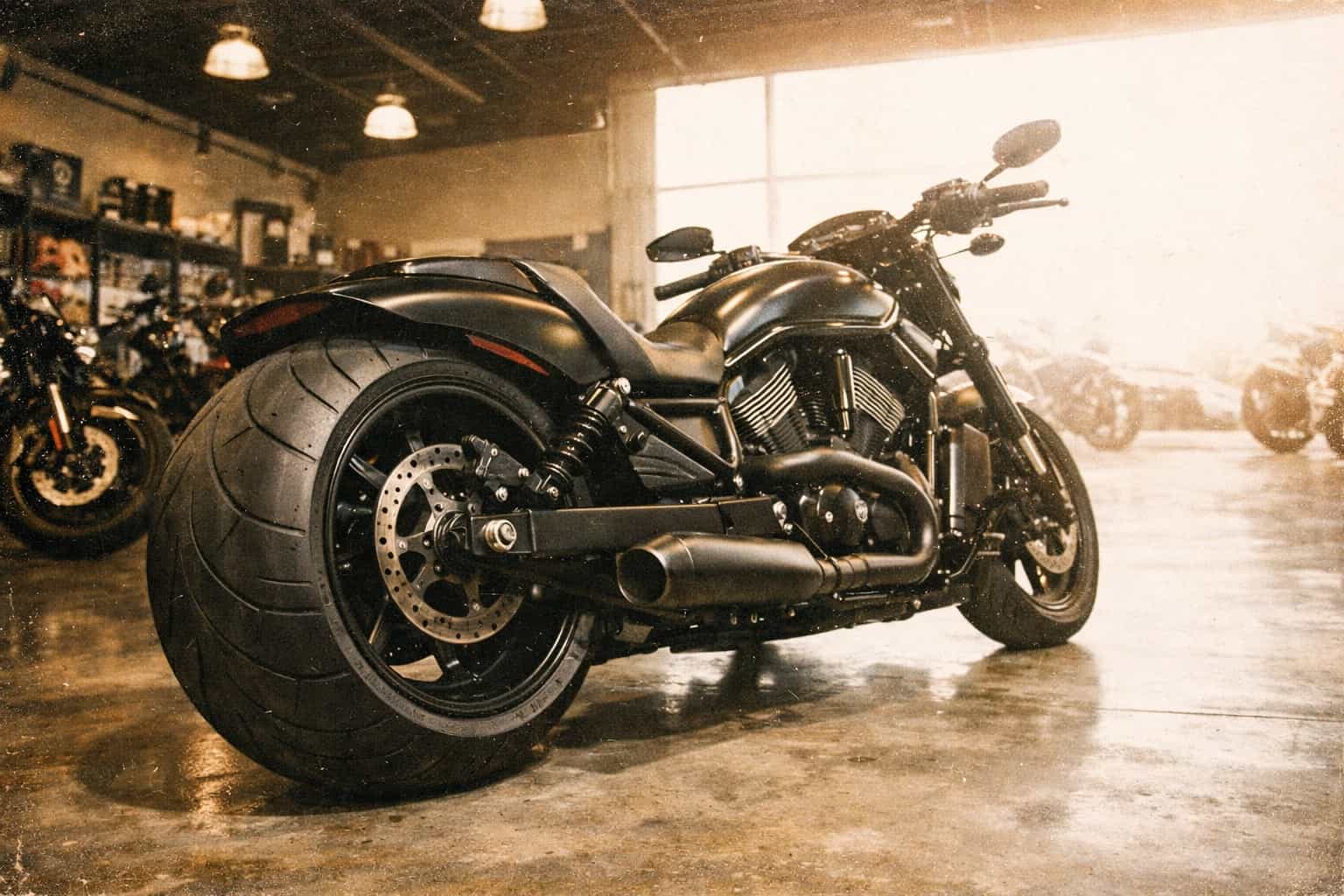
The Answer, Straight Up
Yes. The V-Rod is discontinued. Harley-Davidson built the VRSC line from the 2002 model year through 2017, then left it out of the 2018 lineup and moved on.
What makes this question keep coming back is how it ended. There was no farewell edition, no press release, no “thank you for sixteen years” statement. The Drive reported in August 2017 that Harley had quietly killed the V-Rod, noting the 2017 V-Rod Muscle and Night Rod Special were the last of the line and that the Dyna family went the same way in the same lineup revamp. The bike simply stopped being on the price sheet.
That silence matters for a practical reason. Every article that tells you exactly why Harley killed the V-Rod, this one included, is reading tea leaves. Below we separate what is documented from what is inference, then get to the parts and used-market questions riders actually need answered.
Production Timeline: What Harley Actually Built
The platform code was VRSC, which Harley used for V-Twin Racing Street Custom. The engine inside was the Revolution.
| Model | Code | Model years | Engine |
|---|---|---|---|
| V-Rod | VRSCA | 2002-2006 | 1,131cc |
| V-Rod (black powder-coat) | VRSCB | 2004-2005 | 1,131cc |
| Screamin’ Eagle V-Rod (CVO) | VRSCSE / VRSCSE2 | 2005 / 2006 | 1,247cc |
| Night Rod | VRSCD | 2006-2008 | 1,131cc, then 1,247cc |
| Street Rod | VRSCR | 2006-2007, announced and on sale from January 2005 | 1,131cc |
| V-Rod | VRSCAW | 2007-2010 | 1,131cc, then 1,247cc |
| Night Rod Special | VRSCDX | 2007-2017 | 1,131cc, then 1,247cc |
| V-Rod Muscle | VRSCF | 2009-2017 | 1,247cc |
| Destroyer (drag racing, not street legal) | VRXSE | 2006 | 1,300cc |
Model-year ranges above follow the consolidated VRSC model history, which also records the engine change: bore went from 100mm to 105mm for the 2008 model year while stroke stayed at 72mm, taking displacement from 1,131cc to 1,247cc. Redline stayed at 9,000 rpm throughout. Every VRSC was assembled at Harley’s Kansas City, Missouri plant.
The Street Rod is the one row worth explaining, because you will see it listed under two different years. Harley’s press release of 24 January 2005 calls it “the all-new 2006 VRSCR Street Rod” and says it was “available now at Harley-Davidson dealerships.” So the bike reached buyers in 2005 while carrying a 2006 model-year designation, which is why plenty of listings, European market material and spec sites file it as a 2005. If you are shopping one, read the VIN rather than the advert. It was also the first VRSC with an inverted Showa fork and Brembo brakes, and at 40 degrees it had the most lean angle in the family.
Two dates are worth holding onto. The V-Rod’s last model year was 2017. Kansas City assembly itself ended later: Harley announced on 30 January 2018 that it would consolidate Kansas City final assembly into York, Pennsylvania by 2019, citing US capacity that exceeded US demand. By then the V-Rod and Dyna lines were already gone, so the plant closure is a related event, not the cause.
The Revolution Engine, With the Numbers Reconciled
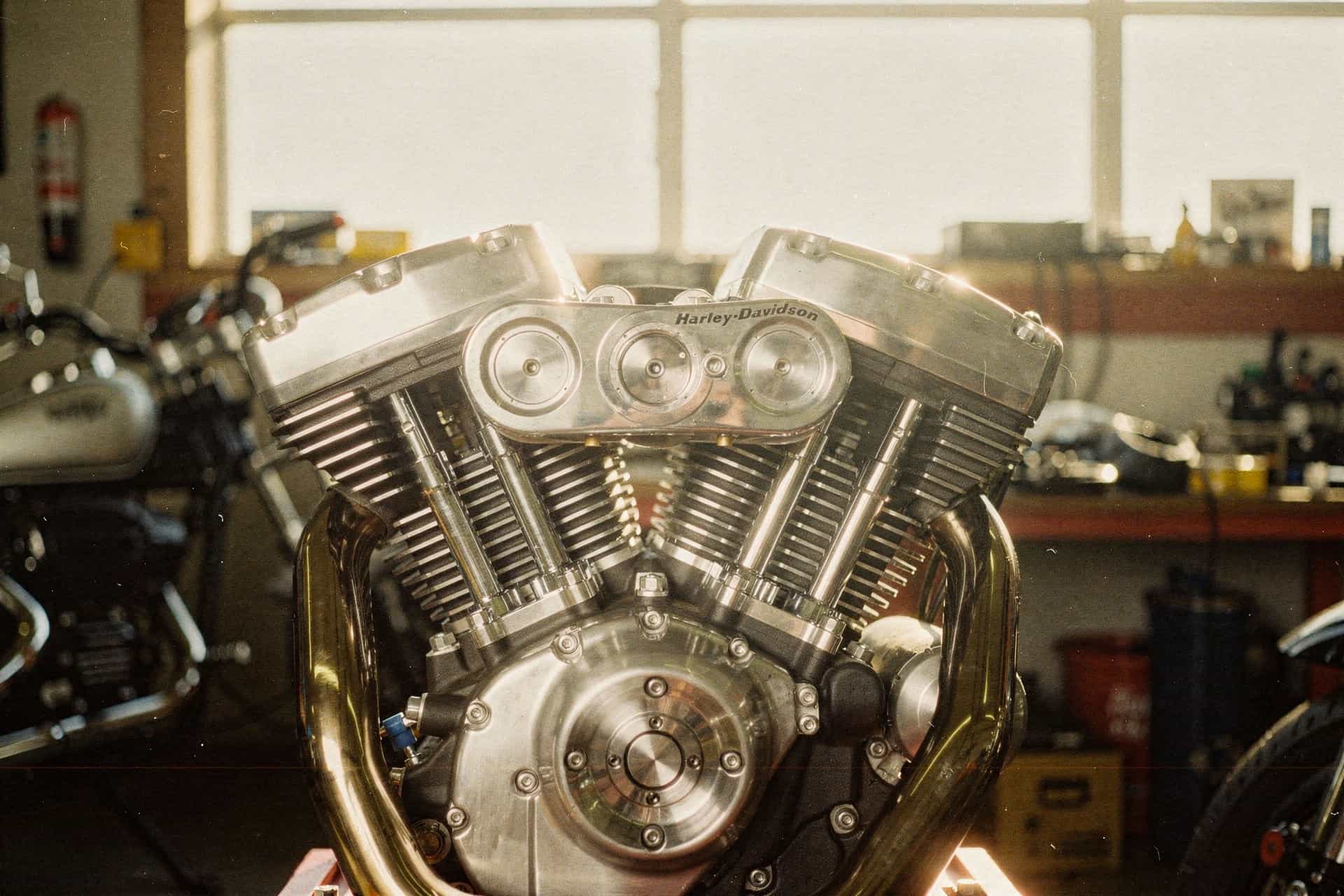
The Revolution is the reason this bike still gets searched. It was Harley’s first modern liquid-cooled production V-twin, and the specs are worth stating carefully because published figures differ.
Harley’s own engine history page says the Revolution was “developed with the assistance of Porsche,” describes the 60-degree cylinder angle, dual overhead cams and four-valve heads, and lists the 69 cubic inch (1,131cc) engine at 11.3:1 compression making “115 hp at 8200 rpm.”
Period road tests and dealer literature from the 2002 launch commonly quote the same 115 hp at 8,250 rpm along with 74 lb-ft of torque at 7,000 rpm. Some secondary databases list higher torque figures that belong to the later 1,247cc engine, or to different measurement standards. The safe reading: 115 hp claimed for the 1,131cc, around 120 to 123 hp claimed for the 1,247cc versions, and a genuine 9,000 rpm ceiling either way. If a listing quotes a number to the decimal place without saying whose dyno it came from, ignore it.
For context on what that meant in 2002, the air-cooled Twin Cam powering most of the lineup that year was a pushrod, two-valve, air-cooled engine that ran out of revs well under 6,000 rpm. The Revolution was not a hotter version of a Harley engine. It was a different design philosophy dropped into the same showroom.
The one thing that never gets said plainly: the radiator was not an accessory choice, it was structural to the concept. Liquid cooling is what let the engine hold high rpm, run tighter tolerances and meet emissions with a high-compression, high-revving layout. You could not delete it and keep the bike.
Why Harley Killed It: Documented vs Inferred
Here is the honest split.
Documented. The 2017 model year was the last. The 2018 lineup did not include a VRSC model. Harley issued no discontinuation press release and gave no public reason. Emissions deadlines in the EU are documented independently of Harley: under Regulation (EU) No 168/2013, Euro 4 applied to new type approvals from 1 January 2016 and to all new vehicles from 1 January 2017, with Euro 5 following for new types on 1 January 2020 and all new vehicles on 1 January 2021. The Milwaukee-Eight engine family is also documented: it launched in the 2017 Touring lineup.
Inferred. Everything else. The sales-volume argument, the “core buyers rejected liquid cooling” argument, the “engineering budget went to Milwaukee-Eight” argument and the “it did not fit the brand” argument are all press and analyst reasoning built on those documented facts. They are reasonable. They are not Harley statements, and we will not dress them up as such.
Note what is missing from that list: a sales number. Harley has never broken out VRSC volumes in its public reporting, so “the V-Rod sold badly” is an inference riders repeat, not a figure anyone can check. The one production count that is documented in the consolidated model history is for the oddities - about 1,400 VRSCX bikes for 2007, and 646 VRXSE Destroyers built with 625 released to dealers - and those are limited models, not the line.
What the emissions timeline does establish is the size of the decision Harley faced. A model line built on an engine that shared almost nothing with the rest of the range was heading into a Euro 5 recertification cycle that would have required real engineering spend on that engine alone. Whether that was the deciding factor, or one input among several, Harley has not said.
The same model history records that the V-Rod became Harley’s best-selling model in some markets outside the United States, which is a useful check on the tidy “nobody wanted it” story. The custom scene points the same way: in Germany especially, shops built the VRSC into some of the most extreme factory-based customs of the 2010s, working with the hydroformed frame and the low, compact engine package. None of that is a sales figure either. It is just a reason to hold the popular explanation loosely. For the opposite end of the Harley customizing spectrum, our guide to what a bobber motorcycle is covers the strip-it-down philosophy the V-Rod scene inverted.
Parts and Service Support in 2026
This is the question that decides whether a used V-Rod is a good idea, and it deserves a careful answer.
Harley-Davidson does not publish a guaranteed parts-availability window for discontinued models. Riders repeat a “ten years after production” figure constantly. We could not find that commitment in any Harley document, and dealer parts systems already flag some parts on much newer models as obsolete. So nobody can honestly promise you a date, and that includes us.
We are not going to tell you the aftermarket is deep, that salvage yards are full of Revolution parts or that any given shop can service one. Those are the exact claims we cannot check from here, they go stale within a year, and a seller will happily repeat them back to you. Availability is a thing you look up, with a date attached, for the specific bike in front of you.
The lookup, which takes an afternoon:
- Pull part numbers from the parts catalogue for that exact model year. Take the Revolution-specific items, because those are the ones with nowhere else to come from: water pump, radiator, cooling fan, thermostat, head gasket set, the ECM, and one piece of model-specific bodywork.
- Have a dealer parts counter run every number. Ask three questions per number - is it still an active part, has it been superseded and to what, and what is the quoted lead time. Write today’s date beside each answer. A parts lookup is a snapshot. One from 2023 tells you nothing about what is in the system now.
- Run the same list past a second dealer, and past a VRSC specialist. Counters do not all chase superseded numbers with the same patience.
- Then price the bike against what came back. A cooling component that is obsolete with no supersession is a different purchase from one sitting in a warehouse.
Do the same on the service side. Ask the shop you would actually use whether it has a technician who has worked on a Revolution, and how recently. Get a yes or a no rather than an assurance.
If you already ride one of these and want to fly the flag without a bar-and-shield-covered fairing, our t-shirt collection is built for riders who actually keep old platforms on the road.
What a Used V-Rod Is Worth
We removed the fixed price bands this article used to carry, because we could not tie them to a dated public dataset and stale price ranges do real damage when someone uses them to negotiate.
Here is the method instead.
- Price the exact model and year, not “a V-Rod.” A 2005 VRSCA, a 2013 Night Rod Special and a 2017 V-Rod Muscle are three different markets. The CVO Screamin’ Eagle models (VRSCSE, VRSCSE2) were low-production and sit in their own bracket.
- Use condition-graded valuations. Hagerty’s valuation tools publish condition tiers for VRSC model years and record past sales. Grade the actual bike honestly before you read a number.
- Cross-check against recent sold listings in your region, not asking prices. Asking prices tell you what sellers hope for.
- Discount hard for deferred cooling-system maintenance. More on that below.
- Treat “V-Rod values are climbing” as a claim to test, not a fact. It may well be true for clean final-year bikes. We could not verify it against a public dated sold-price series, so we are not going to assert it.
Buying Used: What to Actually Check
The Revolution engine’s condition depends heavily on maintenance history. A used-bike inspection should verify the cooling system, charging system, fuel system, and documented service rather than assuming the platform is either trouble-free or inherently fragile.
- Cooling system first. Coolant condition, water pump area, hose ends, radiator fins and fan operation. A bike whose coolant has never been changed tells you what the rest of the service history looks like.
- Charging system on early bikes. Voltage regulator problems on the earlier VRSC years are a well-known owner complaint. Check charging voltage at idle and at rpm before you hand over money.
- Exhaust and header joints. Look for cracking and repair welds, particularly on bikes that have been through more than one aftermarket system.
- Frame and swingarm. The hydroformed frame is strong but expensive to put right. Any evidence of a hit is a walk-away for most buyers.
- Tune and mods. Big rear tires, stretched swingarms and reflashed ECMs are common. Ask what the current map is matched to, and whether anyone has the stock parts.
- Which era to target. The 2008-and-later bikes get the 1,247cc engine and, on many models, ABS and later electronics. The 2002-2006 VRSCA with the polished bodywork and silver frame is the one to buy if you want the original look rather than the last refinement.
What the V-Rod Left Behind
The clean line people draw from the Revolution to the current Revolution Max in the Pan America 1250 and Sportster S is a philosophical one, not a parts one. Revolution Max is a newer, separate engine design. What carried across was the argument the V-Rod won inside Harley: that a liquid-cooled, high-revving, DOHC V-twin belongs in the range at all.
Set the V-Rod against the rest of the Harley-Davidson story and it looks less like a failure and more like a first attempt. The Evolution engine saved the company by modernizing the formula riders already wanted. The V-Rod tried to sell a formula they had not asked for. The LiveWire later ran into a version of the same problem from the other direction, and the Sportster line eventually got the liquid-cooled treatment the V-Rod pioneered.
Sixteen model years, one engine family, no official goodbye. If you want one, buy the bike in front of you on its maintenance history and its parts lookup, not on a story about what it might be worth later.
Sources
- History of Harley-Davidson Engine Types - Harley-Davidson USA - manufacturer statement of Revolution displacement, compression, claimed output and Porsche involvement
- Harley-Davidson Has Quietly Killed the V-Rod - The Drive - contemporaneous August 2017 reporting that the platform ended without an announcement, and that the 2017 Muscle and Night Rod Special were the last
- Harley-Davidson VRSC model history - consolidated variant list, model-year ranges, bore change from 100mm to 105mm for 2008, redline and Kansas City assembly
- Harley-Davidson Introduces New V-Rod-Based Street Rod - Roadracing World - the 24 January 2005 Harley press release designating the VRSCR a 2006 model and stating it was available at dealerships from that date, plus the inverted Showa fork, Brembo brakes and 40 degree lean angle
- Harley-Davidson Closing Kansas City Plant by Summer 2019 - Rider Magazine - the 30 January 2018 consolidation announcement and Harley’s stated capacity reasoning
- EU motorcycle emissions standards - TransportPolicy.net - Euro 4 and Euro 5 application dates under Regulation (EU) No 168/2013
- A Peek Inside the V-Rod - Cycle World - technical description of the Revolution engine architecture
- Harley-Davidson V-Rod road test, September 2001 - Cycle World - launch-period road test and claimed output figures
- Hagerty valuation tools - condition-graded values and recorded past sales used for pricing a specific VRSC year rather than the platform