The Bar and Shield is one of the most defended trademarks in American industry. The company has spent over a century filing lawsuits against counterfeiters, fashion brands, and merchandise sellers who used the mark without permission. What most people do not realize is how many times Harley Davidson has redesigned, retired, and reintroduced its own logo across that century.
This is the year-by-year evolution of the Harley Davidson corporate logo. If you are looking specifically for tank emblems, the painted and chromed badges that appeared on actual fuel tanks across the decades, our Harley Davidson tank emblems by year guide is the place for that. This article focuses on the corporate logo: the trademark itself, how it has been used, and how it has changed.
The First Seven Years: No Logo at All
Harley Davidson was founded in 1903 by William S. Harley, Arthur Davidson, and Walter Davidson in Milwaukee, Wisconsin. For the first seven years, the company had no formal corporate logo. Period catalogs and parts orders used plain wordmarks: the words “Harley-Davidson Motor Co.” in basic typography, with no shield, no graphic mark, no consistent visual identity.
The earliest motorcycles built between 1903 and 1909 carried no logo on the tanks. The brand identity was the bike itself.
1908 to 1910: The Bar and Shield Appears
The first known appearance of the Bar and Shield is on a toolbox transfer decal dated 1908. By 1910, the logo had migrated to parts packaging and company literature. On July 19, 1910, Harley Davidson filed an official trademark application with the US Patent Office.
The 1910 logo had the elements that would define the brand for over a century:
- A vertical shield shape
- A horizontal bar across the upper third of the shield
- The word “Harley-Davidson” in capital letters across the bar
- The words “Motor Cycles” stacked across the lower portion of the shield
The original was strictly black and white. There was no orange anywhere. Color came later.
The designer of the logo was never recorded in company archives. Harley historians have speculated about influences, but no documentation has surfaced to confirm who drew the original mark or what specifically inspired the shield shape.
1920s: Orange Enters the Brand
Around 1920, the standard Bar and Shield began appearing in the orange and black color scheme that would become inseparable from the brand. The shift happened gradually. Some early color uses experimented with red, yellow, and even blue accents before the orange-black-white combination became standardized by the mid 1920s.
There was no documented brand strategy meeting that produced the color decision. The combination simply worked: orange against black is high-contrast, visually loud, and reads at a distance. By 1925, anyone walking into a Harley dealership saw the same color combination on signage, parts packaging, and apparel.
1929 to 1933: The Eagle Joins the Mark
In 1929, the United States economy collapsed. Motorcycle sales collapsed with it. Harley Davidson responded with a logo refresh that added a soaring bald eagle to the existing Bar and Shield. The eagle imagery leaned into American patriotic identity at a moment when the company needed every emotional connection it could find with American buyers.
The eagle and shield combination did not replace the standard Bar and Shield. It became an additional design used in print, advertising, and select product applications. The eagle would appear and disappear from Harley branding repeatedly over the next 90 years.
In 1930, a brief experiment painted the letter O in the wordmark with a red and yellow gradient. By 1933, the company had committed to the dominant black and orange palette and dropped the gradient experiments.
1934 to 1949: The Tank Emblem Era
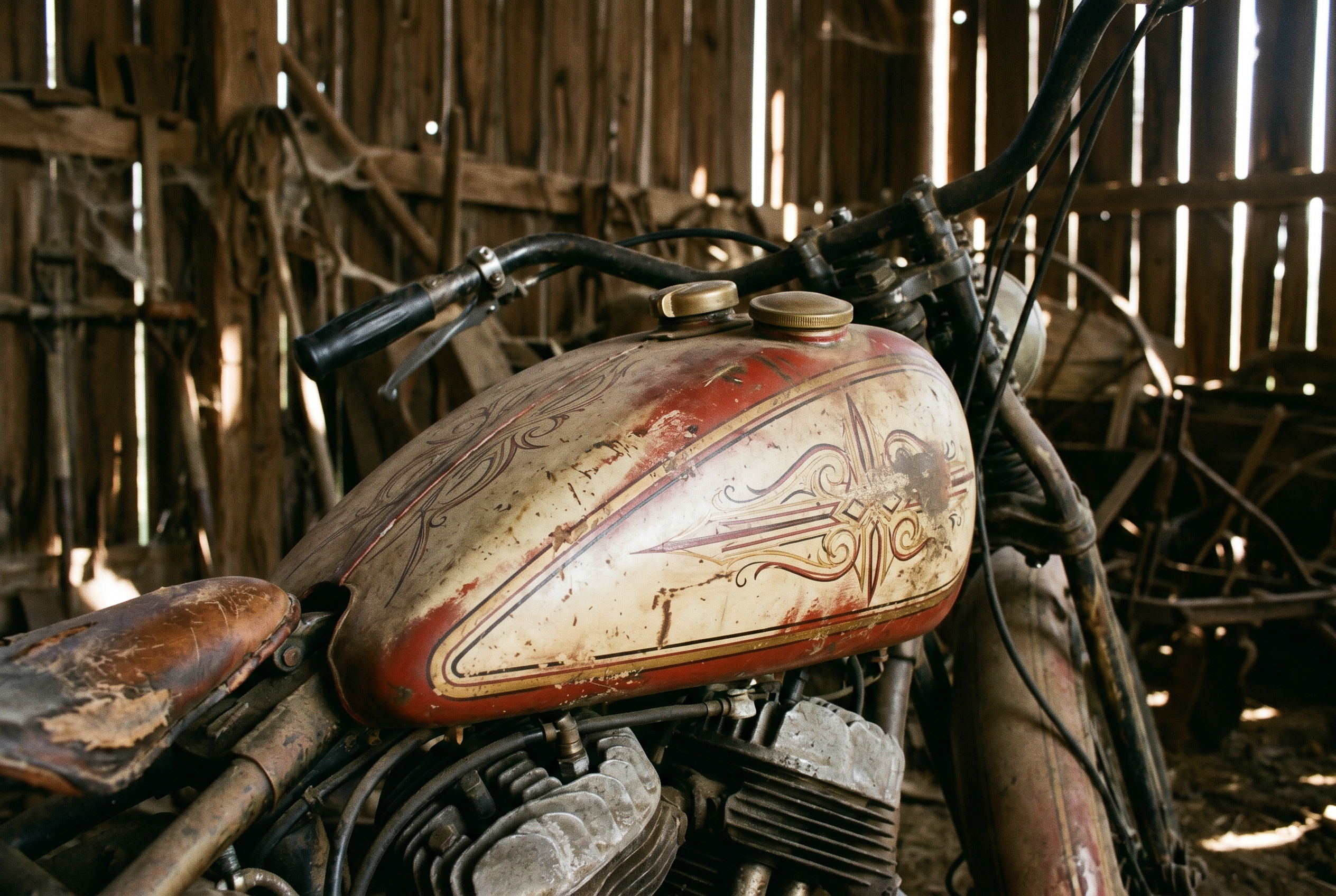
Through the 1930s and 1940s, the corporate Bar and Shield continued in use on signage, paperwork, and apparel. On the actual motorcycles, however, Harley Davidson commissioned a series of distinct tank emblems that are largely separate from the corporate trademark. The Flying Diamond, the Streamliner, the Speedball, and other tank emblems from this era are covered in detail in our Harley Davidson tank emblems by year article.
The corporate Bar and Shield was modernized in 1949 with a more dimensional metallic rendering. The shape and content stayed the same. The execution became more sculptural, fitting the post-war era’s appetite for chrome and visible engineering.
1953 to 1965: The Big V
The first major redesign of the corporate logo arrived in 1953 to mark the company’s 50th anniversary. Harley Davidson temporarily replaced the Bar and Shield with a large V-shaped logo, an explicit reference to the V-twin engine that had defined the brand since the 1909 V-Twin model. A small Bar and Shield sat at the top of the V, with text reading “50 Years” and “American Made” in the upper and lower portions.
The V logo ran for 12 years, from 1953 through 1965. It was visually busy and never developed the iconic recognition the original Bar and Shield had achieved. The company quietly retired the V logo in 1965 and reverted to a simplified version of the original mark.
1963 to 1965: The Diamond Stretch
Between 1963 and 1965, Harley Davidson used a transitional logo sometimes called the “diamond” Bar and Shield. The standard shield shape was stretched horizontally to better fit the profile of a fuel tank. The diamond version was short-lived and is one of the most easily missed entries in the logo history.
By 1965, the company committed to a cleaner, more proportional Bar and Shield in monochrome black and white. This 1965 simplification is the version that most modern riders recognize as “the” Harley Davidson logo, even though the orange and black color scheme was still standard in advertising and signage.
1969 to 1981: The AMF Era
In 1969, AMF (American Machine and Foundry, an industrial conglomerate best known at the time for bowling equipment and recreational products) acquired Harley Davidson. The corporate identity changed accordingly.
Throughout the AMF ownership era, the Bar and Shield was paired with AMF branding on the bikes themselves. The most common rendering stacked an AMF block above the Harley Davidson Bar and Shield, creating a combined “AMF Harley-Davidson” tank emblem. The AMF era was financially difficult for the brand, and the visible AMF text on tanks became a symbol of the period.
In 1981, a group of 13 senior Harley executives led by Vaughn Beals and including Willie G. Davidson completed a leveraged management buyback of Harley Davidson from AMF. The AMF text was removed from the corporate identity. The standalone Bar and Shield returned as the sole mark.
1976: Black and Orange Becomes the Standard
By 1976, Harley Davidson had standardized the production version of the contemporary Bar and Shield: black base, orange borders for both the bar and the shield, orange “Motor Cycles” text on the shield, and white “Harley-Davidson” text on the bar.
This is the version of the logo that has remained essentially unchanged from 1976 through today. Anniversary editions and special applications have introduced variations, but the standard production Bar and Shield has held this configuration for nearly 50 years.
2003: The 100th Anniversary Logo
Harley Davidson released a 100th anniversary commemorative logo in 2003. The design wrapped wings around the standard Bar and Shield, with the dates “1903” and “2003” flanking the wings and a “100” callout below the shield. The anniversary logo appeared on commemorative bikes, apparel, dealership signage, and merchandise throughout 2002 and 2003.
The standard Bar and Shield continued in production use during this period. The 100th anniversary logo was treated as a celebratory overlay rather than a permanent replacement.
2018: The 115th Anniversary Eagle Returns
For the 115th anniversary in 2018, Harley brought back the bald eagle. The 2018 anniversary logo placed a bald eagle behind the Bar and Shield, with wings spread upward. The standard Bar and Shield remained the visual center, with “1903” and “2018” flanking the design and “115 Years” inscribed below.
This was the second time the eagle had been formally paired with the Bar and Shield as an anniversary mark, the first having been the 1929 Depression-era redesign.
The Logo Today
The 2026 Harley Davidson logo is the same Bar and Shield trademarked in 1910, in essentially the same configuration standardized in 1976. Black base. Orange borders. White wordmark on the bar. Orange “Motor Cycles” text on the shield. The mark is among the most recognized brand identities in American industry.
For riders building bobbers from Harley donor bikes, the Bar and Shield evolution matters because the tank emblem and corporate logo do not always match. A 1972 Shovelhead might wear a tank emblem unrelated to the simultaneous AMF Harley Davidson corporate mark. Restorations require attention to which logo era applied to which bike year. We have worked on a couple of bikes in the shop where the previous owner installed period-incorrect tank emblems, and the only way to spot the mismatch is knowing the timeline.
Why the Trademark Defense Matters
Harley Davidson has filed trademark and copyright lawsuits with consistency that few American companies match. Counterfeit merchandise, unauthorized use of the Bar and Shield, fashion brands borrowing the wordmark, and parts companies marketing aftermarket components with confusingly similar branding have all drawn legal action over the years. Settlements have reached the millions of dollars.
The trademark protections are why authorized Harley apparel costs what it does and why so much “Harley style” merchandise carefully avoids the actual Bar and Shield mark. Generic biker apparel that draws on the broader culture without copying any protected trademark stays clear of these problems entirely. Our Bobber Brothers t-shirts and hoodies are designed in that lane: built around bobber and biker culture themes without imitating any protected corporate or club trademark.
Reading the Logo on a Bike
A few quick visual rules for spotting the era of a Harley logo:
| Visible feature | Era |
|---|---|
| Black and white only | 1910-1920 |
| Orange and black established | 1920s onward |
| Eagle paired with shield | 1929-1933, then 2018 anniversary |
| Large V shape with small shield on top | 1953-1965 |
| Diamond-stretched horizontal shield | 1963-1965 |
| AMF block above shield | 1969-1981 |
| Standalone Bar and Shield, modern proportions | 1981 to present |
| Wings wrapping shield with anniversary dates | 2003 (100th), 2018 (115th) |
The logo on a tank does not always match the year of the bike. A bike restored or repainted decades after production may carry whatever logo the restorer chose to install. Use the engine number, the frame VIN, and the tank emblem in combination to date a Harley accurately.
The Story Continues
For the broader history of Harley Davidson’s place in American motorcycle culture, our Harley Davidson history guide is the cluster pillar. For the parallel story of the actual painted tank badges that appeared on the bikes, the tank emblems by year article is the deeper dive.
The Bar and Shield is now over 115 years old as a trademark. It has survived two world wars, the Great Depression, the AMF era, multiple recessions, and the rise of foreign competition. The shape on the back of a 2026 Sportster is the same shape that appeared on a 1910 toolbox decal. Few American brand marks have stayed that consistent that long.
Sources
- Bar and Shield Story - Harley-Davidson Archives. Official Harley-Davidson Museum archive coverage of the trademark history, with documented dates for the 1908 toolbox decal, 1910 trademark filing, and 1930 renewal.
- Bar and Shield: History of the Motor Company’s Emblem - HDForums. Era-by-era visual reference for the Bar and Shield evolution.
- The History Behind Harley-Davidson’s Bar And Shield Logo - TopSpeed. Coverage of the V logo era, the 1953-1965 anniversary period, and the 1965 return to the simplified shield.
- Harley Davidson Logo Evolution and History - VikingBags. Coverage of the 1929 Depression-era eagle introduction and the 1930s color experiments.
- Harley-Davidson Logo. Bar And Shield Forever - Cyril Huze Post. Industry coverage of the modern trademark defense and the contemporary Bar and Shield specification.