A friend showed up at the shop last spring wearing a $90 black “moto jacket” he had bought from an online fast-fashion retailer. He had ridden in it twice. Both shoulders were already cracking at the seams. The zipper had jumped the track. The leather - which was not really leather but a printed PU coating over fabric - had peeled off the cuff in a strip. He asked us why “real moto jackets cost so much.” This article is the answer.
A leather moto jacket is one of the most recognizable garments in the world. The asymmetric front zip, the snap-down lapel, the fitted shoulders, the zip cuffs - the silhouette has not meaningfully changed since Irving Schott designed the Perfecto in 1928. That is not because the design is sacred. It is because every line on a real moto jacket exists to solve a problem a rider actually has, and nobody has improved the solution in nearly a hundred years.
This is what separates a real leather moto jacket from a fashion lookalike, what to look for when you buy one, and what each of the major cuts is actually built for.
What Makes a Real Leather Moto Jacket
A real moto jacket is engineered. Every feature on it traces back to a specific problem a 1920s motorcyclist needed solved. Strip away the fashion-magazine context and you get a list of specs that have nothing to do with looks.
- Asymmetric front zip. The diagonal zip line was designed so a rider in a forward tuck would not have a vertical zipper digging into their sternum. It also creates a wind-blocking overlap that a centered zip cannot match. Cosmetic versions keep the asymmetric line because it became iconic. The structural reason still applies.
- Snap-down lapel. When the jacket is fully zipped, the lapel snaps flat against the chest so it does not flap into the rider’s face at speed. Open the zipper and the lapel falls back into a notched-collar shape. This dual function is what makes the lapel work.
- Fitted shoulder yoke. The shoulder seam is constructed to keep weight on the shoulders rather than the neck, so the jacket stays in position when the rider leans forward. Fashion versions move the seam for a slouchier silhouette and the jacket rides up at speed.
- Zip cuffs. Wrist zips let the rider tighten the cuff over a glove and seal off wind. They also let the rider get the jacket off without removing gloves. Snap cuffs work for fashion. Zip cuffs are functional.
- Reinforced elbows and shoulders. Real moto jackets have a second layer of leather (or modern padding) at impact points. Older jackets used heavier leather panels. Newer jackets often add CE-rated armor pockets.
- Belted waist. The waist belt is not decorative. It cinches the jacket against the body so wind does not balloon the back panel and lift the rider at speed. Ungratifying detail: the belt also keeps the jacket from creeping up over the kidneys in a slide.
- Long back panel. A real moto jacket sits longer in back than in front. The cut keeps the lower back covered when the rider leans forward. Fashion versions are even all the way around because they were designed to be photographed standing up.
A jacket missing any three of these features is not a moto jacket. It is a moto-styled fashion jacket. The two are not the same garment.
Real Leather: What 1.0-1.4 mm Actually Means
Leather thickness is the single biggest tell for whether a jacket will hold up. The rider standard is 1.0-1.4 mm cowhide. Below 1.0 mm, the leather is fashion grade - thin lambskin or top-grain cowhide that abrades through fast under impact. Above 1.4 mm, the leather is heavy, slow to break in, and overkill for street riding (though appropriate for track or competition-grade jackets).
The four leather grades to know:
- Full-grain cowhide. The top layer of the hide, with the natural grain intact. Strongest and most durable. Premium jackets use full-grain.
- Top-grain cowhide. Sanded to remove imperfections, then stamped with a fake grain. Slightly weaker than full-grain but still protective.
- Corrected grain / genuine leather. Heavily processed lower layers, often coated in a polyurethane finish to mimic full-grain. This is the “leather” in $150-$250 jackets. Looks the part new, falls apart fast.
- Bonded leather. Leather scraps glued together with polyurethane. Avoid for any rider use.
If a jacket is described as “genuine leather” with no further detail, it is corrected grain at best. If a brand will not specify thickness in millimeters, assume the leather is too thin to matter. A real maker tells you the spec because it sells the jacket.
Lambskin and goatskin are softer and lighter than cowhide. They look great. They fail under abrasion in conditions where cowhide would still be protecting. Use them for fashion or for warm-weather city riding where the trade-off is acceptable.
If you want a jacket that will hold up year after year without paying for full cowhide, our Built Not Bought faux leather biker jacket is cut on the same asymmetric moto silhouette with quilted interior - good for the ride to the bar and the parking lot bike show, honest about what it is.
The Three Main Moto Jacket Cuts
Most leather moto jackets fall into one of three silhouettes. Each was designed for a different riding position and a different era.
The Asymmetric (Perfecto) Cut
The original. Irving Schott patented it in 1928 as the Perfecto, named after his favorite cigar. The asymmetric zip, the snap-down lapel, the belted waist, the fitted-shoulder yoke - everything modern moto jackets descend from started here. Marlon Brando wore one in The Wild One (1953), James Dean wore one off-set, and the silhouette became cultural shorthand for the rebel before the bike was even part of the conversation.
Asymmetric moto jackets work for upright and slightly-forward riding positions. They are the default cut for cruisers, bobbers, and standard motorcycles. The silhouette photographs well off the bike too, which is part of why the cut has lasted nearly a century.
The Cafe Racer Cut
Cafe racer leather jackets emerged in 1950s and 60s Britain to suit the cafe racer motorcycle scene. Riders tucked into clip-on bars and rearset pegs needed a jacket that did not bunch at the waist when they leaned forward.
Distinguishing features of a cafe racer jacket:
- Centered front zip instead of asymmetric, since a tucked rider’s chest is not over the zipper line.
- Stand-up collar or minimal collar instead of a notched lapel, to reduce wind drag at speed.
- Shorter, more fitted body that does not bunch when the rider is forward.
- Minimal external hardware. Cafe racer jackets are clean and stripped, matching the bikes they were built for.
Lewis Leathers (UK), Aero Leather (UK), and Vanson (US) are the names that built the cafe racer jacket reputation. Modern brands like Roland Sands, BellStaff, and Black Bear have adapted the cut.
The Vintage Touring / Cossack Cut
Less common today but worth knowing about. The Cossack-style jacket has a longer body, double-breasted closure, and broader collar. Built for riders sitting upright on touring bikes through cold weather. The early Schott Bros catalog included Cossack jackets alongside the Perfecto. They mostly faded out by the 1970s as Highway Patrol and military-style touring jackets took over the cold-weather market.
If you see a vintage moto jacket with a center button line, double-breasted closure, and a larger lapel, it is a Cossack or Cossack-derivative. Mostly a collector’s piece now.
Buying Guide: What to Pay and What to Look For
There are essentially four price tiers in the leather moto jacket market.
| Price | What You Get | Notes |
|---|---|---|
| Under $200 | Corrected-grain or split leather, weak hardware, decorative lining | Looks the part new. Fails in use. Fashion only. |
| $200-$500 | Top-grain cowhide, decent hardware, some real construction | Brands: Wilsons, Calvin Klein, Marc New York. Daily wear, light riding. |
| $500-$1000 | Full-grain cowhide, solid hardware, real construction | Brands: Schott NYC (the source), Vanson Leathers, Roland Sands, Belstaff. Real riding gear. |
| $1000-$2500+ | Premium cowhide or kangaroo, hand-finished construction, often custom sizing | Brands: Lewis Leathers, Aero Leather, Vanson Comp series, ICON Hooligan. Built for serious riders or collectors. |
The brands worth knowing if you want a real jacket:
- Schott NYC. The original. Their Perfecto 618 is the asymmetric jacket that started it all. Made in the same New Jersey factory since 1928. ~$700-$900.
- Vanson Leathers. US-made, race-grade construction, popular with sport riders. ~$700-$1500.
- Lewis Leathers (UK). The British original, Lightning and Aviakit cuts are cafe racer benchmarks. ~$1000-$1500.
- Aero Leather (UK/Scotland). Heritage builds, exact reproductions of 1930s-50s American jackets. ~$900-$1400.
- Roland Sands Design. Modern interpretations with rider-specific construction. ~$500-$900.
- Belstaff. UK heritage, more touring-oriented than asymmetric. ~$700-$1500.
- ICON, Dainese, Alpinestars. Modern technical jackets that use leather plus armor. ~$500-$1500. Best protection per dollar if you actually ride hard.
Honest take: if you want a jacket that will outlast every bike you own, save up and buy a Schott Perfecto 618 or a Vanson Model B. Either one will be on your back in 30 years. Cheap leather jackets are the most expensive way to buy outerwear because you replace them every two seasons.
We have seen plenty of riders in the shop come in with $1500 jackets they bought because a magazine told them to. Some of them ride. Most of them do not. The jacket is a tool. If you are not using it, do not buy the top-tier version. A solid $400-$600 jacket from a mid-tier brand is plenty for daily rides.
How to Tell a Real Moto Jacket From a Fashion Copy
Quick checklist when you have a jacket in hand:
- Smell it. Real leather smells like leather. PU coating smells faintly chemical or like nothing at all.
- Pinch it. Real leather has give and resilience. Fake bonded leather feels like cardboard wrapped in plastic.
- Look at the back of the leather. Real leather has a suede-like reverse with visible fiber structure. Faux leather has a fabric backing.
- Inspect the seams. Real moto jackets have double-stitching at all stress points - shoulders, sleeves, side seams. Single stitching means corner-cutting.
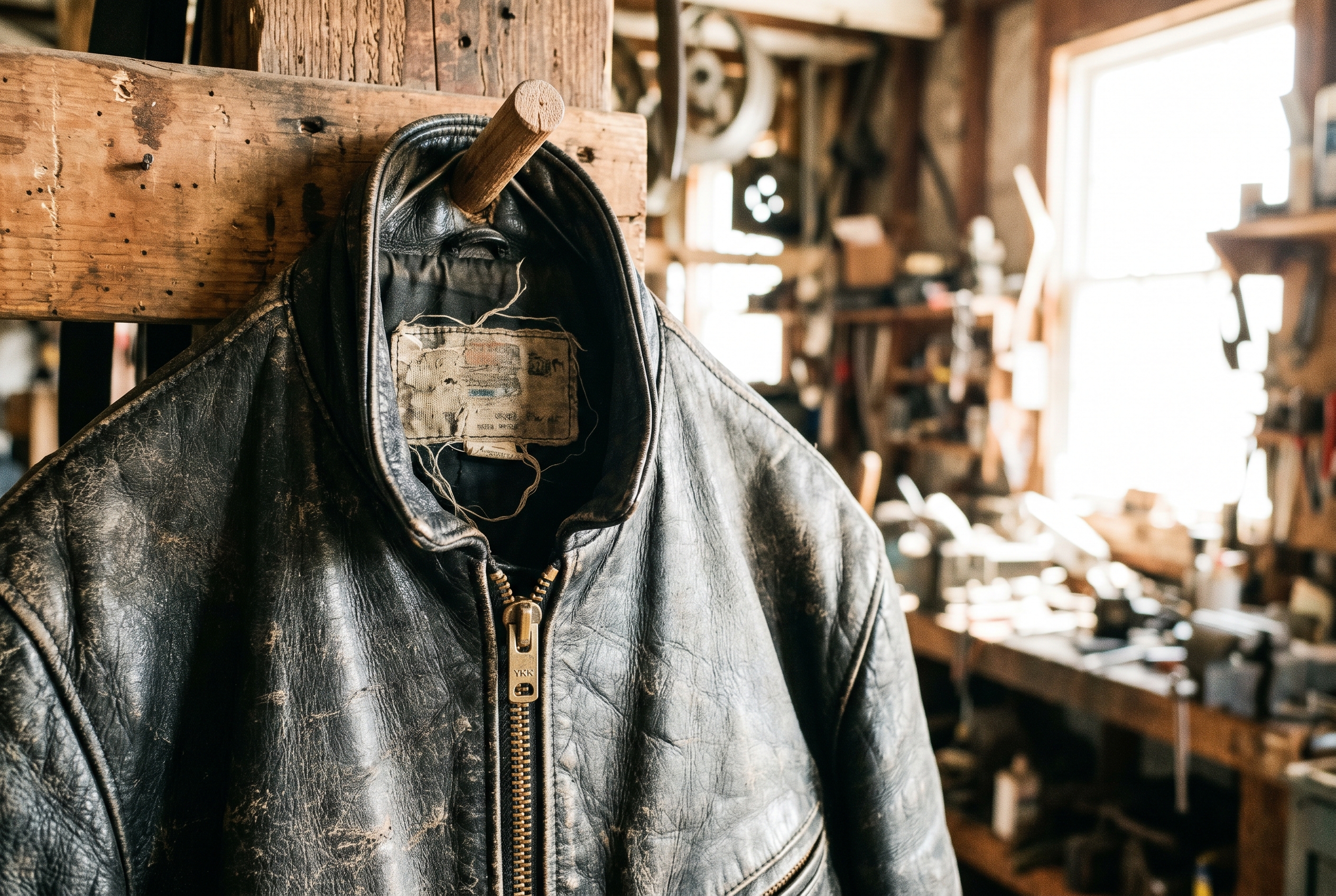
- Test the zipper. A real moto jacket uses YKK metal zippers, often with custom pulls. Plastic zippers fail first.
- Check the lining. Quilted polyester or cotton lining is standard. Slick polyester only is a budget tell. Wool or shearling lining is premium.
- Look for armor pockets. Modern technical jackets include CE-rated armor or pockets to add it. Vintage-style jackets do not, which is fine if you understand the trade-off.
- Weigh it. A real cowhide jacket in a size large weighs 4-6 pounds. A faux leather version weighs 2 pounds or less.
If a jacket fails three or more of these tests, it is not the real thing. That is fine if you are honest about what you are buying. It is not fine if you paid full price expecting it to last.
How Long a Real Leather Moto Jacket Lasts
A well-built leather moto jacket has a lifespan measured in decades. Schott Perfecto jackets from the 1950s and 60s show up at vintage shows still in wearable condition. Vanson jackets from the 1980s are still on backs at bike nights.
The leather only gets better. Cowhide develops a patina with use - the natural oils from your skin, the sun, the rain, the road dust all combine into a finish that no factory can replicate. A jacket that started life stiff and uniformly dyed will, in five years, have softened, darkened in the high-wear areas, and developed creases that match the way you ride. It looks like yours.
Hardware is what fails first. Zippers, snaps, and buckles wear before leather does. Most premium makers will replace hardware decades after purchase. Schott still services Perfectos sold in the 1970s. That is what you are paying for at the higher tiers - not just the leather, but the assumption that the jacket is repairable.
If you are deeper into the gear question, our biker gear guide covers the full kit a serious rider should have - jackets, boots, gloves, and helmets - without the marketing fluff.
Sources
- Schott NYC: “Our Story” - documented origin and continuous production timeline of the Perfecto from 1928 onward
- Vanson Leathers: official jacket construction specs - cowhide thickness standards and hardware specs
- Lewis Leathers: Wikipedia article - 1950s-60s cafe racer jacket history including the Lightning, Bronx, and Aviakit lineage
- The Black Sunday: A Photographic History of the British Motorcycle Movement - cited for cafe racer jacket development context
- ASTM International: F1952 standard for motorcycle protective garments - leather thickness performance benchmarks