Two Bikes, Not One
The single most repeated mistake about the Marlboro Man bike is talking about it in the singular. There were two machines, built by the same hands, and they were not the same bike.
Mickey Rourke owned one. It ran an S&S 98 cubic inch stroker and it was already his personal motorcycle before MGM had a camera on it. The studio then paid the same builders to make a duplicate with a stock 80 cubic inch Evolution engine, and that duplicate was the stunt bike.
Where the accounts stop agreeing is the screen. Gene Thomason, who was on the build, says “Mickey had one bike, the backup bike was the stunt bike that did most of the movie.” RB Racing’s page splits it differently, with Rourke’s stroker “used for some opening scenes and basic riding shots” and the 80 inch duplicate as the primary stunt bike. And the same Bikernet piece carrying Thomason’s account concedes the point outright: which BD bike appears in the finished film remains unclear. Nobody has published a shot list. So any confident scene-by-scene division of labour, including the popular version where the stroker barely turned a wheel, is somebody’s reconstruction rather than a record.
That much the builders have at least put on record. A lot of the rest of what you will read about this bike is repeated without a source, so this article separates the two.
Who Built It, and Where
The bikes came out of Bartels’ Harley-Davidson, the Los Angeles dealership that did the custom work. The crew named in the builders’ own accounts is Gene Thomason, Dave Fournier and Allan Barsi. Rourke reportedly brought the idea in as a sketch on a cocktail napkin.
One small correction on the address: RB Racing, the exhaust shop that made the pipes, says Bartels’ was “then in Culver City CA” and refers to the Marina del Rey shop elsewhere. Bartels’ operated at more than one address in that stretch of West Los Angeles over the years. Both are in circulation and neither is a red flag.
A bigger correction: some magazines at the time credited the build to California builder Billy Westbrook. The interview-based Bikernet build history says that attribution was wrong. Westbrook did build Rourke a separate bike, and that one was stolen, which is probably where the mix-up started.
What “Black Death 3” Actually Means
This is the detail almost everyone gets backwards, including an earlier version of this article. The number does not refer to three rounds of modification on one motorcycle.
Rourke had earlier bikes he called Black Death. According to the builders, Black Death 1 and Black Death 2 were built and then scrapped. The bike that reached the film was the third go at the same idea, so it became Black Death 3, usually shortened to BD3. RB Racing describes it plainly as Rourke’s third attempt at his ideal bike.
The name was never a Harley-Davidson designation and never came from a marketing department. It was what the owner called his bike, and the custom scene picked it up.
The Spec Sheet as Built
Pulled from the builders’ accounts rather than from spec-site guesswork:
| Item | What the build accounts say |
|---|---|
| Base motorcycle | 1989 Harley-Davidson FXR |
| Rourke’s engine | S&S 98 cubic inch stroker |
| Duplicate/stunt engine | Stock 80 cubic inch Evolution, Bartels BP-40 cam, S&S Super E carburetor |
| Rear end | Solid steel struts in place of shocks (rigid conversion), chrome swingarm |
| Rake | About 42 degrees |
| Front end | Extended fork tubes, roughly 6 inches over |
| Wheelbase | Around 70.5 inches |
| Bars | Low drag bars |
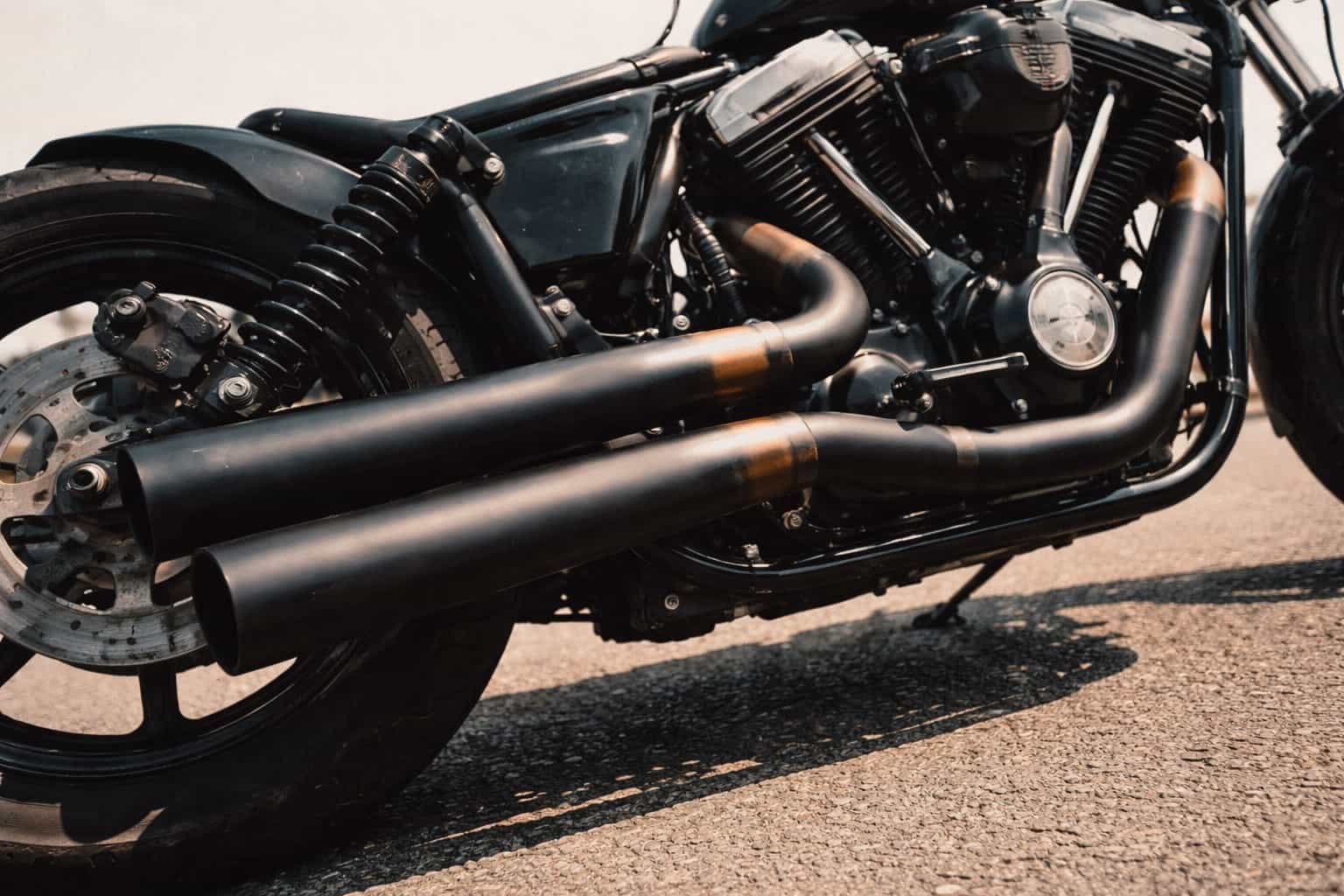
| Exhaust | RB Racing 1.5 inch drag pipes |
| Tank | 5 gallon Softail tank, left in primer with a 6 inch lettered centre plate in the Bikernet spec |
| Seat | Shortened Don Crager unit |
| Detail work | ”V” shaving on the cylinder fins, digital gauges fitted early and later removed |
Two things on that list are worth saying out loud because they change how the bike reads on screen.
The rear is rigid. Those are struts, not shocks. Combine that with 42 degrees of rake, six inches of fork extension and a 70.5 inch wheelbase and you get a machine that steers slowly, does not soak up anything, and looks far longer and lower than a stock FXR. It is a chopper-influenced club bike, not a lightly modified factory Harley.
And the exhaust story is genuinely a two-stage one. RB Racing first made two inch severe-cut megaphones for the earlier white version of the bike, on the reasoning that they would read well on a movie poster. For the film they went to 1.5 inch primary drag pipes specifically so the motor would crackle on the overrun. Accounts differ on whether the film pipes were left bare or finished black, so pick your own on a replica.
The White Bike, and Where the Playing Cards Belong
Before the film build, Rourke’s FXR was white and wore RB Racing’s two inch severe-cut megaphones, made so they would read on a movie poster. RB Racing then says flatly that “the white paint job and the Megaphones went away and the bike was raked and made as ‘raw’ as possible.”
The hand-lettered playing cards are a separate question, and an earlier version of this article got it wrong by assigning them to the white bike. The two build-side accounts do not put them in the same place, and the honest answer is to lay the conflict out rather than pick a winner.
- RB Racing mentions “the hand-lettered playing cards on the tanks” - tanks, plural - by an unnamed artist, carrying the initials of Rourke’s friends. It does not tie that detail to the white configuration, and it sits in a page that is otherwise describing Black Death 3 as built for the film.
- Bikernet’s build history puts the cards squarely on the film bike, in its 1997 spec of the machine: a 5 gallon Softail tank left in primer, wearing a 6 inch plate down the centre with artwork of playing cards inscribed with friends’ initials.
Both sources agree the cards exist, that they carry initials of Rourke’s friends and that the artist is not named. Neither establishes that the white bike wore them first, and Bikernet reads the other way. Treat the cards as a feature of the film-era bike unless someone produces a dated photograph of the white one.
That Bikernet spec is worth holding onto for another reason. A tank left in primer with a lettered centre plate is not the same as a gloss black tank, so “blacked out” describes the overall look of these bikes rather than a paint code you can order.
The Money Numbers, With Sources
Three figures circulate. Only two of them have a source we could find.
- $50,000. RB Racing puts this on Black Death 3 as built and equipped. That is the builder-side figure.
- $12,000. What Gene Thomason paid MGM for the studio’s stunt bike on 15 March 1995, according to the Bikernet account, outbidding a $6,000 offer.
- $40,000 in modifications. This number appears all over the internet, including in an earlier version of this article. We could not trace it to any builder, studio or auction record. We have removed it.
Chuck Zito later worked with an Arizona shop, Carefree Custom Cycles, to build officially styled replicas using BD3 as the template. Those sold at around $35,000 and used a 114 cubic inch Powerhouse engine rather than an Evo, so they are tribute bikes rather than clones.
Where the Bikes Went
The MGM stunt bike. Thomason bought it from the studio in 1995 with paperwork, then sold it on around 1997 to a Denver-area owner. It is now owned by Heath Rodney, president of Loess Hills Harley-Davidson in Pacific Junction, Iowa, who displays it at the dealership. It carries Rourke’s autograph and the original 1995 MGM purchase documentation, and it can be identified by a replacement Harley OEM left front peg fitted after the original JayBrake peg was damaged.
Rourke’s own bike. Chuck Zito transported it to New York along with another of Rourke’s motorcycles. In his 2002 book Street Justice, Zito wrote that he had borrowed it six years earlier and still had it. The carburetor reportedly carries an inscription identifying the bike as the original used in the film.
Still unresolved. The screen-time question opened this article and it closes it too, because nothing has settled it. The same sources also use BD3 and BD4 inconsistently, so even the naming of the surviving machines is shaky. RB Racing has Rourke’s stroker doing some opening scenes and basic riding shots; Thomason has the duplicate doing most of the movie; the Bikernet piece that carries his account still calls the question unclear. Nobody has produced a shot list. If you see a confident claim on this point, ask what it is based on.
The Film Itself
Released by MGM on 23 August 1991, directed by Simon Wincer from a screenplay by Don Michael Paul, running 98 minutes. It grossed $7,434,726 domestically against a reported $23 million budget.
The setup is near-future 1996: Harley Davidson (Rourke) and the Marlboro Man (Don Johnson) rob a bank to save the bar they drink in, take a shipment of a designer drug instead of cash, and spend the rest of the film being hunted for it. Chelsea Field, Daniel Baldwin, Giancarlo Esposito, Tom Sizemore, Vanessa Williams and Robert Ginty fill out the cast.
Critics buried it. Riders did not, and the reason is not complicated: the bikes are real customs owned and ridden by the lead, not a prop-house rental dressed for camera. That authenticity is the same thing that keeps other motorcycle films alive long after their box office is forgotten, which our rundown of biker movies that hold up gets into in more detail.
Why the FXR Was the Right Bike
The FXR was Harley’s rubber-mounted, five-speed Big Twin performance chassis, in regular production from 1982 through 1994 with a police FXRP built for 1995. It has a shorter wheelbase than a Touring model and a stiffer frame than the Dyna that replaced it, which is why club riders and custom builders still hunt them. Our 1982 FXR platform guide covers the model history in full.
One nuance the film’s legacy usually skips: Harley did not abandon the FXR entirely in 1994. The Custom Vehicle Operations program brought it back for 1999 as the FXR2 and FXR3, roughly 900 of each, and again for 2000 as the FXR4 in a run of about 1,000. Those CVO bikes are the actual last FXRs.
The platform is the easy part of a tribute build. The details are not, and all of them are in the build accounts above: the rigid strut conversion, roughly 42 degrees of rake, six inches of fork extension and 1.5 inch primaries. Skip those and you have a black FXR with drag bars.
Building a Credible Replica
If you want one, here is what actually matters, in order of how badly people get it wrong.
- Start with a genuine FXR frame. A Dyna is a different bike. The film bike was never a Dyna, whatever forum comments claim.
- Commit to the rigid rear. Solid struts, not lowered shocks. This is the single biggest silhouette difference and the one most replicas skip because it wrecks the ride quality.
- Get the geometry right. Roughly 42 degrees of rake and extended tubes. Without it you have a stock-stance FXR in black paint.
- Run 1.5 inch drag pipes. The sound is half the reason anyone remembers this bike.
- Strip everything else. No windshield, no bags, minimal instrumentation. The digital gauges came off the original for a reason.
- Decide honestly whether you want a rider or a tribute. A raked rigid with a 98 inch stroker is not a comfortable motorcycle. That was fine for a film. It is a real commitment on a 300 mile day.
The same trade-off runs through every rigid build, and our hardtail versus softail comparison lays out what you actually give up.
If you want to fly the flag without spending a build budget, our t-shirt collection and hoodies are made for riders who care about the difference between a real build and a costume.
What the Bike Left Behind
The Marlboro Man FXR gave a stripped, raked, blacked-out Big Twin a prominent place on screen. Later FXR and club-style builds share parts of that visual language, although a direct line of influence is hard to prove. Our motorcycle culture guide maps the wider custom-bike context.
Milwaukee kept building other icons in the meantime. The Fat Boy got its own 1991 movie moment, and the V-Rod later showed what happened when Harley tried to engineer a legend instead of letting one happen in a Los Angeles dealership’s back shop.
Get the frame right, get the stance right, and do not repeat a number you cannot source. That is the whole job.
Sources
- RB Racing - Rourke Marlboro Man Bike - first-hand account from the shop that built the exhausts: megaphones for the white bike, 1.5 inch drag pipes for the film, the Black Death 3 naming, the $50,000 figure, and the Bartels’ builders
- Movie Mystery Bike Solved, the Mickey Rourke Black Death - Bikernet - interview-based build history with Gene Thomason covering the 1989 FXR donor, the two engines, the rigid strut conversion, rake and wheelbase, the 1995 MGM purchase, and the correction of the Billy Westbrook attribution
- Harley-Davidson and the Marlboro Man Bike at Loess H-D - Bikernet - provenance chain of the studio stunt bike from MGM to its current dealership display, plus the unresolved BD3 versus BD4 labeling
- Harley Davidson and the Marlboro Man - Box Office Mojo - domestic gross, reported budget, distributor, release date and running time
- 1989 Harley-Davidson FXR - IMCDb - on-screen vehicle identification as a 1989 FXR, with the frame and model-code disagreements recorded in the comments
- Harley Davidson and the Marlboro Man (1991) - IMDb - director, screenwriter and full cast credits