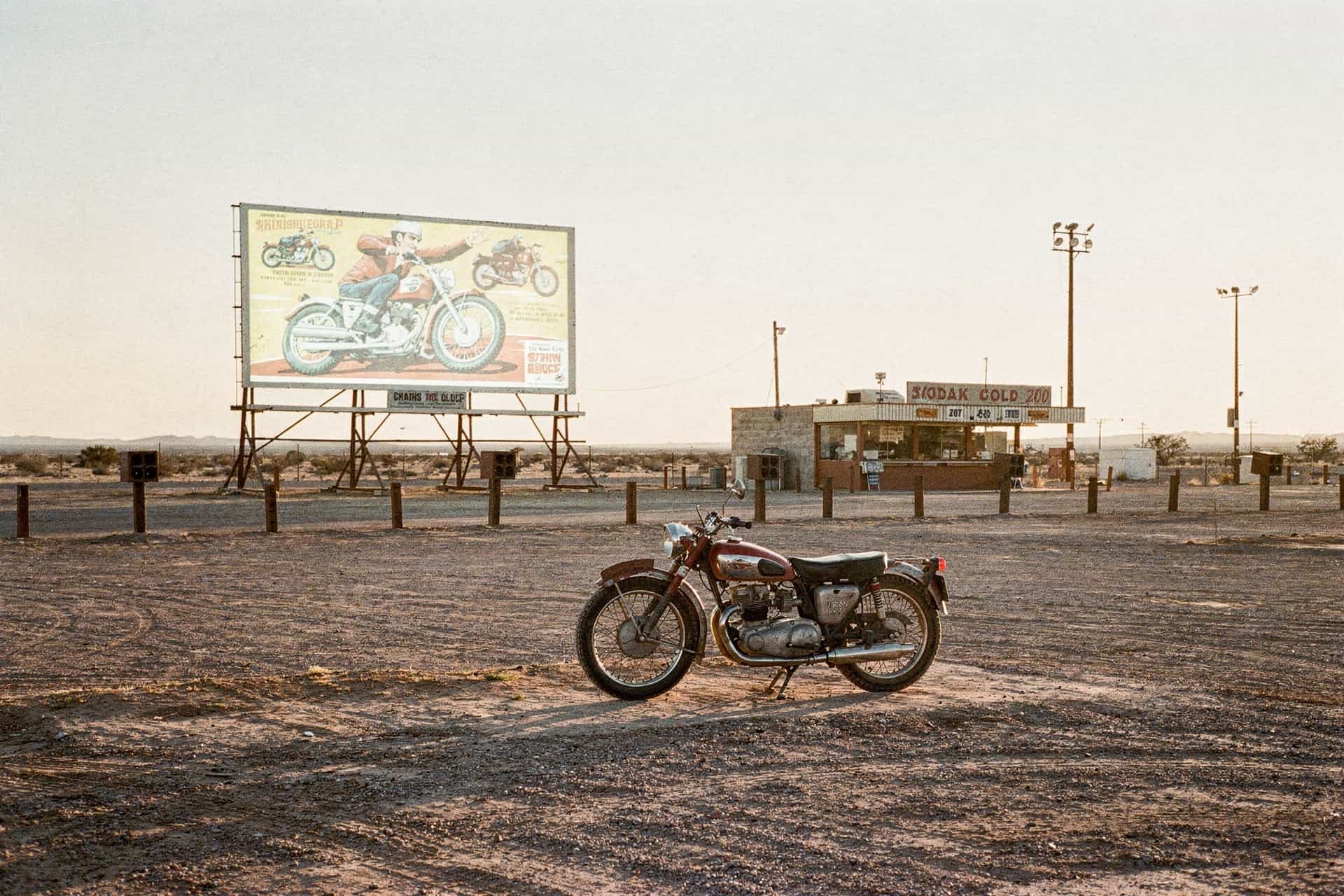
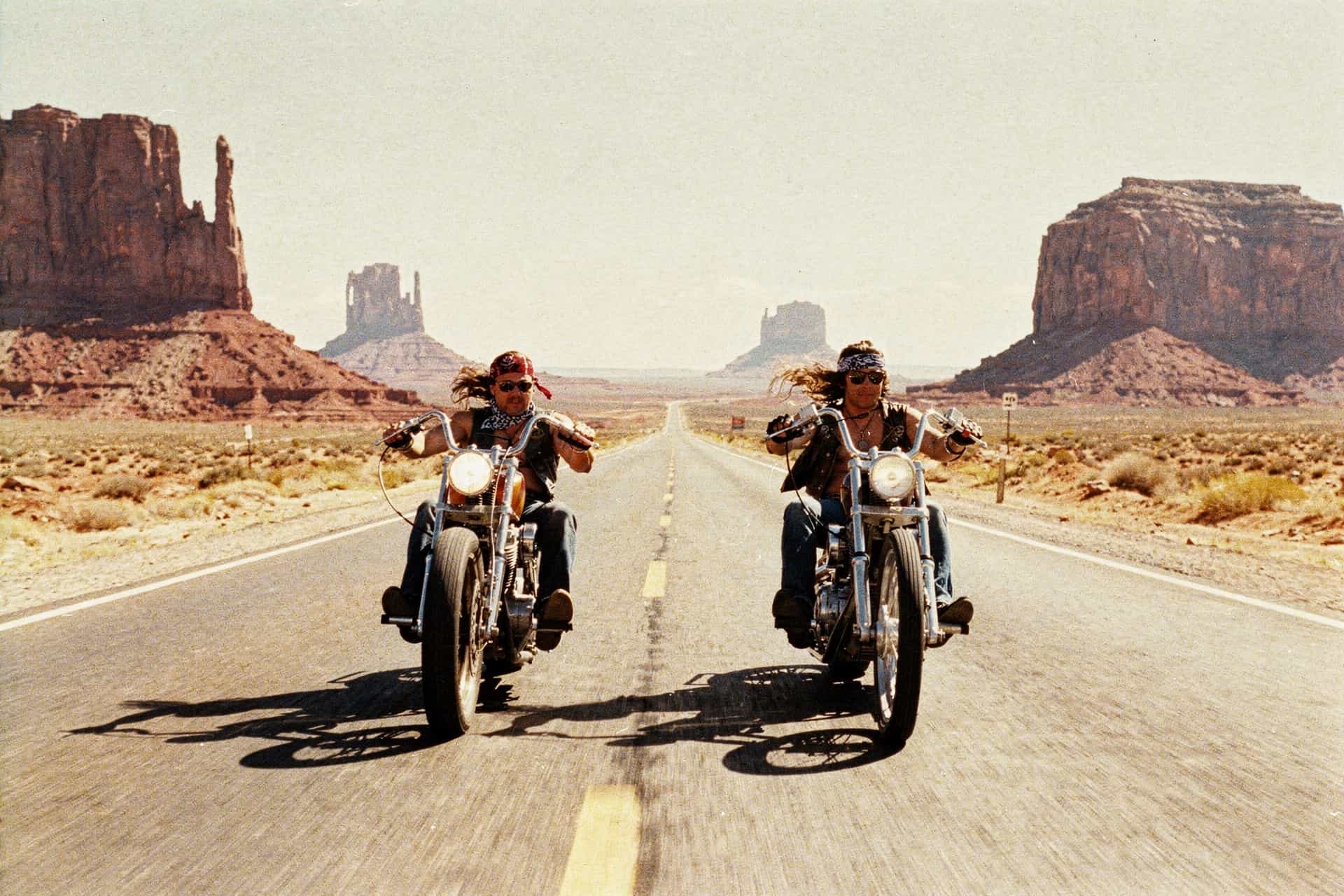
Peter Fonda’s chopper crests a ridge in Monument Valley. No dialogue. No plot. Just two wheels, red desert, and Steppenwolf hammering through a tinny speaker somewhere off-camera. That one shot from Easy Rider did more to shape how the world sees motorcycles than every Harley-Davidson ad campaign combined.
There is no universal rider ranking, so this is an editorial list rather than a pretend community poll. The films are grouped by era, with the real iron that showed up on screen and clear calls on what each one gets right.
This is one piece of a bigger picture. For how films, clubs, and riding culture all connect, our motorcycle culture guide lays out the full map.
How We Judged the Best Biker Movies
The list uses four editorial checks. They are not a numeric score, and a film does not need to lead every category. A movie can be historically important without being mechanically accurate, while a convincing riding scene cannot rescue a weak film by itself.
| Criterion | What we checked |
|---|---|
| Motorcycle accuracy | Whether the identified bike, setup, and mechanical claims match reliable records |
| Riding authenticity | Practical riding and documented stunt work, without treating marketing claims as fact |
| Cultural value | What the film recorded, changed, or revealed about motorcycle culture |
| Film craft | Story, performance, cinematography, and whether the film still rewards a full watch |
| Category pick | Why it leads this category | Main limitation |
|---|---|---|
| On Any Sunday | Real competitors, multiple disciplines, and riding as the subject rather than decoration | It is a documentary, so it does not satisfy a rider looking for club drama |
| The Bikeriders | Vintage motorcycles, documented cast training, and a club story with consequences | It is fictionalized from Danny Lyon’s photo book rather than a documentary record |
| Easy Rider | The strongest cultural and visual influence in the group | Its pacing and experimental sequences will not work for every viewer |
| The World’s Fastest Indian | The clearest builder story and a documented real-world record at its center | The film compresses and dramatizes parts of Burt Munro’s life |
The 1950s: Brando Starts Something He Cannot Stop
The Wild One (1953)
Director: Laszlo Benedek. Stars: Marlon Brando, Lee Marvin.
Ground zero for every outlaw biker image that followed. Brando plays Johnny Strabler, leader of the Black Rebels Motorcycle Club, rolling into a small California town and unsettling everyone in it. His answer when asked what he is rebelling against - “Whaddya got?” - became a bumper sticker, a tattoo, and eventually a cliche. But in 1953, nobody had said it yet.
Here is the irony that never gets old: American Motorcyclist identifies Brando’s machine as a 1950 Triumph Thunderbird 6T. The film that popularized an American outlaw-biker image put its star on a British bike, while Lee Marvin’s rival club rode Harley-Davidsons. The movie shaped the public image of biker rebellion, but it did not create motorcycle clubs or outlaw identity.
The British Board of Film Censors refused the film a certificate when it was submitted in 1954. A University of Westminster exhibit based on the classification record says it remained without a certificate until the Board granted it an X certificate in 1967.
Motorcycle Gang (1957)
Director: Edward L. Cahn.
Not a good movie. But it established the exploitation-film formula that dozens of biker B-movies copied: outsider infiltrates a gang, falls for a woman, chaos in the third act. You can trace a straight line from this script template through every outlaw MC drama up to and including Sons of Anarchy.
The 1960s: Drive-Ins, Counterculture, and the Birth of the Chopper Film
The sixties cranked out more biker films than any other decade. Most were cheap drive-in exploitation pictures shot in two weeks. Three of them changed everything.
The Great Escape (1963)
Director: John Sturges. Stars: Steve McQueen, James Garner, Richard Attenborough.
Not technically a biker movie, but it contains one of cinema’s best-known motorcycle scenes. McQueen’s Captain Hilts tries to clear a barbed-wire fence on a stolen German motorcycle while escaping a POW camp. Triumph’s history identifies Bud Ekins as the stunt rider and the machine as a modified TR6 Trophy dressed to resemble a German motorcycle.
McQueen competed in desert events and the International Six Days Trial. Triumph’s account documents that competition background as well as Ekins performing the fence jump.
McQueen did not merely pose beside motorcycles. His documented competition record makes the riding credible even before Bud Ekins takes over for the fence jump.
The Wild Angels (1966)
Director: Roger Corman. Stars: Peter Fonda, Nancy Sinatra, Bruce Dern.
Corman’s low-budget exploitation picture drew on the outlaw-club image that newspapers and earlier films had already established. Published accounts differ on the exact budget and revenue, so the durable point is the film’s commercial success and the wave of biker pictures that followed. Production accounts describe club-member participation, but bike-by-bike records are incomplete.
Fonda’s performance here led directly to Easy Rider three years later.
Easy Rider (1969)
Director: Dennis Hopper. Stars: Peter Fonda, Dennis Hopper, Jack Nicholson.
This is the one. Fonda plays Wyatt, Hopper plays Billy. They ride from LA to New Orleans after a cocaine deal, searching for something the film never quite names. Jack Nicholson got an Academy Award nomination for Best Supporting Actor as an alcoholic small-town lawyer who steals every scene he occupies.
The bikes are the real stars. Fonda’s “Captain America” chopper - built by Ben Hardy and Cliff Vaughs - had a raked-out springer front end, a stars-and-stripes tank, and a chromed hardtail frame. Four bikes were built total, two per rider. Most were destroyed during production or stolen afterward. A bike claimed to be an original sold at auction in 2014 under disputed authenticity.
Easy Rider cost roughly $400,000 and grossed over $60 million worldwide. It earned two Oscar nominations and helped ignite the New Hollywood era alongside Bonnie and Clyde and The Graduate.
As a film, Easy Rider is less consistent than its reputation. The pacing sags in the middle and the Mardi Gras sequence has aged poorly. As a cultural object, it is indispensable. Those two choppers rolling down a two-lane highway became part of the visual language of American motorcycling.
The 1970s: The Real Thing on Film
On Any Sunday (1971)
Director: Bruce Brown. Stars: Steve McQueen, Mert Lawwill, Malcolm Smith.
Bruce Brown - the man behind the surfing documentary The Endless Summer - pointed his camera at motorcycles and made this list’s strongest documentary. The film earned an Academy Award nomination for Best Documentary Feature. Claims that it caused a specific nationwide sales increase are repeated often, but no public model-level sales record proves the effect.
It covers flat-track, motocross, desert racing, trials, and road racing. McQueen appears throughout as a real participant, not a celebrity cameo. Grand National Champion Mert Lawwill and desert legend Malcolm Smith are the other two leads.
What makes On Any Sunday different from every biker film before it: zero outlaw mythology. No gangs, no leather-clad antiheroes, no rebellion. Just people who love motorcycles, doing the thing they love. The closing sequence - McQueen, Lawwill, and Smith riding dirt bikes on the beach - is pure, unfiltered joy on two wheels.
Electra Glide in Blue (1973)
Director: James William Guercio. Stars: Robert Blake.
An underrated slow-burn. Blake plays a short, ambitious motorcycle cop in the Arizona desert who wants to make detective. He rides - naturally - a Harley-Davidson Electra Glide, the standard police bike of that era. The film uses the desert landscape the way a western would, and the riding footage is some of the best committed to film in the 1970s.
Go in expecting a mood piece, not an action film, and you will be rewarded.
The Late 1970s-1990s: Stunts, Excess, and the Harley Revival
Mad Max (1979) and The Road Warrior (1981)
Director: George Miller. Stars: Mel Gibson.
The original Mad Max is a biker film at its core. Max is a police officer in a disintegrating Australian society, and the villains are a motorcycle gang led by the Toecutter. The visible motorcycle fleet is dominated by modified Japanese machines, but the article does not assign an exact model to every screen bike.
The Road Warrior shifts toward cars, but the biker gang element stays. The practical stunt work gives the riding sequences a physical weight that later computer-generated action often struggles to match. That observation does not require repeating unsupported injury stories from the production.
If you ride in our Bobber Brothers tees, you already know the look: stripped down, no apologies. These films nailed that energy before anyone called it an aesthetic.
Harley Davidson and the Marlboro Man (1991)
Director: Simon Wincer. Stars: Mickey Rourke, Don Johnson.
Objectively a bad movie. Rourke plays a biker, Johnson plays a cowboy, and together they rob a bank to save their favorite bar. The plot is nonsense.
But Rourke rides a blacked-out Harley-Davidson FXR-based custom with an S&S engine, and the motorcycle gives the film its clearest identity. Exact displacement claims vary between enthusiast accounts, so verify a particular replica or auction listing before treating its specification as a production record. The movie helped make the black FXR silhouette part of 1990s biker-film memory.
The 2000s: CGI Shows Up, Authenticity Fights Back
Biker Boyz (2003)
Director: Reggie Rock Bythewood. Stars: Laurence Fishburne, Derek Luke, Kid Rock.
Inspired by reporting on underground sport-bike racing in Southern California, Biker Boyz was an early major-studio film centered on Black motorcycle culture. Its visible lineup includes Hayabusas, Ninjas, R1s, and other Japanese sport bikes, while the action mixes practical riding with early-2000s visual effects.
The World’s Fastest Indian (2005)
Director: Roger Donaldson. Stars: Anthony Hopkins.
Hopkins plays Burt Munro, a New Zealander who spent decades modifying a 1920 Indian Scout in his shed, then hauled it to the Bonneville Salt Flats in 1967 and set a land speed record. Indian Motorcycle records the official figure as 184.087 mph and says the record still stands in its class.
This is this list’s strongest builder story. Munro repeatedly reworked his 1920 Indian Scout over decades, including major engine and streamlining changes. The film compresses and dramatizes parts of that life, but the long development effort and the 1967 record are historical. Hopkins gives the mechanical persistence at the center of the story real weight.
Builder stories like Munro’s are rare. The film works because repeated mechanical changes, not a single miracle part, drive the record attempt.
The Place Beyond the Pines (2012)
Director: Derek Cianfrance. Stars: Ryan Gosling, Bradley Cooper, Eva Mendes.
Gosling plays Luke, a motorcycle stunt rider who robs banks to support his family. The first act is built around riding and opens with a long tracking shot from a carnival trailer into a motorcycle stunt inside a metal globe. This list does not assign every street-riding shot to Gosling without a production source.
Not a chopper, not a cruiser. But the raw skill on display carries the same energy as any outlaw film in this list.
The 2020s: Full Circle
The Bikeriders (2023 Premiere, 2024 US Release)
Director: Jeff Nichols. Stars: Austin Butler, Tom Hardy, Jodie Comer, Michael Shannon.
Based on Danny Lyon’s 1968 photo book, The Bikeriders follows a fictional Chicago motorcycle club from its mid-1960s founding through its 1970s transformation. Tom Hardy plays the founder, inspired by the Outlaws MC. Austin Butler plays a quiet, magnetic member whose loyalty to the club collides with his marriage.
The production used vintage motorcycles rather than generic modern stand-ins. Associated Press reporting documented the cast training and riding the old bikes at speed, while the film’s official site identifies its US theatrical release as June 21, 2024. It premiered at Telluride in 2023, which explains why both years appear in listings.
By this article’s criteria, it is the strongest fictional portrayal of motorcycle club culture on the list. It balances the pull of brotherhood with the cost of loyalty without pretending that every club follows the same path. If you care about MC culture, it is required viewing. For more on the real clubs that inspired it, our guide to famous biker gangs covers the major organizations.
How to Check Where a Biker Movie Is Streaming
Streaming catalogs change by country and month, so a static list of services becomes wrong quickly. Start with the rights holder or official film page: Sony maintains a purchase page for The Wild One, Focus Features links to current at-home options for The Bikeriders, and Bruce Brown Films maintains the official On Any Sunday page. Then confirm the title, year, and region inside the service before paying.
Honorable Mentions
A few more worth throwing on the screen:
- Hells Angels on Wheels (1967) - Jack Nicholson before Easy Rider in another period outlaw-club film.
- Stone (1974) - Australian biker film that predates Mad Max. Cult classic in Oceania.
- Torque (2004) - Absurd, over-the-top, and fully aware of it. Think Fast and Furious on two wheels.
- Why We Ride (2013) - Documentary in the On Any Sunday tradition. Interviews riders across every discipline about what keeps them coming back.
- Long Way Round (2004) and Long Way Down (2007) - Ewan McGregor and Charley Boorman rode R1150GS Adventures from London to New York via Europe, Asia, and North America for Round. They used R1200GS Adventures from Scotland to South Africa for Down. Both are television series rather than films.
What Separates the Great Ones
Across these decades, the motorcycle movies that last share three things.
Real riding. Practical stunts and real motorcycles carry physical detail that audiences recognize. McQueen and Ekins in The Great Escape, the racers in On Any Sunday, and the vintage-bike work in The Bikeriders all give the machines real weight.
Bikes as characters. In the great motorcycle films, the machine is not a prop. Captain America’s chopper is as iconic as Fonda himself. Munro’s Indian Scout is the emotional center of The World’s Fastest Indian. When the bike matters to the story, the film matters to riders.
Respect for the culture. The Wild One created a stereotype. Easy Rider complicated it. On Any Sunday bypassed it entirely. The Bikeriders finally showed the full picture. The films that endure are the ones that treat motorcycle culture as something lived, not something to exploit for a quick box-office return.
Different films offer different doors into the culture. McQueen and Ekins made the escape jump unforgettable. Fonda’s chopper fixed a particular image of freedom in the public imagination. Munro’s Indian made patient engineering as dramatic as a race.
Whatever it was, it proves what Hollywood figured out seventy years ago and still has not gotten tired of: there is nothing on screen quite like a motorcycle.
For more two-wheeled entertainment, our companion piece on the best motorcycle TV shows covers everything from Sons of Anarchy to Ride with Norman Reedus.
Sources
- The Wild One (1953) - IMDb page for the Brando film that launched the outlaw biker genre
- Easy Rider (1969) - IMDb page with cast, box office data, and Academy Award nominations
- On Any Sunday (1971) - IMDb page for Bruce Brown’s documentary featuring Steve McQueen
- NPR - Behind the Motorcycles in Easy Rider - the real story of builders Cliff Vaughs and Ben Hardy
- BFI - 10 Great Biker Films - British Film Institute’s curated list with historical context
- University of Westminster - The Wild One classification exhibit - classification chronology from the film’s 1954 refusal through its 1967 X certificate
- American Motorcyclist - 100 Years of the AMA: The 1950s - AMA history identifying Brando’s 1950 Triumph Thunderbird 6T and the rival club’s Harley-Davidsons
- Sony Pictures - The Wild One - official film page and at-home availability link
- Triumph - Bud Ekins - manufacturer history of Ekins, McQueen, the TR6 Trophy, and the Great Escape jump
- Bruce Brown Films - On Any Sunday - rights-holder page for the documentary
- Indian Motorcycle - Burt Munro - official page on Munro’s 184.087 mph land speed record
- Focus Features - The Bikeriders - official page with the June 21, 2024 US release and at-home links
- Associated Press - The Bikeriders vintage motorcycles - reporting on the cast’s training and practical vintage-bike work
- BMW - Long Way Round on the R1150GS Adventure - factory release identifying the motorcycle and route
- BMW - Long Way Down on the R1200GS Adventure - factory release identifying the later motorcycle and Africa route
- Lyon, Danny. The Bikeriders. Chronicle Books, 1968 (reprint 2003) - the photo book that inspired the 2023 film