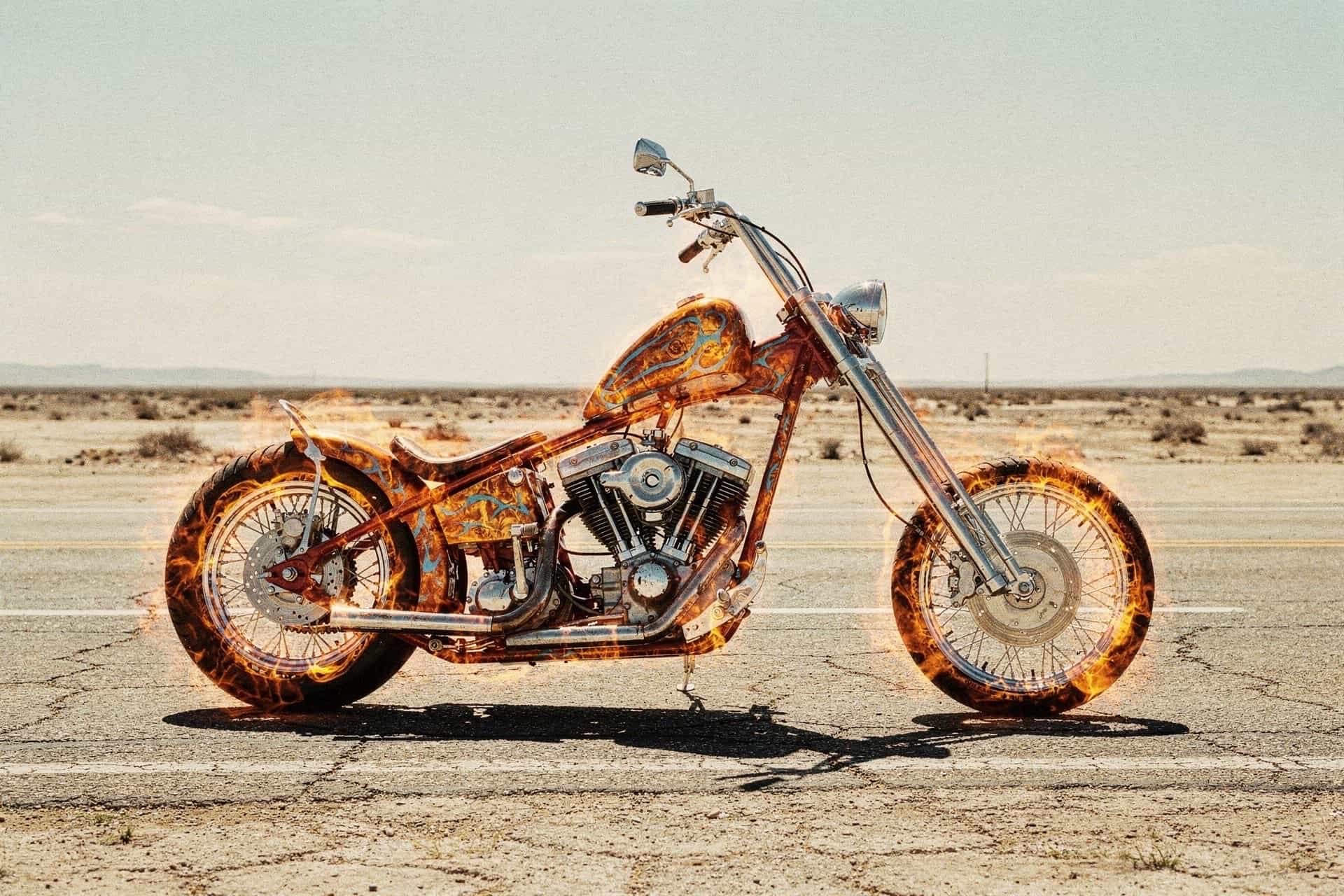
A flaming skeleton on a motorcycle. That is the entire pitch, and it has worked for over fifty years because the motorcycle is not Ghost Rider’s accessory. It is half the character. Take away Thor’s hammer and he is still a god. Take away Ghost Rider’s bike and he is a skull on fire standing on a sidewalk with nowhere to go.
No other comic book character is so completely built around a motorcycle. Across five decades of Marvel Comics, two Nicolas Cage films, television appearances, and video games, that bike has changed shape repeatedly, and each version tells you what motorcycles meant to the culture at the time.
Every Ghost Rider Motorcycle at a Glance
| Version | The motorcycle | What it actually is |
|---|---|---|
| Johnny Blaze comics, 1972 | Seventies hardtail chopper | A drawn machine, styled from the Southern California chopper scene of the era |
| Danny Ketch comics, 1990s | Lower, chain-wrapped supernatural bike | Drawn as a summoned entity rather than a converted street bike |
| Robbie Reyes comics, 2014 | 1969 Dodge Charger | Not a motorcycle at all |
| Ghost Rider, 2007, street scenes | Panhead-style custom chopper | A purpose-built film bike styled after the Easy Rider Captain America chopper |
| Ghost Rider, 2007, stunts | Buell sportbike | A production motorcycle used because a chopper cannot do the stunt work |
| Ghost Rider, 2007, transformed | The Hellcycle prop | A one-off 11-foot prop, not a modified production motorcycle |
| Spirit of Vengeance, 2012 | Yamaha VMAX | A production 1,679cc V4 muscle cruiser |
The short version: there is no single Ghost Rider motorcycle. Every era answered the question differently, and the film answers are the ones most people are actually searching for.
The Comic Book Hellcycle: 1972 to Present
Johnny Blaze’s Original Ride (1972)
Ghost Rider first appeared in Marvel Spotlight #5, cover-dated August 1972, created by writer Gary Friedrich, artist Mike Ploog, and editor Roy Thomas. The original Johnny Blaze version rode a motorcycle Ploog drew straight from the Southern California chopper scene of the era.
That first depiction shows a classic seventies chopper silhouette: extended front forks, rigid hardtail rear, high-rise handlebars, teardrop fuel tank. The reference points are the bikes rolling out of custom shops during the Easy Rider years, built long and low for looks rather than handling.
In the early issues the bike transforms when Blaze becomes Ghost Rider. Flames erupt from the wheels and exhaust and the chrome glows, but the underlying machine stays recognizable as a chopper. It was not yet a supernatural entity in its own right. It was Johnny’s chopper, supernaturally amplified.
The timing made sense. In 1972 choppers dominated custom culture and the market for antiheroes and occult imagery was wide open. For how choppers differ from other custom styles, our guide to the difference between bobbers and choppers breaks it down.
The Hellcycle Evolves: Danny Ketch Era (1990s)
Johnny Blaze’s younger brother Danny Ketch took over the mantle in Ghost Rider volume 2 #1 in 1990, and the bike changed with him.
Ketch’s motorcycle reads as early-nineties rather than seventies. Artists Mark Texeira and Javier Saltares drew it with a lower, more aggressive profile. The supernatural elements got louder: chains wrapped the frame, the wheels became solid discs of flame, and the machine sometimes looked closer to bone and metal than to a transformed street bike.
The Ketch-era Hellcycle also gained abilities the Blaze bike never had in print. It rides up vertical surfaces, crosses water, repairs itself, and moves on command. By the 2000s, Jason Aaron’s run pushed further and the bike became less motorcycle and more demonic entity in motorcycle form, with no clear mechanical basis under the flames.
That drift matters for anyone trying to identify a “real” comic Hellcycle. After the nineties there is no consistent make or model to identify, because the artists stopped drawing one.
Robbie Reyes: Breaking the Pattern (2014)
Writer Felipe Smith and artist Tradd Moore introduced Robbie Reyes in All-New Ghost Rider #1 in 2014 and broke with every Ghost Rider before him. Reyes does not ride a motorcycle. He drives a 1969 Dodge Charger, the Hell Charger.
Riders noticed immediately. A Ghost Rider without a bike lands differently regardless of story quality. Reyes appeared in Agents of S.H.I.E.L.D. Season 4, played by Gabriel Luna, driving the Hell Charger, and the character has stayed car-based since.
The Nicolas Cage Films: Real Bikes, Real Money
Ghost Rider (2007)
Director: Mark Steven Johnson. Stars: Nicolas Cage, Eva Mendes, Sam Elliott, Peter Fonda.
The casting alone shows the film knew its motorcycle lineage. Peter Fonda, Captain America himself from Easy Rider, plays Mephistopheles. The 2007 film gave the character’s motorcycle its most detailed live-action treatment, and it took three separate machines to do it.
Johnny Blaze’s street chopper: the Panhead-style custom
Before transforming, Cage’s Blaze rides a custom chopper built for the film. Enthusiast and auction accounts describe it as a Panhead-styled build modeled on the Easy Rider Captain America chopper and fitted with an S&S engine, which is why Fonda’s character reacts to it on screen. We have not found a studio production document confirming the builder or the engine, so treat those attributions as well-repeated rather than verified.
The visible build reads as:
- Hardtail frame with no rear suspension
- Extended springer front forks
- Panhead-style V-twin, with mock-ups used for some static shots
- Flame paint on the fuel tank
- Spoked wheels and drag handlebars
- Long, stretched chopper proportions
Multiple versions were built: functional riding bikes, static props for detail work, and stunt versions. The design was deliberately retro, anchoring Blaze in the seventies chopper tradition that matches his comic origins.
The stunt bike: a Buell sportbike
For action requiring speed and agility no chopper can deliver, the production used a Buell, commonly identified as an X1 Lightning. The sportbike chassis let stunt riders do things that would be impossible on a heavy chopper prop. This is the bike most often confused with the Hellcycle, and it is worth separating the two: the Buell did the riding, not the transforming.
The Hellcycle: a purpose-built prop, not a converted motorcycle
The transformed bike is the showpiece, and it is where most published descriptions go wrong. The Hellcycle was not built on a Buell chassis. The Volo Museum, which displays one of the surviving units, describes an 11-foot machine built in Australia from the ground up, roughly 50 inches tall, with a fiberglass shell over a custom chopper frame, no front or rear suspension, front and rear disc brakes, and a KTM 525 single-cylinder engine. The museum puts the build cost at approximately $300,000.
Treat that $300,000 as a museum listing figure rather than a studio accounting record. It is the most specific published number available, it is consistent across the secondary coverage that repeats it, and no production document we could find either confirms or contradicts it.
Most of the Hellcycle’s screen time is computer generated. The flames, the supernatural movement, and the transformation are all digital. The physical prop carried the close-ups, the reference lighting, and the static shots, and the design kept the chopper silhouette rather than modernizing it. That was the right call. A Ghost Rider on a sportbike would have erased the character’s visual identity.
If you want the skull-and-flames look without the supernatural contract, our t-shirt collection has designs that would make Blaze nod.
Ghost Rider: Spirit of Vengeance (2012)
Directors: Mark Neveldine and Brian Taylor. Stars: Nicolas Cage, Idris Elba, Ciaran Hinds.
The sequel went a different direction: grittier, more chaotic, shot by the Crank duo like a controlled demolition.
The Yamaha VMAX
For Blaze’s human-form riding, the production swapped the Panhead-style chopper for a Yamaha VMAX. The second-generation VMAX is a 1,679cc liquid-cooled 65-degree V4 with a claimed output around 200 PS at 9,000 rpm and roughly 167 Nm of torque at 6,500 rpm. Published figures appear as both 197 bhp and 200 hp depending on the measurement standard, which is the same single manufacturer claim converted two ways.
The choice fits the sequel’s tone. The first film’s chopper was nostalgic. The VMAX is violent and modern. It works for the movie’s energy even though it breaks continuity with everything before it.
The transformed bike
The Hellcycle in Spirit of Vengeance is again mostly computer generated, and more extreme than the first film. Metal warps and reforms on screen, flames come off every surface, the wheels scorch the ground. Impressive as effects work, but it loses the clean readability of the first design. A flaming skeleton on a chopper is instantly legible. A flaming skeleton on a melting metal shape is just noise.
Ghost Rider Tribute Builds: What Riders Actually Build
Ghost Rider has inspired custom builds since the seventies, ranging from flame paint and skull details on an otherwise standard chopper to full Hellcycle replicas with LED flame effects and sculpted bodywork.
| Base bike | Why builders pick it | The tradeoff |
|---|---|---|
| Panhead or Shovelhead chopper | Closest to the original comic silhouette | Vintage V-twin running costs and hardtail comfort |
| Softail | Hidden rear suspension mimics a hardtail while staying rideable over distance | Less authentic profile up close |
| Metric cruiser such as a Honda Shadow or Yamaha V-Star | Cheapest route to the look | Usually needs heavy bodywork to sell the shape |
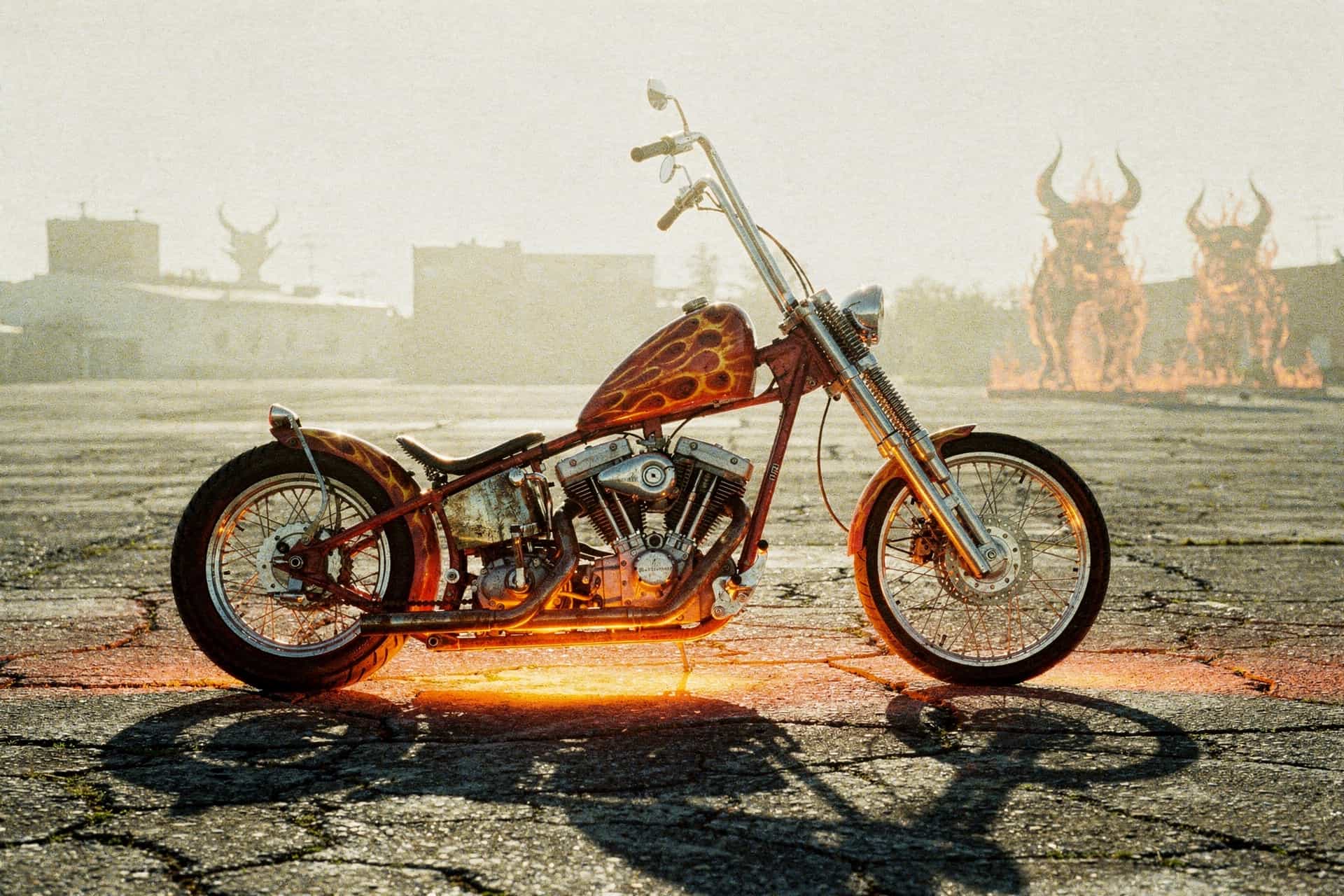
The builds that hold up keep it restrained. One or two supernatural details on an otherwise clean chopper hits harder than a bike buried in skulls and LED flames. A flat-black hardtail with orange pinstriping and a skull shift knob reads as Ghost Rider without looking like a parade float. The character was always better on the page when the artist drew a real chopper with fire on it rather than a shapeless mass of effects.
If you are working toward a hardtail of your own, our guide to what makes a bobber covers the stripped-down end of the same tradition.
The Swedish Ghost Rider: A Real-World Side Note
The name carries a second meaning in motorcycle culture with no connection to Marvel.
Starting in the late 1990s, an anonymous Swedish motorcyclist posted videos of himself riding at extreme speeds on public roads in a black helmet and leathers, calling himself Ghost Rider and releasing DVDs that circulated widely in the sportbike world. Swedish press reporting has linked the persona to Patrik Fürstenhoff, including traffic prosecutions. Coverage of the identity, the specific speeds, and the machines involved comes from press and enthusiast accounts rather than court records we can cite directly, so this article does not present the details as established fact.
Nothing about those rides is worth copying. Public-road speed runs of that kind kill riders and bystanders, and the legal exposure is real. The overlap worth noting is thematic only: both the comic character and the persona used the motorcycle as a tool for becoming someone else.
Why Ghost Rider Matters to Riders
Ghost Rider occupies a unique space. He is the only major superhero whose power is inseparable from a motorcycle, which makes him the only comic book character who is, at his core, a rider.
The character introduced a lot of non-riders to motorcycle imagery through comics, cartoons, films, and games. For kids reading Ghost Rider in the seventies, the Hellcycle was a first look at chopper culture: the long forks, the hardtail frame, the stripped-down shape. The distance from a comic panel to a garage project is shorter than people assume.
In the broader motorcycle culture conversation, the character stands for the motorcycle as a symbol of power and transformation. Johnny Blaze is an ordinary stunt rider until he throws a leg over the bike. Then he is something else.
For the real-world films that shaped biker culture without the supernatural elements, see our guides to the best biker movies and Sons of Anarchy’s motorcycles. And if Keanu Reeves building ARCH Motorcycle is more your speed, that is a different kind of Hollywood-meets-two-wheels story.
Sources
- Marvel - Ghost Rider (Johnny Blaze) - official character profile and publication history
- Britannica - Ghost Rider - character history from Marvel Spotlight #5 in 1972 through modern iterations
- Volo Museum - 2007 Hell Cycle - listing for a surviving Hellcycle with its Australian build, dimensions, KTM 525 engine, and approximate $300,000 cost
- Heritage Auctions - Ghost Rider process Hell Cycle - auction record for a non-powered process unit built for scenes that did not need a drivetrain
- SlashGear - What Motorcycle Did Nicolas Cage Ride in Ghost Rider? - breakdown separating the Panhead-style chopper, the Buell stunt bike, and the Hellcycle prop
- Bennetts BikeSocial - Yamaha VMAX 2009 to 2017 buyers guide - second-generation VMAX engine, output, and chassis figures
- Ghost Rider (2007) - cast, crew, and production credits
- Ghost Rider: Spirit of Vengeance (2012) - cast and production credits for the sequel
- Friedrich, Gary, and Mike Ploog. Marvel Spotlight #5. Marvel Comics, August 1972 - first appearance of Johnny Blaze as Ghost Rider