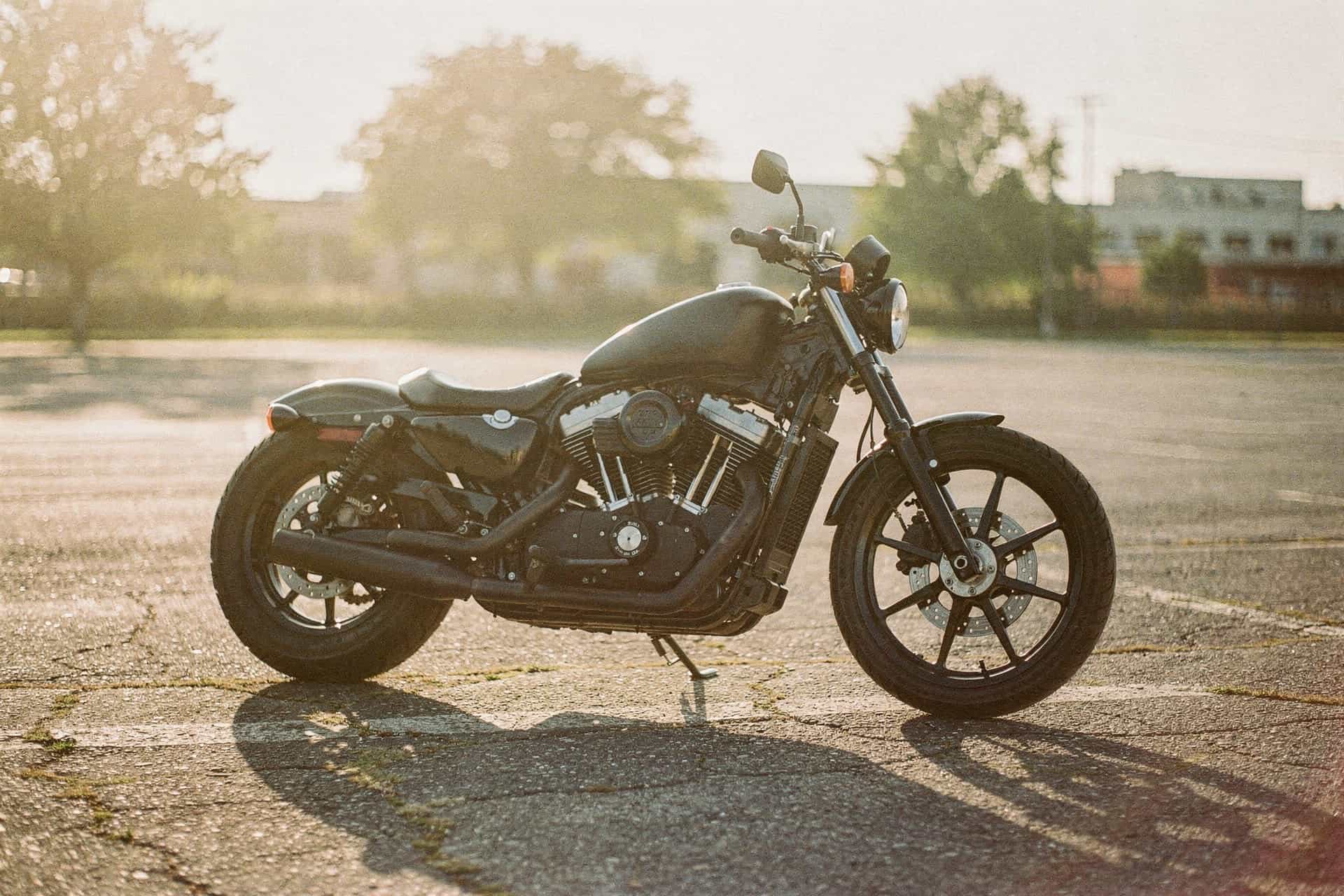
You hear an Iron 883 before you see it. A flat, mechanical idle, tighter and busier than a Big Twin, coming from a blacked-out engine sitting low in a compact frame with nothing chromed and nothing surplus.
The XL883N Iron 883 ran from the 2009 model year through 2022, and it did the job Harley built it for: it got people who were never going to buy a Road King onto a Harley. This guide is built around the questions people actually search for on this bike, in order: what the numbers are, which seat height figure is the real one, what changed from year to year, and what to look at before you hand over money for a used one.
The Short Version
- Model designation: XL883N, part of the Sportster XL family
- Model years: 2009-2022
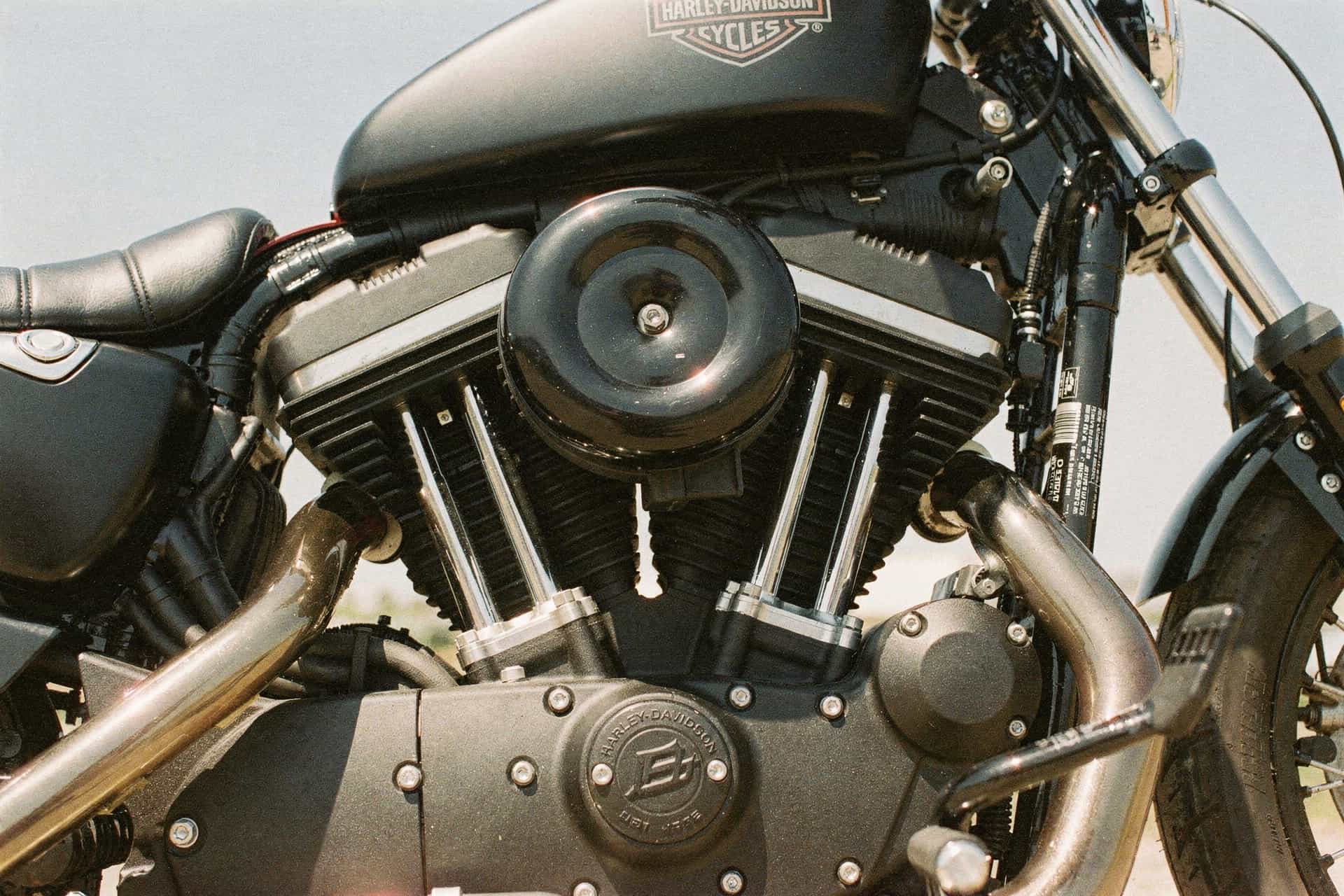
- Engine: 883cc air-cooled Evolution 45-degree V-twin, ESPFI fuel injection
- Torque: 53.8 ft-lb (73 Nm) at 3,750 rpm (2018 US spec)
- Seat height: 25.7 in laden / 29.9 in unladen (2018 US spec)
- Weight: 545 lb as shipped, 564 lb in running order (2018 US spec)
- The buying line: 2014 and later got bigger brakes, an ABS option and a tachometer
Harley did not publish a horsepower rating for the Evolution Sportster in its US model materials. Any “the Iron 883 makes 50 hp” figure you see comes from a third-party dyno run or a European homologation document, and almost none of them state dyno type, correction factor or whether the number is at the crank or the wheel. Torque at 3,750 rpm is the figure Harley actually stood behind.
Where the Iron 883 Came From
The Iron descends directly from the XL1200N Nightster, Harley’s first Dark Custom model, introduced for 2007. Harley announced the Iron on 26 January 2009: same stripped, blacked-out idea, smaller engine, cast nine-spoke wheels in place of laced rims, narrower bars, and “a ticket to ride the Iron 883 starts at just $7,899 MSRP.” Launch colors were Black Denim and Brilliant Silver Denim, both matte.
There is a small dating discrepancy worth knowing about. Harley’s own Sportster history timeline places the Iron 883 joining the Dark Custom series in 2010, while the press announcement, the contemporary road tests and the model-year designation all point to 2009. The 2009 date is the one supported by the primary announcement; the corporate timeline appears to be tracking the campaign rather than the model year.
The timing was not an accident. 2009 was a brutal year for motorcycle sales, Big Twin volume was falling, and Harley needed a cheap entry point that did not look cheap. It got one.
Full Specifications: 2018 XL883N
The 2018 model year sits after every meaningful revision and before the run wound down, so it is the fairest single-year snapshot of the bike. These are Harley’s published US figures for that year.
Engine and drivetrain
| Spec | Detail |
|---|---|
| Engine | Air-cooled Evolution, 45-degree V-twin |
| Displacement | 883cc (53.9 cu in) |
| Bore x Stroke | 3.000 x 3.811 in (76.2 x 96.8 mm) |
| Compression ratio | 9:1 |
| Torque | 53.8 ft-lb (73 Nm) at 3,750 rpm |
| Fuel system | Electronic Sequential Port Fuel Injection (ESPFI) |
| Transmission | 5-speed |
| Primary drive | Chain, 34/57 ratio |
| Final drive | Belt |
| Clutch | Cable-actuated, wet multi-plate |
Chassis, wheels and brakes
| Spec | Detail |
|---|---|
| Frame | Tubular steel, rubber-isolated engine mounts |
| Front suspension | 39mm conventional fork |
| Rear suspension | Preload-adjustable coil-over emulsion shocks |
| Brakes | Dual-piston calipers front and rear |
| ABS | Optional |
| Wheels | Black 9-spoke cast aluminum with machined highlights |
| Front tire | 100/90B19 57H |
| Rear tire | 150/80B16 77H |
Dimensions and capacities
| Spec | Detail |
|---|---|
| Overall length | 86 in (2,185 mm) |
| Seat height, laden | 25.7 in (654 mm) |
| Seat height, unladen | 29.9 in (760 mm) |
| Wheelbase | 59.6 in (1,515 mm) |
| Rake | 30 degrees |
| Trail | 4.6 in (117 mm) |
| Ground clearance | 5.5 in (140 mm) |
| Lean angle | 27 degrees right, 28 degrees left |
| Fuel capacity | 3.3 gal (12.5 L) |
| Oil capacity | 2.8 qt with filter (2.6 L) |
| Weight, as shipped | 545 lb (247 kg) |
| Weight, in running order | 564 lb (256 kg) |
| Fuel economy | 51 mpg EPA combined estimate |
US base MSRP for 2018 was $8,999, with Hard Candy Custom finishes at $9,449.
The seat height question, answered properly
More people search for the Iron 883’s seat height than for any other single spec on this bike, and the two numbers in circulation both come from Harley.
25.7 in is the laden figure. Harley measures it with a rider aboard and the suspension settled. It is the number in the marketing material and the number that matters if you are asking “can I flat-foot this.”
29.9 in is the unladen figure, measured on a bike sitting on its own with nobody on it. Cycle World and several spec databases publish roughly 30 in for the same motorcycle. They are not wrong and Harley is not wrong; they are quoting different measurements.
For practical purposes: the Iron’s laden seat height is genuinely low for a 564-pound motorcycle, and the short rear suspension travel that makes it low is also the source of the bike’s main ride complaint. Those two facts are the same fact.
Year by Year: What Actually Changed
The Iron 883 was never redesigned. It was refined, unevenly, across thirteen model years. Grouping it into three phases is more honest than pretending each year was distinct.
2009-2013: the launch bike
The original recipe: 883cc Evolution engine, five-speed, belt final drive, nine-spoke cast wheels, drag bars, solo seat, side-mount plate. For 2010 Harley relocated the engine control unit out from under the seat, which opened up aftermarket seat fitment on a bike that owners started customizing immediately. Everything else across these years is paint and graphics.
Two practical consequences for buyers. These are the cheapest Iron 883s on the used market. And they have the smaller pre-2014 brakes, no ABS option, and no tachometer or gear indicator.
2014-2016: the update that matters
The 2014 model year carried the only substantial revision in the model’s history. What Harley changed across the Sportster line:
- Brakes, standard on every bike. The front rotor grew from 292mm to 300mm, the restyled front caliper went to dual 34mm pistons in place of 25mm, a new aluminum front master cylinder cut friction, and the rear caliper went to dual 38mm pistons. Braided stainless lines at both ends.
- Electrical and instruments, standard. New wire harness and voltage regulator, an instrument console with an analog speedometer and digital tachometer, restyled hand controls, and a left-hand trip switch that cycles odometer, tripmeter, gear indicator and rpm.
- Exhaust. Fully welded header pipes and new heated oxygen sensors feeding a closed-loop emissions circuit.
- ABS, optional. A standalone factory-installed option at $795. A 2014 or later Iron does not automatically have it, so check the specific bike.
- Keyless ignition, optional and bundled. It came only as part of the $395 H-D Smart Security System, a proximity fob that disarms the bike as you approach. Sportsters ordered without that option kept a conventional keyed ignition. “2014 and later means keyless” is wrong as a used-buying rule.
The engines themselves were not changed for 2014. Claims that the year brought a raised compression ratio or added a catalytic converter do not match Harley’s own announcement of the update.
If you are choosing between a 2013 and a 2014 on similar money, take the 2014. The brake upgrade is standard equipment rather than an option box, which makes it the one change you can count on finding.
2016 brought revised suspension damping and seat foam. Those are refinements, not reasons to pay a premium.
2017-2022: steady state, then the end
No mechanical changes of consequence. Colors rotated, the bike sold, and Harley was already building the Revolution Max platform that would replace the whole Evolution Sportster family. The 2021-2022 bikes are the last of them.
Harley built the final Evolution Sportster, a Gunship Gray 883, on 18 November 2022. That closed the Sportster Evolution engine’s run from the 1986 model year to 2022, and the run of the Sportster line itself back to the 1957 XL.
Where It Sits in the Sportster Family
The Sportster launched in 1957 with the Ironhead engine and ran on it through 1985. The Evolution Sportster arrived for 1986 in 883cc and 1,100cc displacements, with 1,200cc following. That engine is a completely different design from the Big Twin Evolution despite the shared name, using four gear-driven camshafts and unit construction; our Evolution engine guide explains why the two are not interchangeable.
The other date worth knowing: Sportsters from 2004 on use rubber isolation mounts with tie links limiting engine movement to one plane, which cut the vibration reaching the rider substantially. Every Iron 883 ever built is on that side of the line. If somebody hands you advice about Sportster vibration drawn from a pre-2004 bike, it does not apply here.
Within the lineup, the Iron was the cheap one that did not look cheap. The SuperLow (XL883L) was the more overtly beginner-focused 883, and the Forty-Eight and 1200 Custom sat above on displacement and price. Our full Sportster history covers the whole model line, and the Harley-Davidson history guide puts the Sportster era against the rest of the company’s timeline.
Buying Used: What to Check
We are not publishing a used-price table. Used values on a thirteen-model-year run move with region, season and condition, and a price band printed in an article ages badly and then misleads people. Pull current numbers from a valuation service that dates its data, such as J.D. Power’s XL883N values, and compare against live local listings before you make an offer.
What to inspect is more durable advice.
Skip the cam chain tensioner myth. You will find checklists telling you to listen for cam chain tensioner rattle on a used 883. That advice belongs to the Big Twin Twin Cam, which used spring-loaded polymer tensioner shoes from 1999 to 2006. The Sportster Evolution drives its four camshafts with gears. There is no cam chain and no tensioner shoe in this engine.
Run the VIN through the recall databases. This is free and takes two minutes. Use Harley’s own motorcycle safety recall lookup and NHTSA’s VIN search. Iron 883 campaigns have been light: the notable recent one covered certain 2021-2022 Sportsters over improperly affixed DOT4 brake fluid decals. Note also that the large 2014-2015 Harley clutch master cylinder recalls do not touch this bike, because the Iron uses a cable clutch rather than a hydraulic one. Our VIN decoding guide covers reading the number itself.
Charging system. Sportster charging systems are adequate rather than generous, and bikes that sat for long periods or ran a lot of added accessories are the ones that show problems. Measure battery voltage at idle and again at a fast idle and confirm it rises and holds. A reading that does not climb off battery voltage points at the stator or regulator and is worth diagnosing before purchase, not after.
Final drive belt. Look along the belt for cracking, frayed edges or missing teeth. Belt replacement labor is not trivial on a Sportster, so a marginal belt is a real bargaining item.
Service records over odometer reading. The Evolution Sportster is a simple engine, not a maintenance-free one. Documented oil and filter changes, primary chain adjustment and drive belt inspection at the manual’s intervals tell you more than a low number on the clock. There is no scheduled valve clearance adjustment on this engine: the Sportster Evolution runs hydraulic lifters, which take up lash automatically. Any checklist telling you to have the valves shimmed on an 883 was written for a different motorcycle. The intervals for a specific bike live in that model year’s owner manual, not in a generic online chart.
Modifications. Exhaust, air cleaner and seat swaps are common on this model and are not a red flag by themselves. Ask what parts were fitted, whether the calibration was changed, and who verified the result. Popping or unusual heat alone does not diagnose a lean mixture, so use service records and proper air-fuel testing rather than guessing from sound.
Mods That Change the Bike
Ranked by how much they change the motorcycle rather than by what they cost.
Suspension first. This is where Harley economized hardest. The 39mm fork is non-adjustable, and the rear shocks give you preload adjustment and nothing else on very little travel. Short travel on a 564-pound motorcycle leaves little room to absorb a sharp bump, which is the mechanical reason the stock bike feels harsh over broken pavement. Replacement rear shocks with more travel and damping control, plus a fork spring kit, are the highest-value change you can make to how an Iron 883 rides, and together they cost less than a good exhaust.
Exhaust and intake, with the correct calibration. A freer exhaust and less restrictive air cleaner change airflow by amounts that depend on the exact parts. Follow the component and tuner instructions, then verify the calibration instead of assuming the stock map is adequate or that every modification automatically creates the same lean condition.
Seat. Seat comfort depends on rider build and trip length. Replacement seats are widely available, while a spring solo seat on a hinge kit changes the look for a Sportster bobber build. Verify mounting hardware and tire-to-fender clearance before treating any seat as a drop-in part.
Bars and controls. Bar and riser changes may require different throttle cables, clutch cable, brake line, wiring, clamps, or ABS-compatible parts. There is no universal rise threshold. Use a kit listed for the exact model and year, then verify free control movement and line clearance through full steering travel before riding.
If you are building one out, Bobber Brothers stocks gear for that kind of work: our full collection is cut for the garage.
The 883 to 1200 conversion
Big bore kits take the 883 to 1,200cc by changing cylinders and pistons. The result is a real increase in usable output and it makes the bike noticeably better at sustained highway speed. Cylinder and piston kits are widely available, and this engine’s 1200 upgrade path is well trodden.
The honest arithmetic still usually favors buying a used 1200 instead. Parts plus labor on a conversion frequently exceeds the price gap between a used 883 and a used 1200, and the work does not lift resale value by anything close to what it costs. Do it because you want to build it, not because it pencils out.
Is It a Good First Harley?
Yes, with the qualifications spelled out rather than glossed.
In favor: the laden seat height genuinely puts most riders’ feet down, which removes the most common cause of low-speed drops. The Evolution’s power delivery is linear with no step in it. Belt final drive removes chain maintenance. Mid-controls put you in a neutral position. And there is no motorcycle on earth with deeper parts availability.
Against: 564 pounds in running order is a lot of motorcycle for a first bike compared with a Rebel or a Vulcan S, and short-travel suspension on a heavy bike is less forgiving of a mistake. The 3.3 gallon tank and zero wind protection make it a poor interstate tool. And on any bike before 2014, you get no tachometer and the smaller brakes.
The range point deserves its own line. A 3.3-gallon tank at the 51 mpg EPA combined estimate is roughly 168 miles on paper. Real range varies with speed, wind, load, temperature, tune, and condition, so 120 to 140 miles is a conservative trip-planning range rather than a guaranteed result. If you are still deciding between this and something lighter, our beginner motorcycle comparison puts it against the alternatives.
Harley ended production of the air-cooled Evolution Sportster family in November 2022, so the Iron 883 is currently a used-market motorcycle. That documented production end is not a promise that the model name can never return on a different platform.
Sources
- 2018 Harley-Davidson Iron 883 specifications - Total Motorcycle - reproduction of Harley’s published 2018 XL883N spec sheet: pricing, torque at rpm, bore and stroke, gearing, dimensions, laden and unladen seat height, weights and EPA economy
- 2018 Harley-Davidson Sportster Iron 883 Buyer’s Guide - Cycle World - independent listing of the same model year, quoting a 30 in seat height against Harley’s 25.7 in laden figure and matching Harley’s 564 lb wet weight
- 2014 Harley-Davidson Sportsters Receive ABS and Keyless Security Options - Motorcycle.com - the itemized 2014 Sportster update from Harley’s announcement: 300mm front rotor, 34mm and 38mm caliper pistons, new harness and instruments, welded headers and oxygen sensors, ABS at $795 and keyless security at $395, with the engines unchanged
- Harley-Davidson Updates 2014 Sportster Lineup - Ultimate Motorcycling - the same announcement, confirming the Smart Security System and ABS were standalone factory-installed options rather than standard equipment
- First Look: 2009 Harley-Davidson Iron 883 - Motorcyclist - contemporary coverage of the 2009 introduction and the $7,899 launch price
- Harley-Davidson Introduces New Iron 883 - Roadracing World - the 26 January 2009 Harley-Davidson announcement text and launch colors
- Harley-Davidson Sportster - Wikipedia - cited entries for the 2009 introduction, the 2004 rubber-mount change, the 2007 move to fuel injection, and the 18 November 2022 final Evolution Sportster. Its 2014 change list adds a raised compression ratio and a catalytic converter, which Harley’s own announcement of that update does not support
- Harley-Davidson Sportster History - Harley-Davidson USA - the manufacturer’s own Sportster timeline, including the 1957 XL, the 1986 Evolution engine in 883 and 1100cc, and its 2010 dating of the Iron’s Dark Custom debut
- Why Harley-Davidson Used Four Camshafts For Pushrod V-Twins - Jalopnik - the Sportster Evolution’s gear-driven four-camshaft valvetrain, which is why it has no cam chain tensioner
- Motorcycle Safety Recall Information - Harley-Davidson USA - the manufacturer’s VIN recall lookup
- Recall: Some 2021-2022 Harley Sportsters May Have Faulty Brake Fluid Decal - RideApart - the most recent Iron 883 recall campaign and its affected build dates
- 2018 Harley-Davidson XL883N Iron values - J.D. Power - dated used valuation data, used here instead of a fixed price table