Start With What the Engine Actually Makes
Before any of this is worth spending money on, get the baseline right, because most Sportster upgrade advice starts from a number nobody measured.
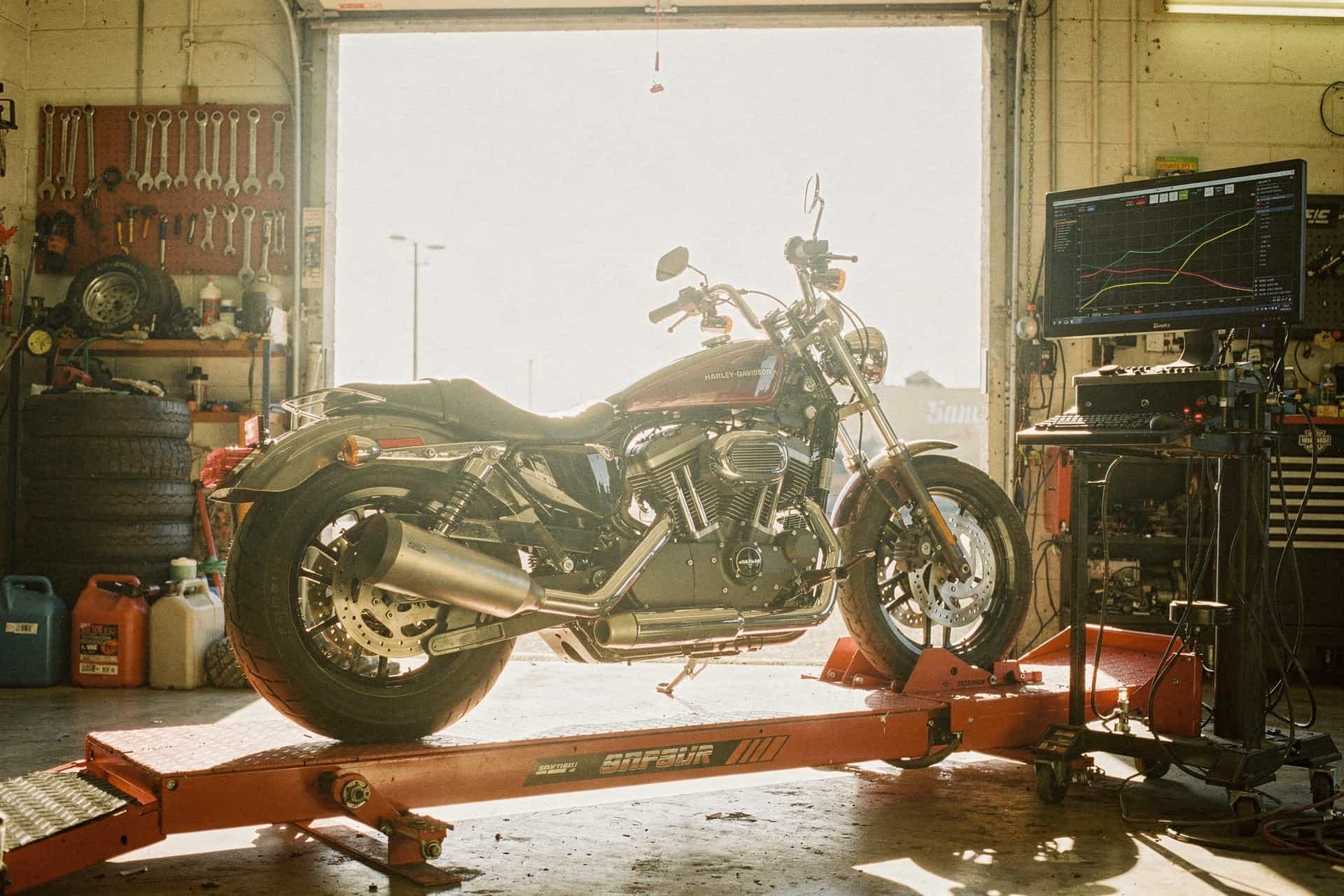
Cycle World put a stock 2018 Iron 1200 on the dyno and documented 59.14 hp at 5,410 rpm and 67.08 lb-ft of torque at 4,050 rpm at the rear wheel. Harley’s own material for that bike claims 73 lb-ft of engine torque at 3,500 rpm and does not publish a horsepower figure for the US market at all. The engine is a 1,202cc air-cooled 45-degree pushrod V-twin, 88.9mm bore by 96.8mm stroke, 10:1 compression on the late bikes and closer to 9:1 on the early Evo 1200s.
So the real starting point is roughly 60 rear-wheel horsepower and a torque peak that arrives at 4,000 rpm and is basically finished by 5,500. That shape is the thing worth changing. Chasing peak horsepower on a motor that is done revving before a Japanese twin has warmed up is how riders spend $4,000 and end up with a bike that is worse in traffic.
This guide is sorted by what you want, then by stage, then by what it costs. Prices are indicative US retail ranges as of mid-2026 and move constantly, so treat them as planning numbers and check current pricing before you order.
First: Know Which Sportster You Have
The Evo Sportster 1200 ran a long time and it is not one platform. Buying parts for the wrong one is the single most expensive mistake on this list.
| Era | Engine mounting | Fuel system | Notes |
|---|---|---|---|
| Pre-2004 | Solid mount | Carbureted | Different frame, mounts and swingarm from later bikes; very little crosses over |
| 2004-2006 | Rubber mount | Carbureted | 2005 brought larger axles and swingarm, 2006 a revised transmission with spiral-cut gears |
| 2007-2021 | Rubber mount | EFI (ESPFI) | Tuning is done through the ECM; individual-cylinder control is possible |
The 2004 redesign stiffened the frame and added rubber engine mounts along with roughly 50 pounds of weight. Frames, engine cases and swingarm hardware differ enough between the solid-mount and rubber-mount eras that treating them as interchangeable will cost you.
The other split that matters for power: Hammer Performance reports that 2007 and later EFI bikes tend to make around 5 to 10 percent more than a comparable 2004-2006 carbureted build, because closed-loop EFI can trim each cylinder individually. That is not a reason to sell a carbureted bike. It is a reason to set expectations correctly.
The line ended with the Iron 1200 (XL1200NS) for the 2018-2021 model years in North America, after the 1200s were dropped in Europe in 2020 over Euro 5. If you want the wider family history, our Sportster history and buyer’s guide covers every era.
Goal 1: Make It Feel Alive, Cheapest Path
What to buy: full exhaust, high-flow air cleaner, fuel correction. All three, as one job.
Indicative budget: $700 to $1,500 fitted, depending on whether you do the labour.
The factory intake and exhaust are restrictive by design, sized for noise and emissions certification rather than airflow. Opening one side without the other, and without correcting fuelling, is where most Sportster money gets wasted.
- Exhaust. A full system replaces the head pipes, which is where the restriction lives. A well-designed 2-into-1 with a proper merge collector generally does more for midrange torque on this engine than open drag pipes, which trade usable low and mid range for a top end an air-cooled Sportster barely reaches. Budget $500 to $900 for a quality full system.
- Air cleaner. $150 to $350 and half an hour. Worth almost nothing on its own. Necessary as part of the package.
- Fuel correction. On carbureted bikes through 2006, a jet kit with new mains, pilots, needles and shims runs $75 to $150. On 2007 and later EFI bikes you need a flash or piggyback tuner. Running a freer intake and exhaust without correcting fuelling gives you decel popping, a lean cruise mixture and a genuine risk of heat damage over time.
What to expect: a wider, flatter torque curve, much sharper throttle response, and a modest rear-wheel horsepower gain. Published Stage 1 numbers for this platform vary wildly because they come from different bikes, dynos, exhausts and calibrations. We will not pick one and present it as the answer. What we will say plainly: the change you feel on the road is mostly the torque curve and the throttle, not the peak number.
Goal 2: More Midrange Torque
What to buy: displacement, or cams, or both. Displacement first if you can only pick one.
Indicative budget: $800 to $1,500 for a kit, plus fitting and tuning.
Displacement is the cheapest genuine torque on this engine, and the fitment news is better than most riders expect.
- S&S 1250 conversion: takes 1986-2021 883cc and 1200cc Sportsters to 1250cc. S&S states no machining or rebalancing is required and the kit bolts into stock crankcases. Flat-top pistons give about 10.3:1 with stock 1200 or S&S CNC heads; 5.5cc pop-up pistons give about 11.2:1. S&S states plainly that “883 cylinder heads may not be used with this kit.” That sentence carries no exception for ported ones, so do not read port work as a way in. An 883 owner going the S&S route needs 1200 heads or S&S heads.
- Hammer Performance 1250 and 1275 kits: 3-9/16 inch and 3.600 inch bores respectively, both stated as installable without case boring. Piston choice is matched to which heads you actually have, including different domes for 1988-2003 heads, 2004-and-later heads, XL1200S heads and Buell Thunderstorm heads.
- The 883-head option is Hammer’s alone, and it is a Hammer package. Hammer lists 1275 pistons for 883 conversions with valve pocket placement cut to work with 883 heads specifically, plus reverse-dome and 30 degree dome options quoted against 883 chamber volumes. That is one manufacturer’s kit with that manufacturer’s pistons, sold as a matched set. It is not evidence that 883 heads work with the S&S 1250, and mixing the two vendors’ logic is how people end up with a piston that does not clear a valve.
- 90 cubic inch kits: these are the ones that require boring the cases (to 4.005 inches on the Hammer kits) and are explicitly not bolt-on. Different project, different budget.
That distinction matters because “big bore kits need machine work and a full engine strip” is one of the most repeated pieces of bad advice about this platform. For the common 1200-based kits, it is not true.
Cams. Sportsters use four gear-driven cams accessible from the right side, which is a genuinely simpler job than a Twin Cam chain-tensioner service. The stock W cams already have the earliest intake-valve closing timing available for the platform, meaning they are optimised for bottom-end power. That is why cam swaps aimed at bottom end rarely deliver much, and why wide-range profiles like the Hammer JackHammer 570 are the sensible street choice. Hotter profiles such as the IMPACT 560 concentrate their gain at the top, and Hammer’s own dyno commentary notes a small loss across most of the rpm range in exchange for the top-end jump. Budget $200 to $400 for cams plus $300 to $500 in labour if a shop does the work.
One planning rule that saves real money. Hammer Performance puts it bluntly: hopping up a motor incrementally over time is expensive because you buy some parts twice. Larger valves usually mean enlarging the chamber, which drops compression, which means new pistons. Decide the finished spec first, then buy toward it.
If your build is heading toward a stripped-down Sportster rather than a stock-bodied one, our Sportster bobber build guide covers the chassis side of that decision.
Goal 3: Chase Peak Horsepower
What to buy: displacement, matched cams and head work, planned as one package with tuning budgeted from the start.
Indicative budget: $3,000 to $4,000-plus all in, and up sharply from there once head work is involved.
This is where honest numbers get scarce. Documented triple-digit rear-wheel results on big-bore Sportsters exist, and they all have the same shape: displacement plus ported heads plus matched cams plus induction plus a proper tune. No single part in that list gets you there.
Two cautions worth more than any dyno chart:
Match the parts to each other. Compression, dome shape, valve size, cam timing and fuelling are one system. A 1250 kit with the wrong pistons for your heads can end up making less than the combination you started with, or needing fuel you cannot buy locally.
Do the arithmetic against the bike’s value. A high-output build can easily reach half or more of what a clean used Evo 1200 is worth. That is a reasonable choice if you love the bike and intend to keep it. It is a poor choice if the goal is a number to quote. For a sense of what the Big Twin side offers instead, compare the 96 cubic inch Twin Cam and the 103 horsepower and torque question before committing.
Goal 4: Make the Bike Actually Ride Better
This is the upgrade path that gets skipped, and for a lot of riders it is the right first purchase.
- Rear shocks. Short travel and minimal damping from new, and worse after a few tens of thousands of miles. Progressive-type shocks at $200 to $400 change the bike. Premium units at $700 to $1,200 change it more.
- Fork springs and oil. Under $100 of parts, meaningful improvement in stability under braking and in corners.
- Tires and brake pads. The cheapest handling upgrade on any Sportster and the one nobody posts about.
An Iron 1200 leaves the factory at around 564 lb in running order, and Cycle World’s dyno put the stock engine at 59.14 rear-wheel horsepower with the torque peak done by 4,050 rpm. A heavy, short-travel chassis with those numbers is not power-limited on any road you can legally use it on. It is damping-limited and grip-limited, and those are the two things shocks, springs, tires and pads actually fix. Adding a handful of horsepower to worn suspension changes the dyno sheet and not much else.
If your build also changes gearing or rear-end clearance, read the Sportster chain conversion guide before you order sprockets or wheels.
Ignition and Small Gains
A programmable ignition module lets you shape a timing curve for your specific combination. On carbureted bikes, converting from the stock dual-fire ignition to single-fire generally gives smoother idle and cleaner combustion, with kits around $200 to $350.
Expect very little peak horsepower from this. Expect a noticeably better-behaved engine. Those are different things and it is worth being clear about which one you are buying.
The Risks Nobody Puts in the Catalogue
Legal. The Clean Air Act prohibits knowingly removing or rendering inoperative emissions equipment, and separately prohibits manufacturing, selling or installing parts whose principal effect is to defeat that equipment. EPA’s enforcement alert on tampering and aftermarket defeat devices sets out how it treats both. Highway motorcycles are covered. Plenty of desirable parts, including the S&S 1250 conversion, are sold marked for closed-course competition use only. That marking is the manufacturer telling you it is not certified for street use, and it does not protect a registered bike at inspection time or in your local market’s noise and emissions rules.
Warranty. Engine internals, tunes and full exhausts on a bike still under factory warranty are a conversation to have with your dealer before the parts arrive, not after.
Heat. More compression, more fuel and more timing on an air-cooled engine means more heat, and an air-cooled engine has exactly one way to get rid of it: air moving across the fins on the cylinders and heads. That airflow is the cooling system. At road speed the airstream supplies it. Stopped at a light, crawling in traffic or idling in a hot car park, there is no airstream and head temperature climbs. Harley treats that condition as real enough to engineer around on other platforms: its Engine Idle Temperature Management System cuts the rear cylinder fuel injector once the bike is at idle, under 1.2 mph and above a set engine temperature.
Two tools, two different problems, and it is worth knowing which one you have. A properly sized fan aimed at the cylinders and heads restores airflow in precisely the window where there is none, so it earns its place on a bike that spends real time stopped and at walking pace. It stops mattering once you are moving, because the airstream is already doing that job. An oil cooler works the other way round: it does most of its work with the bike in motion and air passing through the core. Commuter stuck in traffic, the fan is the relevant part. Long hot miles, the cooler is. Both, if your riding is both.
Resale. Heavily modified Sportsters sell to a narrower audience than clean stock ones. Keep the take-off parts in a box.
Tuning is not optional. Every meaningful item on this page changes the fuel requirement. Budget the dyno time or the wideband tuning as part of the part, not as an extra you will get around to.
What Is Not Worth Your Money
- Velocity stacks without a tune. Intake noise, leaner mixture, less power than a proper high-flow air cleaner with correct fuelling.
- Slip-ons alone. Sound, not power, and a leaner mixture at cruise.
- Cheap unbranded exhaust. Thin steel, poor welds, no engineered scavenging. You will buy exhaust twice.
- Dress-up hardware. Nothing wrong with wanting the bike to look right. It is not a performance line item, so do not budget it as one.
- Undersized or badly mounted cooling fans. Not fans as a category - see the heat section above, where they do real work at low speed. What wastes money is a kit that moves too little air to change a head temperature, or that aims what it does move at your leg. Buy on airflow and mounting position, not on the photograph.
The Order We Would Buy In
- Tires, pads, fork springs and rear shocks, if the bike is on tired stock parts
- Full exhaust, air cleaner and fuel correction as one job
- Displacement, chosen against your actual heads and target compression
- Cams matched to the rpm range you ride
- Head work, only inside a complete high-output plan
- Ignition module, if you want the refinement rather than the number
That sequence gives you the biggest change at every step and avoids buying anything twice.
The Evo Sportster responds to intake, exhaust, tuning, displacement, and chassis work, but each step needs a matched combination and realistic target. If you want the bike you already own to work better every ride, start with maintenance and chassis condition before buying engine parts, and browse our full gear collection for the stuff that survives an afternoon on the garage floor.
Sources
- Cycle World - 2018 Harley-Davidson Sportster Iron 1200 Dyno Test - independent rear-wheel measurement of 59.14 hp at 5,410 rpm and 67.08 lb-ft at 4,050 rpm on a stock 1200, used as this article’s baseline
- S&S Cycle - 1250cc Conversion Kit for 1986-21 Sportster Models - manufacturer fitment statement covering no machining or rebalancing, piston and compression options, the 883 head restriction, and the closed-course competition use labelling
- Hammer Performance - XL Big Bore Kits - bore sizes, piston-to-head matching, and which kits install without case boring versus which require boring the cases
- Hammer Performance - Hopping Up Your Sportster 1200 - stage combinations, cam profile characteristics, the EFI versus carbureted output comparison, and the caution about incremental upgrading
- EPA - Aftermarket Defeat Devices and Tampering are Illegal - Clean Air Act prohibitions on tampering and on selling or installing defeat devices, and their application to certified highway vehicles
- Vance & Hines - FP4 Fuel Tuner - EFI tuning capability and autotune function for fuel-injected Sportsters
- Harley-Davidson Service Information - Engine Idle Temperature Management System - manufacturer description of rear-cylinder injector shutoff at idle above a set engine temperature, cited as evidence that standing heat with no airflow is a condition Harley engineers around