Braided Leather With a Weight on the End
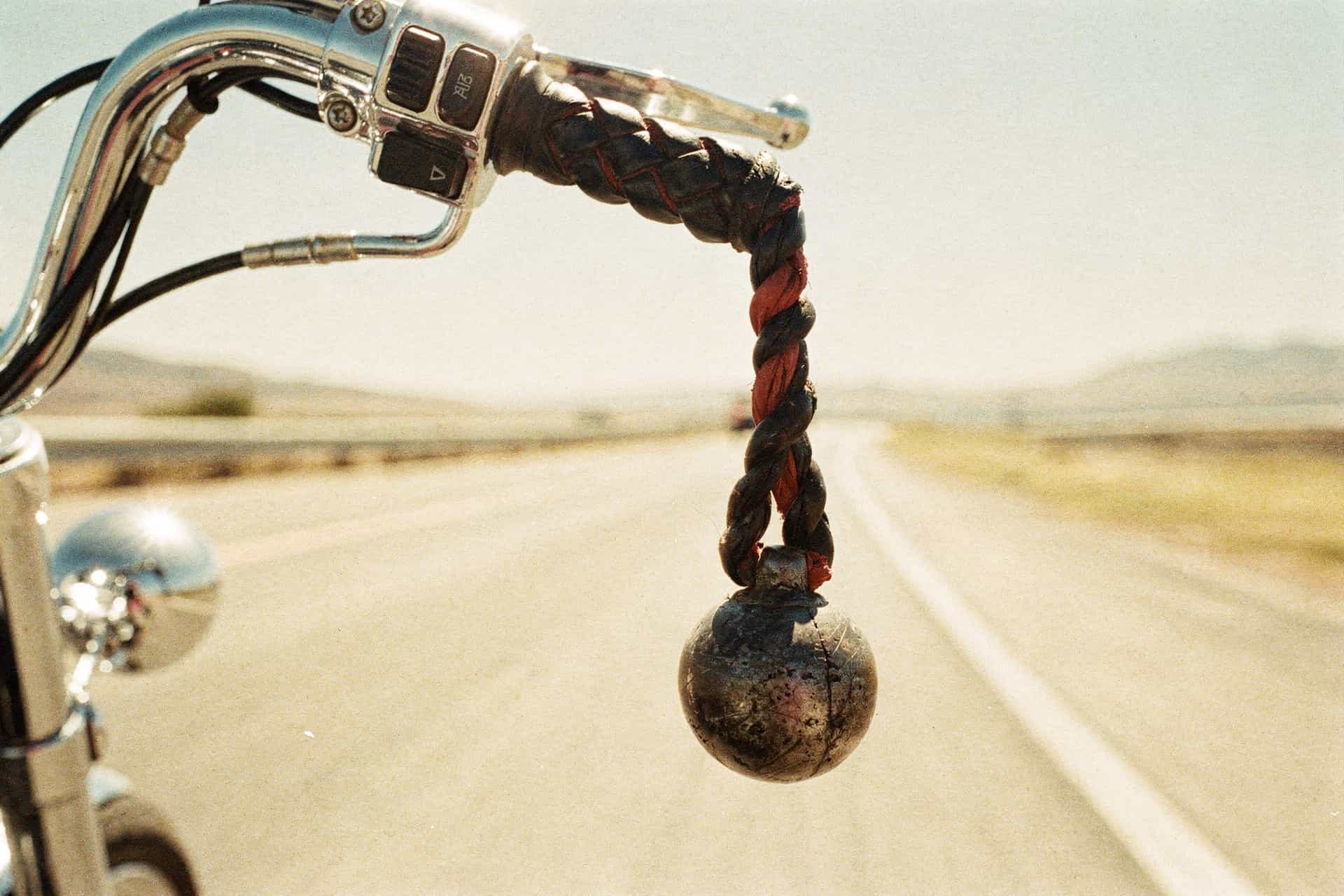
Pull into a bike night almost anywhere in the Southeast or Midwest and you will see them. Thick braided leather or paracord hanging off clutch levers and brake reservoirs, swinging in the wind, slapping fork tubes, trailing behind the bike like a tail. Some are plain black. Others are braided in specific color combinations.
A get-back whip is one of the pieces of biker culture that everyone notices and almost nobody outside the riding world can explain. It looks decorative. It is not only decorative. It also carries genuine legal exposure in some states, of the kind you do not want to learn about during a traffic stop.
Two things about this article are worth saying up front. First, we separate what is documented from what is repeated, because on this topic the gap between them is enormous. Second, nothing here is legal advice. Weapons statutes are state law, they change, and the analysis turns on details of your specific whip and how you carry it.
What Exactly Is a Get-Back Whip?
A get-back whip, also written getback whip, is a braided leather or paracord cord, commonly 24 to 48 inches long, attached to the clutch lever or brake lever of a motorcycle. It hangs from the lever and swings freely while riding.
Most have a weighted element at the business end: a metal ball, a heavy knot, a steel clip, or a small weight worked into the braid. That weight is the functional difference between a get-back whip and a decorative lanyard, and it is the detail that shows up in the weapons provisions covered further down.
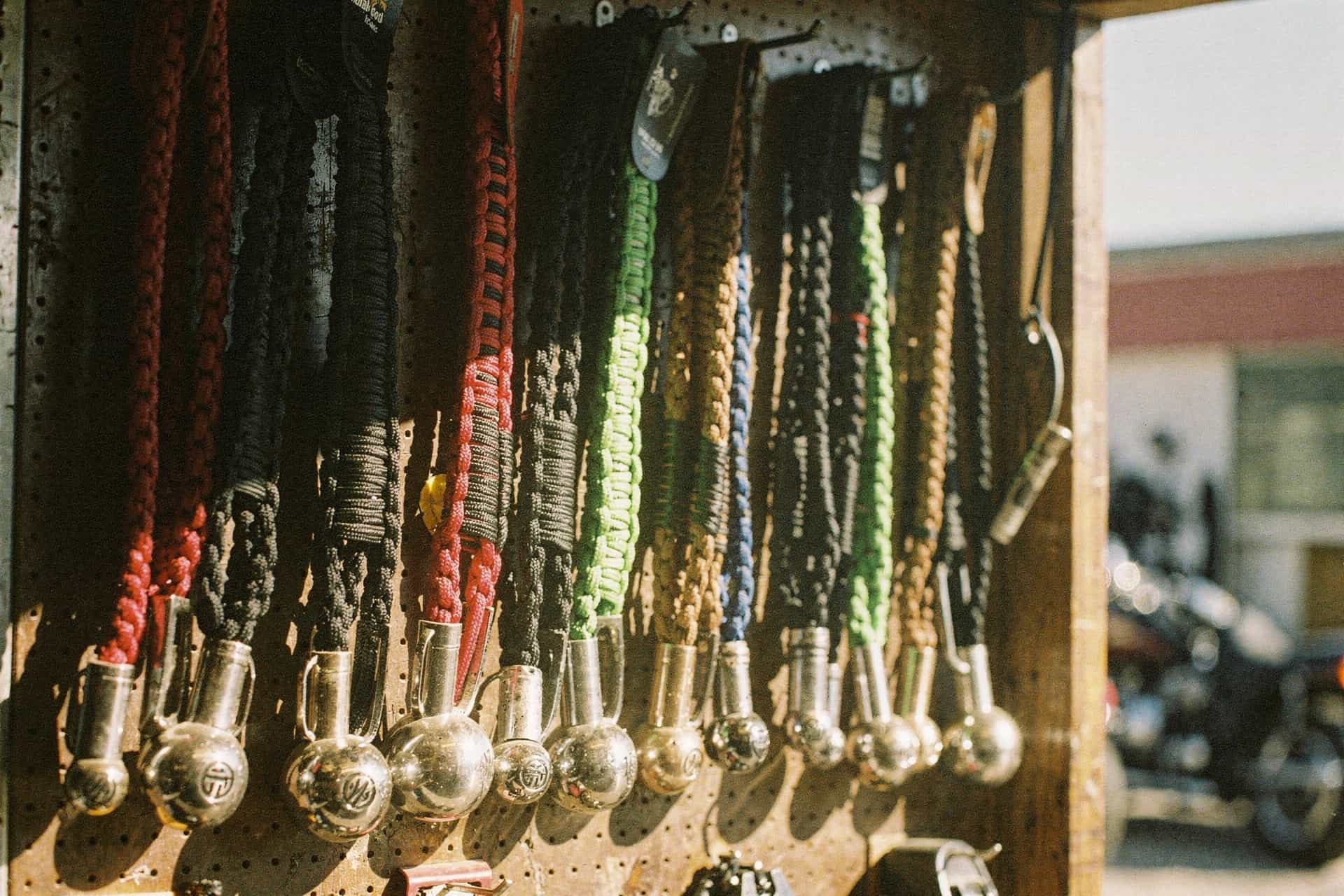
Traditional whips are hand-braided from leather lace in a round or flat pattern. Modern versions often use paracord, which is lighter, cheaper, and available in any color combination. Quality varies enormously, from hand-braided leather work to mass-produced imports that come apart in the first hard rain.
The History: What Is Documented, and What Is Not
The standard story is that get-back whips came out of outlaw motorcycle club culture in the 1970s and 1980s, braided in club colors to serve as a visible affiliation marker at speed and as a weapon available in a hurry.
We went looking for the source of that story and did not find one. What exists instead is a set of retrospective explanations that conflict with each other:
- Self-defense. The whip could be pulled free and used to strike a threat, which is where the name comes from. This is the most commonly given explanation.
- Dog whip. Some accounts trace the practice to keeping aggressive dogs off at low speed, under the name dog whip.
- Signaling. Another version holds that before turn signals were standard equipment, a flick of the whip told a following driver what the rider intended.
- Tailgaters. A related account says the name refers to warning off a vehicle following too closely, or someone approaching during a roadside stop.
- Club identification. The color-coding explanation, where whips braided in a club’s colors read as affiliation from a passing vehicle when a back patch cannot.
Every one of those appears in modern web writing, retailer copy, and enthusiast articles. None of them appears in a contemporaneous 1970s or 1980s source we could locate, and the sources that repeat them do not cite anything either. The honest position is that the origin is oral tradition. It may well be accurate. It is not documented.
Contrast that with the parts of this topic that are documented: the statutes, the enforcement actions, and the charging theories. Those exist on paper with dates on them, and they are covered below.
Motorcycle culture is full of practices in this category, where the meaning is real to the people who carry it and the paper trail is thin. The guardian bell tradition works the same way, and so does most of what people believe about club insignia, which our outlaw MC patch meanings guide covers in detail.
Attachment Methods and Why They Matter
The whip fastens to the clutch lever, or less commonly the brake lever, and drapes down that side of the bike. Three methods dominate.
Quick-release clip. A heavy snap clip or carabiner around the lever. The most common setup, because the whip comes free with one hand in about a second.
Loop and knot. A fixed loop over the end of the lever, cinched down. More secure than a clip and slower to remove.
Lever wrap. The top of the whip woven directly around the lever. Clean-looking, and effectively impossible to remove quickly.
This is not only a style question. Under the California section covered below, the enforcing agency singled out quick detachment as part of why it treated a weighted whip as a prohibited weapon, and it named a whip permanently attached to the motorcycle as the exception. Whether detachability carries that weight anywhere else depends on the wording of that state’s provision and on how it is read there, which is a question for the statute and for a lawyer in that state rather than for this page.
What the Colors Do and Do Not Tell You
Here is where most articles about get-back whips go wrong, including the earlier version of this one.
The colors of the major clubs are documented. Red and white, black and white, red and gold, green and red: those schemes are established, photographed, registered as marks, and described in court exhibits. You can look them up, and our profiles of the Outlaws, the Bandidos, the Vagos, and the Pagans go through them.
What is not documented is a rule that a whip in those colors signals membership. No club has published one. There is no cross-club standard, and there is no reason to expect a convention in one region or decade to hold in another. The tidy color-to-club table that circulates online is somebody’s inference presented as a code.
That does not make the practical advice wrong, and the practical advice is simple. In areas with an established club presence, a color combination closely matching a local club’s colors can draw attention that an unaffiliated rider does not want, whether or not any formal rule exists. Solid black is the option that matches nothing. If you are unsure about a combination in your area, ask someone who has ridden there far longer than you have. This is one of the situations where the cost of asking is zero and the cost of guessing is not.
The Legal Picture: How the Analysis Actually Works
This section is the reason most people find this page. Read it rather than skimming it, and then go read your own state’s code.
None of the statutes below names get-back whips. Not the California section, not the New York section, not the Texas provisions. That is why the discussion here runs through general weapons language rather than a whip-specific rule, and it is also why the analysis can change the moment you cross a state line.
The theory is the slungshot. A slungshot is classically defined as a weight fastened to a strap or cord and used as a striking weapon. Statutes written a century or more ago to cover slungshots, billies, blackjacks, saps, and sandclubs are broad enough that a weighted, detachable whip can be argued into them. That is the charging theory described in the California attorney commentary in our sources, and it is the one the California enforcement below rests on.
In the one public enforcement statement we can quote, two details did the work. The Hollister Police Department pointed to the weight and to quick detachment when it explained why it treated whips as prohibited under the California section. That is one agency describing one statute in one city. Elsewhere, the wording of the local provision and how it is read there is what will matter, and we have no basis for telling you in advance how that comes out.
California
Penal Code section 22210 makes it an offense to manufacture, import, keep for sale, offer or expose for sale, give, lend, or possess “any leaded cane, or any instrument or weapon of the kind commonly known as a billy, blackjack, sandbag, sandclub, sap, or slungshot.” The offense carries up to a year in county jail or a term under the felony sentencing provision.
California is also where we found the clearest public enforcement material. Defense-attorney commentary describes riders being charged under section 22210 over whips at traffic stops, and we are citing that as secondary rather than as a count of cases. The concrete item is the Hollister Police Department report on the July 3 and 4, 2026 rally weekend: officers confiscated ten whips and completed ten investigations involving section 22210, three on July 3 and seven on July 4, and the department stated that while some people view these items as accessories, they are designed to be quickly detached and used as an impact weapon, and that unless the whip is permanently attached to the motorcycle a weighted one qualifies as a prohibited slungshot under that section.
That is an agency stating its position in public, in a specific city, on a specific date. It is the single most useful data point in this entire article, and it applies to Hollister, California, in 2026. It is not a national rule and it is not a court ruling.
New York
Penal Law section 265.01, criminal possession of a weapon in the fourth degree, lists among prohibited items a “billy, blackjack, bludgeon, plastic knuckles, metal knuckles, chuka stick, sand bag, sandclub, wrist-brace type slingshot or slungshot, shuriken, or throwing star.” A weighted whip with a solid end can be argued into that list. We are not going to tell you how New York courts have applied it to a braided whip, because we did not find a decision addressing one. The statutory text is what we can put in front of you; the application is a question for a New York lawyer.
Texas, and why the internet is out of date
Nearly every article about get-back whips says Texas allows them up to 12 inches. That figure has no statutory basis we could find, and the underlying Texas law changed years ago.
House Bill 446, passed by the 86th Legislature and effective September 1, 2019, amended the Penal Code to remove “or club” from the unlawful carrying provision and struck knuckles from the prohibited weapons list. Club is still a defined term in the Penal Code, described as an instrument specially designed, made, or adapted to inflict serious bodily injury or death by striking, with blackjack, nightstick, mace, and tomahawk as the listed examples. Location restrictions in the Penal Code still apply.
The point of including Texas is not that Texas is now safe. It is that a state legislature rewrote the relevant list in a single session, so anything written before that date is describing a list that no longer exists. That is the normal condition of this topic.
What we removed and why
The earlier version of this page listed roughly a dozen states as banning or restricting get-back whips, sourced to secondary summaries. We took that list out. Several of those entries could not be traced to statutory text, the entries that could be traced were often paraphrased inaccurately, and a list like that ages badly in exactly the way the Texas example shows. A short, accurate, sourced set of examples plus a clear explanation of the mechanism is more useful than a long list that gives false confidence.
The part that is genuinely advice
Read the current text of your own state’s weapons statute, not a summary of it. If a whip matters to you, ask a criminal defense attorney licensed in your state, because that is a question about your specific facts. And understand that officer discretion carries real weight in how any of these encounters go, regardless of what the statute says on paper.
Mechanical Safety, Separately From Legal Risk
The legal question is not the only one. A whip is a loose object hanging near your front wheel and your controls.
Position it so it cannot reach the front wheel or spokes, and so it cannot interfere with clutch or brake operation at full lever travel. Check the attachment before every ride, because a whip that separates at highway speed becomes debris for whoever is behind you. Choose a length that cannot touch the road, wheel, controls, or rider through the full range of steering and suspension movement.
We have not found crash data on get-back whips specifically, and we are not going to invent a statistic. The mechanical concerns above are the ordinary ones that apply to any loose item mounted near a moving wheel.
Making or Buying One
If you have checked your local law and want one, there are two routes.
Buying. These are sold by rally vendors, leather shops, and online sellers. Look for tight, consistent braiding, sound material, and a secure attachment, then check whether the length and weighted end create mechanical or legal risk.
Making your own. Braiding one is a straightforward leather or paracord project, usually a round four-strand braid. You need lace or cord, an attachment, and patience. Building your own lets you control color, length, and whether there is any weight at all, and that last decision is the one with legal consequences.
What You Are Actually Carrying
The get-back whip sits in an awkward space. It is an identity marker, a decoration, an object the folklore around it describes as a weapon, and in the wrong jurisdiction a criminal charge, and which of those it is depends entirely on context.
That layering is normal in motorcycle culture. Patches, colors, hand signals, riding formations all mean different things in different places, and all of them are described online with far more certainty than the evidence supports. Our complete guide to motorcycle clubs covers the club structures behind most of that, and our motorcycle culture guide covers how these symbols travelled into the broader riding world.
If you ride with a whip, know what your state’s statute actually says, know what your colors might read as locally, and keep the thing away from your front wheel. That is the whole of the honest advice.
For riders who want the culture without the legal gray area, our patches and merch and riding tees are built around biker and bobber themes. They are apparel rather than protective gear, they do not imitate any club’s insignia, and we are not an MC.
Sources
- California Penal Code section 22210, California Legislative Information. Primary statutory text listing the billy, blackjack, sandbag, sandclub, sap, and slungshot, and the applicable penalty.
- New York Penal Law section 265.01, New York State Senate. Primary statutory text for criminal possession of a weapon in the fourth degree and the prohibited items list.
- Texas House Bill 446, 86th Legislature, enrolled text. Primary source for the September 1, 2019 removal of clubs from the unlawful-carry provision and knuckles from the prohibited weapons list.
- Hollister Police Department rally enforcement report, July 2026, via Crime Voice. Agency statement on the July 3 and 4 rally weekend: ten whips confiscated and ten Penal Code 22210 investigations completed, three on July 3 and seven on July 4, plus the permanently-attached exception.
- Are Get Back Whips Legal? Motorcycle Legal Foundation. Attorney-authored secondary analysis of the slungshot charging theory. Used for the mechanism, not for state-by-state conclusions.
- The Getback Whip Issue Revisited, Biker Law Blog. California attorney commentary on charging practice and case outcomes, cited as secondary.