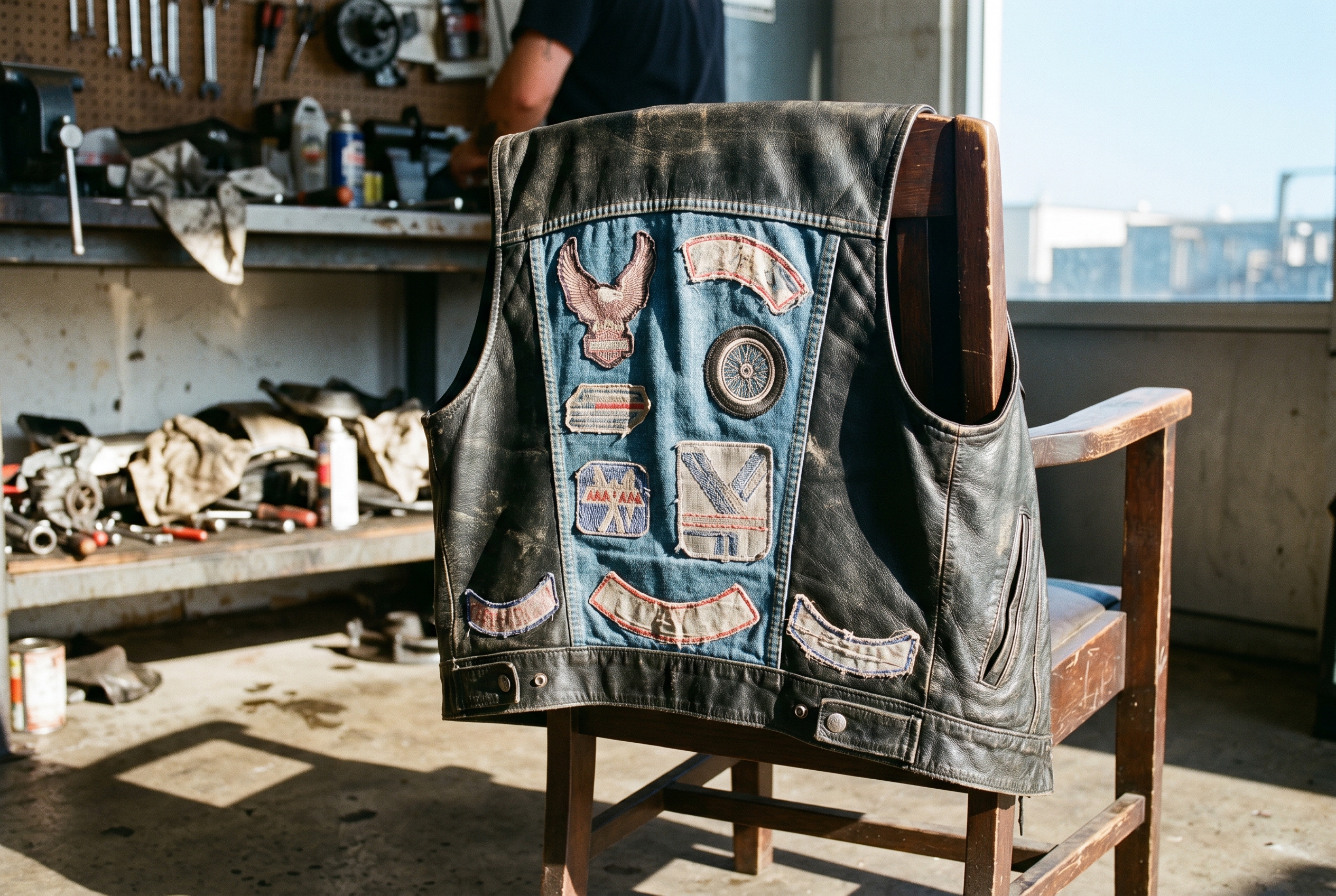
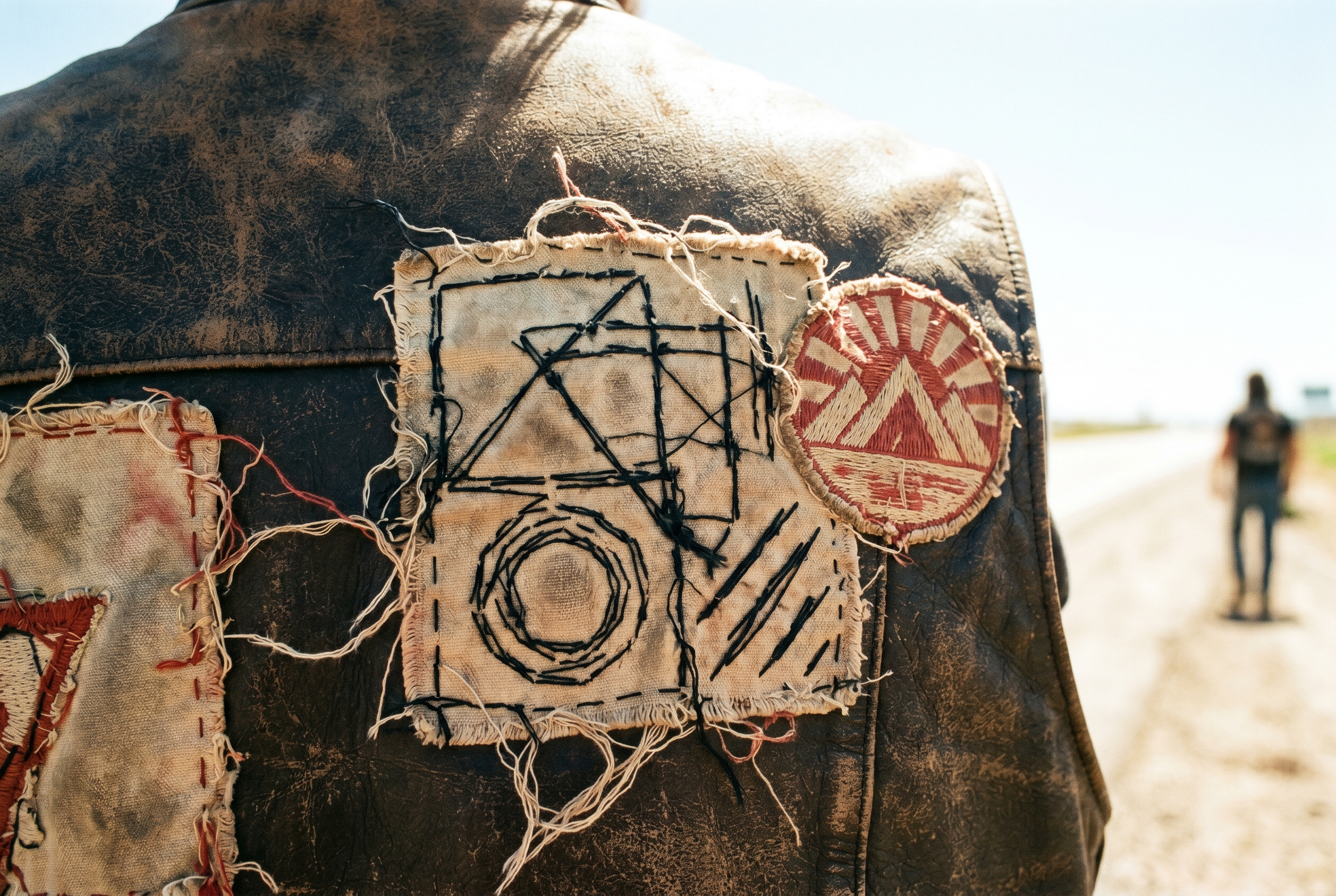
A leather cut covered in patches looks like decoration to an outsider. Inside the outlaw motorcycle world, most of it means something specific. The problem for anyone trying to read a vest from across a parking lot is that almost none of it means the same thing twice.
Center patches are the closest thing to an exception. The emblems themselves are photographed often, and some appear in trademark records or court filings, so what a patch depicts is usually checkable. Where the record thins out fast is the story behind the design. Most of the origin accounts you will read, including several that sat on this page in its earlier form, trace back to other websites rather than to a club document, a court exhibit, or anything written at the time. Everything smaller than the center patch is thinner still. Numbers, side patches, color codes, and rocker rules are set by each club internally, they change, and they differ between charters and countries. The glossaries circulating online flatten all of that into a single list of “meanings” with no sources behind it.
This article covers what the major center patches depict, how far the design stories can actually be followed, and which of the commonly repeated meanings hold up. If you want the mechanics of how patches are arranged on a vest, the rocker system, and the difference between an MC and an RC, our biker patches meaning guide covers that ground instead.
Read This Before You Read Any Patch
Three rules do most of the work here.
A club’s rules are that club’s rules. There is no governing body that standardizes patch meaning across the outlaw motorcycle world. Each organization writes its own bylaws about who wears what and why. Academic work on these clubs, including Thomas Barker’s survey of the field, describes internal rule sets that differ organization to organization rather than one shared code.
Meanings drift with time and geography. A patch convention from a 1970s American charter is not evidence about a 2020s European charter of the same club. When you see a confident claim about a small patch with no date and no place attached to it, that is a signal the claim has not been checked.
A reference site is not a record. Most of the confident patch histories online trace back to other websites, which trace back to still others. When we say below that something is unverified, that is what we mean: we followed the chain and it never reached a club document, a court exhibit, or a source written at the time.
Hells Angels: The Winged Death Head
The Hells Angels Motorcycle Club center patch is a skull in profile with a swept wing behind it, in red, white, and black. Members and outsiders both call it the death head.
The account you will find almost everywhere credits the official death head design to Frank Sadilek, a past president of the San Francisco charter, and says the colors and shape of an earlier pre-1953 emblem were taken from the insignia of the 85th Fighter Squadron and the 552nd Medium Bomber Squadron. We could not follow that account back to a club publication, a court record, or anything written at the time. It circulates through reference sites that reproduce each other, so we are flagging it as unverified rather than repeating it as design history. The extra detail that circulates alongside it, that Sadilek bought design rights from a former Army Air Forces pilot, has even less behind it, and we have removed it from this page rather than pass it along.
What one firsthand source does support is the general pull of military imagery. Sonny Barger, the long-time public face of the Oakland charter, wrote in his memoir that early members gravitated to that kind of imagery because many of them had served. That is one member’s recollection about one club in one era, which is exactly how it should be read.
The corporation that holds the club’s marks has registered the death head image and the club name with the United States Patent and Trademark Office, and those filings are searchable in the public register. Trademark enforcement against unauthorized merchandise is the most heavily documented part of the club’s relationship with its own emblem.
A common search question concerns photographs showing the death head facing in different directions on different cuts. Which direction means what, and whether it means anything beyond charter convention, is not something we found published in a source we can put in front of you. Treat confident explanations online as unverified.
Outlaws MC: Charlie, the Skull and Pistons
The Outlaws Motorcycle Club center patch is a skull set against crossed pistons, in black, white, and red. Members call the skull Charlie.
The most repeated origin story is that the design came from the 1953 Marlon Brando film The Wild One, where a similar skull and pistons appears on a jacket. This is the clearest example on this page of folklore hardening into “fact” through repetition. The emblem exists and the film exists. A causal link between them is asserted constantly and demonstrated nowhere we could find, and every published account of the club’s founding puts it years ahead of the film.
The club’s timeline, including when the emblem took the form it has now, belongs on its own page rather than being half-told here. Our Outlaws MC profile goes through it with the dates attached.
Bandidos MC: The Cartoon Figure
The Bandidos Motorcycle Club center patch does not look like anything else in the outlaw world. Where other clubs use skulls, wings, and mythic figures, the Bandidos use a cartoon: a sombrero-wearing figure holding a machete and a pistol, in red, yellow, and gray.
The frequently repeated claim that the club’s founder drew specifically on the Frito Bandito advertising mascot is retold everywhere and sourced nowhere we can find. The broader observation that the figure draws on bandit imagery from Mexican popular culture is uncontroversial. The specific advertising link is not established, and neither is any account of who drew the emblem or exactly when.
Members call the figure the Fat Mexican. That nickname is widely reported and has also drawn outside criticism. We report it because it is the name in use, not as an endorsement.
The club’s name and emblem appear on the federal trademark register. Note what a trademark filing does and does not prove: it establishes that an entity claimed and registered a mark on a date. It is not evidence of current membership numbers, chapter counts, or territory. Our Bandidos MC profile handles the club history.
Pagans MC: Surtr the Fire Giant
The Pagans Motorcycle Club center patch is usually described as Surtr, the Norse fire giant, seated on the sun and wielding a flaming sword, rendered in red, yellow, and white on black.
Surtr himself is solidly documented in Old Norse literature: the giant who rides out of Muspelheim with a blazing sword at Ragnarok. What is not documented, in anything we can point to, is the club’s reason for choosing him. Every published explanation of the symbolism is an outside interpretation, and the versions that sound most confident are usually the ones furthest from a source.
The small red 16 that appears on some Pagans cuts is the single most searched question that brings riders to this page. The standard explanation is that 16 stands for P, the sixteenth letter of the alphabet, matching the club’s initial. We cannot show you a club document, a court record, or a contemporaneous source confirming that, and the same is true of the other letter-to-number readings that circulate. The explanation is consistent and repeated everywhere. It is also unverified, and that is an honest place to leave it.
Our Pagans MC profile covers the club’s documented history in more depth.
If you want gear that reads as biker culture without imitating any club’s protected imagery, our patches and merch collection is built for exactly that lane.
Mongols MC: The Genghis Profile and the Trademark Case
The Mongols Motorcycle Club center patch shows a Mongol warrior figure in profile, in the club’s black and white.
The Mongols emblem is the most legally tested patch in the country, and the case is routinely described wrong, including in the earlier version of this article. Here is the accurate sequence.
A federal jury convicted Mongol Nation on RICO counts and found various club property forfeitable, including its collective membership marks. Months after the verdict, in 2019, the district judge declined to order forfeiture of the marks, reasoning that stripping them would collide with the First Amendment rights of members to display them and would amount to an excessive fine under the Eighth Amendment. Both sides appealed. In January 2023, the Ninth Circuit affirmed the denial of forfeiture, but on a narrower and purely statutory ground: RICO’s forfeiture provision lets the government seize property, not extinguish it, and the government had effectively asked the court to destroy the club’s exclusive rights without ever taking title. The panel explicitly did not resolve the broader trademark questions.
The practical result is the same, the club kept its marks, but the reasoning matters. The 2023 decision is not a constitutional ruling about patches. Anyone citing it as one is citing the 2019 district court order and mislabeling it.
Our Mongols MC profile covers the club’s history.
Vagos MC: The Hooded Rider
The Vagos Motorcycle Club, nicknamed Green Nation, uses a green and red patch showing a hooded figure on a motorcycle. Many published descriptions identify the figure as Loki, the Norse trickster. The club has not consistently confirmed that reading, and the identification should be treated as an outside interpretation rather than a club statement.
The green is what outsiders notice first, because green is unusual in a world where black, white, red, and silver dominate. Founding detail and design history belong on the club’s own page, and our Vagos MC profile goes deeper.
Warlocks MC: Two Clubs, Two Birds
Two separate motorcycle clubs use the Warlocks name, and they wear different center patches. One, associated with Florida, uses a bird of prey usually described as a Phoenix or Warbird, in orange, crimson, and gold on black. The other, associated with Pennsylvania, uses a Harpy Eagle.
For identification purposes the visual difference is the reliable signal, and that is as far as we will take it here. Founding claims, the relationship between the two organizations, and the history of the shared name are exactly the kind of detail that gets repeated confidently online without a record behind it. Our Warlocks MC article handles that history where it belongs.
Nomads: A Rocker, Not a Club
A nomad patch is not a club emblem. The word appears on the bottom rocker of vests from different clubs and is often used for a member who is not attached to a specific chapter geography. The exact status remains club-specific.
Beyond that, the specifics vary by club. Some organizations use the nomad designation for senior members who travel between chapters. Some use it for members whose work or personal circumstances require relocation. The claim that nomads universally hold some elevated enforcement role inside every club is one of the most common pieces of internet lore about outlaw patches, and it is not supportable as a general rule. Our nomad biker gang article explains the structure and where the confusion comes from.
The 1%er Diamond
Published photographs and accounts show members of several clubs above wearing a small diamond patch reading 1%, usually on the front of the cut. It is generally described as identification with one-percenter culture, but any club-specific eligibility or meaning must come from that club.
The category traces to the aftermath of the 1947 Hollister rally and a statement widely attributed to the American Motorcyclist Association about 99 percent of motorcyclists being law-abiding. The attribution is disputed, and we have not found a contemporaneous record of anyone at the association saying it. The full origin story, including what is and is not documented about Hollister, is in our 1 percenter biker guide.
What the diamond means inside any particular club, how it is granted, and what happens to someone wearing one without standing are internal matters. They are asserted with enormous confidence online and published by nobody, and they would differ by club and by decade even if they were. We are not going to pretend to a precision that does not exist.
Symbols Riders Ask About That We Cannot Verify
These are the searches that bring people to this page most often. Each has a confident answer somewhere online. None of them has a source we can put in front of you.
| Symbol asked about | Status |
|---|---|
| 666 on Bandidos or Outlaws cuts | Multiple incompatible explanations circulate. No club document or court record we can find defines it. |
| Filthy Few, war patch, and similar side patches | Discussed in press and memoir accounts, usually secondhand. Meanings asserted online are not confirmed by any club or court record. |
| Mongols wing patches and side-patch letter codes | Widely listed in online glossaries with no cited source. |
| Bandidos TCB and Desperado patches | Reported in enthusiast writing only. |
| Property of patches | The garment style is documented in press coverage and academic writing. The specific internal rules attached to it differ by club and era. |
| 13, 81, 16 and similar numbers | The letter-to-number readings appear in every glossary online and in no club document or court record we could find. |
If that table feels unsatisfying next to a site that will confidently tell you what every patch means, that is the point. The unsatisfying version is the accurate one.
Color Schemes Used for Identification
Published descriptions of the major clubs converge on distinct color schemes, which is what makes identification at a distance possible in the first place.
| Club | Commonly published colors |
|---|---|
| Hells Angels | Red and white on black |
| Outlaws | Black, white, red |
| Bandidos | Red and yellow on black |
| Pagans | Red, yellow, white on black |
| Mongols | Black and white |
| Vagos | Green and red |
| Warlocks (Florida) | Orange, crimson red, gold on black |
One caveat, and it matters. This table describes how these emblems are commonly published and photographed. It is not a rule set, nobody enforces it on paper, and nothing in it tells you what any club does about another club adopting a similar scheme. Claims about enforcement need club-specific evidence.
Why the Trademarks Are the Best-Documented Part
The intellectual property fights leave records, which is why the legal side of patches is far better evidenced than the symbolic side. Registrations are searchable. Complaints and opinions are filed. The Mongols case ran through a jury verdict, a district court forfeiture ruling, and a federal appellate opinion, all publicly available.
The documented pressure on anyone selling or reproducing a club’s emblem is the civil one: a trademark claim from the entity that holds the mark, filed in a court that publishes its docket. That is the part with a paper trail, and it is the part we can point you to.
This is the practical argument for generic biker apparel over imitation. Our t-shirts and hoodies are built around bobber and biker culture themes and do not copy any club’s protected imagery. We are not an MC and we do not claim any affiliation with one.
How to Check a Patch Claim Yourself
Use the same test we used to rewrite this page.
- Ask what kind of claim it is. A design description, a founding date, and an internal rule are three different things with three different evidence standards. Design and dates are checkable. Internal rules usually are not.
- Ask for a date and a place. A patch convention without a decade and a country attached to it is not a fact about anything.
- Follow the citation until it stops. Most patch histories bottom out in another website. If a club publication or a court record is genuinely at the end of the chain, label which one it is instead of neutralizing it into “it is known that.”
- Prefer records that were created for another purpose. Trademark filings, indictments, and court opinions were not written to explain patch symbolism, which is exactly why the details they contain are more reliable than a glossary written to explain patch symbolism.
- Accept an open question. Most of the small-patch lore is unresolved. Saying so costs nothing and is more useful than a confident wrong answer.
Reading vests is part of being literate in motorcycle culture, the same way reading squadron patches is part of military culture. Being literate also means knowing where the record stops. For placement conventions, rocker formats, and their evidentiary limits, head to our biker patches meaning guide, and the motorcycle clubs complete guide is the cluster pillar tying the MC content together. If you are more interested in how these symbols travelled into film, music, and rally culture, our motorcycle culture guide picks up there.
Sources
- United States v. Mongol Nation, No. 19-50176 (9th Cir., January 6, 2023). Federal appellate opinion affirming the denial of forfeiture of the club’s collective membership marks on statutory RICO grounds. Supports the corrected account of the trademark case.
- Order on forfeiture, United States v. Mongol Nation (C.D. Cal., 2019). The district court order that declined to forfeit the marks. Supports the distinction between the 2019 First and Eighth Amendment reasoning and the 2023 appellate reasoning.
- Ninth Circuit sides with Mongol Nation on the trademark, Courthouse News Service. Contemporaneous reporting on the 2023 decision and the grounds the panel used.
- USPTO Trademark Status and Document Retrieval. Public register used to check registered marks and filing dates for club emblems and names.
- US Department of Justice archived outlaw motorcycle gangs profile. Government classification of the major clubs. Archived material, so its counts and status descriptions are historical rather than current.
- Hells Angels insignia summary, LiquiSearch. A third-party reference compilation. It is not a club publication and not a primary record, and it is cited here only as an example of where the Sadilek and squadron-insignia account circulates, which is the claim we flag above as unverified.
- Barger, Sonny. Hell’s Angel: The Life and Times of Sonny Barger and the Hell’s Angels Motorcycle Club. William Morrow, 2000. Firsthand Hells Angels account of early emblem choices, valid for that club only.
- Barker, Thomas. Biker Gangs and Transnational Organized Crime. Routledge, 2nd edition, 2014. Academic survey supporting the point that club rule sets are organization-specific rather than shared.
- Thompson, Hunter S. Hell’s Angels: The Strange and Terrible Saga of the Outlaw Motorcycle Gangs. Random House, 1967. Contemporaneous embedded reporting on 1960s iconography.