The Gypsy Jokers Motorcycle Club is a documented one-percenter outlaw motorcycle club founded in California in 1956, with documented operations across the Pacific Northwest and Australia.
| Field | Documented detail |
|---|---|
| Founded | April 1, 1956, California (most sources cite San Francisco; some accounts cite San Bernardino) |
| Center patch | Grinning jester, three-piece back patch with 1%er diamond |
| Documented presence | Pacific Northwest US (Oregon concentration), Western Australia (Perth) |
| Federal classification | Outlaw motorcycle gang per US and Australian authorities |
| Notable historical context | Founded in the same post-war Bay Area wave that produced the Hells Angels and the Boozefighters |
Bobber Brothers is a riding brand, not a motorcycle club. What follows is documented history drawn from court records, news reporting, and published sources. For broader cluster context, our motorcycle clubs complete guide is the cluster reference.
Born in San Francisco, April 1956
The Gypsy Jokers Motorcycle Club was founded on April 1, 1956, in California - most sources cite San Francisco, though some accounts place the founding in San Bernardino. That date and location put them squarely in the first generation of outlaw motorcycle clubs - the wave that formed in the decade after World War II when surplus military bikes were cheap and the men riding them had little patience for the American Motorcyclist Association’s version of proper behavior.
San Francisco in 1956 was already a magnet for people operating outside mainstream American life. The Beat Generation was gathering steam in North Beach. The waterfront was still rough, still working-class. The roads running out of the city - north across the Golden Gate, south down the Peninsula toward the redwoods, east toward the Central Valley - were some of the finest riding roads on the West Coast.
The Gypsy Jokers formed alongside a dozen other Bay Area clubs during this period. The Hells Angels had organized in Southern California in 1948 and were expanding north. The Boozefighters had already cemented the post-war outlaw image at Hollister in 1947. San Francisco was ground zero for an explosion of MC culture, and the Gypsy Jokers were part of that first blast.
They adopted the one-percenter diamond and a three-piece back patch featuring a grinning jester - the emblem that still identifies the club today. For a time, according to multiple published accounts, the Gypsy Jokers were considered the second most powerful outlaw motorcycle club in California, behind only the Hells Angels.
That ranking would not last. California was getting crowded with clubs, and one organization was consolidating territory faster and more aggressively than anyone else.
Pushed North: The Hells Angels and the End of the Bay Area Chapter
The Hells Angels’ expansion across Northern California in the 1960s squeezed smaller clubs hard. Some folded. Some merged into the HA. The Gypsy Jokers chose a third option - they moved.
By 1967, the Gypsy Jokers had relocated their center of gravity to the Pacific Northwest, specifically to Oregon and Washington. The mother chapter established itself in Lincoln City, Oregon, a small coastal town about ninety miles southwest of Portland. Additional chapters formed in Portland, Salem, and along the Oregon coast.
This was not a retreat in the way outsiders might understand it. The Pacific Northwest was open territory - no dominant one-percenter club had staked a claim. Oregon and Washington had the same raw ingredients that had produced California’s MC culture: blue-collar towns, logging roads, industrial workers with mechanical skills, and a deep cultural streak of independence. The difference was room to breathe.
The relocation transformed the Gypsy Jokers from a California club competing for scraps of territory into the dominant outlaw MC in a region that fit their personality. Portland, with its timber-and-shipping working class, its rain-soaked highways, and its general attitude of leaving people alone, became home in a way San Francisco never fully was.
Portland: The Permanent Home
Portland and the Gypsy Jokers have been connected for over half a century now. The club’s presence in Southeast Portland became part of the neighborhood fabric - one of those things longtime residents simply grew up knowing about.
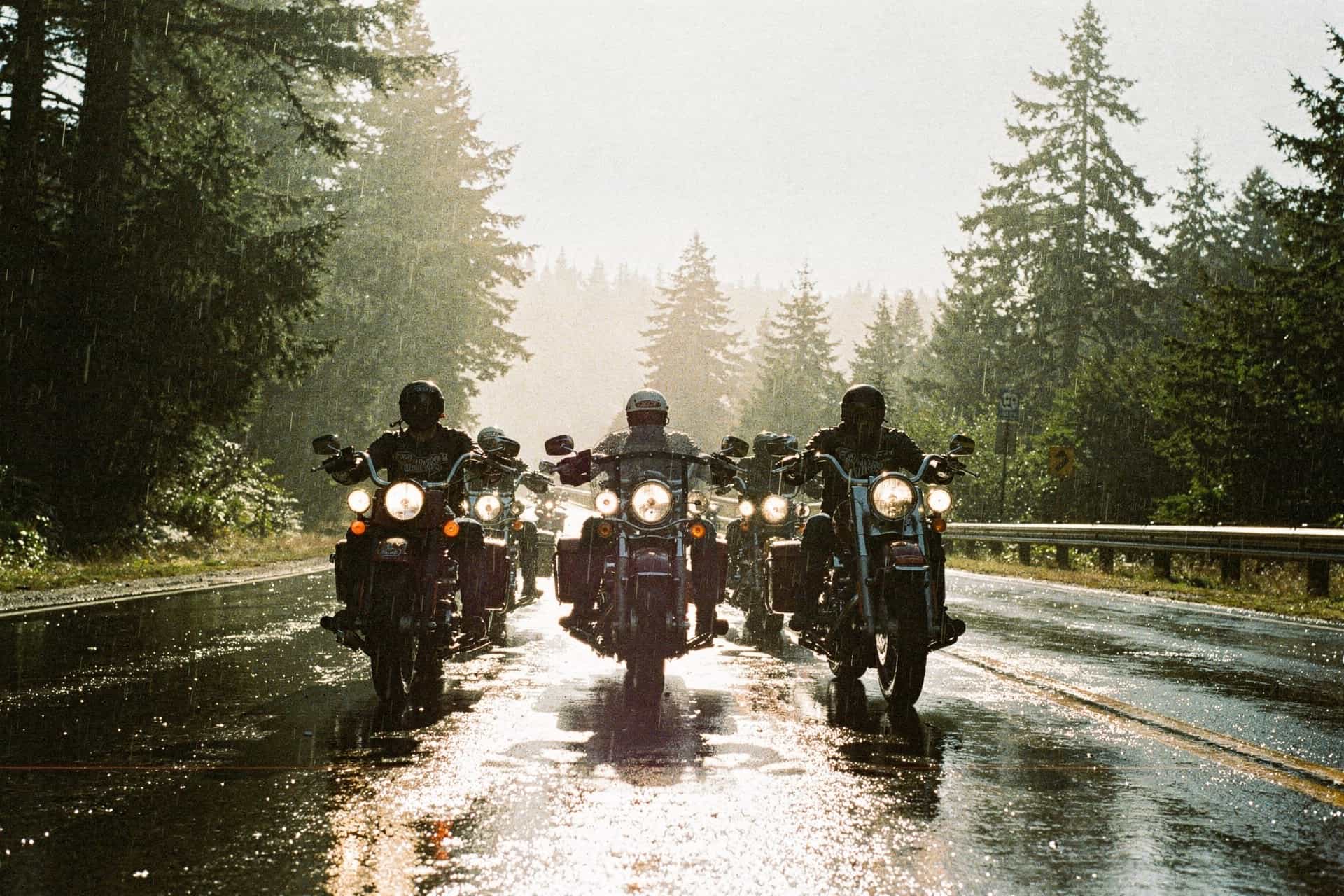
The Pacific Northwest riding environment shaped the club as much as the club shaped the local scene. Oregon is not a sunshine state. The riding season gets cut short by rain in the fall and does not reliably return until late spring. The roads through the Coast Range are narrow, wet, and winding. The Columbia River Gorge funnels wind through the canyon hard enough to push a loaded touring bike sideways. We have ridden that stretch of I-84 east of Portland, and it is no joke - the kind of road that separates people who ride for Instagram from people who ride because they cannot stop.
That environment produces a particular kind of rider. Someone who does not need perfect weather. Someone who owns rain gear that actually works. Someone whose commitment to riding is not conditional on comfort. That mentality runs through the Gypsy Jokers’ Pacific Northwest identity like a thread through canvas.
Chapters in Portland, Salem, and the coast meant the club controlled a significant geographic footprint. The distances between Oregon cities are real - Portland to Salem is fifty miles, Salem to Lincoln City is another sixty through the Coast Range. Maintaining cohesion across that territory required the kind of organizational discipline that defines successful motorcycle clubs.
Club Structure and Protocols
The Gypsy Jokers MC operates under the traditional one-percenter club structure that has been standard across outlaw motorcycle organizations since the 1960s. National president, regional officers, chapter-level leadership with a president, vice president, sergeant-at-arms, secretary, and treasurer.
Prospecting - the mandatory trial period before a rider earns a full patch - is central to the Gypsy Jokers’ process. Like other one-percenter clubs, prospecting is designed to test commitment, loyalty, and the willingness to prioritize the club above personal convenience. The length and intensity vary, but the function is the same across the outlaw MC world: make sure the man wearing the patch earned it with more than a membership fee.
The club’s colors display the grinning jester on a three-piece back patch. Top rocker with the club name, center patch with the jester, bottom rocker with the chapter’s territory. Those colors are not decorative. In Gypsy Joker territory, they represent a claim - on the road, on the region, on the right to operate as a recognized outlaw motorcycle club. The protocols around who wears what, where, and when follow the same traditions that govern the broader MC world.
Australia: A Second Continent
The Gypsy Jokers’ expansion to Australia represents one of the most significant chapters in the club’s history and one of the more remarkable stories in international MC culture.
The Australian chapter was founded in November 1969 by former members of St Mary’s Motorcycle Club. Sydney became the first Australian chapter. From that starting point, the club spread across the continent - establishing a particularly strong presence in Western Australia and South Australia. Perth became one of the club’s most important strongholds outside the United States.
The Australian expansion happened during a period when several American one-percenter clubs were establishing chapters on the continent. The Hells Angels, the Bandidos, and the Comanchero all built Australian presences during the 1970s and 1980s. Australia’s outlaw MC scene grew rapidly, and the concentration of major clubs in a country with a much smaller population than the United States produced intense competition for territory and influence.
The Australian Gypsy Jokers operate as a fully independent entity with their own national structure while maintaining ties to the American mother club. They developed their own identity shaped by the Australian landscape - the long, flat highways of Western Australia, the coastal roads, and a social environment that has its own relationship with authority and rebellion.
New Zealand also saw Gypsy Joker chapters established during this expansion period, making the club a genuine Southern Hemisphere presence.
The Hells Angels Rivalry: Seven Decades and Counting
The relationship between the Gypsy Jokers and the Hells Angels is one of the longest-running dynamics in the entire outlaw MC world. It goes back to their shared origins in Northern California and has played out across multiple states and two continents.
In California, the HA’s aggressive expansion effectively pushed the Gypsy Jokers out of the Bay Area. This was not a single event but a gradual shift - the Hells Angels grew larger, better organized, and more territorial throughout the 1960s. The Gypsy Jokers read the situation and consolidated in the Pacific Northwest rather than fighting a losing battle.
But the two clubs have coexisted in Oregon for decades. Portland and the surrounding region have seen both organizations operating in the same general territory. According to law enforcement reports and court documents, this coexistence has included periods of documented confrontation, territorial disputes, and open hostility. It has also included long stretches of relative calm. The dynamic is complicated in the way that all territorial relationships between major motorcycle clubs are complicated - built on protocols, mutual recognition, and the understanding that escalation has costs.
The rivalry has also played out in Australia, where both clubs have established chapters and compete for territory and influence. The Australian outlaw MC scene has produced some of the most intense inter-club conflicts in the global motorcycle world, and the Gypsy Jokers-Hells Angels tension has been a recurring feature.
Law Enforcement: United States
The Gypsy Jokers MC has been the subject of sustained law enforcement attention for decades. The club is classified by multiple federal and state agencies as an outlaw motorcycle gang.
In Oregon and Washington, federal and state operations have targeted Gypsy Joker chapters on charges including drug trafficking, weapons violations, assault, and racketeering. The FBI, ATF, and Oregon State Police have all maintained ongoing intelligence operations focused on the club’s Pacific Northwest activities.
The most significant recent federal case involved the conviction of Gypsy Joker members in Portland on kidnapping and murder charges. According to reporting by the Organized Crime and Corruption Reporting Project (OCCRP), members were convicted in connection with violent crimes against individuals, including a former member. A chapter president was sentenced to life in prison for torture and murder, as reported by KGW News in Portland.
These cases follow the pattern seen across the one-percenter world - federal prosecutors using RICO and conspiracy statutes to target club organizations, while the clubs maintain that criminal behavior represents individual choices rather than organizational policy. That tension has defined the legal landscape for outlaw MCs for generations and shows no sign of resolving.
Law Enforcement: Australia
If the American law enforcement response to the Gypsy Jokers has been aggressive, the Australian response has been another level entirely. Australian states have enacted some of the most severe anti-motorcycle-club legislation in the world.
Queensland’s Vicious Lawless Association Disestablishment (VLAD) Act of 2013 specifically targeted outlaw motorcycle clubs with extreme penalties - including mandatory sentences for members who gathered in groups. The VLAD Act was later repealed, but similar legislation appeared across multiple states. Western Australia, where the Gypsy Jokers have their strongest Australian presence, has conducted numerous law enforcement operations targeting the club.
One of the most high-profile cases connected to the club occurred in Perth on September 1, 2001, when retired detective superintendent Don Hancock and his friend Lou Lewis were killed by a car bomb in the suburb of Lathlain. The investigation led to the conviction of Gypsy Joker member Sidney John Reid, who pleaded guilty to wilful murder and received a life sentence. The case became one of the most widely covered criminal cases in Western Australian history.
The breadth of anti-bikie legislation in Australia has affected every outlaw motorcycle club on the continent, not just the Gypsy Jokers. But Perth’s status as a Gypsy Joker stronghold has meant the club has absorbed a disproportionate share of the enforcement pressure in Western Australia.
The Pacific Northwest Scene Beyond the Patch
The Gypsy Jokers are the most prominent outlaw MC in the Pacific Northwest, but the region’s riding culture extends far beyond the one-percenter world. Oregon and Washington support a broad community of riding clubs, veteran organizations, charity riders, and independents who share the highways with the patch holders.
Events like charity poker runs, memorial rides, and regional rallies draw thousands of riders every season. The terrain explains the dedication - the Cascade Range offers mountain passes that test your cold-weather gear and your nerve. The Oregon Coast delivers some of the most dramatic ocean-side riding in North America. The high desert around Bend and Redmond opens up into long, straight highways under an enormous sky. And the Columbia River Gorge, running east from Portland, is one of the great motorcycle roads in the American West.
If you are interested in how other regions developed their own MC cultures, the Chicago biker scene and the Detroit MC landscape show how industrial cities shaped club culture in their own ways. The common thread everywhere is the same: the motorcycle, the road, and the people who cannot imagine life without either.
Seven Decades, Two Continents
The Gypsy Jokers MC is not the Hells Angels. They do not have chapters in fifty countries. They do not dominate magazine covers or documentary series. But they have something that many larger organizations do not: an unbroken connection to the earliest days of the one-percenter movement, maintained across seven decades and two continents.
From a founding day in California in April 1956, through the migration to Portland, through the expansion to Australia and New Zealand, the Gypsy Jokers have persisted. The grinning jester has survived law enforcement operations, rival club pressure, internal upheaval, and the kind of public scrutiny that dissolves organizations without deep roots. The Harley-Davidson V-twins underneath them have changed - from Panheads to Shovelheads to Evolutions to Twin Cams - but the patch has not.
We carry gear for riders who respect the culture and the history behind it. Our patches and merch collection is built for people who understand what symbols mean in this world. And our t-shirts and hoodies are made for people who ride in all weather - because some of us do not have the option of waiting for sunshine.
Disclaimer
We are not an MC, and we do not pretend to be. We are a brand built by riders who respect the culture and the history. The information in this article is drawn from public records, court documents, news reporting, and published sources. We do not endorse or glorify criminal activity. We report documented history.
Sources
- One Percenter Bikers: Gypsy Joker MC - Club history, founding details, and organizational structure
- Viking Bags: Gypsy Joker Motorcycle Club - Club presence, crime involvement, and Australian expansion
- OCCRP: U.S. Convicts Gypsy Joker Outlaws of Kidnapping and Murder - Federal conviction details for Portland-area crimes
- Gypsy Joker Motorcycle Club - Wikipedia - club history and the 2015 Robert Huggins murder case that led to federal racketeering convictions and life sentences
- Alex McRae: The Gypsy Jokers MC - A History of Rebellion and Brotherhood - Historical overview including California origins and Pacific Northwest relocation
- Barker, Thomas. Biker Gangs and Transnational Organized Crime. Routledge, 2nd edition, 2014.
For the broader motorcycle culture - rallies, films, music, and the lifestyle that surrounds riding - see our motorcycle culture guide.