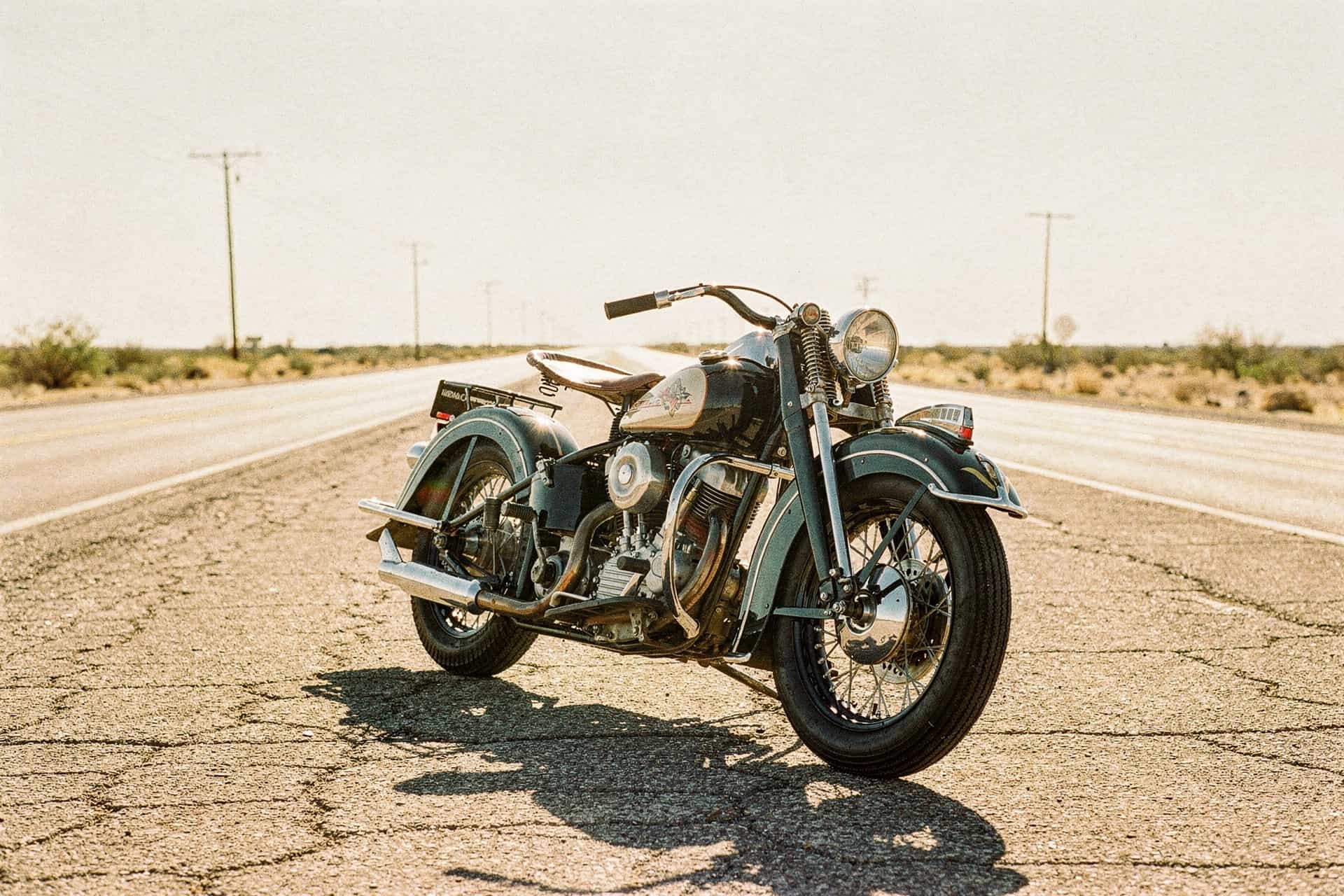
Every Harley built in the 1940s had to answer one of two questions. Before Pearl Harbor and after the war, it was “can this sell to a rider who just wants to go?” In between, it was “can this survive a soldier, a mud hole and a shell crater?” The bikes that came out of that decade carried both answers, and they shaped every Harley you can buy today.
This is our pick of the five 1940s Harley-Davidson bikes that mattered most, plus a year-by-year run through the decade and what to watch for if you are shopping for one.
The Decade in One Table
| Year | What happened |
|---|---|
| 1940 | Lineup of 61 ci EL Knucklehead, 74 and 80 ci U-series flatheads, 45 ci WL and the Servi-Car. Military WLA production begins |
| 1941 | 74 ci FL Knucklehead arrives and replaces the 80 ci flathead Big Twin |
| 1942 | WLA output ramps up after Pearl Harbor. The experimental XA flat-twin is built for the Army |
| 1943-1944 | Civilian production curtailed to War Production Board approved orders |
| 1947 | Last Knucklehead year. Harley buys a second plant on Capitol Drive |
| 1948 | Panhead engine debuts on the old springer front end. The S-125 two-stroke single arrives |
| 1949 | Hydraulic telescopic forks on the Big Twins. The Hydra-Glide is born. WLA production restarts for the Korean War era |
Sources for each line are in the sections below.
1. The WLA: The Harley That Went to War
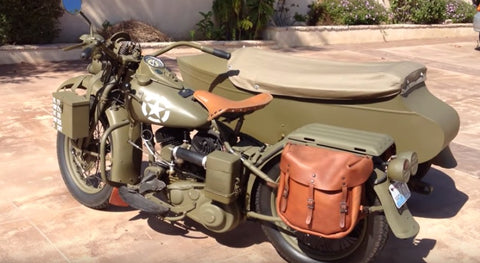
If you only know one 1940s Harley, it is this one. The WLA was a 45 cubic inch flathead V-twin built for the US Army. The “A” stood for Army.
The National Motorcycle Museum’s WLA page lists the numbers: a rated 23.5 hp, a three-speed transmission, 576 pounds dry and about 65 mph flat out. It also says over 88,000 WLAs were built for the war, with some 30,000 sent to the Soviet Union under Lend-Lease, and that Harley built the WLC to a slightly different spec for Canadian forces. Other references give lower totals depending on what they count, so if a seller quotes you a precise production figure, ask where it came from.
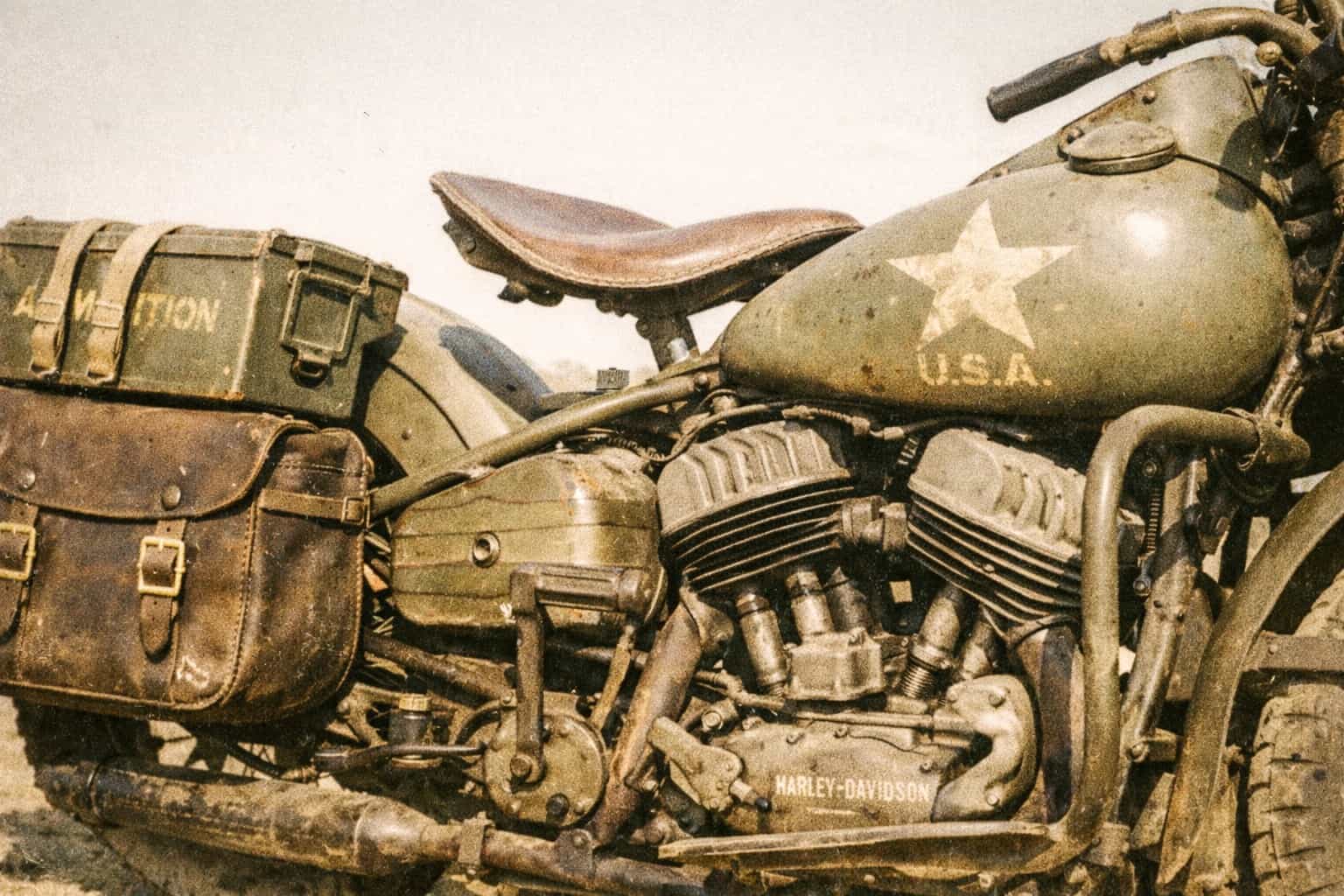
The standard kit tells you what the bike was for: windshield, leg shields, blackout lighting, leather saddlebags, a skid plate, a luggage carrier, crash bars, an ammo box and an oil-bath air cleaner. Soldiers added scabbards for their weapons. The nickname “Liberator” came from the bikes rolling through Europe with Allied troops.
One detail trips up almost every buyer: the museum notes that most WLAs built after Pearl Harbor were serial-numbered as 1942 models no matter when they were actually built. That is why nearly every WLA you see is called a “42 WLA.” The museum also says production restarted in 1949 and ran to 1952 for the Korean War era.
After the war, thousands of surplus WLAs were sold off cheap. Returning GIs stripped the Army gear, cut the fenders and rode them hard. If you want to know where the bobber came from, this is a big part of the answer. Our guide to what a bobber motorcycle is tells that story.
2. The XA: The Shaft-Drive Oddball
The Army also asked Harley for something that looked nothing like a Harley. The result was the XA, a side-valve flat-twin with shaft drive, modeled on the flathead BMW R71 that German forces used. According to Wikipedia’s XA article, it made about 23 hp from 45 cubic inches, ran a four-speed foot-shift gearbox and reportedly kept its oil about 100 degrees Fahrenheit cooler than a standard Harley 45.
Only about 1,000 were built for evaluation. By the time they were ready, the Jeep had taken over the general-purpose role, and the Army kept buying the cheaper WLA. The full story, including its hand clutch and left-side throttle, is in our breakdown of the XA motorcycle.
3. The Servi-Car: The Workhorse Nobody Bragged About
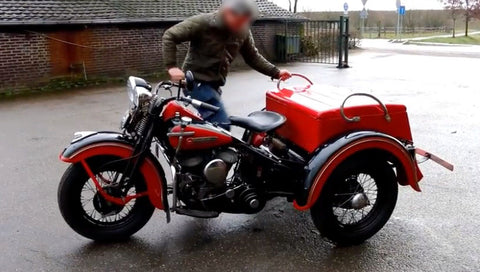
The Servi-Car is not glamorous, and that is exactly why it lasted. It was a three-wheeled utility bike with a box on the back, built from 1932 to 1973. Riding Vintage’s history of the first Servi-Cars explains the original idea: a garage mechanic could tow the Servi-Car behind a customer’s car, drop off the car and ride the trike back to the shop.
By the 1940s, police departments had become some of its biggest fans. A cop on a Servi-Car could chalk tires and write parking tickets all day without balancing a two-wheeler at walking pace. It ran the 45 cubic inch flathead for most of its production life, which makes it one of the longest-running uses of that engine family.
Honest take: a clean Servi-Car is one of the most fun old Harleys to be seen on, and one of the least fun to ride fast. It does not lean. Respect that in the first corner.
4. The 1948 Panhead: New Engine, Old Front End
The Knucklehead had been Harley’s overhead-valve Big Twin since 1936. It got its 74 cubic inch FL version in 1941, which Wikipedia’s FL article notes replaced the old 80 cubic inch flathead. Knucklehead production ended with the 1947 model year, and by then it was selling well again. Riding Vintage’s Knucklehead-era reference records 4,117 EL and 6,893 FL units for 1947, after civilian output had been squeezed down to War Production Board approved orders during 1943 and 1944.
Harley expected a postwar boom and bought room to grow. Historic Structures’ history of the Milwaukee factory records the 1947 purchase of a 269,000 square foot plant on Capitol Drive in Wauwatosa from A.O. Smith for $1.5 million. Sources disagree on whether it took over final assembly or worked as a machine shop feeding Juneau Avenue at first, so we will not pick a side.
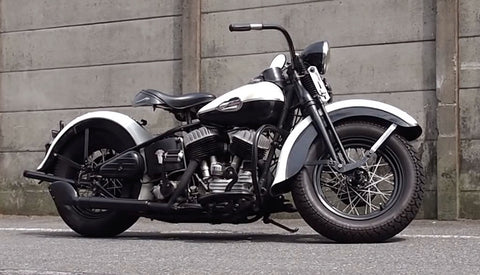
For 1948, Harley replaced the Knucklehead with the Panhead. The new engine got aluminum cylinder heads to fight heat and hydraulic valve lifters to cut down on valve adjustment. The rocker covers looked like upside-down cake pans, and riders named it for them.
What makes the 1948 special is what did not change. Bonhams’ catalog for a first-year Panhead with the last-year springer fork spells it out: 1948 was the last year of the springer front fork on the solo Big Twins. New engine, old front end, one year only. Collectors pay attention to that.
For year-by-year Panhead changes and the lifter problems that came with the first design, see our Harley Panhead guide.
If you want to know what the outgoing engine looked like at its best, our 1947 Harley Knucklehead article covers the final year.
5. The 1949 Hydra-Glide: The Front End That Changed Everything
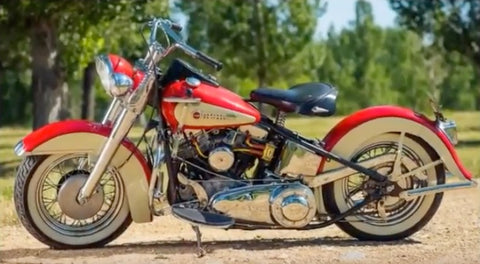
A year after the Panhead, Harley fixed the other end. For 1949, the Big Twins got hydraulically damped telescopic forks in place of the springer. Rider Magazine’s Hydra-Glide retrospective explains the name: “Hydra” for the hydraulic damping, “Glide” for the ride. It was also the first Harley model line to carry a marketing name on top of its letter code, a habit that later gave us the Duo-Glide, Electra Glide and Road Glide.
Rider also credits industrial designer Brooks Stevens with the styling of the new front end. Put a 1948 and a 1949 side by side and the difference is obvious. The 1949 looks like the start of the modern touring Harley, and in many ways it was.
The telescopic fork made the heavy FL far nicer on bad roads. The back end was still rigid until the 1958 Duo-Glide, so your spine still did some of the suspension work.
Honorable Mentions
Five picks leave out some important machines.
- The U-series flatheads. The 74 and 80 cubic inch side-valve Big Twins were still selling in 1940. Motorcycle Classics’ look at the 1940 UL covers that year’s updates, including aluminum heads on the 80 cubic inch UH and 16-inch wheels as standard. The FL Knucklehead pushed them aside from 1941.
- The S-125. Harley’s first small two-stroke arrived for 1948. Wikipedia’s Hummer entry explains that it was based on the German DKW RT 125, whose design rights were shared out among the Allies after the war. The “Hummer” name came later and now covers the whole family of American-built Harley two-stroke singles up to 1966.
- The WR racers. Factory-built, race-only 45 cubic inch flatheads for AMA Class C competition. Rare and valuable today.
Buying a 1940s Harley: What to Check
We hear the same question in the shop all the time: “Is this one real?” With 1940s Harleys, the honest answer takes some work.
Read the engine number, not the frame. Harley did not use frame VINs in this era. The engine case number is the identity of the bike. Riding Vintage’s guide to 1936-1969 serial numbers explains how to read the model year and model letters in it. Our Harley VIN decoder covers the later 17-digit system if you are comparing eras.
Look hard at the stamping. Uneven digits, a ground-down boss or a number that does not match the paperwork are warning signs. Get a marque specialist to look before you pay collector money.
Match the parts to the year. Tank badges, fenders, forks and dash details changed from year to year. A 1949 with a springer, or a 1948 with a Hydra-Glide front end, has been changed, which may be fine for a rider but not for a collector. Our Harley tank emblem timeline helps you date the tinwork.
Know what a military conversion looks like. Many WLAs were civilianized after the war, and some have been dressed up as other models since. A WLA is a 45 cubic inch flathead. It is not a Knucklehead, and a seller who blurs the two is telling you something.
Price against real sales. Values for Knuckleheads, Panheads and WLAs move with originality, documentation and condition. We skip fixed price bands because they go stale fast. Grade the bike honestly, then check Hagerty’s valuation tools and dated auction results for that exact year and model.
Plan for the controls. Most civilian 1940s Harleys use a foot clutch and a hand shifter on the tank. It is a skill, and it takes a few rides to learn. Try before you buy if you can.
Not everyone needs a 1940s Harley in the garage to carry the era with them. Our Built Not Bought collection is made for riders who respect where all of this started.
Why the 1940s Still Matter
Look at a new Harley and you can find the 1940s in it. The overhead-valve Big Twin with aluminum heads, the telescopic fork, the model names that end in “Glide,” the loyalty of riders who first learned on a surplus Army bike. It all comes from one decade that started with flatheads and ended with the Hydra-Glide.
For the full story that runs from 1903 to the Milwaukee-Eight, read our Harley-Davidson history guide.
Sources
- 1942 Harley-Davidson WLA “The Liberator” - National Motorcycle Museum - WLA specs, over 88,000 built, some 30,000 to the Soviet Union, the WLC, standard military equipment, the 1942 serial numbering and the 1949-1952 restart
- Harley-Davidson XA - Wikipedia - XA engine, power, gearbox, the R71 origin and the 1,000-unit evaluation batch
- The First Harley-Davidson Servi-Cars - Riding Vintage - Servi-Car origins and early models
- Knucklehead Era Reference - Riding Vintage - 1940, 1941 and 1947 Knucklehead production and wartime civilian limits
- Harley Davidson Motorcycle Factory - Historic Structures - the 1947 Capitol Drive plant purchase from A.O. Smith
- Harley-Davidson FL - Wikipedia - 1941 FL introduction and the 1949 telescopic fork
- 1948 Harley-Davidson 74ci FL Panhead - Bonhams - 1948 as the first Panhead year and last springer year
- Retrospective: Harley-Davidson Hydra-Glide 1949-1957 - Rider Magazine - the Hydra-Glide name, Brooks Stevens styling and the first named Harley model line
- 1940 Model UL - Motorcycle Classics - 1940 flathead lineup and updates
- Harley-Davidson Hummer - Wikipedia - the 1948 S-125 and its DKW RT 125 origin
- Deciphering Harley’s Serial Numbers 1936-1969 - Riding Vintage - how to read pre-1970 engine numbers
- Hagerty valuation tools - condition-graded values and recorded sales
Wearing it means something. Our biker tees are for Harley riders who back their builds with original gear.