A guy walked into our shop last summer with a fresh one-percenter diamond tattooed on his forearm. No club affiliation. No patch. Just thought it looked cool on Instagram. One of our riders - a man who spent fourteen years in a club - looked at the tattoo, looked at the guy, and walked outside without saying a word.
That is the thing about motorcycle tattoos. In the broader world, a tattoo is personal expression and nothing more. In biker culture, certain ink is a language with grammar, rules, and consequences. Some designs are deeply personal. Some are earned through years of riding and commitment. And some will start a conversation you are absolutely not prepared to finish. Knowing the difference is not optional if you ride in circles where these symbols carry weight.
This is not a Pinterest board. This is a breakdown of what motorcycle tattoos mean, where they come from historically, and which ones demand understanding before you ever sit in the chair.
Roots: How Tattoos Became Biker Culture
The fusion of tattoo culture and motorcycle culture happened in the years after World War II. Returning servicemen - many tattooed overseas following military tradition dating back centuries - came home restless and started riding. The same tattoo shops that had inked sailors and soldiers in port cities like San Diego, Norfolk, and San Francisco became gathering spots for the early motorcycle clubs forming around those veterans.
By the time the original outlaw clubs organized in the late 1940s and 1950s, tattoos were already woven into the social fabric of riding life. The Hells Angels, founded in Fontana, California in 1948, adopted tattooing as a commitment marker early in their history. Other clubs followed the pattern. By the 1960s, visible tattoos were as fundamental to the biker identity as the motorcycle itself - maybe more so, because you could sell the bike but the ink stayed.
The tradition pulled from three streams: military tattoo culture (anchors, eagles, unit insignias), prison tattoo culture (teardrops, spider webs, clock faces), and the broader American traditional tattoo style pioneered by artists like Sailor Jerry Collins in Honolulu. Biker tattoos blended all three into something distinct - a visual language that identified the wearer’s tribe, history, and status within a subculture that did not trust words much.
For the complete history of how motorcycle clubs built their identities, our MC guide covers the structures and codes that tattoo culture grew out of.
Classic Biker Tattoo Motifs and What They Signal
Skulls: Death Acceptance, Not Death Worship
The skull is the most common motif in biker tattooing, and it says more than most people think. In the riding world, a skull is not about morbidity. It is about acknowledging mortality while choosing to ride anyway. Every time you throw a leg over the seat, you accept a level of risk that most people avoid entirely. The skull says: I know the math. I ride anyway.
Variations carry specific meanings:
- Skull with crossed pistons - Marks the wearer as a mechanic or builder. The pistons say you work on engines, not just twist throttles. In circles where wrenching earns respect, this is a credential.
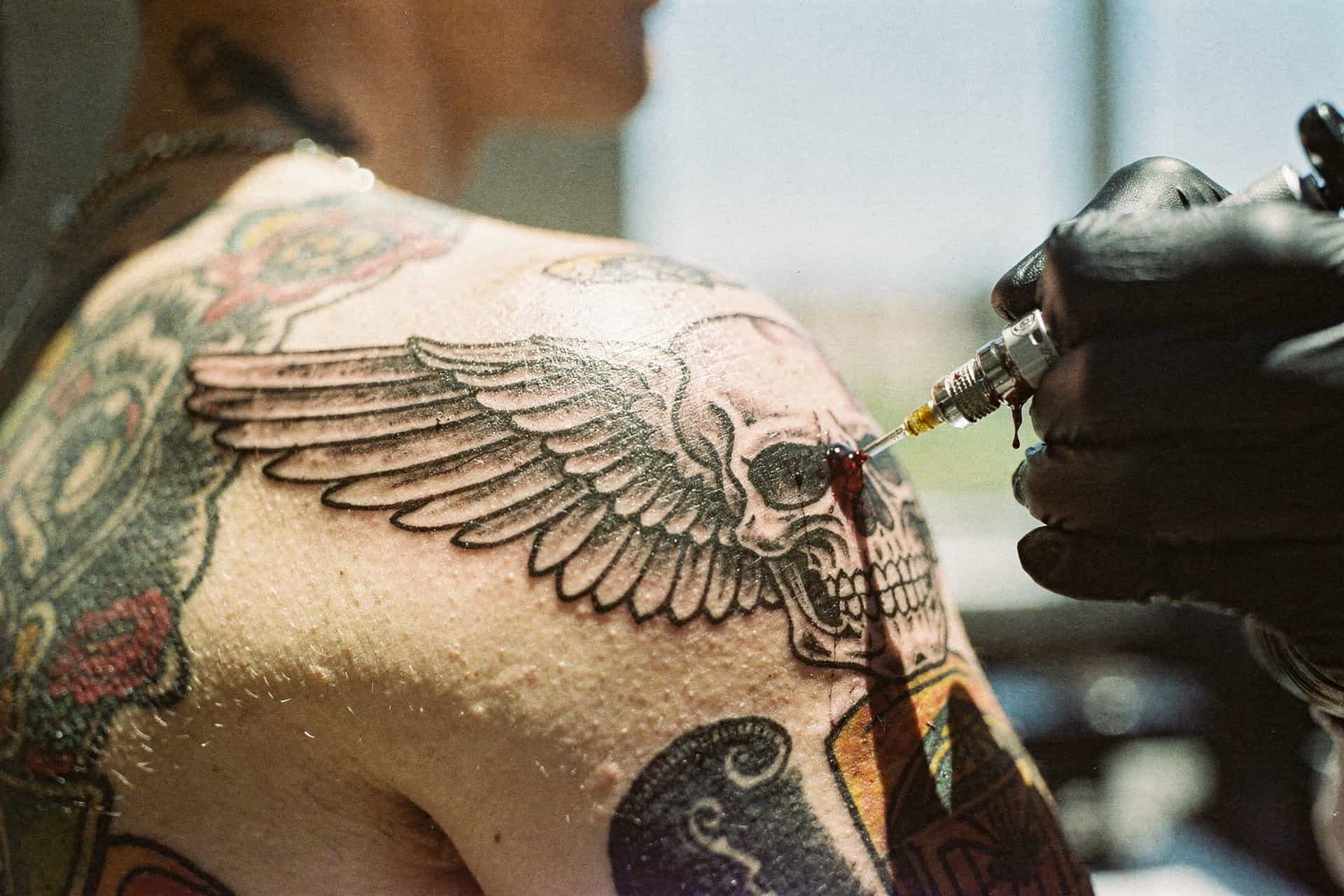
- Skull with wings - Freedom through the acknowledgment of death. Also the most common memorial tattoo for fallen riders. The wings carry the departed; the skull names what took them.
- Skull with helmet - Often a tribute to a specific rider who died. The helmet style frequently indicates the era or discipline - a full-face for a sportbike rider, a half-shell for an old-school cruiser guy.
- Flaming skull - Aggression, intensity, a life run at full throttle. Crossed over heavily from hot rod culture.
- Sugar skull (calavera) - Rooted in Mexican Dia de los Muertos tradition. Common among riders in the Southwest and within Chicano motorcycle communities. Celebrates the dead rather than fearing them. Beautiful work when done by an artist who understands the cultural origin.
Wings: Speed, Freedom, and Loss
Wings are everywhere in motorcycle tattoo culture, predating the biker world - military aviation ink, angel iconography, and the Hells Angels’ winged death’s head all contributed to the visual vocabulary. In a riding context, wings almost always represent freedom and speed. The specific execution narrows the meaning:
- Eagle wings - Patriotic overtones. Common among veteran riders. Often paired with flags or military unit insignias. The eagle connects American identity to the open-road ideal.
- Angel wings - Memorial ink. For a lost riding partner, a family member, a brother who went down. The most emotionally loaded wing design in the biker tattoo world.
- Bat wings - Darker aesthetic. Associated with night riding and the outlaw edge of the culture. Less common than eagle or angel wings but visually striking.
- Single wing - Sometimes indicates the wearer has lost a riding partner. “Flying with one wing” is a phrase that surfaces in memorial contexts. Painful, personal, and instantly recognized by anyone who has lost someone on the road.
Pistons, Wrenches, and Engine Parts: Earned Ink
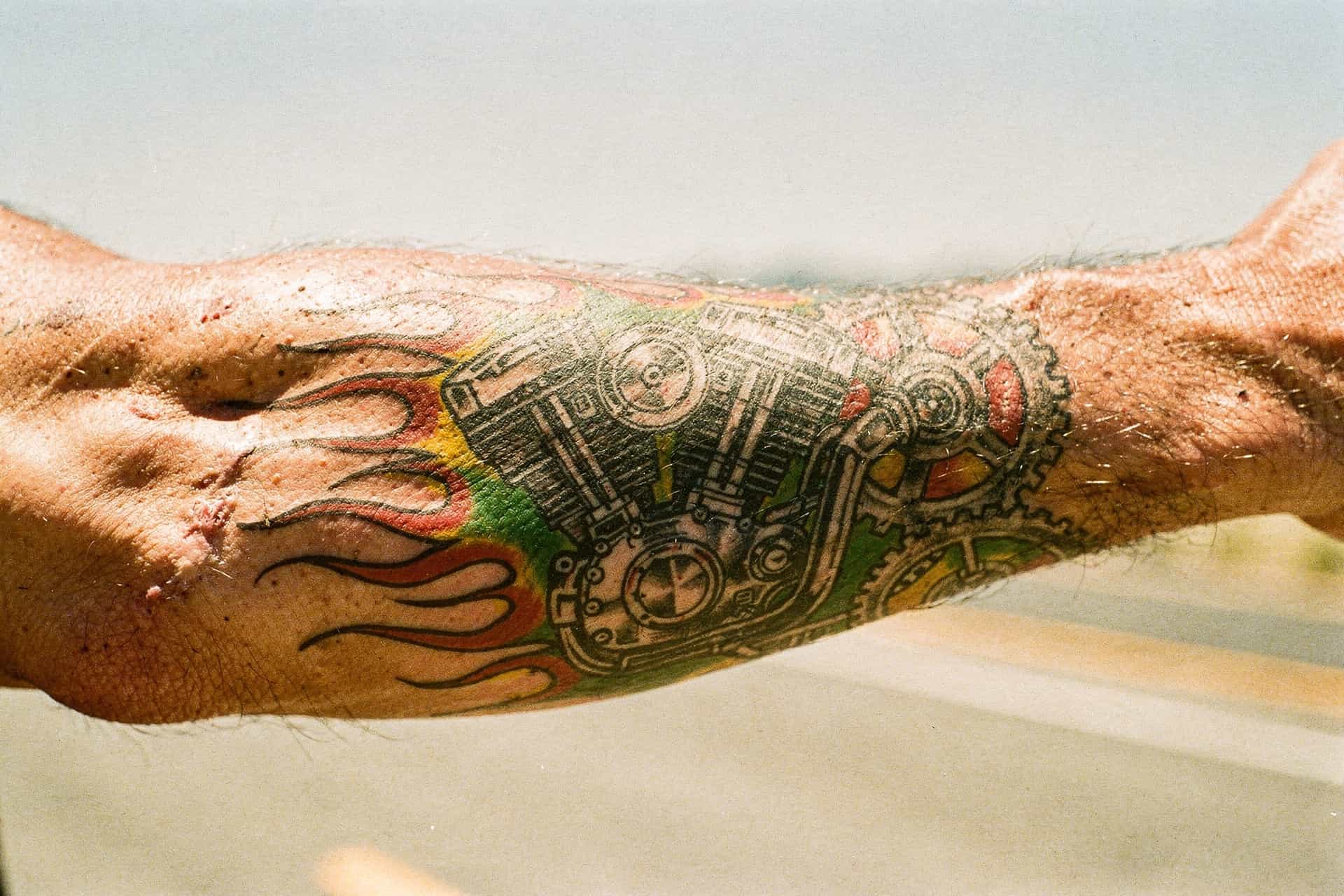
Mechanical imagery is respect-on-sight ink in most riding circles. A piston tattoo signals that you wrench on your own machine. Crossed wrenches say the same. A detailed engine block - a Shovelhead, Panhead, or Knucklehead rendered with accuracy - declares allegiance to a specific era and style of motorcycle.
The key word is specific. A generic engine outline means less than a detailed rendering of a Harley-Davidson Shovelhead that the wearer clearly knows intimately. If you can identify the engine in your tattoo by year and model - if you have rebuilt one, cursed at one, loved one - the ink carries weight. If you picked it because it “looked mechanical,” riders will know.
The One-Percenter Diamond: Do Not Touch This
The 1% diamond is the line you do not cross casually. It originates from the American Motorcyclist Association’s alleged claim that 99% of motorcyclists are law-abiding citizens. The outlaw clubs - Hells Angels, Bandidos, Outlaws, Pagans - adopted “one percenter” as a badge of identity.
A 1% diamond tattoo signals membership in or deep affiliation with an outlaw motorcycle club. Getting this tattoo without earning it through a club is, at best, disrespectful. At worst, it is dangerous. Clubs take their symbols as seriously as any military unit takes its insignia. Wearing unearned ink is treated the same as wearing an unearned patch - and the response can be severe.
This applies to all club-specific symbols. The Hells Angels’ winged death’s head is trademarked and aggressively defended. The Bandidos MC has its own set of protected marks. Our coverage of the Hells Angels goes into more detail on how these symbols function within club hierarchy. The rule is simple: do not tattoo another club’s imagery on your body unless you are a patched member. Full stop.
Flames: Hot Rod DNA in Biker Ink
Fire imagery connects motorcycle culture to the broader post-war custom scene that birthed both hot rodding and bike building. Flames wrapping a forearm or running down a calf are classic Americana tattoo work with roots in the same garages where guys were chopping frames and boring cylinders in the 1950s.
Flames also serve a visual function that good tattoo artists exploit: they create movement in a static image. A skull sitting still is a skull. A skull engulfed in flames has direction and energy. That dynamic quality is why flame elements persist across decades of evolving tattoo styles.
Chains and Barbed Wire: Freedom and Its Cost
Chain tattoos - around the wrist, bicep, or neck - carry multiple readings depending on context. Broken chains represent freedom won: escape from a past life, addiction, or imprisonment. Unbroken chains represent the bonds of brotherhood within a club - connections that hold through everything. The same image means opposite things depending on whether the links are intact or shattered. Context and the wearer’s story determine which reading applies.
Barbed wire carries a similar duality. In some contexts, particularly in Russian and Eastern European prison tattoo traditions that have crossed into biker culture, it indicates time served. In others, it represents a barrier mentality - the wearer keeps the outside world at distance.
Spiderweb: The Complicated One
A spiderweb on the elbow has a layered history. In prison tattoo tradition, it indicates time served - caught in the web of the system. In some older contexts, it carried associations with racial violence, though decades of broader adoption have diluted that specific meaning significantly.
In the biker world, a spiderweb on the elbow often signals that the wearer has done time. Not necessarily tied to any specific act - just an acknowledgment that the system caught them. Some riders wear it as a general outlaw symbol without the prison connection. As with most tattoo meanings, the wearer’s context and the community they move in determine what it communicates.
Placement: Where Ink Sits Matters
In club culture, where a motorcycle tattoo lands on the body is deliberate, not decorative.
Knuckles
Knuckle tattoos are maximum-commitment ink. Visible in every social situation, impossible to conceal. In biker culture, knuckle work is often club-related or carries short declarations: RIDE FREE, HOLD FAST, or club initials across eight letters. Getting knuckle tattoos before you have serious road time is considered premature by old-school riders. The hands are prime real estate. You earn the right to fill them.
Chest and Back
Large-scale chest and back pieces are where club tattoos traditionally live. A club name or logo across the upper back mirrors the positioning of a back patch on a cut. Chest pieces tend toward the wearer’s personal narrative - their bike, their club, memorial imagery for lost brothers, or a single large-scale motif that encapsulates their riding identity.
Forearms
The forearm is the most public real estate for a rider in short sleeves. It is where riders place the ink they want the world to see first: engine parts, skulls, club names, memorial dates. The forearm tattoo is your opening statement.
Ring Fingers
Ring finger tattoos - a motorcycle chain, a wrench, or a simple band - are increasingly common among riders who do not wear jewelry on their hands. A ring can snag on a handlebar or catch in a drive chain. A tattoo cannot. Practical safety turned into a distinct tattoo tradition within the riding community.
Harley-Davidson Ink: The Bar and Shield
The Harley-Davidson Bar and Shield is one of the most tattooed corporate logos in human history. Harley has acknowledged this for decades - the company once ran tattoo contests at its own rallies.
A Bar and Shield tattoo is a brand loyalty statement that transcends marketing. Riders who get the Harley logo inked are declaring a commitment to the brand, the lifestyle, and the community around it. Some variations:
- Bar and Shield alone - Clean, unmistakable, the purest statement
- Bar and Shield with eagle - Brand loyalty fused with patriotic imagery
- Bar and Shield with model name - “Sportster,” “Softail,” “Shovelhead” - allegiance to a specific platform
- Number One logo - Harley’s racing heritage mark, common among riders who follow flat track history
For the full story of the brand behind the tattoo, our Harley-Davidson history guide goes era by era.
Modern Trends: New Styles on Old Bones
American traditional - bold lines, flat color, limited shading - remains the dominant aesthetic in biker tattooing. But the craft has evolved, and modern riders draw from a wider range.
Blackwork and Geometric
Solid black geometric patterns and dotwork have entered the motorcycle world, particularly among younger riders in the custom and cafe racer scenes. A geometric rendering of an engine or a mandala built from sprocket teeth looks nothing like a Sailor Jerry piece, but it carries mechanical DNA and reads as motorcycle culture to anyone paying attention.
Photorealism
Modern equipment and technique have made photorealistic motorcycle portraits possible. A detailed rendering of a specific engine - every cooling fin, every bolt head, every casting mark - requires an artist with serious skill. These tend toward half-sleeve or full-sleeve scale. They are expensive. When executed well, they are stunning.
Script and Lettering
Typography tattoos - riding mantras, memorial dates, GPS coordinates of a favorite road - have grown alongside improvements in clean lettering technique. “Built Not Bought” across the collarbone. Coordinates of a mountain pass on the ribs. A fallen brother’s name and riding years on the inner forearm. Words carry the same weight as images when they name something true.
Minimalist Motorcycle Outlines
Single-line motorcycle profiles - no fill, no shading, just the silhouette - are a subtle identity marker for riders who work in environments where traditional biker ink would draw unwanted attention. Not everyone’s taste, but it has opened the door for riders who want ink without the full commitment of a back piece.
Before You Sit in the Chair
If you are planning motorcycle ink, a few things from riders who have been through it:
Find an artist who knows the culture. Not every tattoo artist can tell a Panhead from a Shovelhead, and that difference matters in an engine tattoo. Look for portfolios that show mechanical subjects rendered with accuracy and respect. Americana and traditional specialists tend to understand this world.
Do not tattoo what you have not earned. This goes beyond the one-percenter diamond. Getting a tattoo of a bike you have never ridden, an engine you have never touched, or a patch you never wore rings hollow in a community that values authenticity above almost everything else.
Think about your riding life. Tattoos on hands and wrists take sun, glove friction, and handlebar wear. They fade faster than protected locations. Fresh ink needs healing time - schedule your session for a period when you will not be riding daily, because sweat, sun, and leather on fresh tattoo work is a recipe for poor results.
Black holds. In a culture where longevity matters, heavy black work ages better than fine-line color. There is a reason traditional biker tattoos use bold black outlines - they still look sharp after thirty years of road life. Color fades. Black endures. Choose accordingly.
The best motorcycle quotes capture the spirit riders often get inked - words that mean more when they live on skin than on a screen. Our best biker movies guide covers the films that shaped much of the visual language behind these designs. The biker vest guide is the natural companion piece - if tattoos are the identity you cannot remove, the vest is the identity you build over years of riding. And if you want to wear your tribe on cloth instead of skin, our patches and merch and hoodies carry the same energy - no needles required.
Sources
- “Exploring Motorcycle Tattoos: What They Mean to Bikers.” Kinetic Motorcycles: kineticmotorcycles.com
- “The History of Biker Tattoos: Inked Legends on the Open Road.” Boartooth: boartooth.com
- “The Outlaw Inked: The History and Symbolism of Biker Tattoos.” Tat2X: tat2x.com
- “Outlaw Motorcycle Club Tattoos: Avoid the Outlaw Ink.” Viking Bags: vikingbags.com
If you want to go deeper into the culture around riding - rally calendars, films worth watching, the lifestyle history - our motorcycle culture guide covers it.