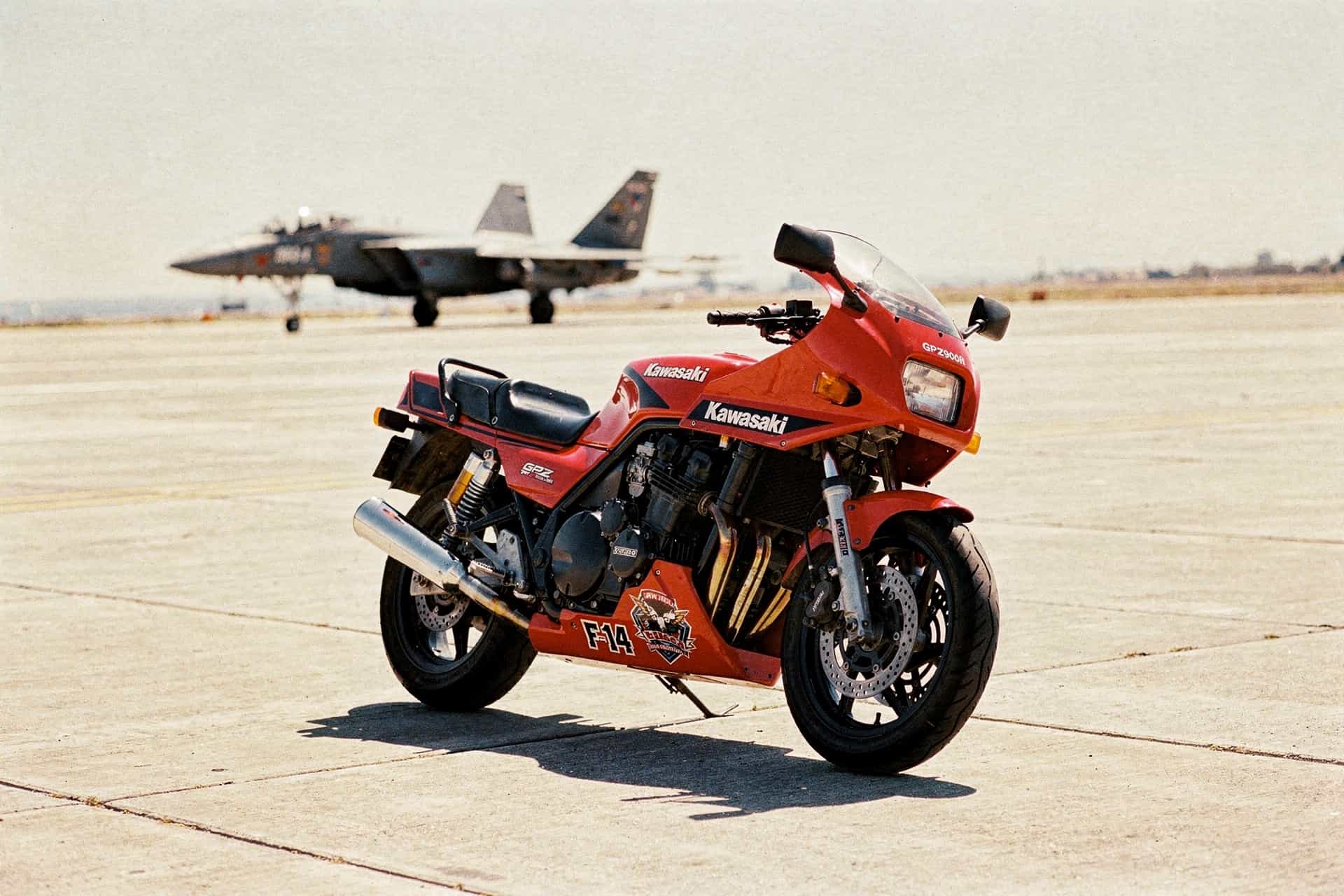
Nobody remembers the second-fastest thing in that scene. Tom Cruise on a Kawasaki GPZ900R, racing alongside an F-14 Tomcat on the tarmac at NAS Miramar - the jet wins, obviously, but the bike owned that frame. For the next decade, every kid who saw Top Gun (1986) wanted to be Maverick on two wheels, not strapped into an ejection seat.
We have had guys roll into our shop wearing vintage Top Gun tees on brand-new sportbikes and they always want to talk about that runway shot. They remember the feeling more than the details. That is what good cinema does - it sells a sensation. And that single sequence did more for Kawasaki than any dealer incentive or race win ever could. The GPZ900R was already a game-changer before Hollywood found it. After the film, it became something bigger. It became the motorcycle that told America sportbikes were not just for racers.
The full history of motorcycles in film stretches back decades, but this chapter earned its own telling.
The GPZ900R Before the Movie: Kawasaki’s First Ninja
Before Maverick ever threw a leg over it, the Kawasaki GPZ900R - internally the ZX900A - was rewriting the rules. Launched in 1984, it was the first motorcycle to carry the Ninja name. That branding decision would define Kawasaki’s sportbike identity for forty years and counting.
An Engine Built to Break Records
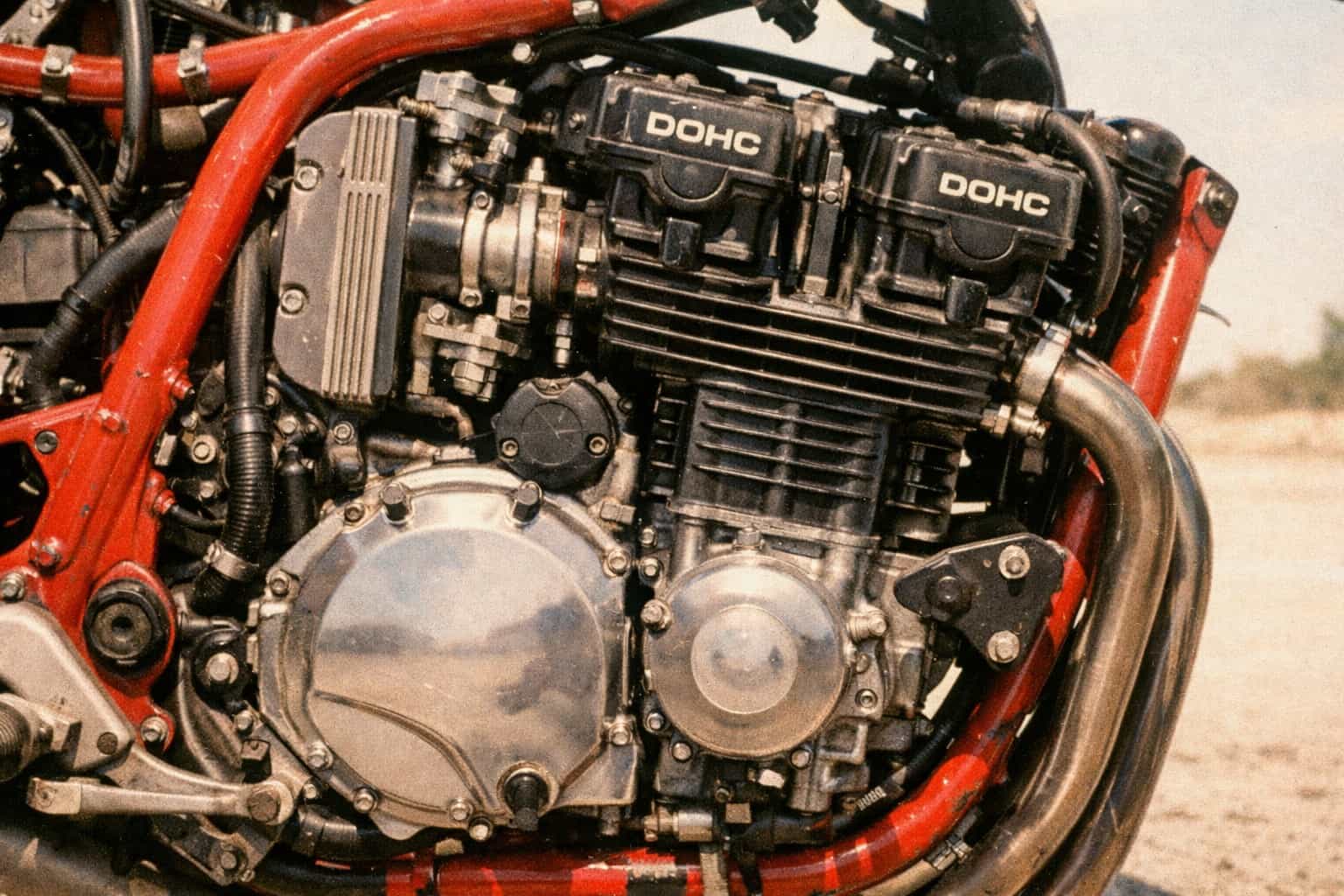
The heart of the GPZ900R was a 908cc liquid-cooled inline-four with dual overhead cams and sixteen valves. In 1984, most Japanese sportbikes still ran air-cooled motors. Going liquid-cooled was a deliberate engineering choice - tighter manufacturing tolerances, higher sustained RPMs, and better heat management when you kept the throttle pinned on long straights.
Stock output: 115 horsepower at 9,500 RPM. That number barely raises an eyebrow in 2026, but in 1984 it made the GPZ900R the fastest production motorcycle on the planet. Kawasaki published a top speed of 151 mph, making it the first stock motorcycle to exceed 150 mph. Independent testers confirmed it, and some pushed past 155 in favorable conditions.
The quarter mile fell in 10.95 seconds at 122.8 mph. Kawasaki test rider Jay “Pee Wee” Gleason reportedly ran a 10.55-second quarter on a preproduction unit - a number that would have been competitive with plenty of dedicated drag bikes at the time.
The cam chain ran on the left side of the engine, an unusual layout that gave the powerplant a narrower profile than its displacement suggested. On the road, the bike felt more nimble than a 900cc machine had any right to feel.
Chassis and Running Gear
The front end used 38mm conventional forks - no upside-down setup existed in production bikes yet - with anti-dive geometry that was cutting-edge for the era. Out back, a Uni-Trak single-shock with adjustable preload handled the rear. Braking came from dual 280mm front discs with twin-piston calipers and a single 270mm rear disc.
Wet weight landed around 550 lbs (249 kg). Heavy by modern standards, but the GPZ900R was not trying to be a track weapon. The riding position was a moderate sport-touring stance - leaned forward enough to feel purposeful, upright enough to ride all day. That dual-purpose character was its real strength.
The Competition in 1984
Suzuki’s GSX-R750 arrived in 1985 and took the opposite approach - lighter, more race-focused, air/oil-cooled. Honda’s VF1000R was heavier and pricier. Yamaha’s FJ1100 had more displacement but less polish.
The Kawasaki’s edge was balance. It could carve canyon roads in the morning and eat 500 miles of interstate in the afternoon without wrecking your wrists or your back. That versatility made it the choice of riders who actually put miles on their machines rather than just displaying them at bike night.
How a Kawasaki Ended Up at Mach Speed
Top Gun was directed by Tony Scott, produced by Don Simpson and Jerry Bruckheimer, and made with heavy cooperation from the Department of Defense - real F-14 Tomcats, real aircraft carriers, the actual Top Gun school at Miramar.
Two Bikes From a San Diego Dealer
Paramount needed motorcycles for filming. According to documented production accounts, two 1985 GPZ900R units were delivered by San Diego Kawasaki dealer Chris Dolan. The Kawasaki factory decals were stripped and replaced with Navy squadron stickers to match Maverick’s world. No major performance modifications - the stock bike was fast enough and cinematic enough to work on camera without tricks.
The Scenes That Mattered
The GPZ900R appears in multiple sequences, but two define the film’s motorcycle legacy. The first is the opening: Maverick and Goose ride to the base, and Cruise races the runway as jets launch overhead. The second is the ride to Charlie’s house - the golden-hour cruise that launched a thousand poster sales and probably sold more leather jackets than any fashion campaign in history.
Cruise reportedly did much of his own riding. Stunt doubles took the higher-risk shots, but Tom on the actual bike is visible in enough footage that it was not a cheat. The man rides. That mattered to the audience even if they did not consciously register it.
The Color That Sold Bikes
The specific colorway - Firecracker Red with silver accents - became “the Top Gun bike” in the public mind. Kawasaki offered other colors throughout the GPZ900R’s production run, but red-on-silver outsold every other combination in North America after the film dropped. Dealers reported buyers walking in and asking for “the Maverick color” by name.
Calculated Placement or Lucky Break?
Stories vary. Some accounts say Kawasaki actively pursued the product placement. Others say the production team simply needed the fastest, best-looking bike available in 1985 and the GPZ900R was the obvious pick. Either way, the outcome was identical - the most effective motorcycle product placement in film history.
What Top Gun Did for Kawasaki and for Sportbikes
We are not inventing sales figures. But the documented reality is clear: Kawasaki saw a significant spike in GPZ900R sales following the film’s May 1986 release. Dealers reported something they had never seen before - non-riders walking into showrooms. People who had never considered a motorcycle were asking about “the Top Gun bike.”
The GPZ900R stayed in production from 1984 to 2003. A nineteen-year run for any sportbike is remarkable. The bike evolved through suspension revisions, larger front discs, and fuel injection in some markets, but the core silhouette stayed recognizable. You could park a 2003 model next to a 1984 and see the family resemblance immediately.
And that Ninja name - born with the GPZ900R - became one of the most recognized nameplates in motorcycling. Every Kawasaki sportbike from the Ninja 250 to the supercharged H2R traces its lineage directly back to this machine.
The Cultural Shift Nobody Expected
Before 1986, sportbikes in America were niche. The motorcycle market was dominated by Harleys, cruisers, and touring rigs. Japanese inline-fours existed, but they did not carry cultural weight the way a V-twin did. The American Chopper era would later give the custom cruiser world its own TV-driven boom, but the GPZ900R got there first for the sportbike crowd.
After Top Gun, the sportbike rider had an identity. Maverick was not an outlaw. He was not a one-percenter. He was a naval aviator who happened to ride fast. That opened motorcycling to a new demographic - young professionals, military personnel, and speed-hungry riders who wanted the rush without the club associations. The sportbike communities that exploded through the late 1980s and 1990s owe a debt to that Kawasaki sitting on a California runway.
Where builder culture and custom shows shaped the cruiser identity, the GPZ900R shaped the sportbike one. Different machines, same principle: a single moment can redefine what a motorcycle means to the public.
Top Gun: Maverick (2022) - The Sequel Upgrade
Thirty-six years later, Cruise climbed back on a Kawasaki for Top Gun: Maverick. The bike this time: a Ninja H2 Carbon.
From 115 Horsepower to 228
The Ninja H2 runs a 998cc supercharged inline-four producing 228 hp in stock trim (2022 model year). The track-only H2R pushes past 300 hp. Kawasaki designed the balanced supercharger entirely in-house - making the H2 the only production motorcycle with a manufacturer-built forced-induction engine.
The jump from 115 hp to 228 hp across thirty-six years mirrors the film’s own jump from the F-14 Tomcat to the fictional Darkstar hypersonic aircraft. Both the bike and the plane got dramatically faster. The GPZ900R was the fastest production motorcycle of 1984. The H2 is not the fastest of its era - that arms race has moved to ridiculous places - but it remains one of the most technologically ambitious machines on two wheels.
The Runway Scene, Rebuilt
Maverick opens with a deliberate echo of the 1986 original - Cruise rides to the base, different airfield, different mission, same energy. The H2 appears in Kawasaki’s signature dark livery. Cruise, at 59 years old during filming, again handled his own riding for multiple sequences. Whatever you think of the man, he commits.
Price of Nostalgia
The H2 Carbon retailed around $29,500 in 2022. The original GPZ900R listed at roughly $3,500 in 1984 - about $10,400 adjusted for inflation. The sequel’s audience skewed older and wealthier, which tracked perfectly with the H2’s position as a halo bike rather than an entry-level sportbike. Dealers reported renewed interest after the film, though Kawasaki does not publish model-specific sales data.
The GPZ900R Today: Finding and Owning One
Clean GPZ900Rs are getting harder to find. The bike was mass-produced, so survivors exist, but decades of hard use, crashes, and neglect have thinned the herd. Well-maintained examples in original condition command strong prices through private sales and auctions.
The most desirable units are 1984-1986 models in Firecracker Red - the “Top Gun spec.” Later models are mechanically superior but lack the cultural connection that drives collector interest.
What Breaks on a 40-Year-Old Ninja
If you are shopping, know what to inspect:
- Cam chain tensioner - The automatic tensioner on early models wears and can fail, causing chain slap and eventual engine damage. This is the number-one mechanical concern on surviving bikes.
- Cooling system corrosion - Four decades of coolant passage exposure means inspecting for internal corrosion and potential head gasket weeping.
- Electrical harness degradation - Wiring insulation breaks down with age and heat cycling. OEM replacement harnesses are scarce. Budget for aftermarket solutions.
- Fork seal leaks - Standard for any bike this old, but the 38mm conventional forks use seals that are still widely available in the aftermarket.
Parts availability is better than you might expect, thanks to the bike’s long production run. Companies like Z1 Enterprises and dedicated Kawasaki specialists stock common wear items. The online community - forums and Facebook groups - actively trades knowledge on sourcing NOS parts and fabricating replacements.
The Restoration Community
A dedicated group of GPZ900R enthusiasts keeps these machines alive. Popular upgrades include swapping the front end for inverted forks from a later ZX-series Kawasaki, fitting braided stainless brake lines, and converting the ignition to a more reliable aftermarket CDI unit. These modifications bring the bike’s handling and reliability closer to modern standards while preserving the stock visual character.
Full concours restorations - frame-off, powder coat, replated fasteners, engine rebuilt to factory tolerances - run several thousand dollars in parts before labor. The result is a machine that rides like it did in 1984 and stops crowds at any show. For a bike with this much cultural weight, the investment makes sense.
Why the GPZ900R Still Holds Weight
The GPZ900R was not the first fast motorcycle, and it was not the last. But it sat at the exact intersection of legitimate engineering achievement and massive cultural exposure in a way no other bike has matched.
The Harley-Davidson Fat Boy in Terminator 2 comes close. The chopper in Easy Rider is more iconic in a countercultural sense. The Sons of Anarchy Harleys brought MC culture to a cable TV audience decades later. But the Maverick motorcycle did something none of those bikes did: it made speed aspirational for the mainstream. It took a Japanese inline-four - a machine type that American culture had largely ignored - and turned it into something every teenager in 1986 wanted in their garage.
We build bobbers. Our world is V-twins, hardtails, and stripped-down machines that look like they were born in a garage because they were. But we respect anything that moves the needle on motorcycle culture, and the GPZ900R moved it hard. The Biker Boyz film tells a different but equally important sportbike story from the culture side. Our best biker movies roundup covers the full cinematic landscape. And if Maverick’s style speaks to you more than his bike does, our T-shirts and caps let you wear the riding life without needing a flight suit.
Sources
- Motorcycle Classics - Top Gun Motorcycle: The Kawasaki GPZ900R - detailed history of the GPZ900R as the first Ninja and its role in the film
- Hagerty - With a Starring Role in Top Gun, the Kawasaki Ninja Became a Blockbuster - production history, quarter-mile testing, and cultural impact
- HotCars - Maverick’s Top Gun Kawasaki GPZ900R: The Real Story - how the bikes were sourced from a San Diego dealer for filming
- Cycle News - Archives: 1984 Kawasaki Ninja GPz900R - original-era specifications and performance testing
- Silodrome - Kawasaki Ninja ZX900 - engineering details and pre-production history
- Top Gun: Maverick (2022) - IMDb page for the sequel featuring the Kawasaki Ninja H2